Francis BLANCHE (1921.1974)
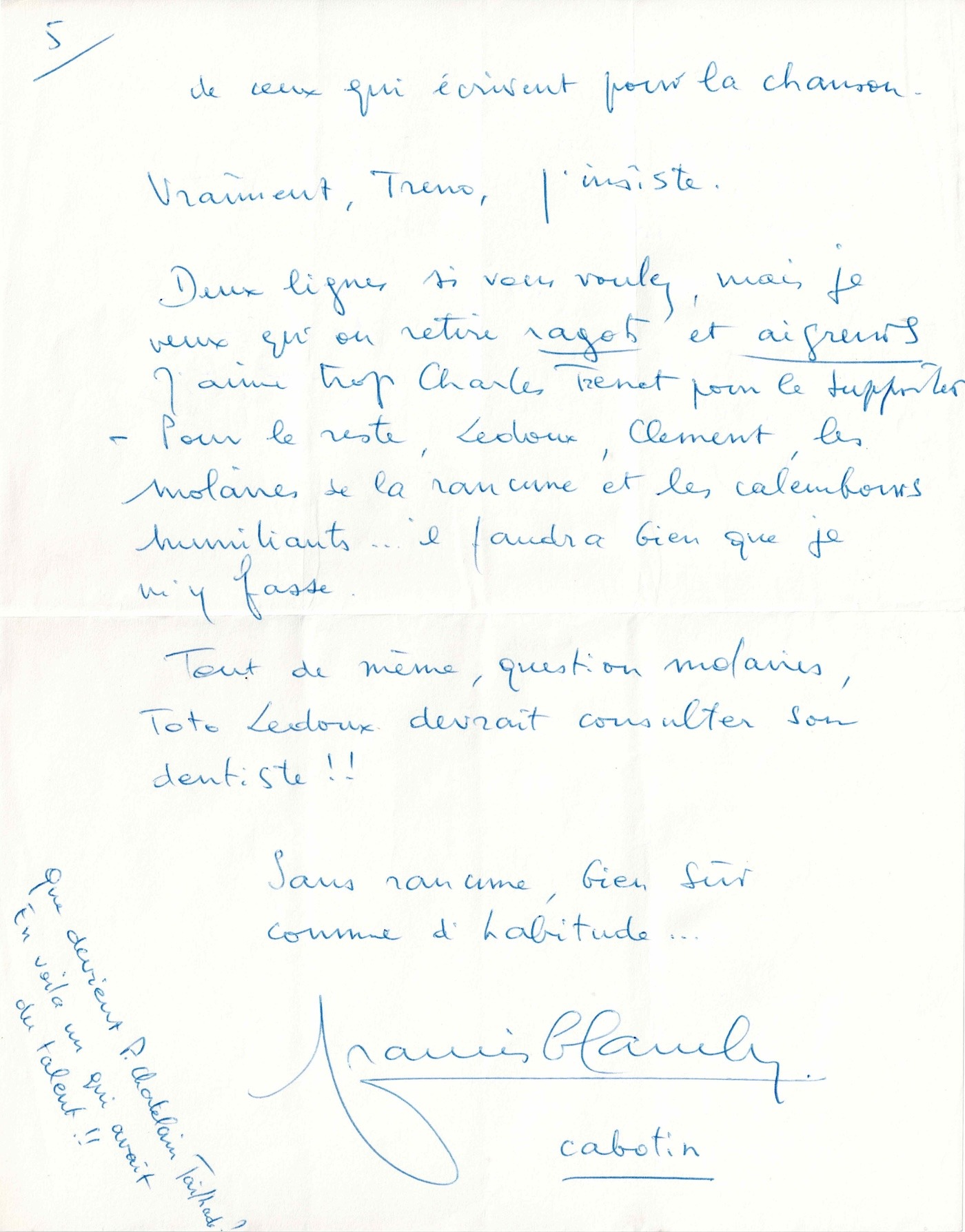
Autograph letter signed to Ernest Raynaud, known as Tréno.
Five pages in-4° (and two pages in-12°).
Paris. [1962 or 1963]
"I love and admire Trenet..."
Francis Blanche is outraged by an article in Le Canard enchaîné that portrays him as mocking, critical, and disdainful of Charles Trenet, an artist he "loves and admires." The actor demands redress and a precise correction from the "collaborator" Ledoux in the newspaper's pages.
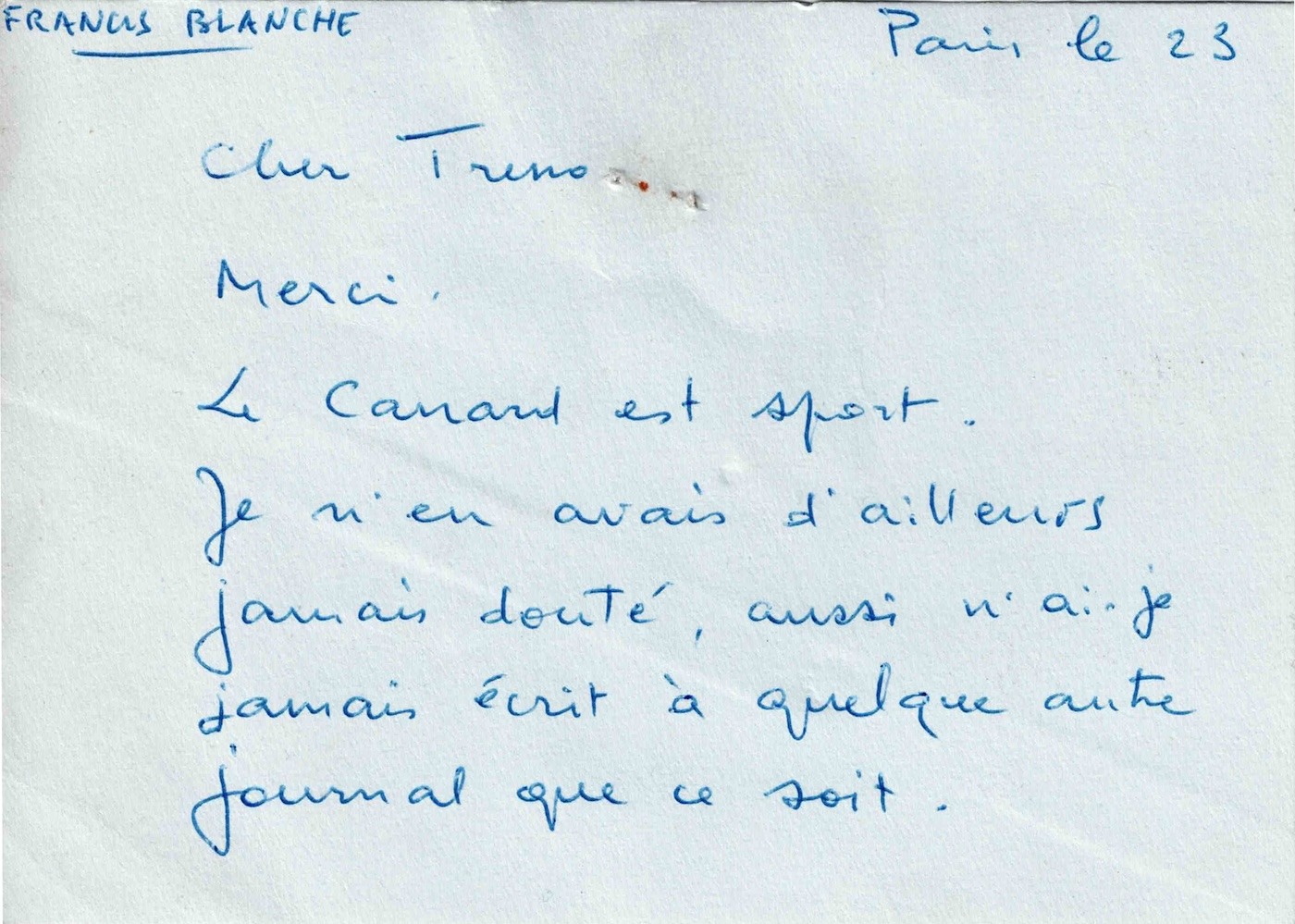
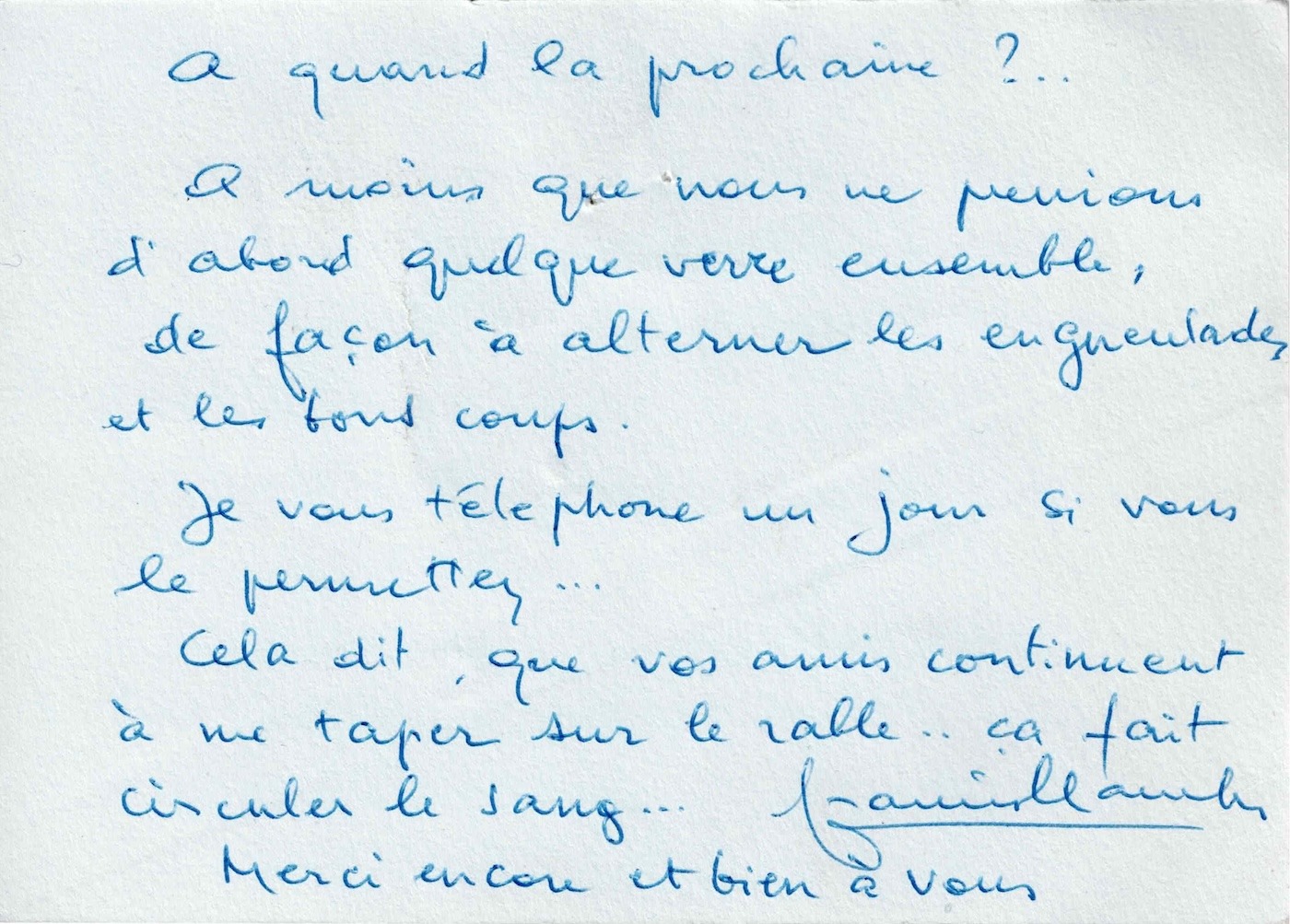
The Duck seems to have complied: indeed, in a card (which we are attaching) Blanche thanks Tréno for his intervention: “ Thank you. The Duck is sporting. I never doubted it. […] That said, let your friends continue to hit me on the back… it gets the blood flowing .”
____________________________________________
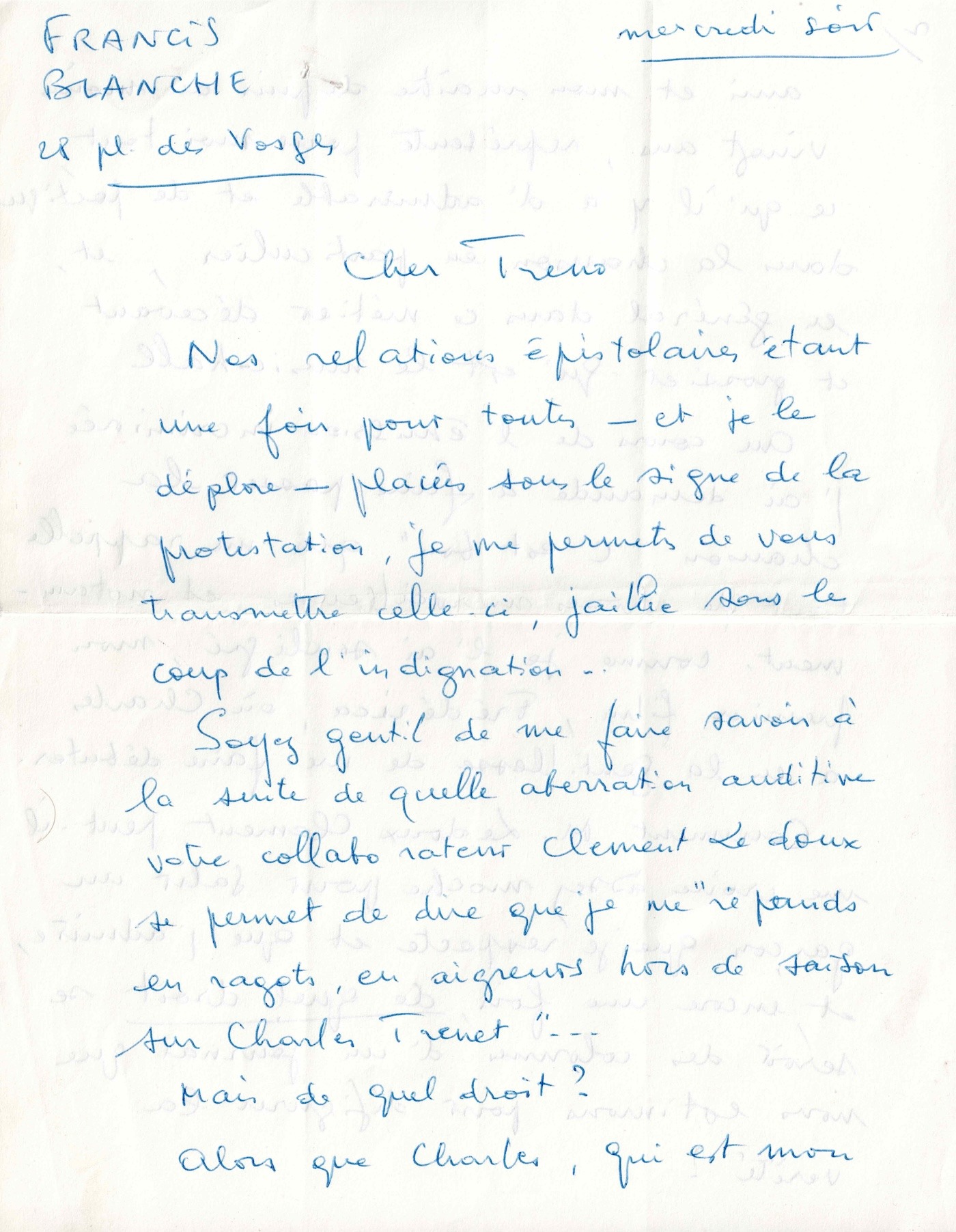
Dear Treno, Our correspondence having now – and I regret to say it – been marked by protest, I take the liberty of sending you this letter, born of indignation. Please let me know what auditory aberration has prompted your colleague Clément Ledoux to claim that I am "spreading out unreasonable gossip and bitterness about Charles Trenet." But on what grounds?
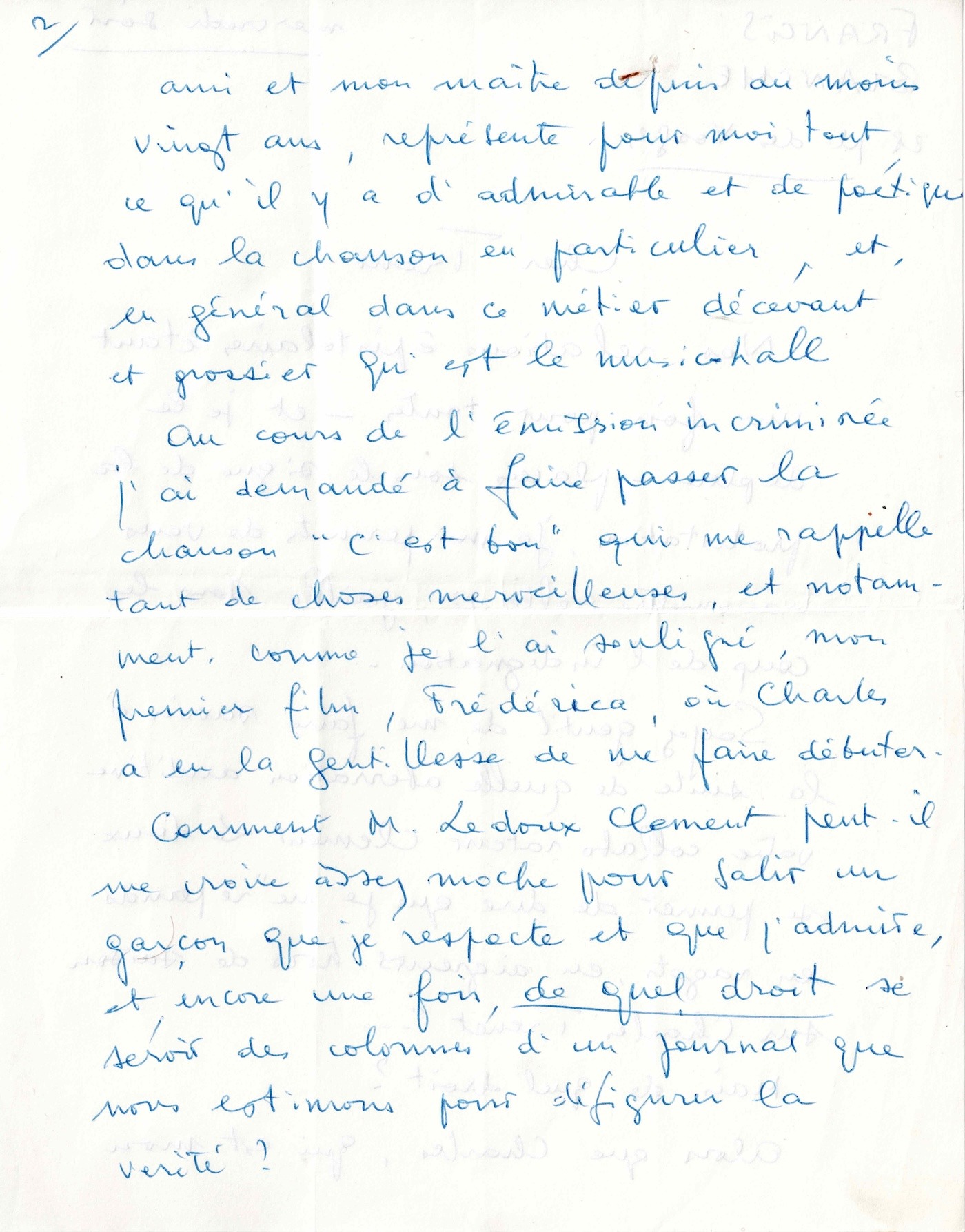
While Charles, who has been my friend and mentor for at least twenty years, represents for me everything admirable and poetic in song in particular, and, in general, in that disappointing and crude profession of music hall. During the broadcast in question, I asked for the song "C'est bon" to be played, a song that reminds me of so many wonderful things, and in particular, as I have pointed out, my first film, Frédérica, where Charles was kind enough to give me my start.
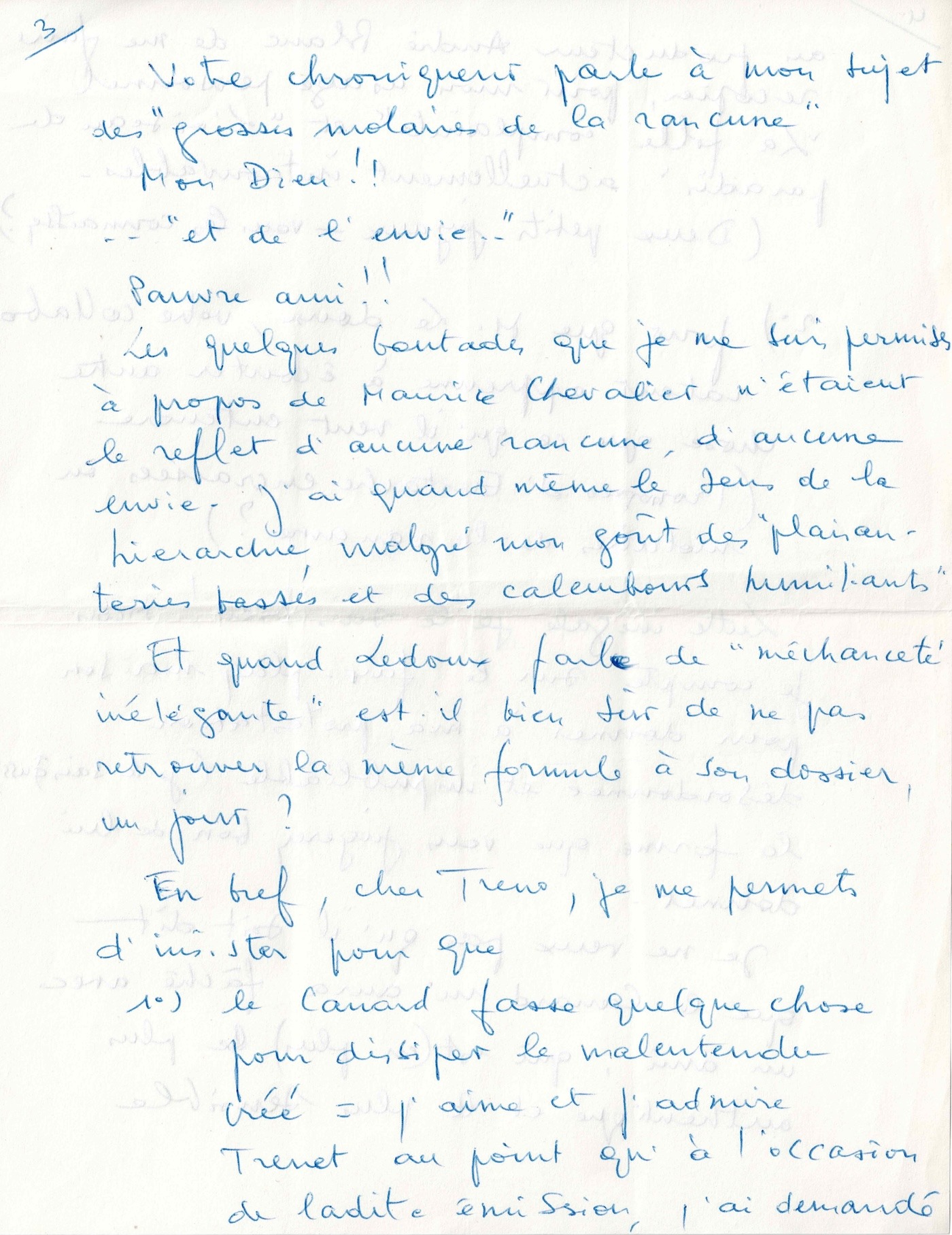
How can Mr. Ledoux Clément think me so ugly as to smear a young man I respect and admire, and, once again, by what right does he use the columns of a newspaper we esteem to distort the truth? Your columnist speaks of me as having "the big molars of resentment." My God!! ... "and envy"!! Poor friend!! The few jokes I allowed myself about Maurice Chevalier reflected no resentment, no envy. I do, after all, have a sense of hierarchy, despite my fondness for "outdated jokes and humiliating puns." And when Ledoux speaks of "inelegant malice," is he really sure he won't find the same phrase in his own file one day?
In short, dear Treno, I would like to insist that:
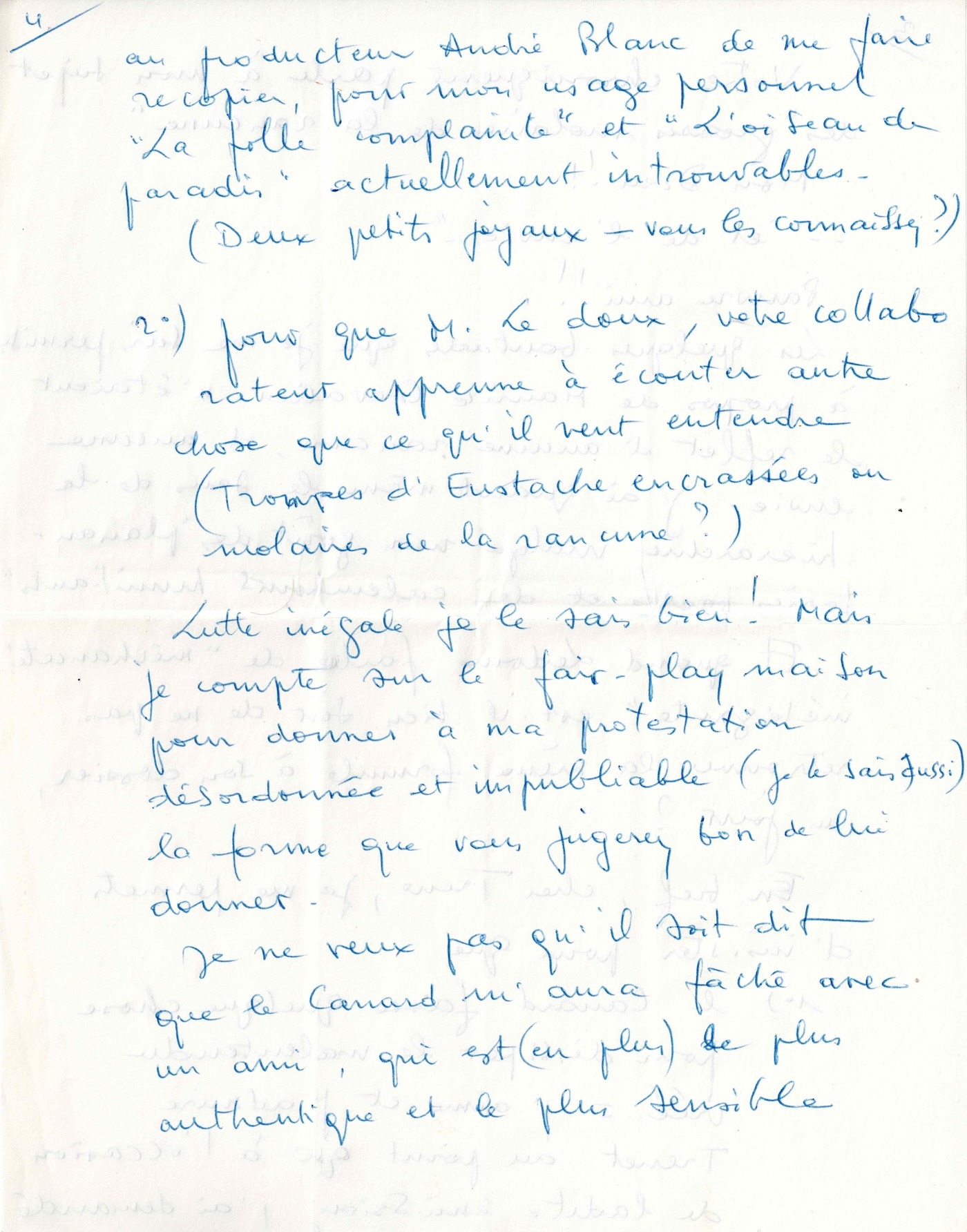
1) Le Canard Enchaîné is doing something to clear up the misunderstanding: I love and admire Trenet so much that, for the aforementioned program, I asked the producer André Blanc to have copies made for me, for my personal use, of "La folle complainte" and "L'Oiseau de paradis," which are currently out of print. (Two little gems, are you familiar with them?)
2) So that Mr. Ledoux, your colleague, might learn to listen to something other than what he wants to hear (Clogging Eustachian tubes or molars of resentment?). Unequal struggle, I know! But I'm counting on the fair play of the house to give my disordered and unpublishable protest (I know that too) the form you deem appropriate. I don't want it said that Le Canard Enchaîné has caused a rift between me and a friend, who is (moreover) the most genuine and sensitive of those who write for the music industry.
Really, Treno, I insist. removed gossip and bitterness. I like Charles Trent too much to put up with it. As for the rest—Ledoux, Clément, the teeth of resentment and the humiliating puns… I'll just have to get used to it. Still, speaking of teeth, Toto Ledoux should see his dentist! No hard feelings, of course, as usual. Francis Blanche. Show-off.
____________________________________________
As lyricist of approximately four hundred songs, Francis Blanche collaborated on the writing of Charles Trenet's famous song, Débit de lait, débit de l'eau, in 1943. It was Trenet himself who gave him his start in cinema the previous year, in 1942, in the film Jean Boyer, Frédérica.
- Ernest Raynaud, known as Tréno, joined Le Canard Enchaîné in 1924 as a proofreader before becoming an editor in 1932. In September 1954, Tréno decided to dedicate himself exclusively to Le Canardin-chief and de facto director until his death. The widow of the satirical weekly's founder, Jeanne Maréchal, gave him free rein to run the newspaper, which was then in serious difficulty. Tréno was the principal architect of the satirical weekly's recovery, quadrupling its sales between the early 1950s and the late 1960s (from approximately 100,000 to 400,000 copies), thus establishing his own distinctive style and an identity closely aligned with libertarian and anarchist circles.
Clément Ledoux is the pseudonym of journalist Pierre Châtelain-Tailhade (1904-1977) who collaborated with the newspaper from 1931 until his death in 1977. At his death in March 1977, Châtelain-Tailhade was presented as the last of the active team to have known Maurice Maréchal, the founder of the satirical newspaper.