Louis ARAGON (1897-1982)
Autographed letter signed to Elizabeth Eyre de Lanux
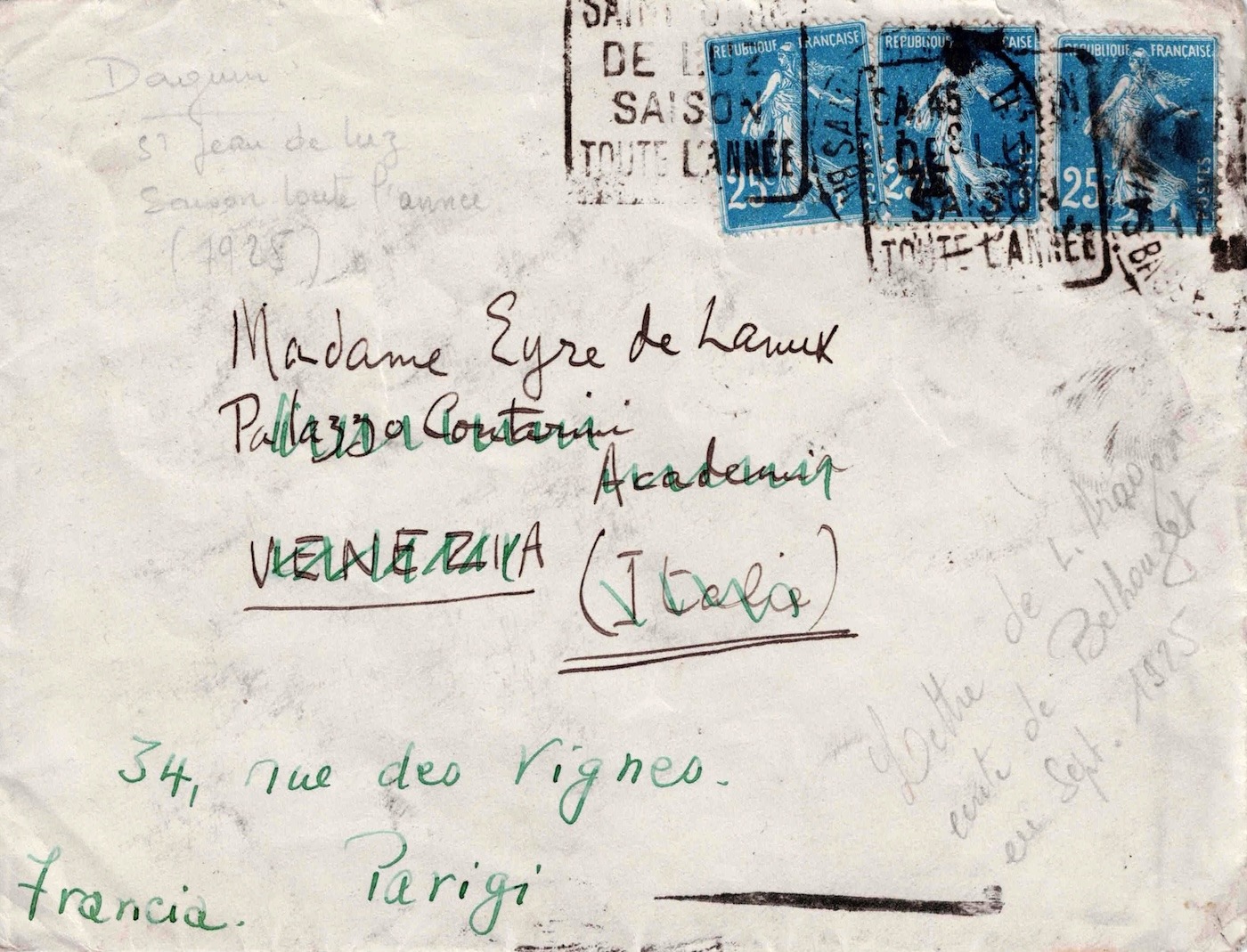
Two quarto pages. Autograph envelope.
[August or September 1925]
"Here I am, in a night that seems to last forever."
Louis Aragon's extraordinary love letter: ardent, spontaneous, marvelous, poetic, the letter possesses all the seductions – but nonetheless leaves a kind of doubt, a diffuse impression: is it Elizabeth Eyre de Lanux with whom Aragon is madly in love or does he madly love love?
___________________________________________________
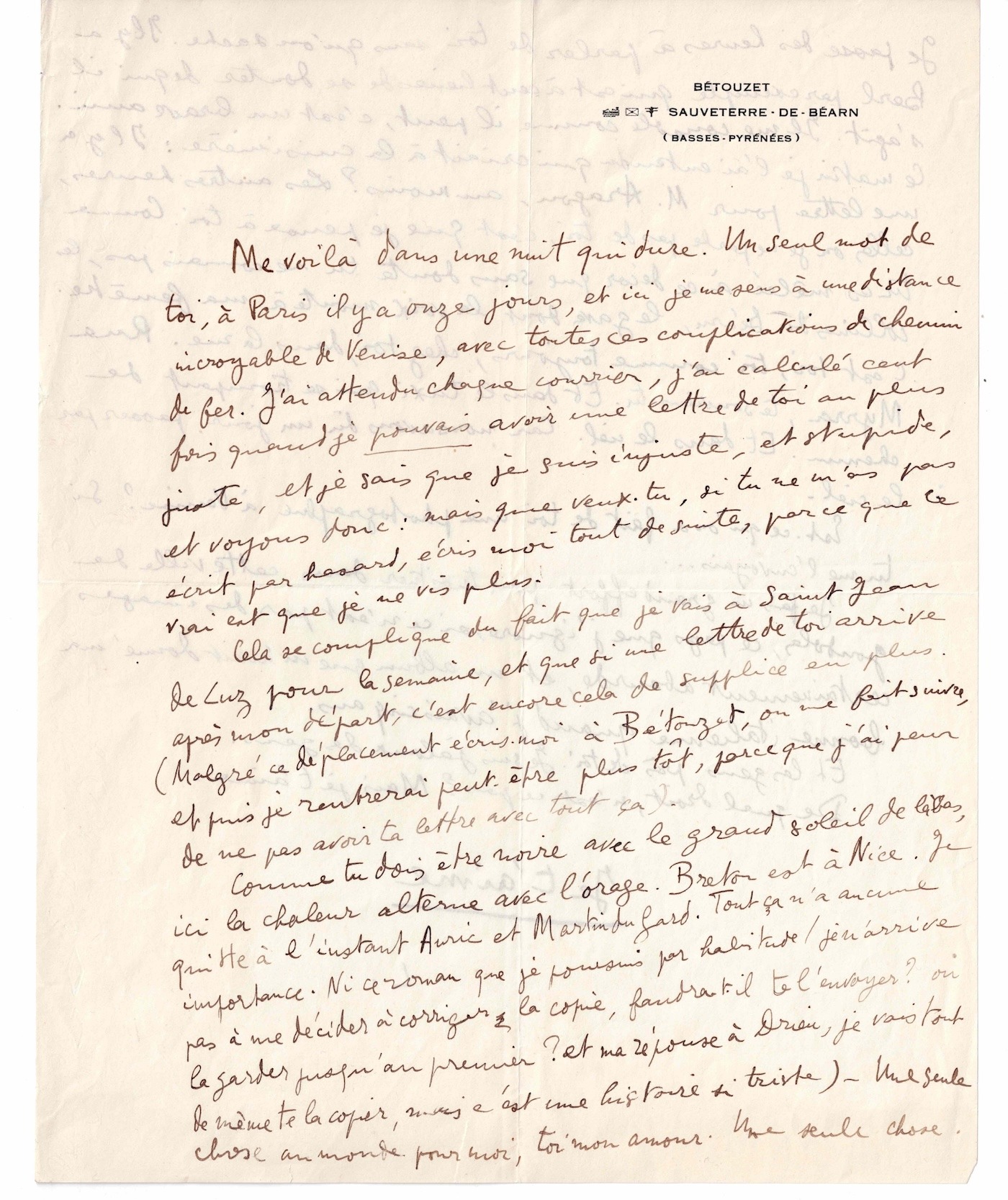
Here I am, in a night that seems to go on forever. Just one word from you, in Paris eleven days ago, and here I feel an incredible distance from Venice, with all these railway complications. I've waited for every letter, I've calculated a hundred times that I could get a letter from you at the very latest, and I know I'm being unfair, and stupid, and so what: but what can you do? If you haven't written to me by chance, write to me right away, because the truth is, I'm no longer alive.
This is complicated by the fact that I'm going to Saint-Jean-de-Luz for the week, and if a letter from you arrives after I leave, that's just another form of torture. (Despite this trip, write to me in Bétouzet; have it forwarded, and then I might come back earlier, because I'm afraid I won't get your letter with all this going on).
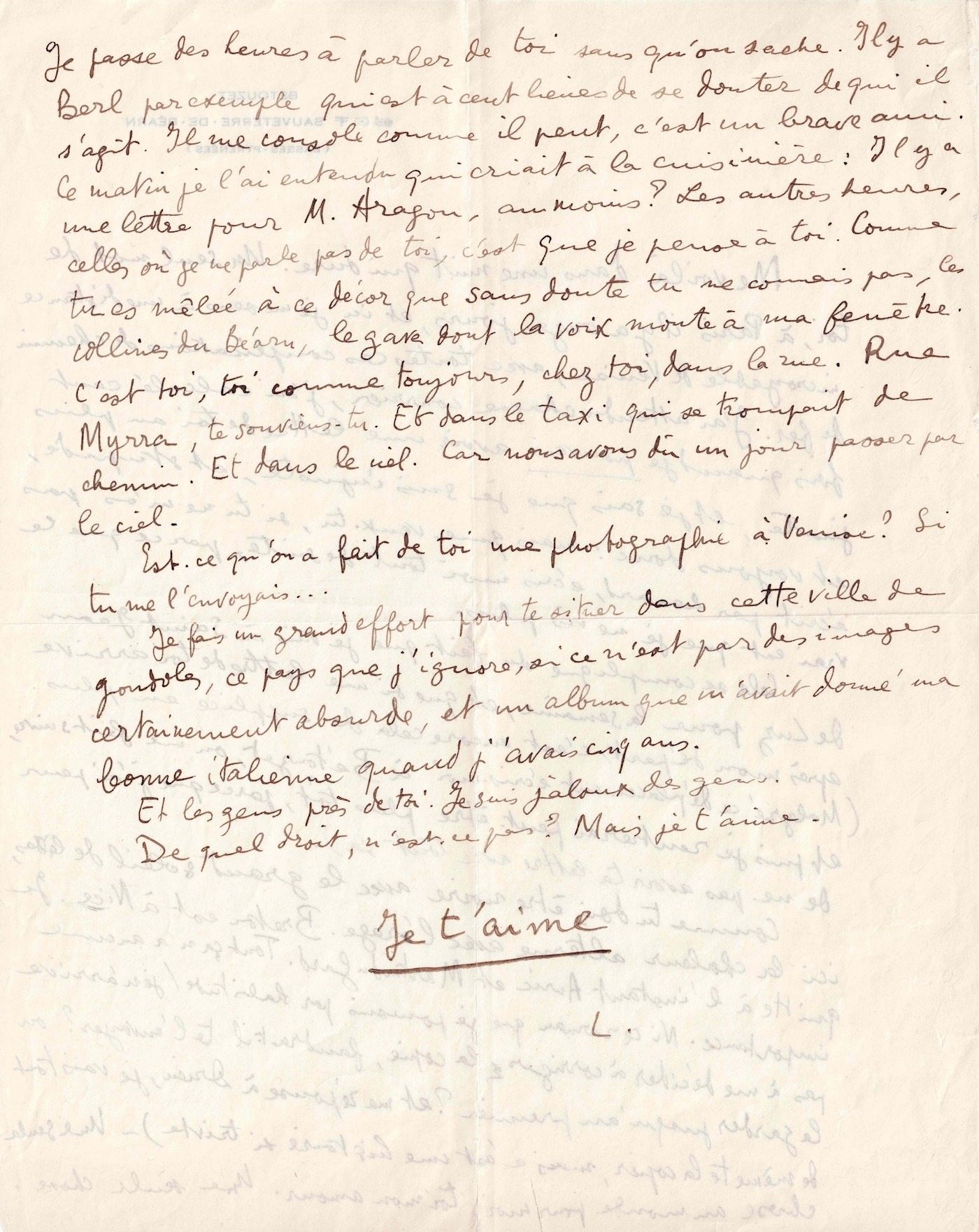
How dark you must be in that bright sun there! Here, the heat alternates with storms. Breton is in Nice. I just left Auric and Martin du Gard. None of that matters. Nor does this novel I'm working on out of habit (I can't bring myself to correct the copy; should I send it to you? Or keep it until the first one? And my reply to Drieu—I'll copy it for you anyway, but it's such a sad story). Only one thing in the world matters to me: you, my love. Only one thing. I spend hours talking about you without anyone knowing. There's Berl, for example, who's completely clueless about who I'm talking about. He comforts me as best he can; he's a good friend. This morning I heard him shouting to the cook: "Is there a letter for Mr. Aragon, at least?" The other hours, the ones when I'm not talking about you, are when I'm thinking of you. As you are intertwined with this scenery you probably don't know, the hills of Béarn, the Gave whose voice rises to my window. It's you, you as always, at home, in the street. Rue Myrra [sic], do you remember? And in the taxi that took the wrong turn. And in the sky. For we must have passed through the sky one day.
Did they take a photograph of you in Venice? If you could send it to me… I'm making a great effort to place you in this city of gondolas, this country I know nothing about except for some certainly absurd images, and an album my Italian nanny gave me when I was five. And the people around you. I'm jealous of people. What right do I have, anyway? But I love you.
I love you
L.
___________________________________________________
At the end of the summer of 1925, Louis Aragon was languishing near Sauveterre-de-Béarn, at the Château de Bétouzet, at Emmanuel Berl's house. Nothing seemed able to distract him from his main preoccupation: Elizabeth Eyre de Lanux, the young woman with whom he had been madly in love for about six months and to whom he was writing.
American, born in 1894 in Pennsylvania to a wealthy family, Elizabeth Eyre married a French diplomat, Pierre Combret de Lanux, in 1918. She quickly asserted her independence, first having an affair with Drieu la Rochelle before a brief relationship with Aragon. Man Ray painted several portraits of her. She was one of the leading figures of the American art scene in Paris, illustrating texts by Valery Larbaud, frequenting Brancusi's studio, Adrienne Monnier's bookshop, and the salon of Natalie Barney, who was also her lover.
What Aragon doesn't know when he writes this letter is that his passion is now unrequited. The fleeting lovers will meet again as friends in the autumn of 1925, and then, in December, she will give birth to a daughter unrelated to the poet. This break echoes another mentioned in the letter, with the "frenemies of Surrealism.".
In August, the NRF published an open letter entitled "The Surrealists' Real Mistake," in which Pierre Drieu la Rochelle addressed Louis Aragon. The ship was rocking: it became entangled in jealousy between successive lovers of the same muse, political disagreements, and the more or less forced confessions of two former companions. The rift would only deepen.