
"I am very receptive to your suggestion of a bit of shooting."
Sold
Boris Vian (1920.1959)
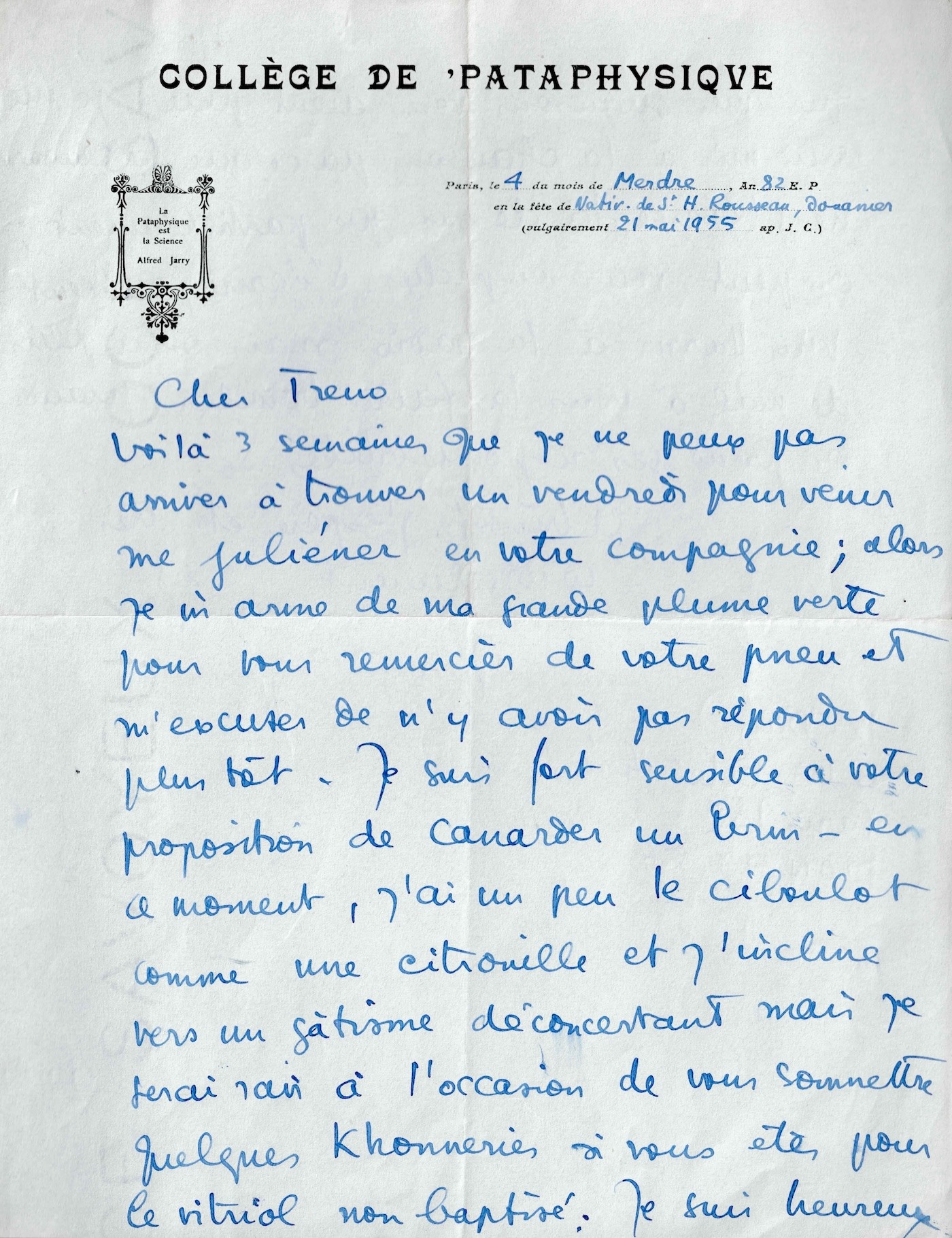
Autograph letter signed to Ernest Raynaud, known as Tréno.
Two quarto pages on letterhead of the College of Pataphysics.
Paris, the 4th of the month of Merdre, year 82 EP, on the feast of the Nativity of St.H. Rousseau, customs officer. (commonly May 21, 1955 AD)
"I am very receptive to your suggestion of a bit of shooting."
A remarkable, previously unpublished letter from Boris Vian to the editor of Le Canard enchaîné. In his inimitable style, the writer agrees to "do a bit of ribbing" with the satirical newspaper. Three weeks after this letter, " La Java des bombes atomiques" (The Java of Atomic Bombs) will make the front page of the weekly.
_____________________________________________
Dear Treno, For 3 weeks now I have been unable to find a Friday to come and spend time with you; so I am arming myself with my large green pen to thank you for your tire and apologize for not having replied sooner.
I am very sensitive to your proposal to have a bit of a go at it – at the moment, my brain is a bit like a pumpkin and I am inclined towards a disconcerting senility, but I would be delighted to submit some nonsense to you on occasion if you are for unbaptized vitriol.
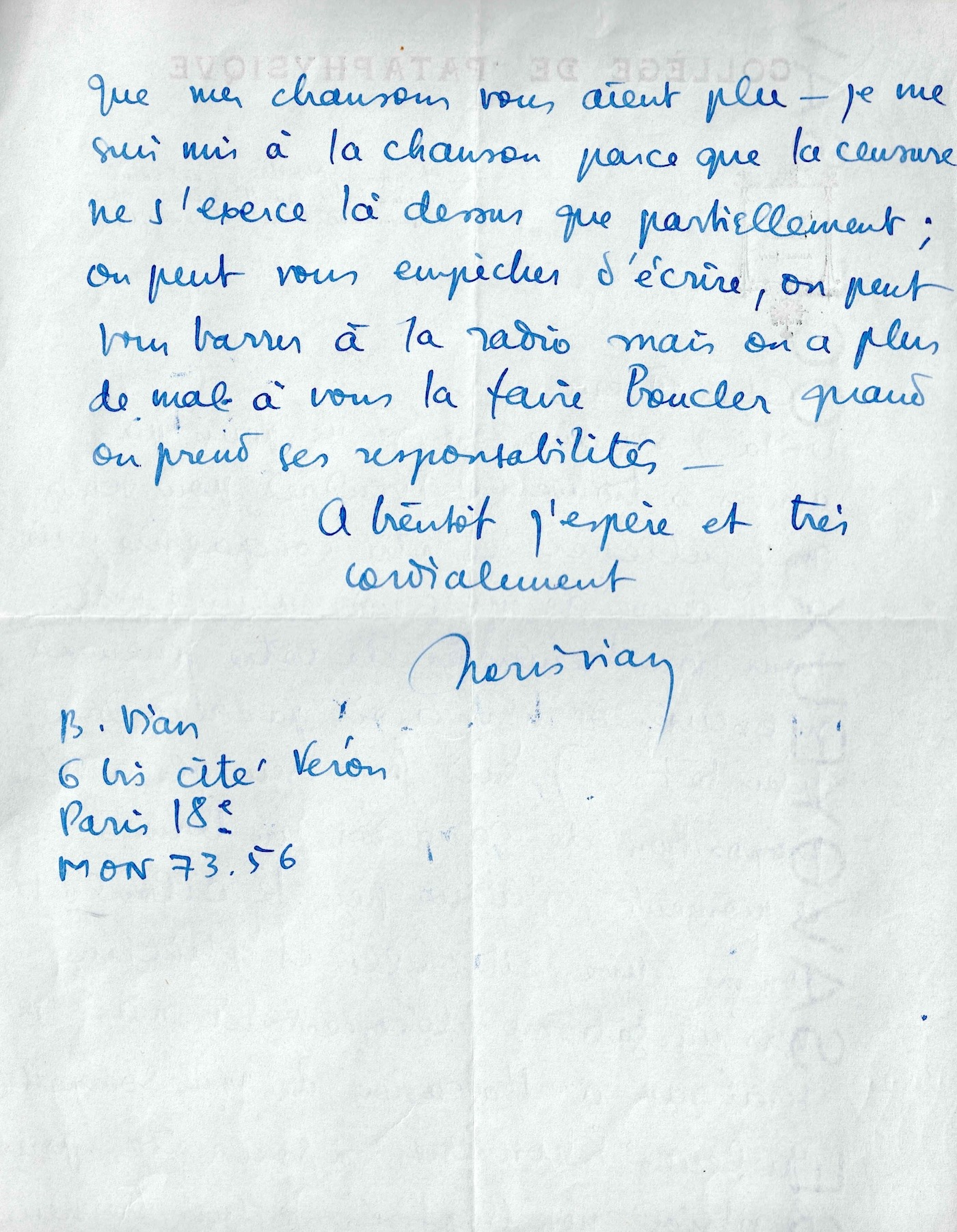
I'm glad you liked my songs – I took up songwriting because censorship only partially affects it ; they can stop you from writing, they can block you from the radio, but they have a harder time silencing you when you take responsibility. See you soon, I hope, and very cordially. Boris Vian.
_____________________________________________
Scandal and censorship. In 1954 and 1955, the " Deserter" caused a major uproar. When Boris Vian, reacting against the Indochina War, released his famous anti-militarist song, " Le Déserteur" (The Deserter), first performed by Marcel Mouloudji, then by Vian himself on February 12, 1955, at the Trois Baudets theater, the scandal was fierce. The song was violently attacked, boycotted on the radio, and virtually censored. It was in this context that Le Canard enchaîné, a staunchly anti-militarist newspaper since the First World War, publicly defended the writer. Le Canard saw in Vian a free spirit and an heir to the newspaper's libertarian tradition.
In April 1955, a few days before this letter, the song was recorded by Boris Vian as a 45 rpm single, with its final lyrics, on a record entitled "Chansons impossibles" (Impossible Songs), which also included the following tracks: "Les Joyeux Bouchers" (The Merry Butchers), "Le Petit Commerce" (The , and "La Java des bombes atomiques" (The Atomic Bomb Java). From then on, there is no doubt that Tréno, encouraged by the favorable reception of Le Canard enchaîné, approached Boris Vian to contribute to the newspaper. Vian replied on May 21, 1955 (the 4th of Merdre, year 82 according to the pataphysical calendar) with enthusiasm and his inimitable style: " I would be delighted to submit some nonsense to you on occasion if you are open to unbaptized vitriol." Three weeks later, on June 13, 1955, " La Java des bombes atomiques" made the front page of Le Canard enchaîné. The caustic and once again anti-militarist song was, like The Deserter, largely blocked on national radio.
It would be almost two years before Boris Vian intervened directly, through his writing, as an editor at Le Canard enchaîné. His first article appeared on May 29, 1957, under the title: " Song Fans, Allow Me to Yell at You and Show Support for Georges Brassens." His second article, in November 1958, was devoted to a glowing endorsement of the young Serge Gainsbourg, who had just released his first album. Brassens, Gainsbourg: Vian's tastes were sharp. Intended to be a long-term collaboration, the partnership between Vian and Le Canard enchaîné was tragically cut short by the writer's death during a screening of the film adaptation of his novel, J'irai cracher sur vos tombes (I Spit on Your Graves), on June 23, 1959.
Tréno, a unique director. Ernest Raynaud, known as Tréno, joined Le Canard Enchaîné in 1924 as a simple proofreader before becoming an editor in 1932. In September 1954, Tréno decided to dedicate himself exclusively to Le Canard, where he remained the editor-in-chief and de facto director until his death. The widow of the satirical weekly's founder, Jeanne Maréchal, gave him free rein to run the newspaper, which was then in serious trouble. Tréno was the principal architect of the satirical weekly's recovery, quadrupling its sales between the early 1950s and the late 1960s (from approximately 100,000 to 400,000 copies), thus establishing his own distinctive style and an identity closely aligned with libertarian and anarchist circles.