SAINT-GEORGES DE BOUHÉLIER (1876-1947)
Autograph manuscript signed – The Death of Zola.
Seven pages in quarto. Erasure, corrections and additions. No place or date. [1927]
" In a corner, someone I soon recognized as Captain Dreyfus was recounting that everything had been done to revive the writer, but their efforts had failed."
A fascinating account, collected by one of his faithful disciples, of the circumstances surrounding the death of Émile Zola.
________________________________________
The Death of Zola.
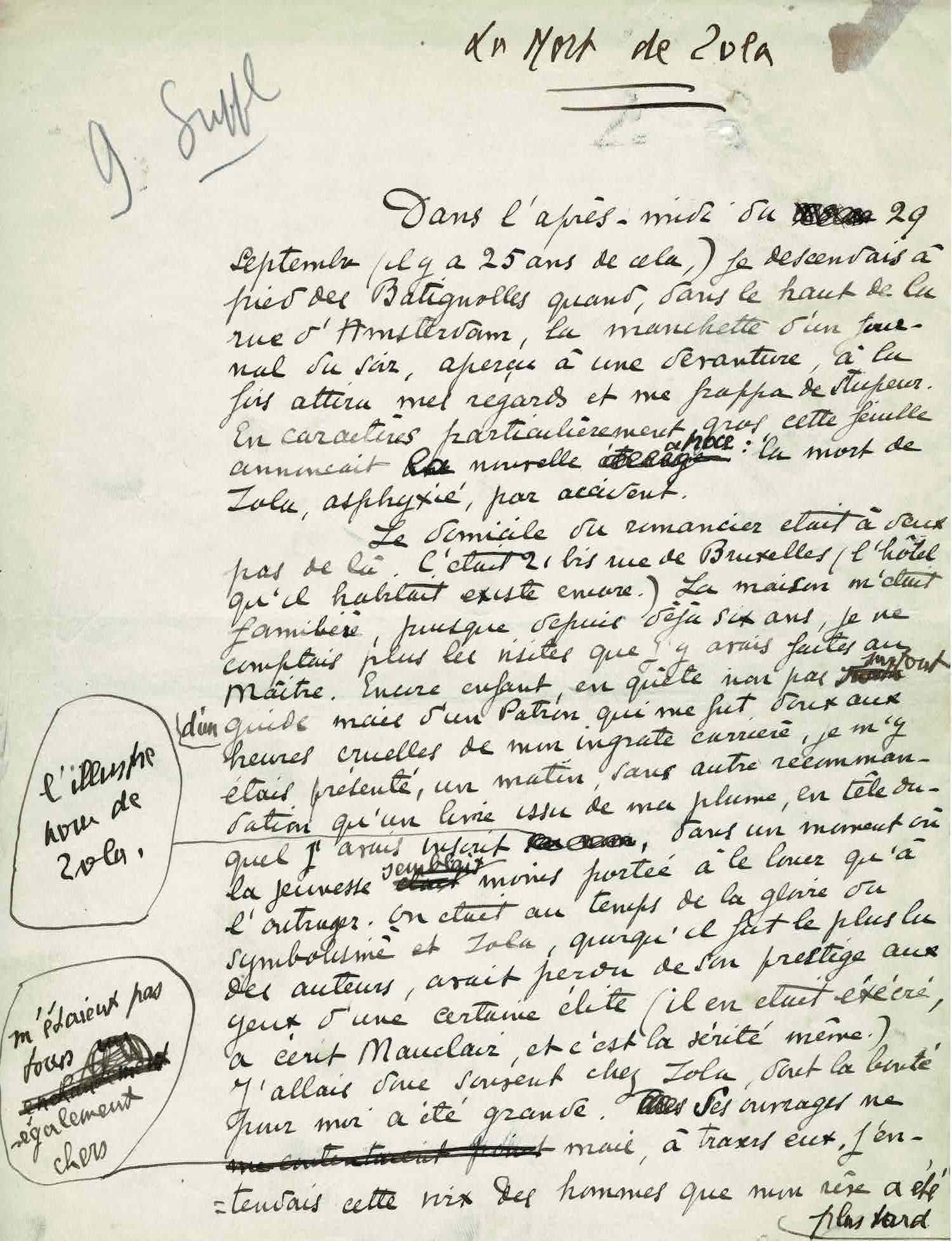
On the afternoon of September 29th (25 years ago), I was walking down from Batignolles when, at the top of the rue d'Amsterdam, the headline ofan evening newspaper, glimpsed in a shop window, both caught my eye and struck me with astonishment. In particularly large print, this sheet announced the terrible news: the death of Zola, asphyxiated, in an accident.
The novelist's home was just a stone's throw away. It was 21 bis rue de Bruxelles (the hotel helived in still exists). The house was familiar to me, since for six years I had lost count of the visits I had made there to the Master. Still a child, searching not so much for a guide but above all for a Patron, someone who would be kind to me during the cruel hours of my thankless career, I had presented myselfthereone morning, with no other recommendation than a book I had written, at the topof which Ihad inscribed the illustrious name of Zola, at a time when young people seemed less inclined to praise him than torevile him. It was the heyday of Symbolism, and Zola, since he was the most widely read of authors, had lost some of his prestige in the eyes of a certain elite (he was detested by them, wrote Mauclair, and that is absolutely true).
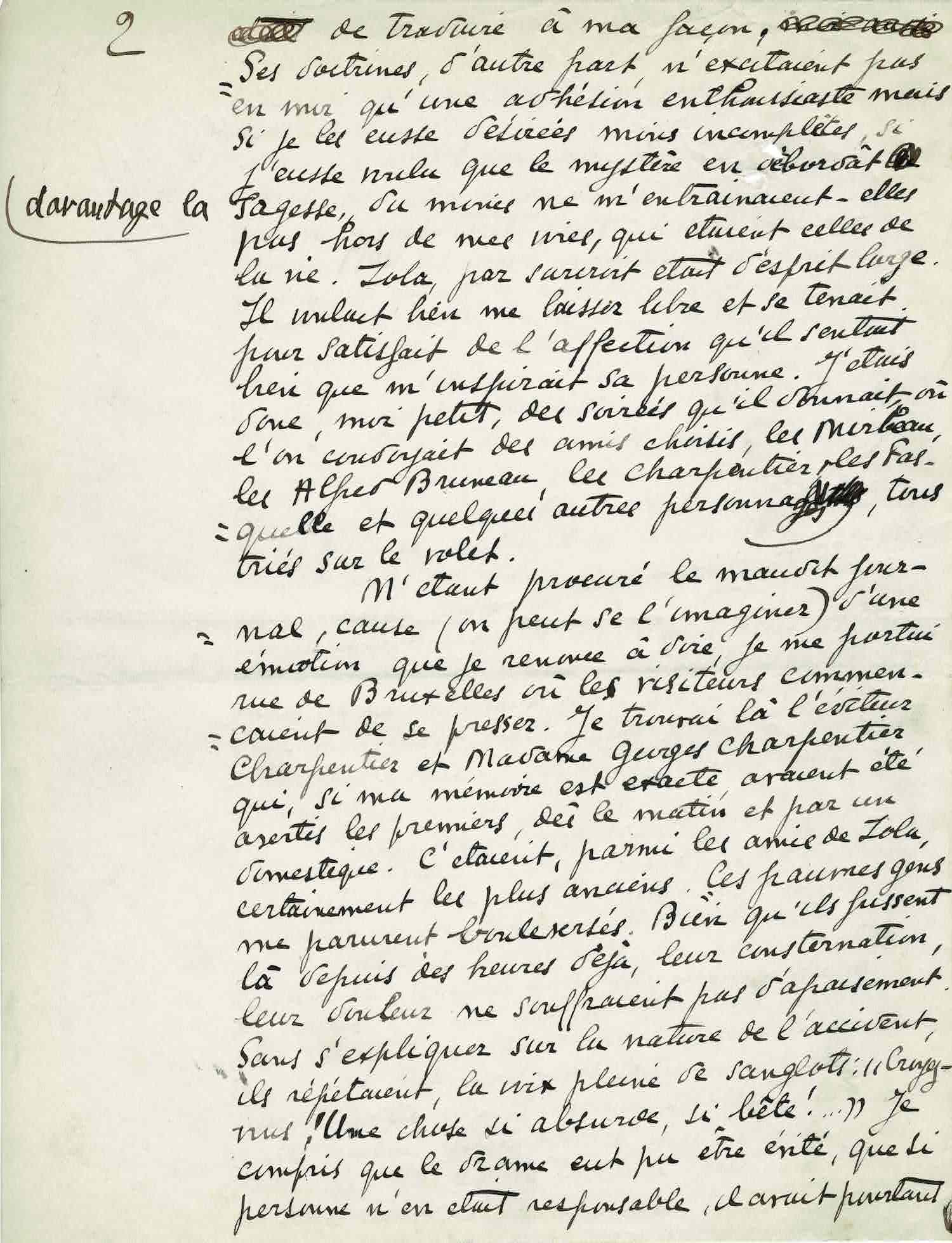
So I often went to Zola's house, and he was very kind to me. Not all of his works were equally dear to me, but through them I heard that voice of humanity which I later dreamed of translating in my own way. His doctrines, moreover, didn't only inspire enthusiastic adherence in me, but even if I had wished them to be less incomplete, if Ihad wished their mystery to overflow with more wisdom, at least they didn't lead me astray from my own lives, which were, in fact, the lives of life itself. Zola, moreover, was open-minded. He was happy to give me my freedom and considered himself satisfied with the affection he sensed I felt for him. So, as a young boy, I was a regular at the partieshehosted, where one mingled with select friends: the Mirbeaus, the Alfred Bruneaus, the Charpentiers, the Fasquelles, and a few other carefully chosen figures.
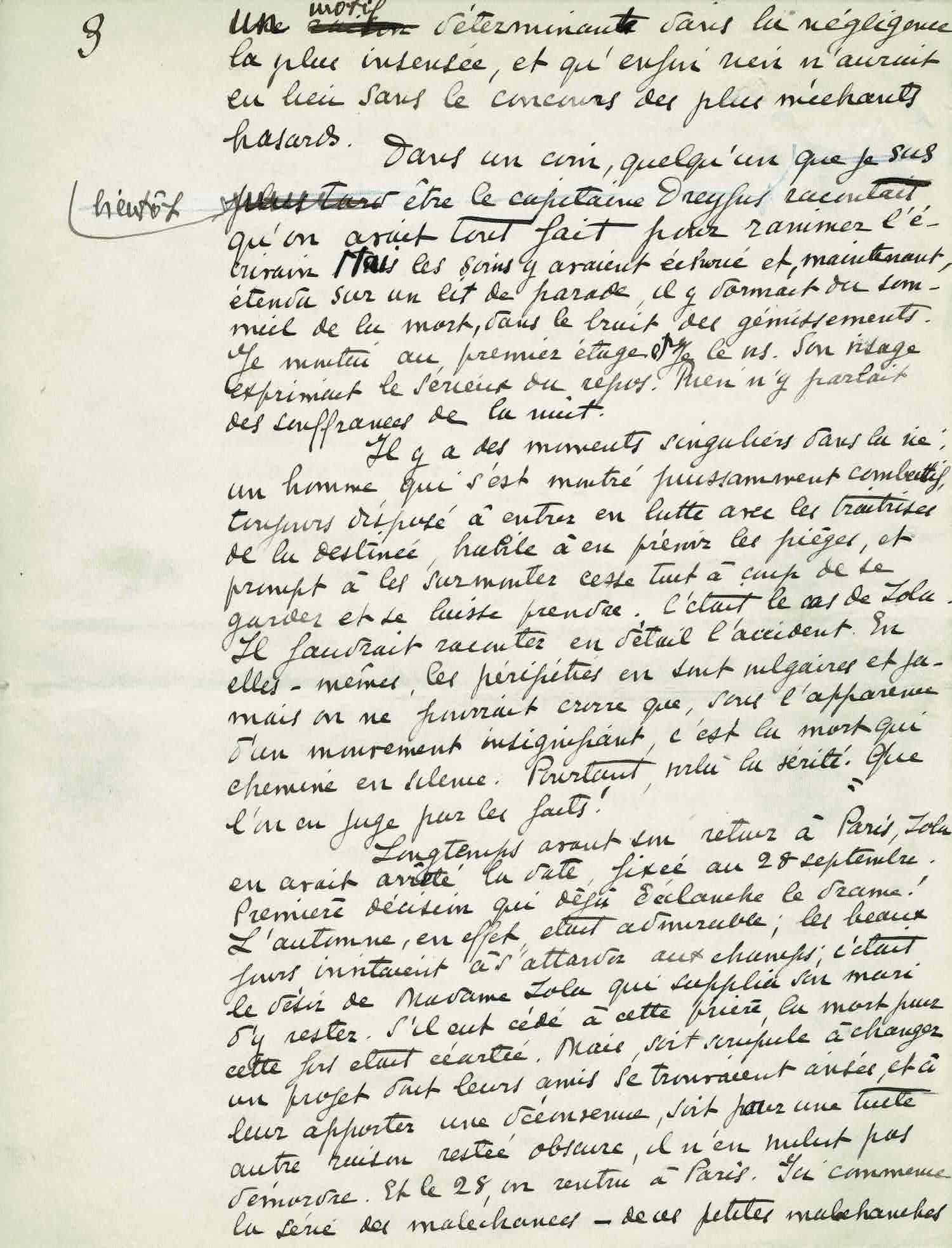
Havingobtained the cursed newspaper, the cause (as one can imagine) of an emotion I refuse to describe, I made my way to the Rue de Bruxelles where visitors were beginning to gather. There I found the publisher Charpentier and Madame Georges Charpentier who, if my memory serves me correctly, had been the first to be informed, that very morning, by a servant. They were certainly among Zola's oldest friends. These poor people seemed distraught. Although they had been there for hours already, their consternation and grief showed no sign of abating. Without explaining the nature of the accident, they repeated, their voices choked with sobs: "Can you believe it! Such an absurd, such a stupid thing ! ..." I understood that the tragedy could have been avoided, that while no one was responsible, it nevertheless stemmed from a decisive act of the most senseless negligence, and that, ultimately, nothing would have happened without the most cruel twist of fate.
In a corner, someone I soon recognized as Captain Dreyfus was recounting how everything had been done to revive the writer, but their efforts had failedand, now, stretched out on a state bed, he was sleeping the sleep of death, to the sound of moans. I went up to the first floor and saw him. His face expressed the seriousness of rest. Nothing there spoke of the sufferings of the night.
There are singular moments in life: a man who has shown himself to be powerfully combative, always ready to fight against the treachery of fate, adept at anticipating its traps, and quick to overcome them, suddenly ceases to guard himself and allows himself to be caught. This was the case with Zola. The accident would have to be recounted in detail. In themselves, the events are commonplace, and one could never believe that, beneath the appearance of an insignificant movement, it is death that silently advances. Yet, this is the truth. Letthe facts speak for themselves !
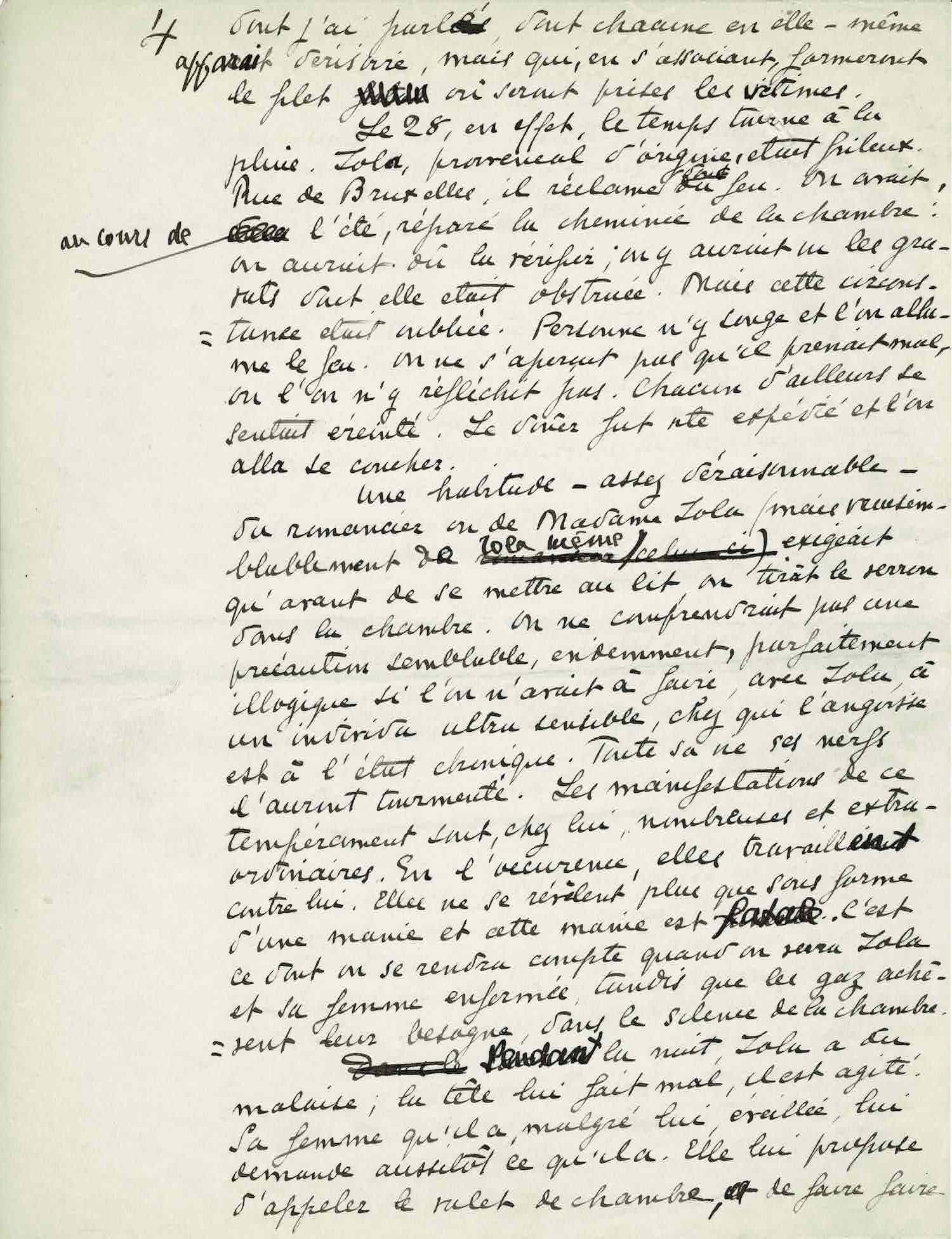
Long before his return to Paris, Zola had set the datefor his departure, September 28th. This first decision alone set the tragedy in motion !Autumn, indeed, was magnificent; the beautiful weather invited one to linger in the countryside; it was Madame Zola's desire, and she begged her husband to stay there. Had he yielded to her plea, death, for once, would have been averted. But, whether out of scruples about changing a plan known to their friends and causing them disappointment, or for some other, still obscure, reason, he refused to budge. And on the 28th, they returned to Paris. Here begins the series of misfortunes—those small misfortunes Imentioned, each of which in itself seems insignificant, but which, combined, will form the net in which the victims will be caught.
On the 28th, the weather turned to rain. Zola,aof, was sensitive to the cold. On the Rue de Bruxelles, hecalled for a fire. The bedroom chimney had been repaired during the summer; it should have been checked; the rubble blocking it would have been visible. But this detail was forgotten. No one gave it a thought, and the fire was lit. No one noticed it wasn't catching properly, or perhaps no one thought about it. Besides, everyone felt exhausted. Dinner was quickly eaten, and everyone went to bed.
A rather unreasonable habit of the novelist or Madame Zola (but most likely Zola himself) required that the bedroom door be locked before going to bed. Such a precaution would be incomprehensible, utterly illogical, if Zola were an ultra-sensitive individual, chronically plagued by anxiety. His nerves tormented him throughout his life. The manifestations of this temperament were numerous and extraordinary in his case. In this instance, they worked against him. They now only manifested as a mania, and this mania proved fatal. This becomes clear when one sees Zola and his wife locked in the room while the gas finishes its work, in the silence of the bedroom.
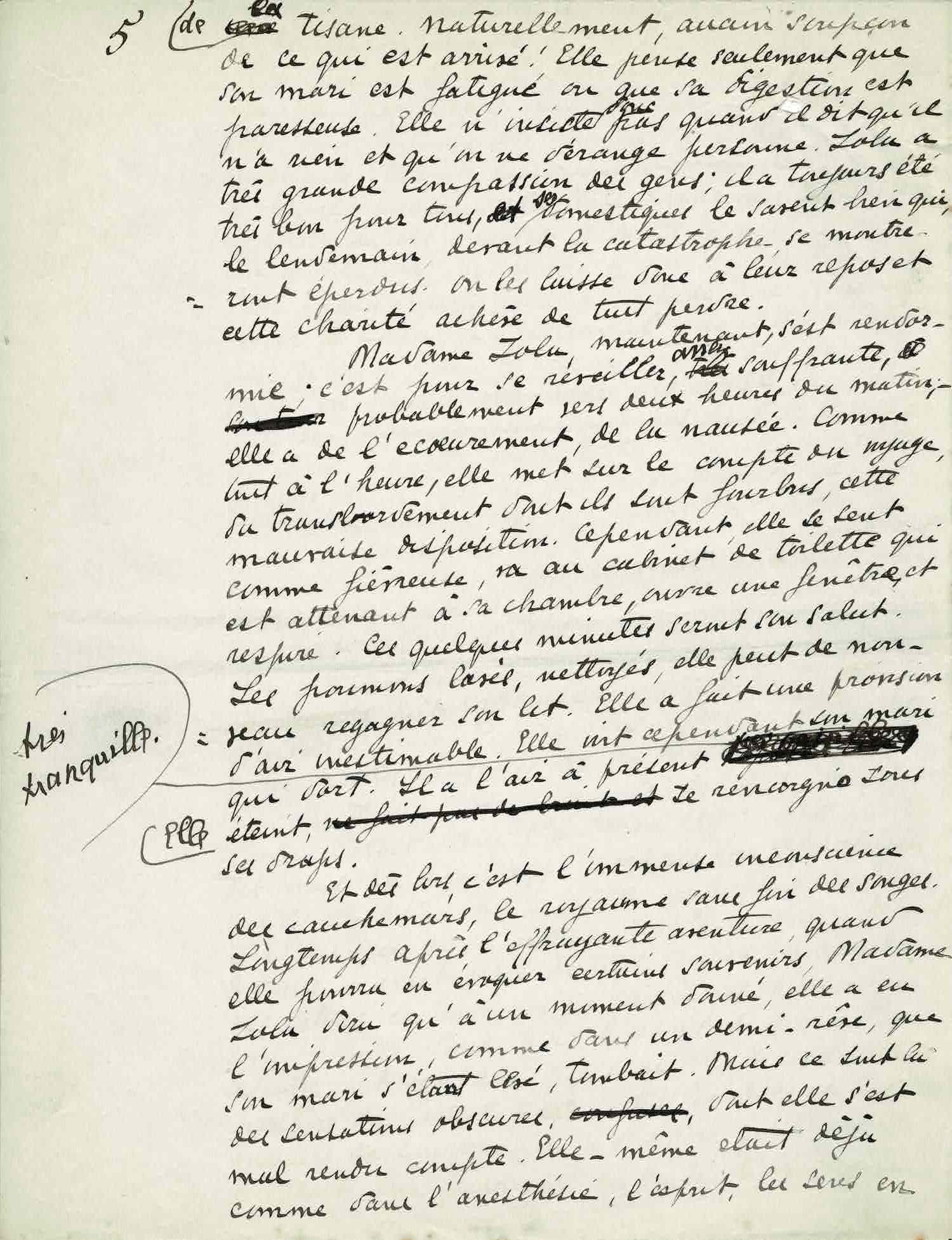
During the night, Zola felt unwell; his head ached, and he was restless. His wife, whomhe hadunwittingly awakened, immediately asked him what was wrong. She suggested he call the valet and have some herbal tea made. Naturally, she had no idea what had happened! She simply thought her husband was tired or had an indigestion. So she didn't press him when he said he was fine and that no one should be disturbed. Zola had great compassion for people. He had always been very kind to everyone; his servants knew this well, and the next day, faced with the disaster, they were distraught. So they were left to their rest, and this act of charity ultimately ruined everything.
Madame Zola has now fallen back asleep; she wakes up, feeling quite unwell, probably around two in the morning; she is nauseous and disgusted. As before, she attributes this ill feeling to the journey, to the transfer that has exhausted them. However, she feels feverish, goes to the bathroom adjoining her room, opens a window, and breathes. These few minutes will be her salvation. Her lungs cleansed, cleared, she can return to her bed. She has obtained an invaluable supply of air. She sees her husband asleep. He now seems very peaceful. She turns off the light and curls up under her sheets.
And from then on, it was the vast unconsciousness of nightmares, the endless realm of dreams. Long after the terrifying ordeal, when she was able to recall certain memories of it, Madame Zola would say that at one point she had the impression, as if in a half-dream, that her husband, having risen, was falling. But these were vague sensations, of which she was barely aware. She herself was already as if anesthetized, her mind and senses numb. She was unable to open her mouth, to move.
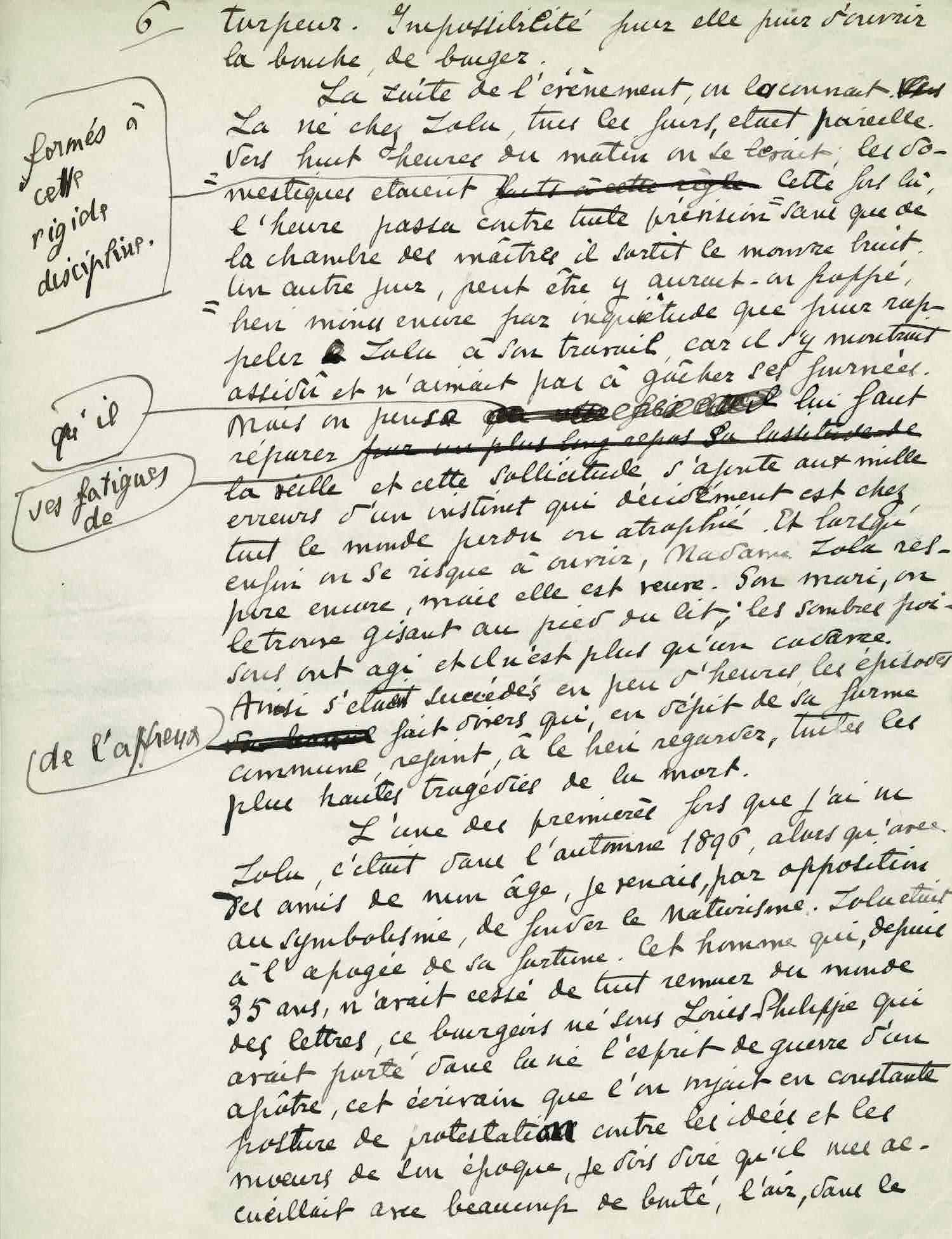
The rest of the story is well known. Life at Zola's house was always the same. Around 8:00 a.m., everyone got up; the servants were trained in this strict discipline. This time, the hour passed against all expectations without the slightest sound coming from the master bedroom. Another day, perhaps, someone would have knocked, much less out of concern than to remind Zola to his work, for he was diligent and disliked wasting his days. But they thought washe needed to recover from the previous day's fatigue, and this concern added to the thousand errors of an instinct thatdecidedlylost or atrophied in everyone. a widow. Her husband was found lying at the foot of the bed; the dark poisons had taken their toll, and he was nothing more than a corpse. Thus, in a few hours, episodes of the dreadful news item had followed one another, which, despite its common form, on closer inspection, joins all the greatest tragedies of death.
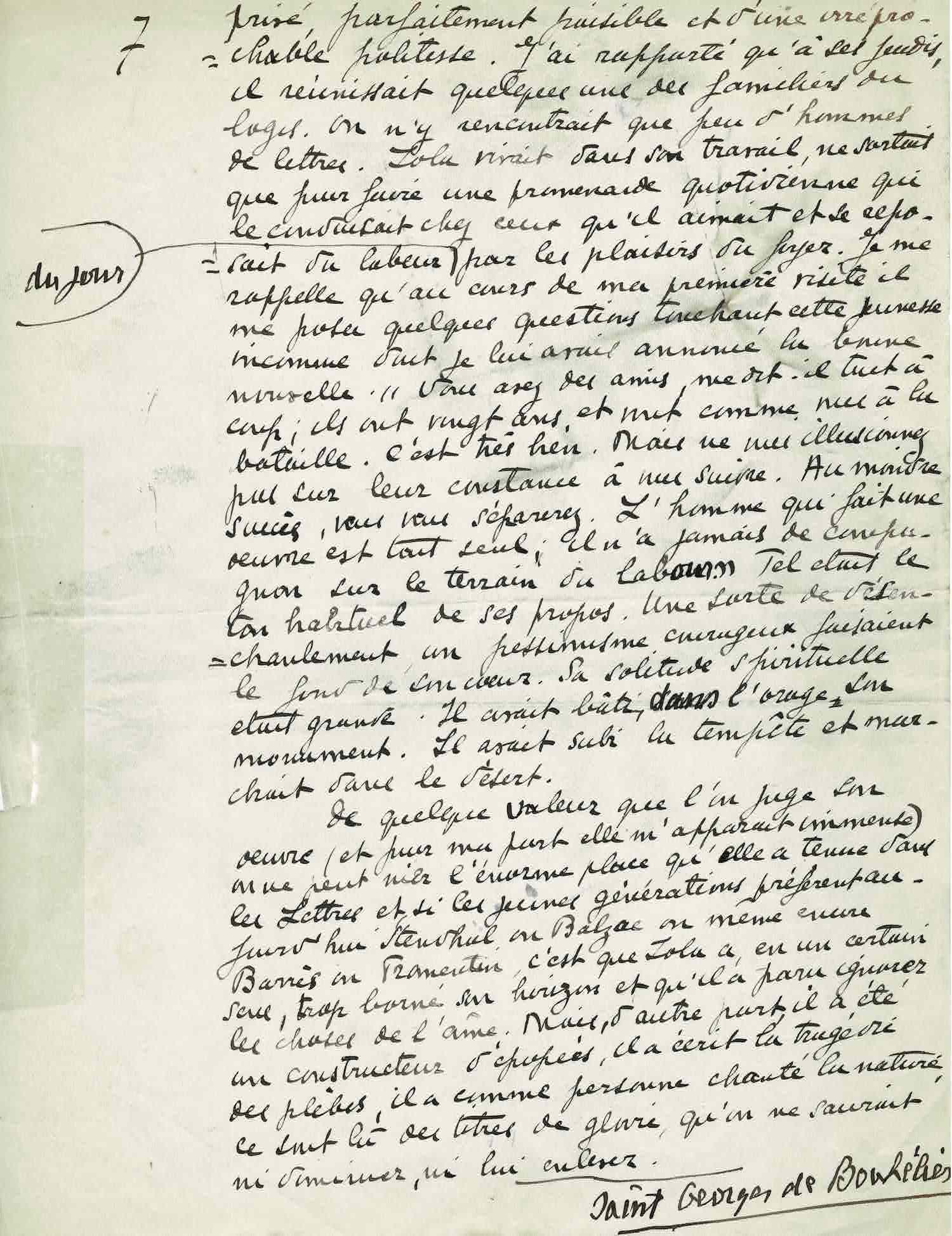
Oneof the first times I saw Zola was in the autumn of 1896, when, with friends my own age, I had just founded Naturism in opposition to Symbolism. Zola was at the height of his fame. This man, who for 35 years had constantly shaken up the literary world, this bourgeois born under Louis-Philippe who had carried in his life the fighting spirit of an apostle, this writer who was seen in a constant posture of protest against the ideas and customs of his time—I must say that he uswith great kindness, appearing, in private, perfectly peaceful and impeccably polite. Ihave reportedthat .on Thursdays, he would gather a few of his close friends. Only a few men of letters were ever seen there Zola lived in his work, only going out for a daily walk that took him to the homes of those he loved, and finding respite from the day's labors in the pleasures of home. I remember that during my first visit, he asked me a few questions about this unknown group of young people whose good news I had shared with him. "You have friends," he said suddenly; "they are twenty years old and, like me, are going to war. That's very good. But don't be fooled about their consistency in following us. At the slightest success, you will part ways. The man who creates a work of art is all alone ; henever has a companion in the field of labor." Such was the usual tone of his remarks. A kind of disenchantment, a courageous pessimism, lay at the core of his being. His spiritual solitude was profound. He had built his monument in the midst of the storm. He had weathered the tempest and was walking in the desert.
Whatever value one may judge his work to be (and for my part, it seemsimmense), one cannot deny the enormous place it has held in literature. If younger generations today prefer Stendhal or Balzac, or even Barrès or Fromentin, it is because Zola, in a certain sense, was too narrow in his scope and seemed to ignore matters of the soul. But, on the other hand, he was a builder of epics, he wrote the tragedy of the plebeians, he sang of nature like no other—these are titles of glory that cannot be diminished or taken from him. —Saint Georges de Bouhélier
________________________________________
Founder of Naturism, a movement that aimed to reconcile the beauty of Art and that of Nature, the reality of life and civic virtues, Saint-Georges de Bouhélier, recommended by Zola, in turn supported the writer in his fight for the revision of the Dreyfus trial.
The manuscript presented here, a detailed account of the unfortunate circumstances of Zola's death, constitutes a valuable source of information. It reveals, in particular, the profound grief of his publisher and the presence of Captain Dreyfus the day after the tragedy.
While this text can also be read as a tribute from a student to his master, some more detached elements, particularly in the introduction and conclusion, attempt to shed new and objective light on the critical reception of Zola's work at the time of his death.
Although the theory of accidental death by asphyxiation was immediately adopted and recognized, several later testimonies now make the theory of assassination plausible: the chimney from which the deadly gases emanated was allegedly deliberately obstructed.