Paul Gauguin (1848-1903)
Autographed letter signed to Ambroise Vollard
Two quarto pages. Slight traces of folding.
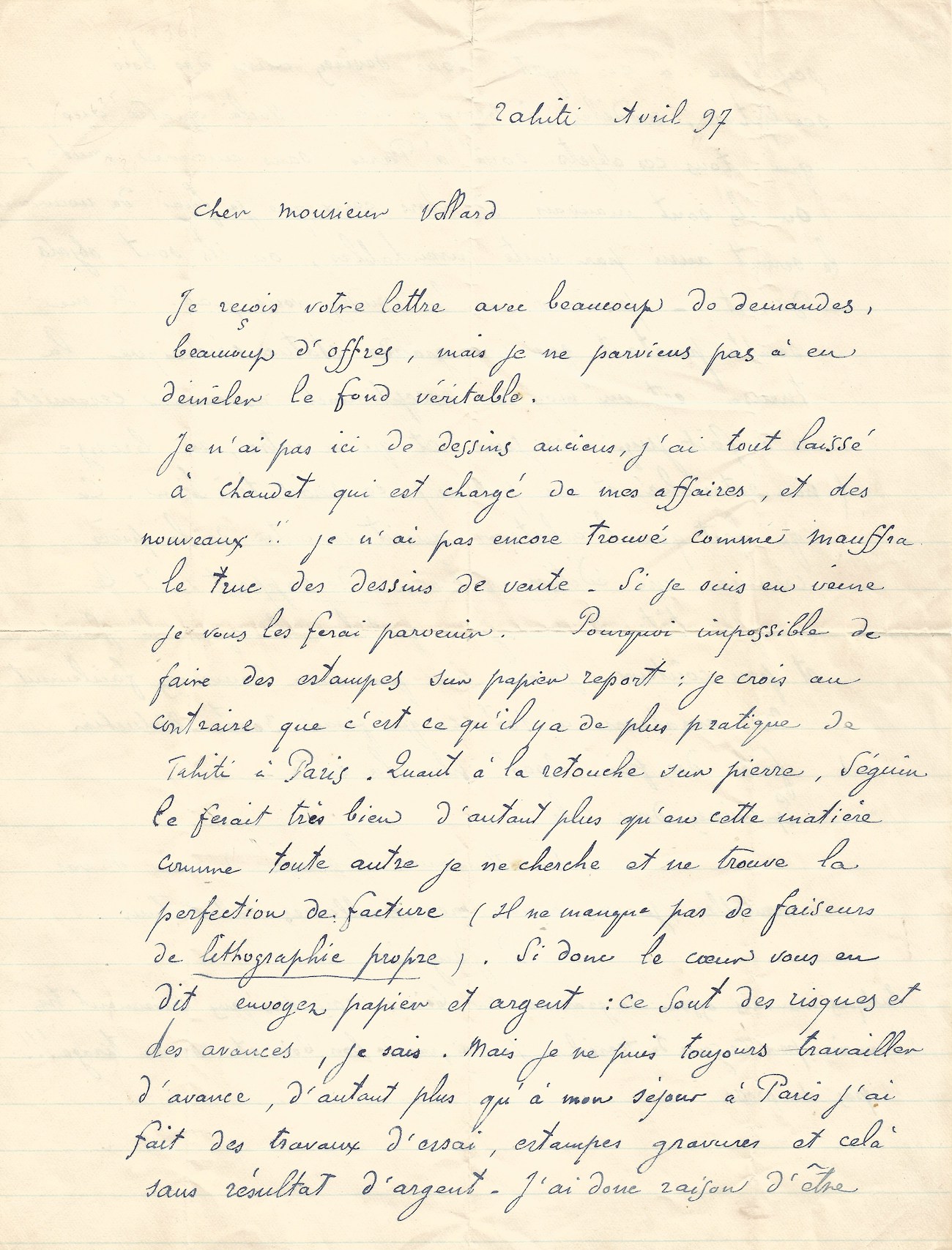
Tahiti. April 1897.
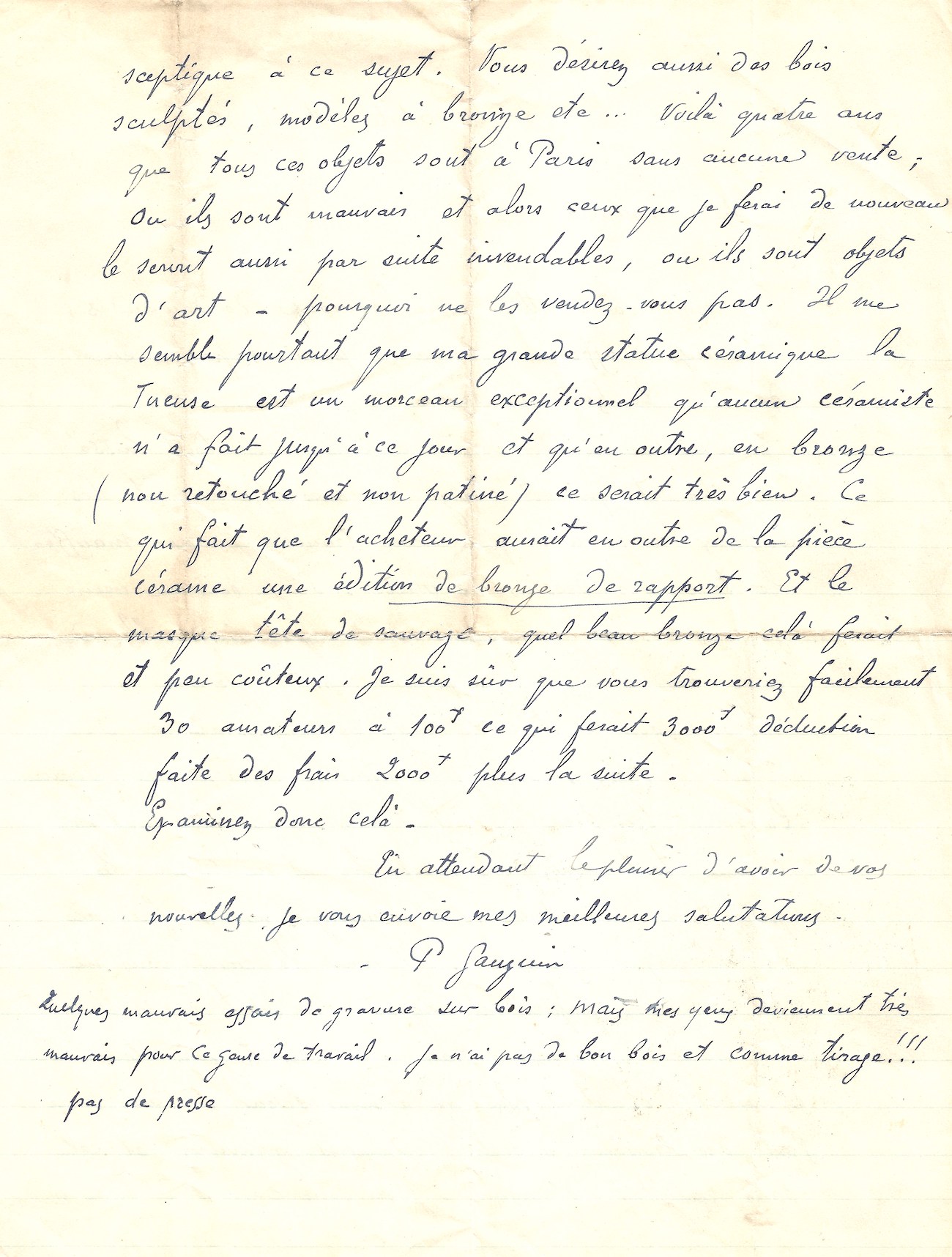
"It seems to me that my large ceramic statue, The Killer, is an exceptional piece that no other ceramist has created to this day."
An important letter from Gauguin to his dealer Ambroise Vollard – the first sent from Tahiti – detailing the extent of his artistic work and praising the exceptional beauty of his Killer , one of his most famous works, the Oviri sculpture.
“Dear Mr. Vollard, I received your letter with many requests and offers, but I can't quite grasp its true meaning. I don't have any old drawings here ; I left them all with Chaudet, who is in charge of my affairs, and new ones too… I haven't yet found, like Mauffra, the trick to producing drawings for sale. If I'm lucky, I'll send them to you. Why is it impossible to make prints on transfer paper? On the contrary, I believe it's the most practical method from Tahiti to Paris. As for retouching on stone, Séguin would do it very well, especially since, in this field as in any other, I neither seek nor find perfection in execution (there's no shortage of makers of good lithographs ).”
So, if you're so inclined, send the papers and the money: it's a risk and an advance, I know. But I can't always work in advance, especially since during my stay in Paris I did some trial work—prints, engravings— and all without any financial gain. So I'm right to be skeptical about it. You also want carved wood, bronze models, etc. For four years now, all these items have been in Paris without a single sale; either they're poor quality , and then any new ones I make will also be unsellable, or they are works of art—why don't you sell them?
It seems to me, however, that my large ceramic statue, The Killer, is an exceptional piece, one that no ceramist has produced to this day, and that, moreover, in bronze (unretouched and unpatinated) it would be very fine. This would mean that the buyer would also have, in addition to the ceramic piece, a bronze edition to match . And the savage head mask—what a beautiful bronze it would make, and inexpensive! I'm sure you could easily find 30 buyers at 100 francs, which would make 3,000 francs, deducting the 2,000 francs in fees, plus the rest. Consider this. Awaiting the pleasure of hearing from you, I send you my best regards. P. Gauguin. A few poor attempts at wood engraving; but my eyes are becoming too poor for this kind of work. I don't have good wood, and as for printing... I don't have a press.
Oviri. The Killer. In the winter of 1894, Gauguin created Oviri ("Wild"), a large ceramic vase depicting a hallucinating woman vanquishing a wolf lying at her feet. The Killer, as he named it, was one of his greatest creative achievements. "I was the first to launch ceramic sculpture," he wrote. The clay version remained his most cherished work, to the point that he wished it to watch over his final rest. Ultimately, it is a bronze version of the work that adorns his tomb in the Marquesas Islands. Oviri was exhibited in Paris during the major Gauguin retrospective of 1906 and is said to have profoundly influenced Picasso, who drew inspiration from it for Les Demoiselles d'Avignon.
Despite the acerbic tone of this letter, Vollard was an indispensable source of income for Gauguin. The year following this letter, the gallery owner organized an exhibition of Gauguin's works in his Parisian gallery, where he showed for the first time the artist's most famous painting: Where Do We Come From? What Are We? Where Are We Going?