Precious letter from Jean Racine to Marshal de Luxembourg. 1693.
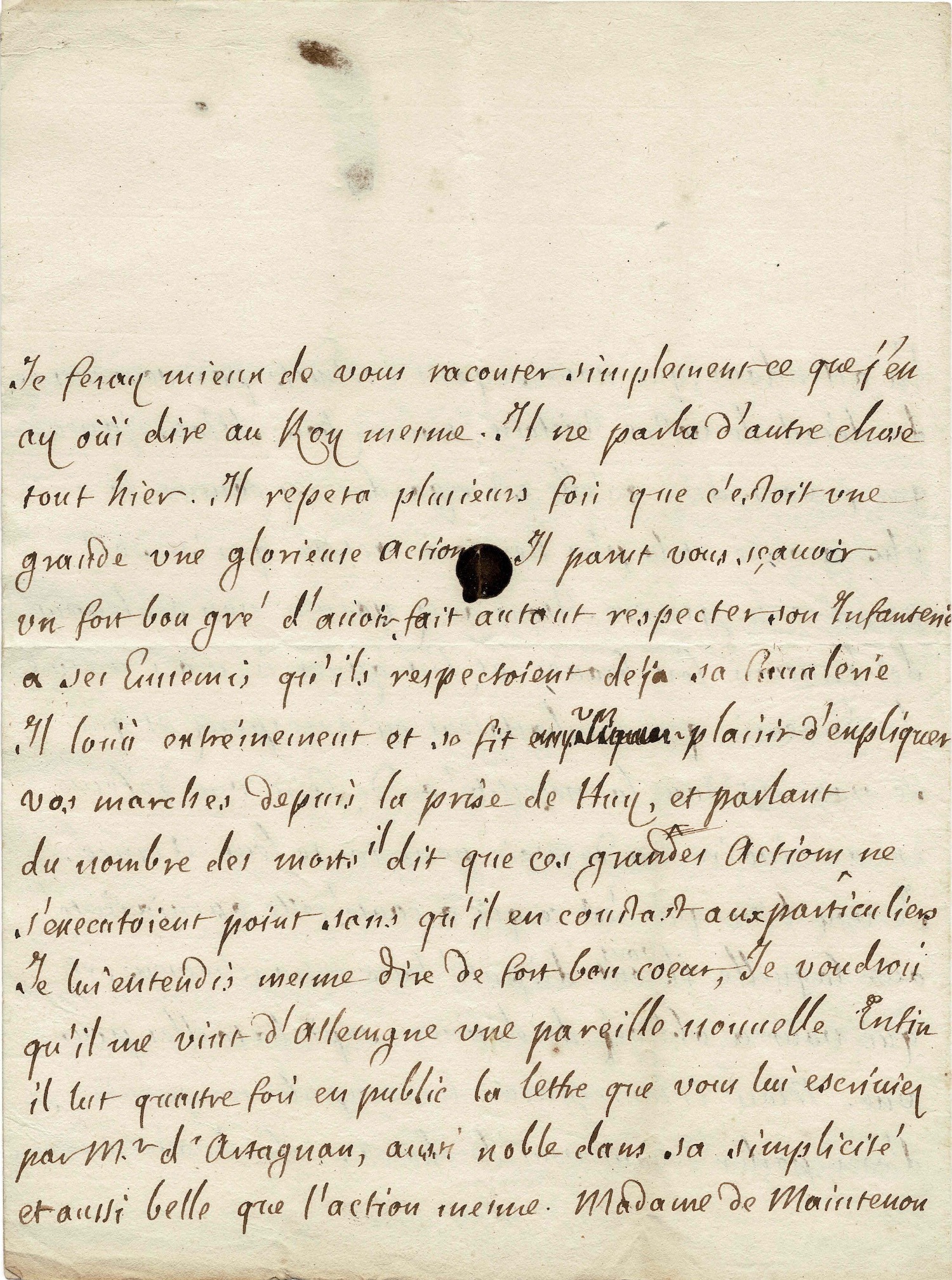
"I would do better to simply tell you what I heard the King himself say about it. He spoke of nothing else all yesterday."
45.000€

"I would do better to simply tell you what I heard the King himself say about it. He spoke of nothing else all yesterday."
45.000€
Jean Racine (1639.1699)
Autograph letter signed to François-Henri de Montmorency-Bouteville, Marshal of Luxembourg.
Four pages in 4° (225 x 165mm)
Paris, August 2 [1693]
« … History must not lose a single syllable…
A precious autograph letter signed by Racine, poet and historiographer of Louis XIV, in an exalted tone, addressed to the victor of the Battle of Neerwinden, Marshal Luxembourg.
With a fluid and modern style, Racine describes, over the course of these four wonderful pages, the flavors of military triumph and invites us alongside the Sun King, Madame de Maintenon, Nicolas Boileau, Count d'Artagnan, etc., in the salons of the Court.
It is important to point out here the exceptional rarity of Jean Racine's letters.
Beyond the donation made by Louis Racine (his younger son) to the King's Library in 1756 of a small collection of his father's manuscripts and works (now held at the BNF), the number of the poet's letters that have survived is extremely small. Those bearing his signature are even rarer.
__________________________________________________
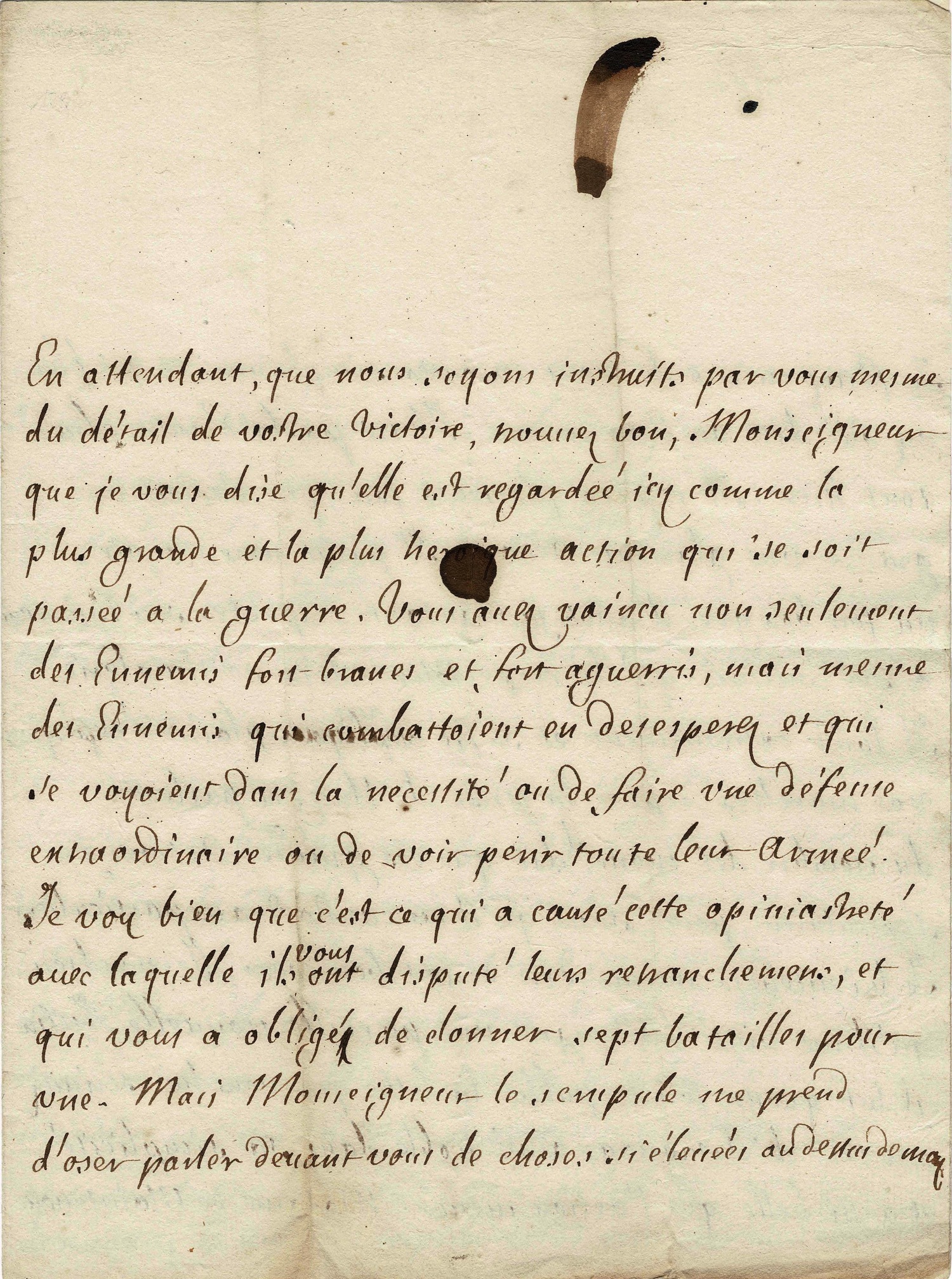
" Until we are informed by you yourself of the details of your victory, allow me, Your Grace, to tell you that it is regarded here as the greatest and most heroic action that has taken place in the war. You have defeated not only very brave and seasoned enemies, but even enemies who fought desperately, and who found themselves forced either to mount an extraordinary defense or to see their entire army perish. I understand well that this is what caused the obstinacy with which they contested your entrenchments, and which compelled you to give seven battles for one. But, Your Grace, I hesitate to speak before you of matters so far above my own understanding."
I would do better to simply tell you what I heard the King himself say about it. He spoke of nothing else all yesterday. He repeated several times that it was a great, a glorious action. He seemed very grateful to you for having made his Infantry as respected by his enemies as they already respected his Cavalry. He praised you highly and took pleasure in explaining your marches since the capture of Huy, and speaking of the number of dead, he said that such great actions were never accomplished without cost to individuals. I even heard him say, quite sincerely, "I wish such news would come to me from Germany." Finally, he read aloud four times in public the letter you wrote to him by Monsieur d'Artagnan, as noble in its simplicity and as beautiful as the action itself.
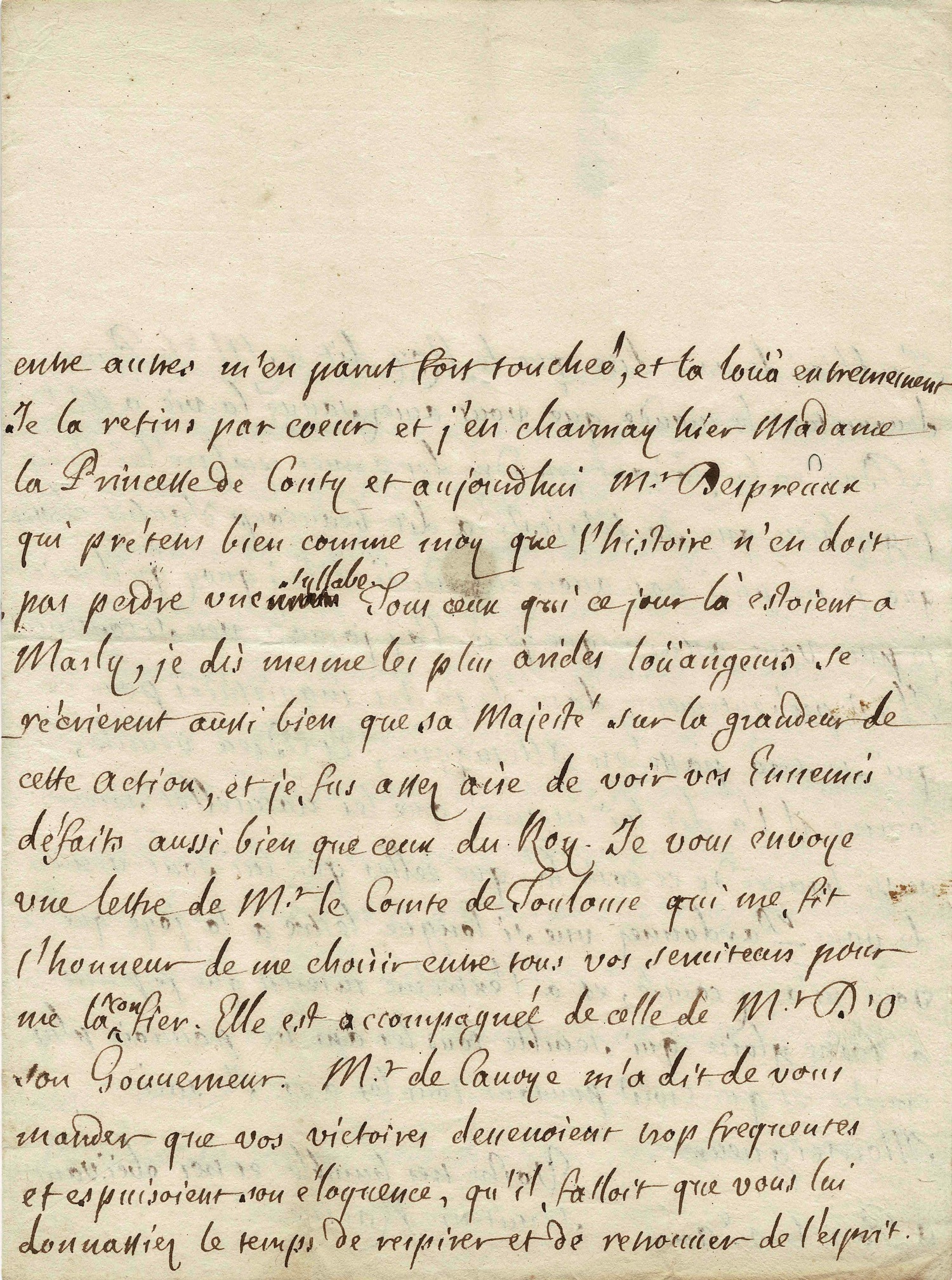
Madame de Maintenon, among others, seemed deeply moved by it and praised it highly. I memorized it and yesterday charmed Madame la Princesse de Conti with it, and today MonsieurDespréaux[ Nicolas Boileau] , who, like me, maintains that history should not lose a single syllable of it. All those who were at Marly that day, even the most ardent praise-singers, exclaimed as fervently as His Majesty over the grandeur of this deed, and I was quite pleased to see your enemies defeated as well as those of the King. I am sending you a letter from Monsieurle Comte de Toulouse, who honored me by choosing me from among all your servants to entrust it to me. It is accompanied by one from Monsieurd' Ô, his Governor. Mr.Cavoye told me to tell you that your victories were becoming too frequent and were exhausting his eloquence, that you needed to give him time to breathe and regain his wit.
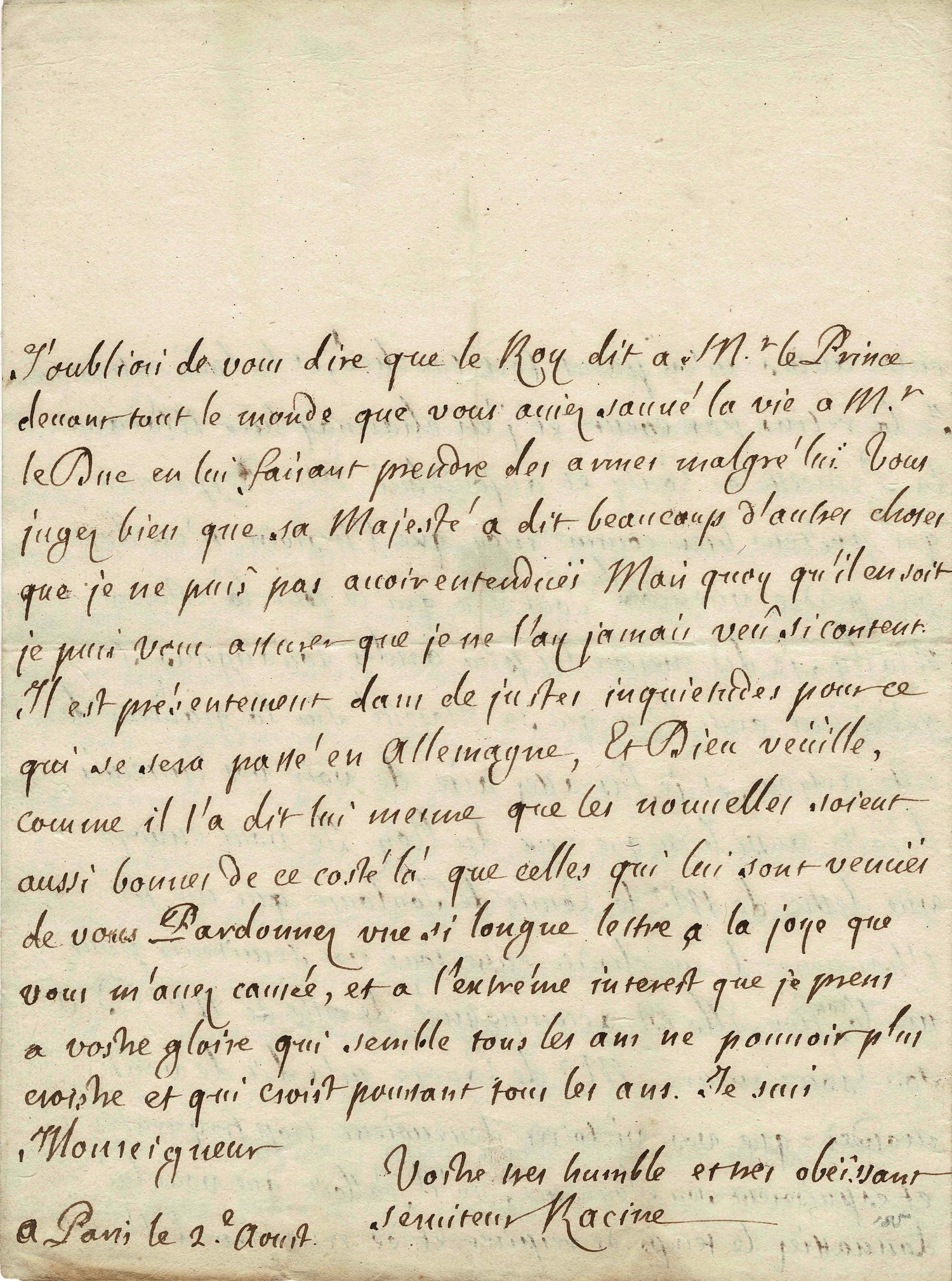
I forgot to tell you that the King toldthe Prince, in front of everyone, that you had saved the Duke's lifeby forcing him to take up arms against his will. You can well imagine that His Majesty said many other things that I could not possibly have heard. But, in any case, I can assure you that I have never seen him so pleased.
He is currently under justifiable concern about what has happened in Germany, and God willing, as he himself said, that the news from that side will be as good as that which has come to him from you.
"Please forgive such a long letter for the joy you have given me, and for the extreme interest I take in your glory, which seems each year to have no more growth, yet grows every year. I am, Your Highness, your most humble and obedient servant Racine. Paris," August 2nd.
__________________________________________________
François-Henri de Montmorency-Bouteville, Duke of Piney-Luxembourg (1628-1695) was made Marshal of France in 1675. Considered one of Louis XIV's most brilliant war leaders, he also remains in military history under his nickname "Tapestry Maker of Notre-Dame" (due to the large number of enemy flags taken by his troops on the battlefields and decorating the nave and choir of the cathedral of Paris).
Under his command, the French army won the victory at Neerwinden on July 29, 1693, during the War of the League of Augsburg (1688-1697), against the armies of the King of England, William III of Orange-Nassau.
It was this last victory, announced to King Louis XIV by Pierre de Montesquiou d'Artagnan (1640-1725), which gave rise in Racine to the exalted tone of this long letter testifying to the Marshal of the enthusiasms of the King and the Court.
Having become historiographer to Louis XIV in 1677, alongside his friend Nicolas Boileau, Racine henceforth put his marvelous pen at the service of royal power: " Mr.Despréaux , [Boileau] just like me, that history should not lose a single syllable. "
The manuscript of his Life of Louis XIV, composed over twenty years of work, tragically disappeared in 1726 in the fire that devoured the eight thousand volumes of the library of Jean-Baptiste-Henri de Valincour, custodian of his works.
The letter presented here is one of three letters from Racine to Marshal de Luxembourg long considered lost.
Regarding these three letters, Jean Lesaulnier writes in his publication of Jean Racine's Correspondence: “Perhaps kept together in the Marshal's family, they were likely put up for sale later. Eugène Minoret's publication, which revealed them to us in 1884, appears to have been kept under wraps for nearly one hundred and thirty years. Since that date, in fact, Racine's three letters to Luxembourg have never been commented on, nor even catalogued.” (pp. 430-431).
__________________________________________________
Provenance: Antoine Eugène Minoret (1816-1891) — President Robert Schuman (1886-1963; his sale, Precious autographs comprising the collection of President Robert Schuman, Paris, March 4 and 5, 1965, experts Cornuau and Castaing, no. 250, acquired by Pierre Berès for 19,249 francs)
Bibliography: Jean Racine, Correspondence, ed. by J. Lesaulnier, Paris, 2017, no. 138 — AE Minoret, Three unpublished letters of Jean Racine (1693), Paris, 1884