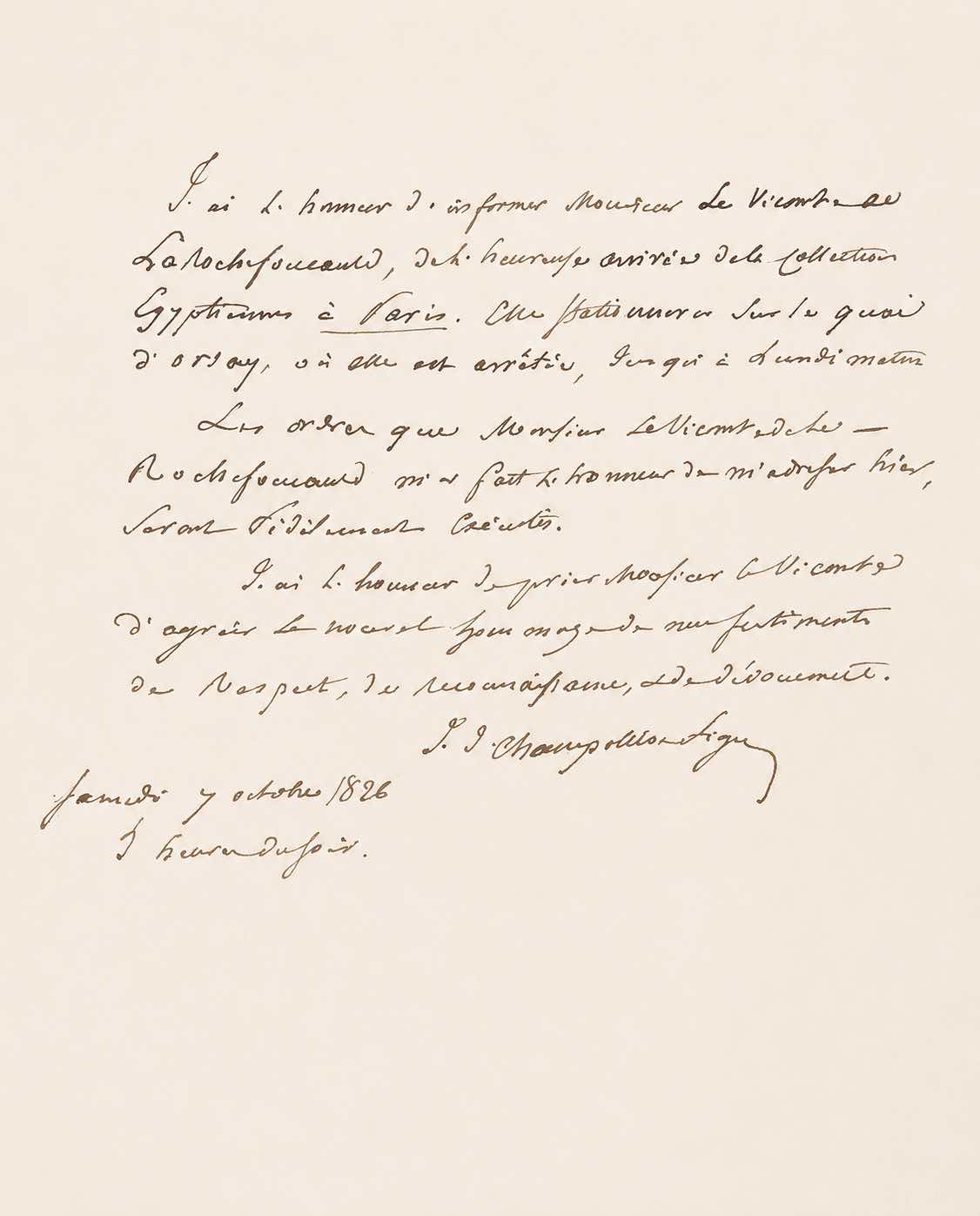
CHAMPOLLION-FIGEAC confirms the arrival in Paris of the Salt collection.
"I have the honor of informing Viscount de La Rochefoucauld of the happy arrival of the Egyptian collection."
750€
"I have the honor of informing Viscount de La Rochefoucauld of the happy arrival of the Egyptian collection."
750€
Jean-Jacques CHAMPOLLION-FIGEAC (1778.1867)
Autograph letter signed to the Viscount of La Rochefoucauld.
One page in-4°.
[Paris] October 7, 1826.
"I have the honor of informing Viscount de La Rochefoucauld of the happy arrival of the Egyptian collection."
Recently acquired by France and destined for the Egyptian antiquities division of the Louvre Museum, the Salt collection, inventoried and cashed in by Jean-François Champollion in Livorno, arrives in Paris. The Egyptologist's brother reports on it to Louis-François-Sosthène, Viscount de La Rochefoucauld, the Director General of Fine Arts.
____________________________________________
I have the honor of informing Viscount de La Rochefoucauld of the happy arrival of the Egyptian collection in Paris. It will remain on the Quai d'Orsay, where it is currently located, until Monday morning. The orders that Viscount de La Rochefoucauld honored me with yesterday will be faithfully executed. I have the honor of asking the Viscount to accept the renewed expression of my respect, gratitude, and devotion. JJ Champollion-Figeac.
____________________________________________
The collection of Henry Salt (1780-1827), British consul in Egypt, reveals an exceptional variety of pieces: sarcophagi, cartonnages, statues, stelae, chests, furniture, vases, ushabtis, papyrus, seals, sandals, basketry, funerary masks, jewelry, amulets… in wood, sandstone, bronze, glazed earthenware, limestone, faience, alabaster, serpentine, gold, ivory.
Captivated by the richness of the collection, Jean-François Champollion ardently desired that France acquire it and thus contribute to the creation of an Egyptian museum. He feared that this collection of treasures would slip through the country's fingers, as had happened with the first Drovetti collection (the Drovettiana), and he strove to convince King Charles X of the merits of the investment.
Finally convinced by the Duke of Blacas's report, Charles X ratified the purchase of the Salt collection on February 23, 1826, at the asking price of 250,000 francs. Champollion was then commissioned to return to Livorno to draw up a descriptive inventory of the 4,014 objects and then organize their transport to Paris.
On May 15, extraordinary news reached Champollion: he learned that an ordinance from King Charles X had just created the Egyptian antiquities division of the Louvre Museum; he was appointed its first curator!
The Salt collection arrived in Paris aboard La Durance, the ship tasked with transporting the crates of antiquities to France. On July 8, 1826, the loading of the pieces was completed: "The entire collection is aboard the Durance. It's full." The precious antiquities arrived in Paris in October, allowing the Champollion brothers and the administrators of the Louvre to receive these treasures.