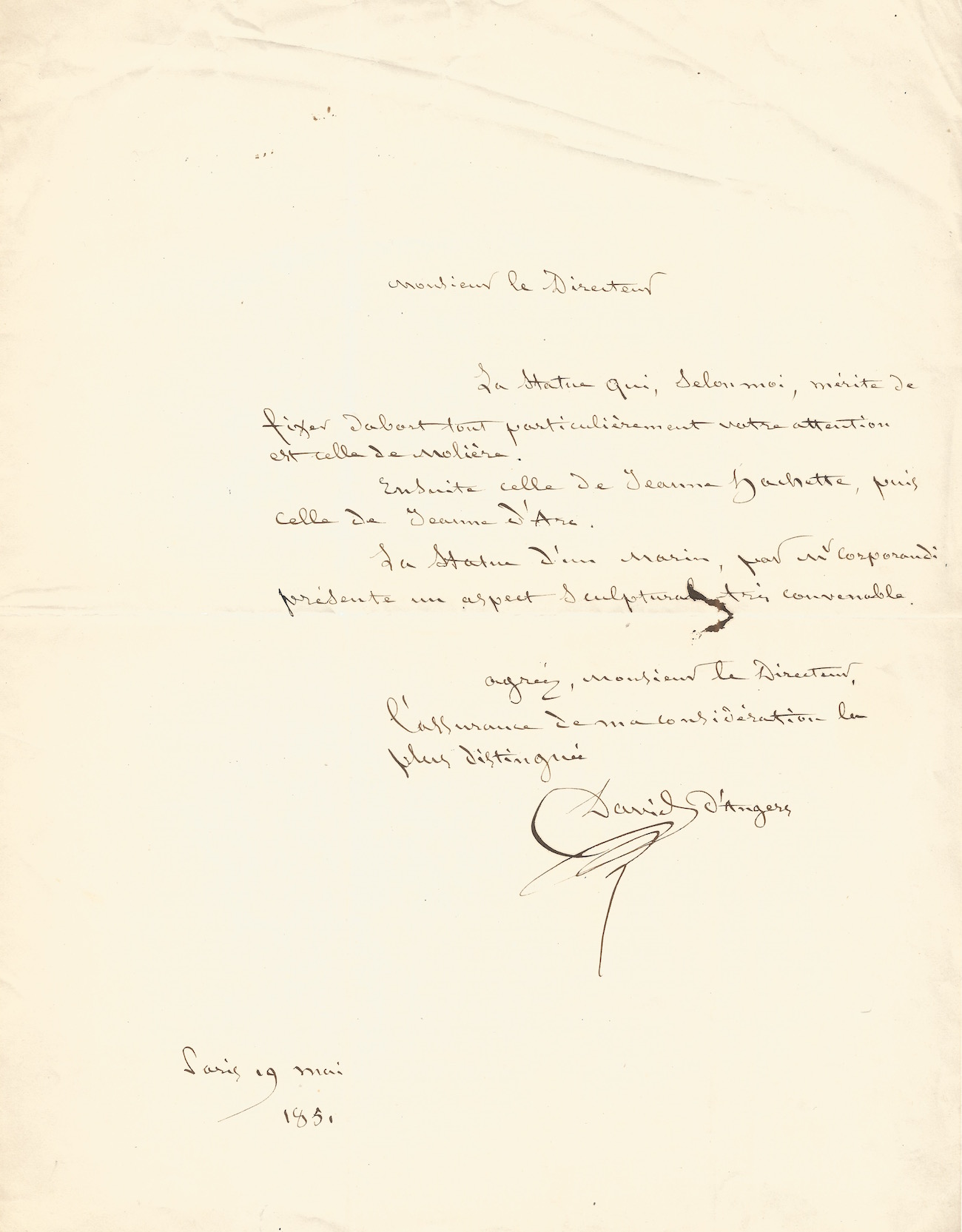
Pierre-Jean DAVID D'ANGERS (1788.1856)
Autographed letter signed.
One page, large quarto. Paris, May 19, 1851.
A very fine letter from the sculptor regarding the statues of Molière and Joan of Arc presented at the Salon of 1851.
"Sir, The statue which, in my opinion, deserves your attention first is that of Molière. Next is that of Jeanne Hachette, then that of Joan of Arc. The statue of a sailor by Mr. Corporandi has a very suitable sculptural aspect. Please accept, Sir, the assurance of my highest consideration. David d'Angers."
David d'Angers's oeuvre is considerable. It comprises no fewer than sixty-eight statues and statuettes, some fifty bas-reliefs, around one hundred busts, and more than five hundred medallions. Among the hundred or so busts, noteworthy figures include Victor Hugo, Lafayette, Goethe, Vigny, Lamartine, Béranger, Musset, Arago, Balzac, Chateaubriand, and Paganini. His statues include Talma (Comédie Française), Corneille (Rouen), Racine (La Ferté-Milon), Gutenberg (Paris and Strasbourg), and Thomas Jefferson (Washington).
In 1830, he received the commission for the pediment of the Panthéon, which he completed in 1837, regularly defending his artistic vision against the dictates of administrative and political officials. The inauguration took place in September 1837, without David d'Angers, who had not been invited. Among his monumental works, the Arc de Triomphe in Marseille, with its three bas-reliefs and various decorations (trophies, statues of Fame, etc.), should also be mentioned
During the Revolution of 1848, he was appointed mayor of the 11th arrondissement of Paris and then elected deputy for the department of Maine-et-Loire. He sat in the Constituent Assembly and defended the existence of the École des Beaux-Arts and the French Academy in Rome. He opposed the destruction of the Chapelle Expiatoire and the removal of two statues from the Arc de Triomphe (Resistance and Peace by Antoine Etex). He also voted against the prosecution of Louis Blanc, against funding for the Roman expedition, for the abolition of the death penalty, for the right to work, and for a general amnesty. In 1851, with the accession of Napoleon III, he was arrested and sentenced to exile. He chose Belgium and then traveled to Greece.