Victor HUGO (1802.1885)
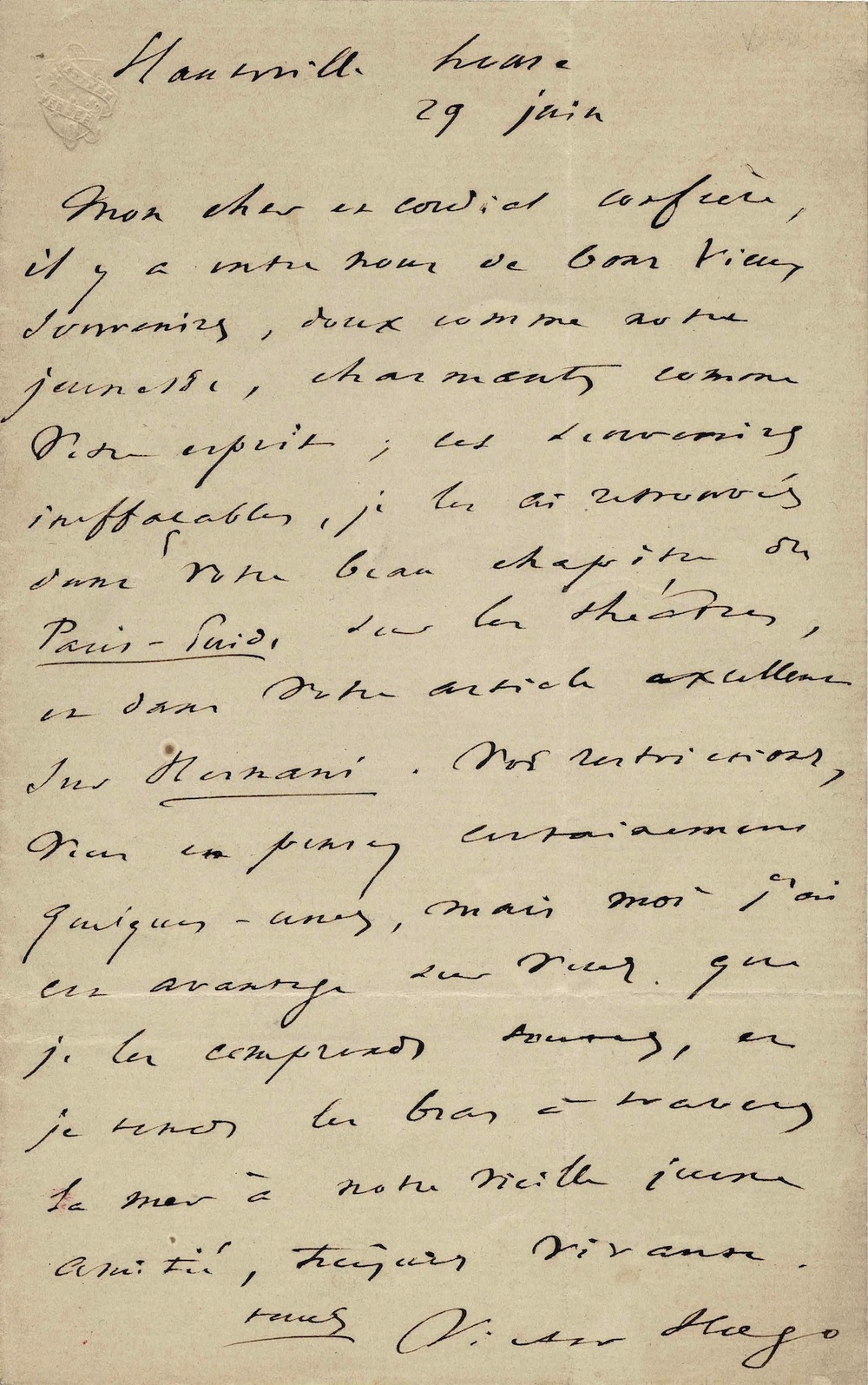
Autographed letter signed to Nestor Roqueplan.
A page in-12° on paper bearing a coat of arms with a fleur-de-lis.
Hauteville house. June 29 [1867]
A very beautiful letter from the great man evoking the revival of Hernani in Paris and the Universal Exhibition of 1867.
Hugo warmly thanks his friend Roqueplan for his article on Hernani and his pages on The Theatres published in the Paris-Guide of 1867 (of which Hugo had written the preface).
___________________________________________________
"My dear and cordial colleague, there are fond old memories between us, sweet as our youth, charming as your wit ; these indelible memories I rediscovered in your fine chapter on theaters in Paris-Guide Hernani . You certainly have some reservations about them, but I have an advantage over you in that I understand them all, and I extend my arms across the sea to our old, young friendship, ever alive. Victor Hugo."
___________________________________________________
In 1867, as preparations were underway for the Universal Exposition in Paris, the revival of Hernani at the Théâtre-Français was decided. Focused on writing the introduction to his Paris-Guide, Victor Hugo entrusted Auguste Vacquerie and Paul Meurice with the task. This revival marked a turning point in Victor Hugo's career, as his plays had been censored on all French stages since the establishment of the Second Empire. On June 20, 1867, the premiere at the Théâtre-Français was a triumph. The reviews were glowing, including those by Mario Proth in L'Europe and Théophile Gautier in Le Moniteur.
From April 1st to November 3rd, 1867, France celebrated its second Universal Exposition, designed to mark the zenith of the Second Empire. Ten to eleven million visitors flocked to the event, along with a dozen monarchs and 42,217 exhibitors spread across 46 hectares. To accompany this exceptional undertaking, an equally unique publishing event was launched under the impetus of the publisher Lacroix: the publication of the Paris-Guide. Prefaced by Victor Hugo, the work garnered contributions from the leading writers of the time: Gautier, Sand, Renan, Quinet, Dumas, his son, Champfleury, Monnier, Banville, Du Camp, Kock, Féval, Sardou, the critics Sainte-Beuve and Taine, Janin, and Michelet.