Victor Hugo inaugurates his banquets for poor children in Guernsey.
"The poor, too, are outcasts; they are exiled from all pleasures and all happiness. We therefore owe them our brotherhood."
Sold

"The poor, too, are outcasts; they are exiled from all pleasures and all happiness. We therefore owe them our brotherhood."
Sold
Victor Hugo (1802.1885)
Autographed letter signed to Alexandre Lacour.
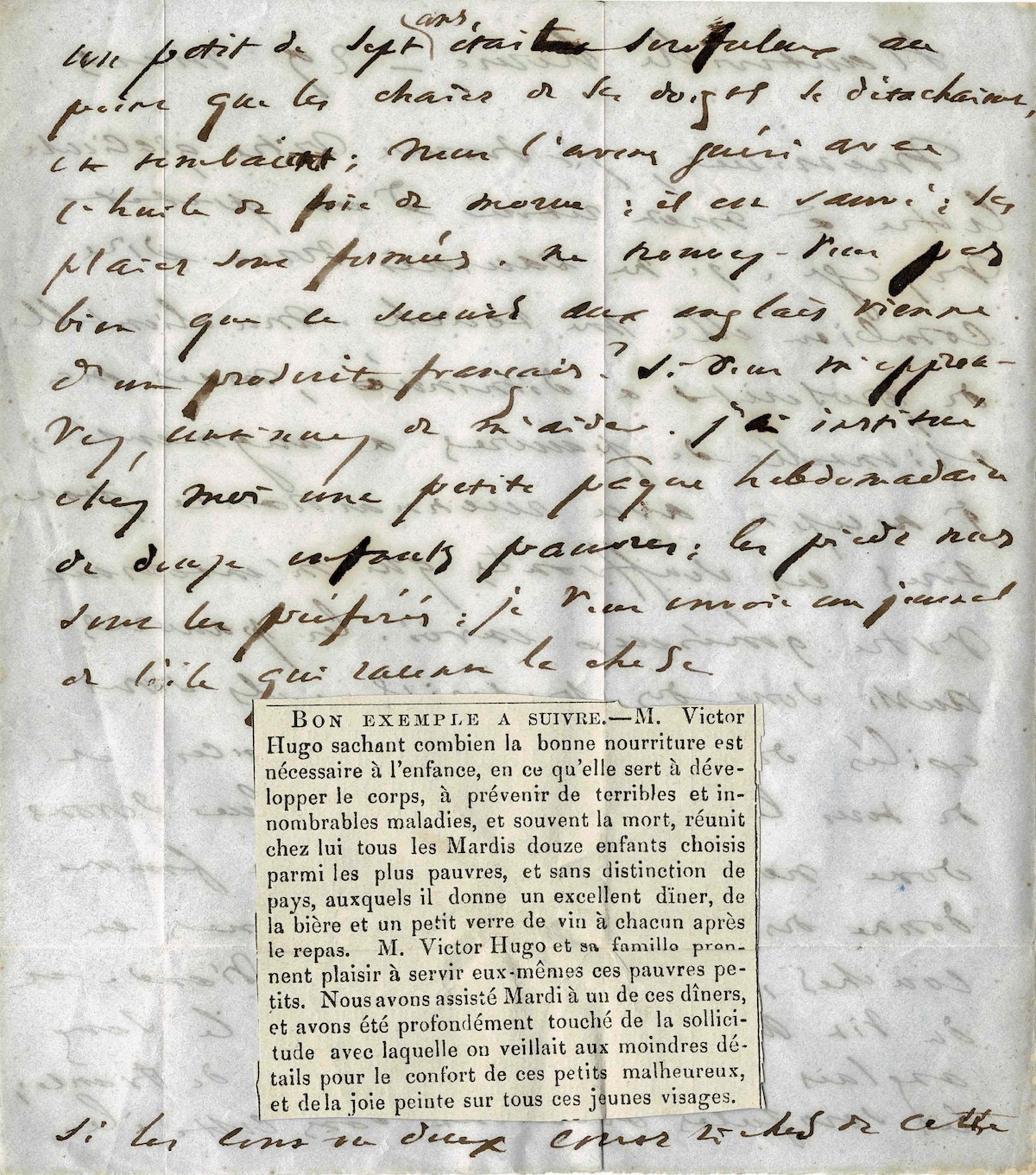
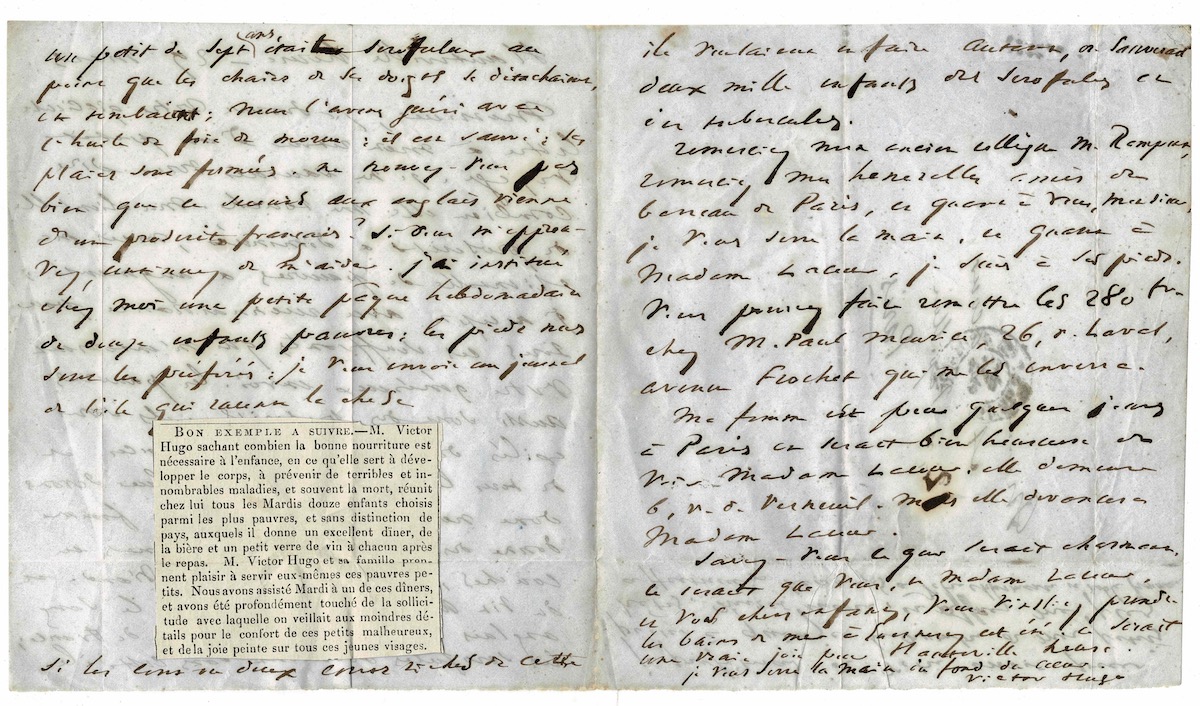
Four square octavo pages, with Hugo-esque press collage on the 2nd leaf .
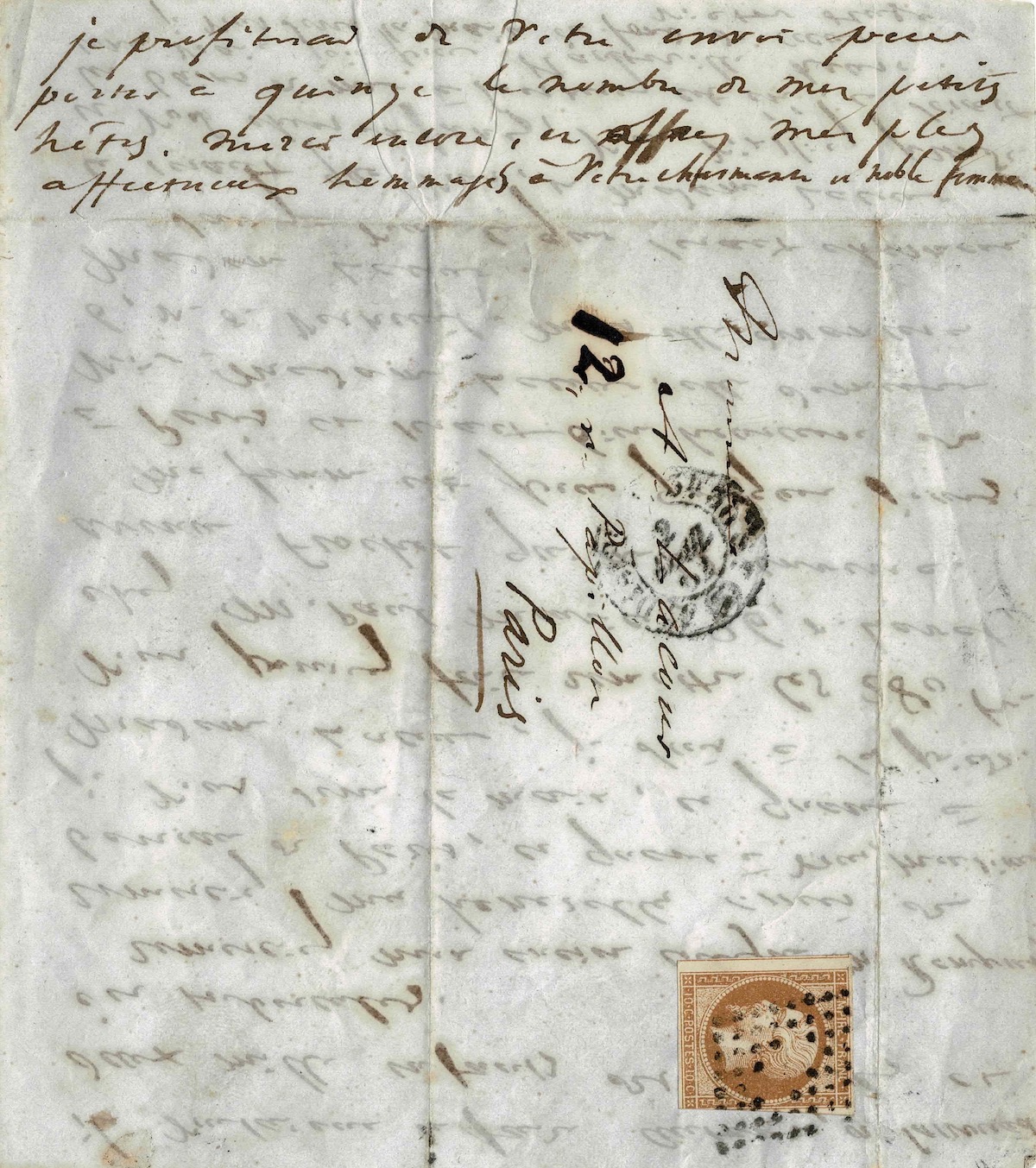
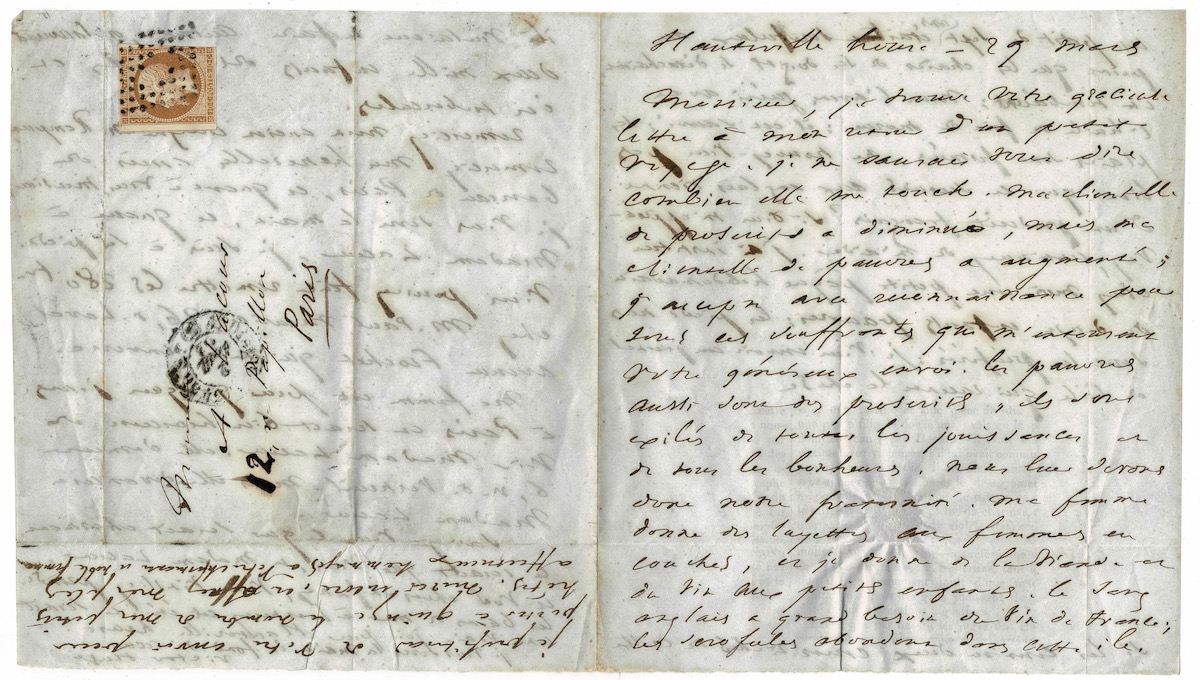
Autographed address, stamp and postal cancellations.
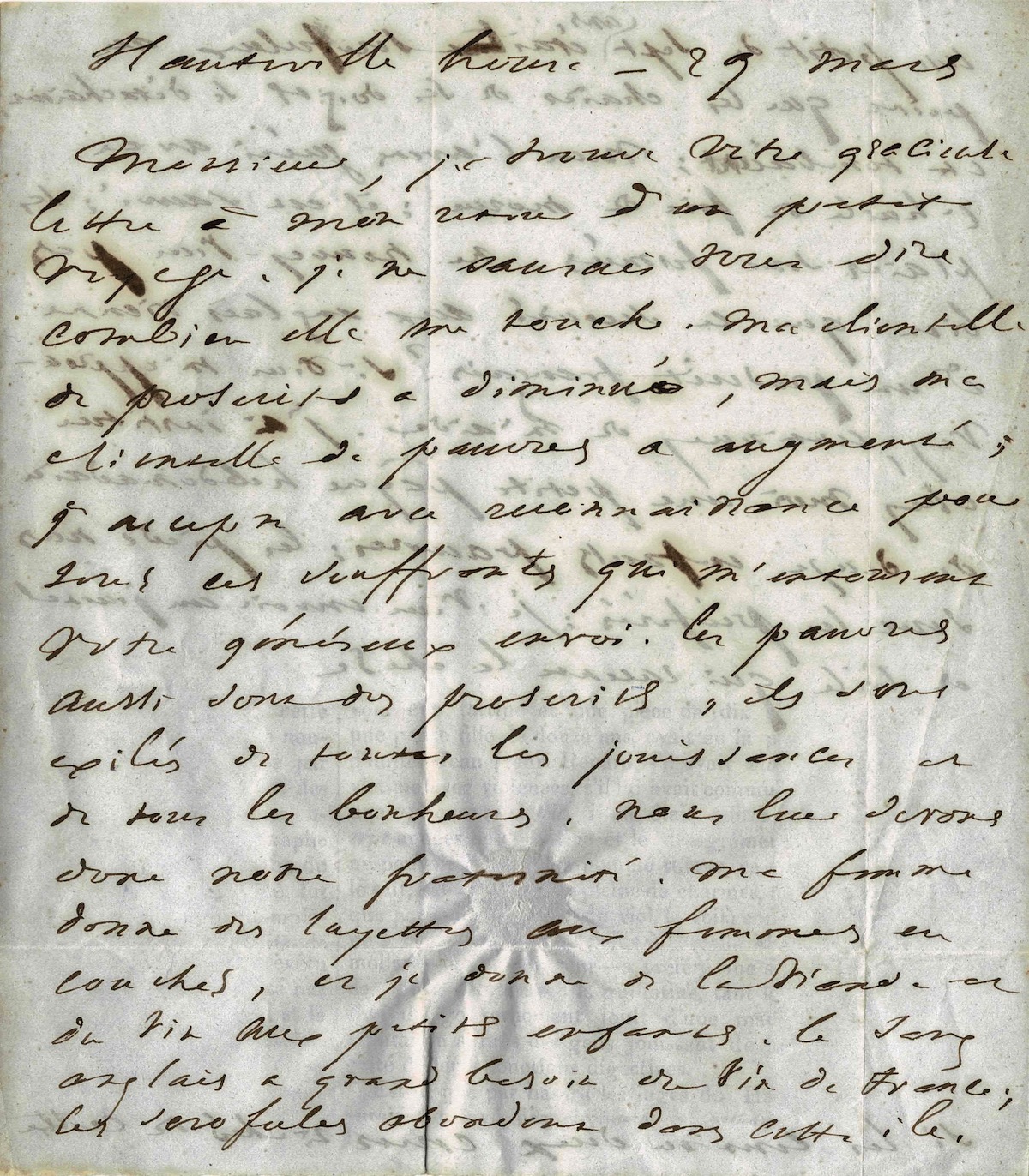
Hauteville house. March 29 [1862]
"The poor, too, are outcasts; they are exiled from all pleasures and all happiness. We therefore owe them our brotherhood."
A precious letter from the great man – three days before the publication of Les Misérables – telling his generous correspondent about the health misfortunes of Guernsey and the inauguration of his meals for poor children at Hauteville House.
A kind and compassionate man, Victor Hugo organized these weekly meals starting on March 10, 1862, to help the poorest children on the island, as evidenced by the small newspaper article Hugo himself pasted into this letter. At the start of these first meals, about ten children were invited. The number steadily increased (Hugo mentions in his notebooks the presence of 18 children on April 22, then 22 in July 1862). Soon, more than forty children were coming to find refuge, food, and care with the Hugo family.
______________________________________________________
“Sir, I found your gracious letter upon my return from a short trip. I cannot express how deeply it touches me. My clientele of exiles has diminished, but my clientele of the poor has increased ; I gratefully accept your generous gift for all those suffering around me. The poor, too, are exiles; they are deprived of all pleasures and all happiness. We therefore owe them our fraternity. My wife gives layettes to women in childbirth, and I give meat and wine to small children. The English bloodline is in great need of French wine; scrofula abounds on this island. A seven-year-old boy was so scrofulous that the flesh of his fingers was peeling away and falling off. We cured him with cod liver oil; he is saved; his sores have closed. Do you not think it good that aid to the English comes from a French product? If you approve of my work, please continue to help me.” I have instituted at my home a small weekly Easter for twelve poor children ; the barefoot ones are the favorites: I am sending you a newspaper from the island which tells the story.
A GOOD EXAMPLE TO FOLLOW. – Mr. Victor Hugo, knowing how essential good food is to childhood, as it helps develop the body, prevents terrible and countless illnesses, and often death, gathers twelve children at his home every Tuesday, chosen from among the poorest, regardless of their country of origin. He provides them with an excellent dinner, beer, and a small glass of wine for each child after the meal. Mr. Victor Hugo and his family take pleasure in serving these poor little ones themselves. We attended one of these dinners on Tuesday and were deeply moved by the care with which even the smallest details were attended to for the comfort of these unfortunate children, and by the joy reflected on all their young faces.
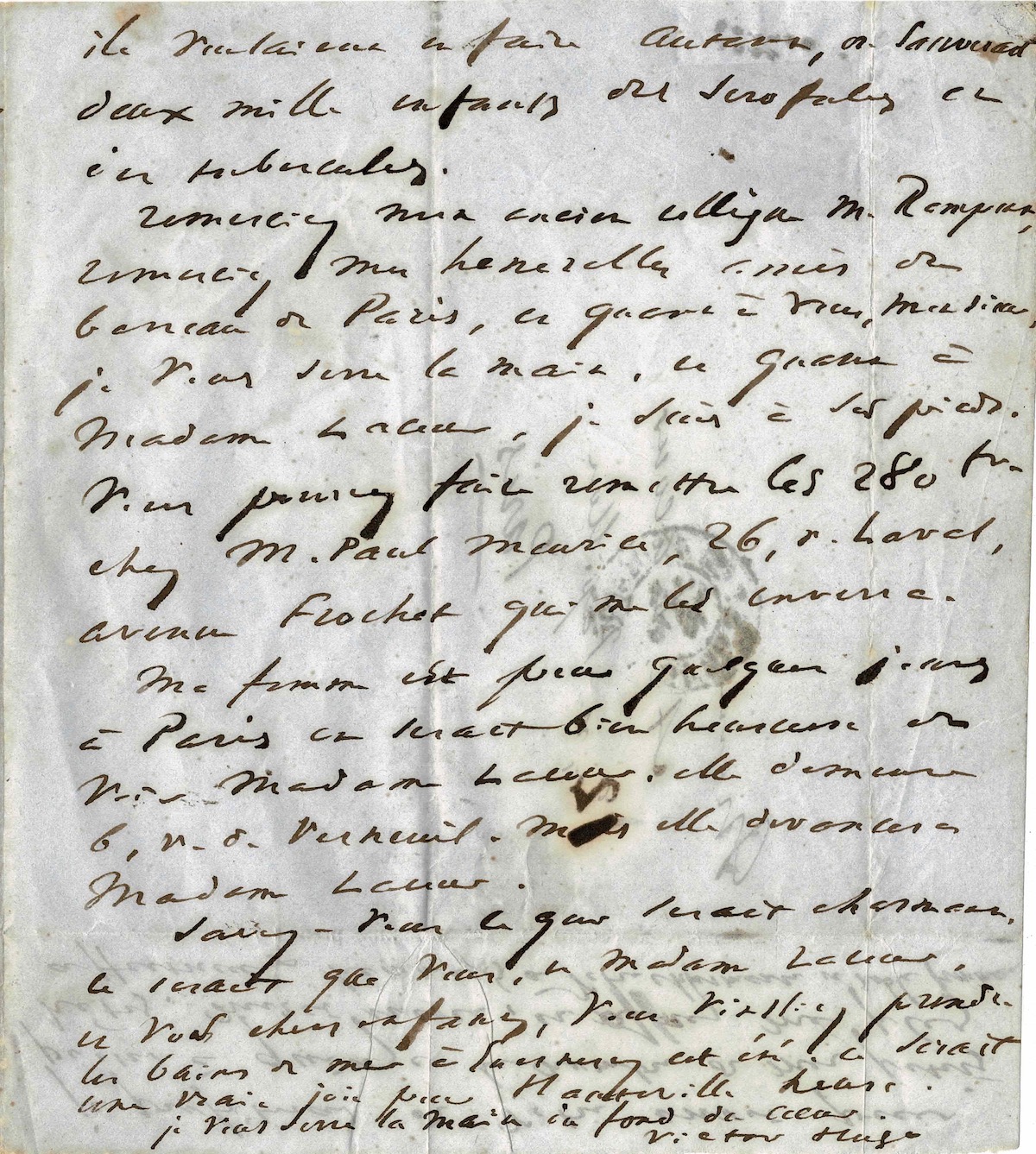
If the hundred or two hundred wealthy people on this island would do the same, two thousand children could be saved from scrofula and tubercles. Thank my former colleague, Mr. Rampaux, thank my honorable friends at the Paris Bar, and as for you, sir, I shake your hand, and as for Madame Lacour, I am at her feet. You can have the 280 francs to Mr. Paul Meurice, 26 rue Laval, avenue Frochot, who will send them to me. My wife is in Paris for a few days and would be very happy to see Madame Lacour; she lives at 6 rue Verneuil. But she will arrive before Madame Lacour. Do you know what would be delightful? It would be if you, Madame Lacour, and your dear children came to take the sea baths in Guernsey this summer. It would be a real joy for Hauteville House. I shake your hand from the bottom of my heart. Victor Hugo. I will take advantage of your contribution to increase the number of my little guests to fifteen. Thank you again, and please give my warmest regards to your charming and noble wife.
______________________________________________________
Here is an excerpt from the speech Victor Hugo delivered at the 1868 dinner for poor children: “The small children's assistance institution that I founded seven years ago in Guernsey, in my home, is bearing fruit, and you who listen to me with such grace will be moved by this good news. It is not what I am doing here that is the issue, but what is being done elsewhere. What I am doing is nothing and not worth mentioning. This foundation of the Dinner for Poor Children has only one thing going for it: it is a simple idea. As such, it was immediately understood, especially in free countries, in England, Switzerland, and America; there it is being implemented on a large scale. I note this fact without dwelling on it, but I believe there is a certain affinity between simple ideas and free countries. I find exile beneficial. First, it allowed me to discover this hospitable island; Then, he gave me the opportunity to realize this idea I had long held: a practical attempt to immediately improve the lot of poor children—from the standpoint of their dual well-being, that is, their physical and intellectual health. The idea succeeded. That is why I am grateful for exile. Ah! I will never tire of saying it: Let us think of children! Human society is always, more or less, a guilty society. In this collective sin that we all commit, sometimes called the law, sometimes customs, we are certain of only one innocence: the innocence of children. Well then, let us love it, feed it, clothe it, give it bread and shoes, heal it, enlighten it, and venerate it. Whatever the pains of this life, I will not complain, if I am given the opportunity to fulfill the two highest ambitions a man can have on earth. These two ambitions are: to be a slave, and to be a servant. A slave to conscience, and a servant to the poor.