
"Hauteville-House and work are less cheerful; but that is duty."
Sold
Victor HUGO (1802.1885)
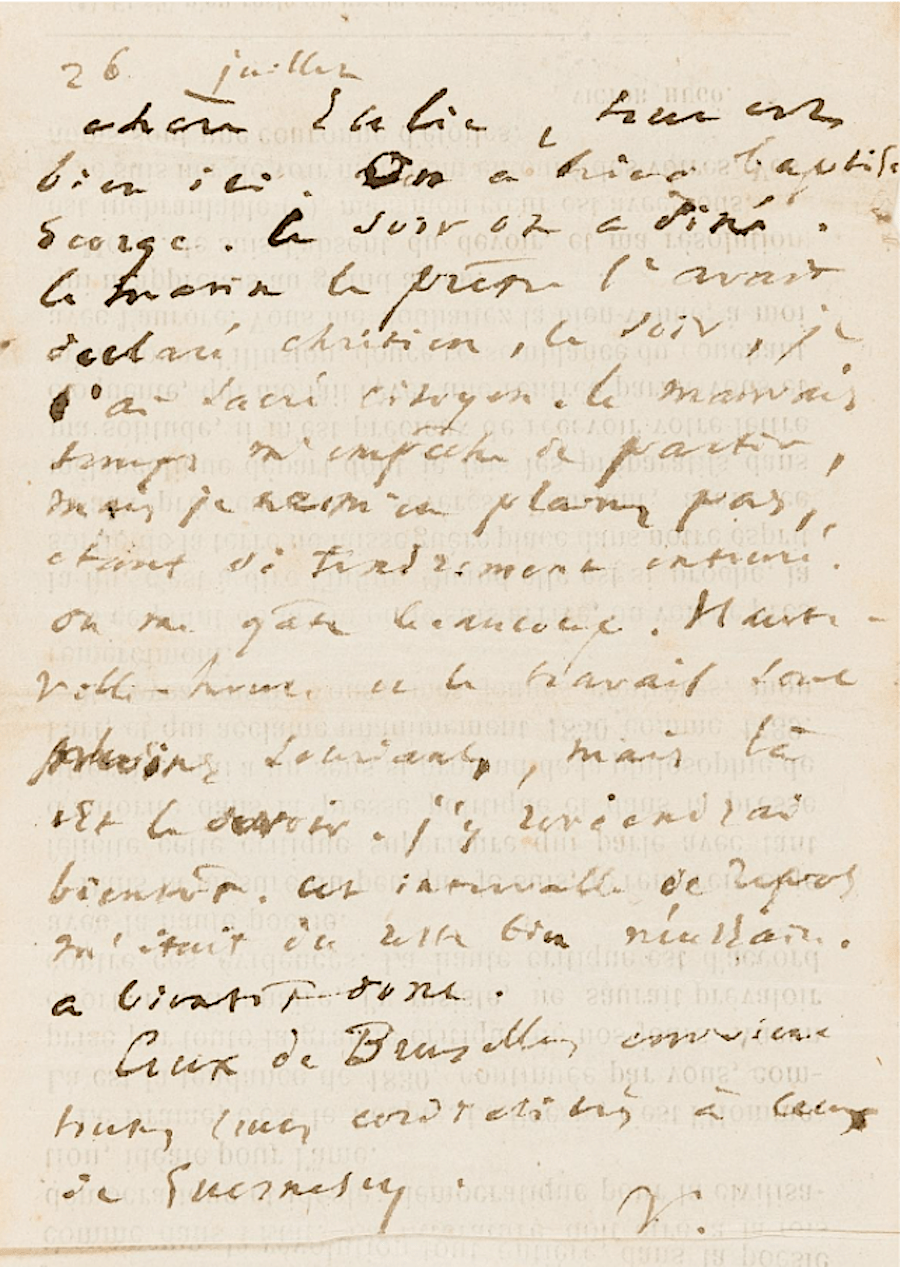
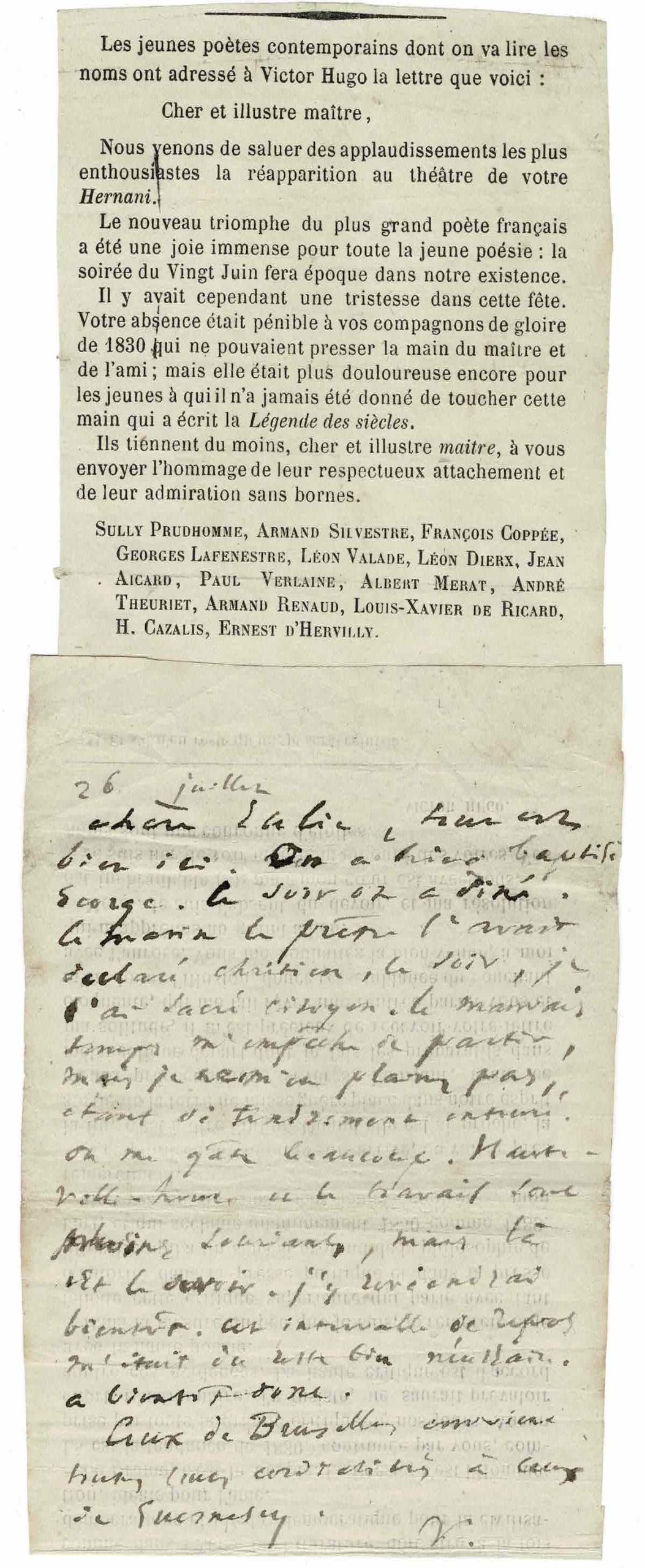
Autographed letter signed and autographed dedication signed to Julie Chenay.
One page in-12°. [Brussels] July 26 [1867]
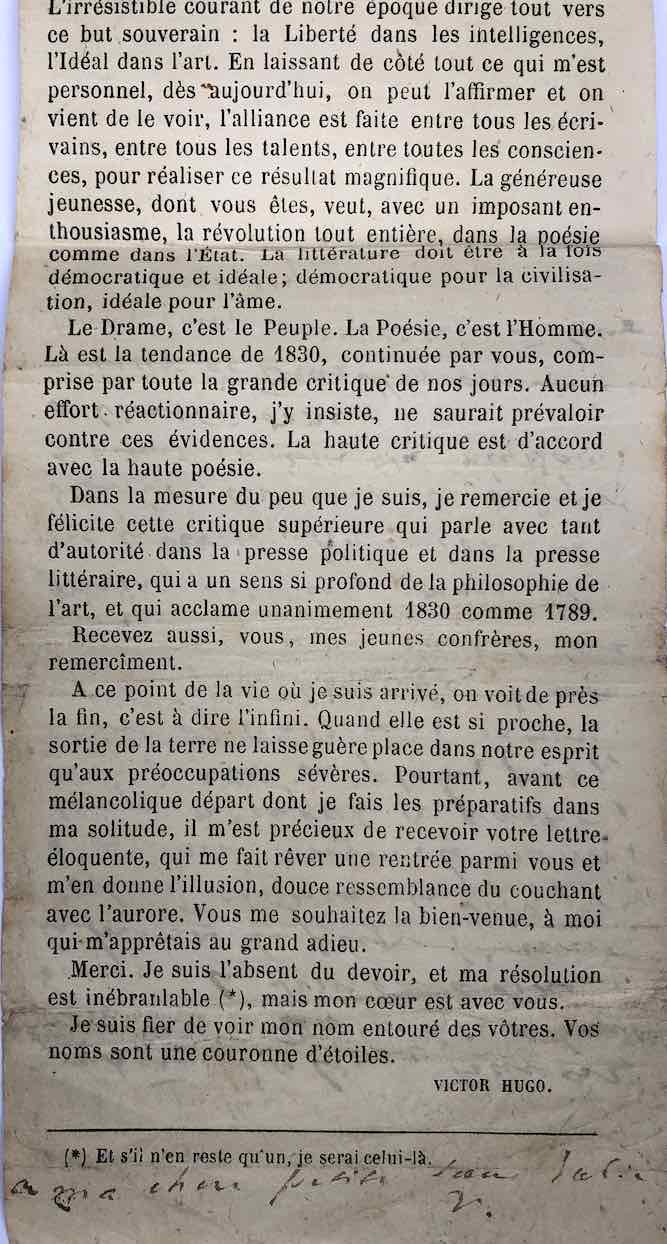
On the back of a long vertical newspaper article, revealing the letter of support from young contemporary poets to Victor Hugo following the revival of Hernani, and Hugo's published response to the poets.
"Hauteville-House and work are less cheerful; but that is duty."
Beautiful letter from the great man who came to Brussels to celebrate the baptism of his grandson Georges.
________________________________________________
“Dear Julie, All is well here. Georges was baptized yesterday. We had dinner in the evening. In the morning the priest declared him a Christian, and in the evening I consecrated him a citizen. The bad weather is preventing me from leaving, but I don't complain, being so lovingly surrounded. I am being spoiled rotten. Hauteville-House and work are less pleasant; but that is duty. I will return soon. This break was, moreover, quite necessary. Until next time, then. Those in Brussels send their warmest regards to those in Guernsey. V.”
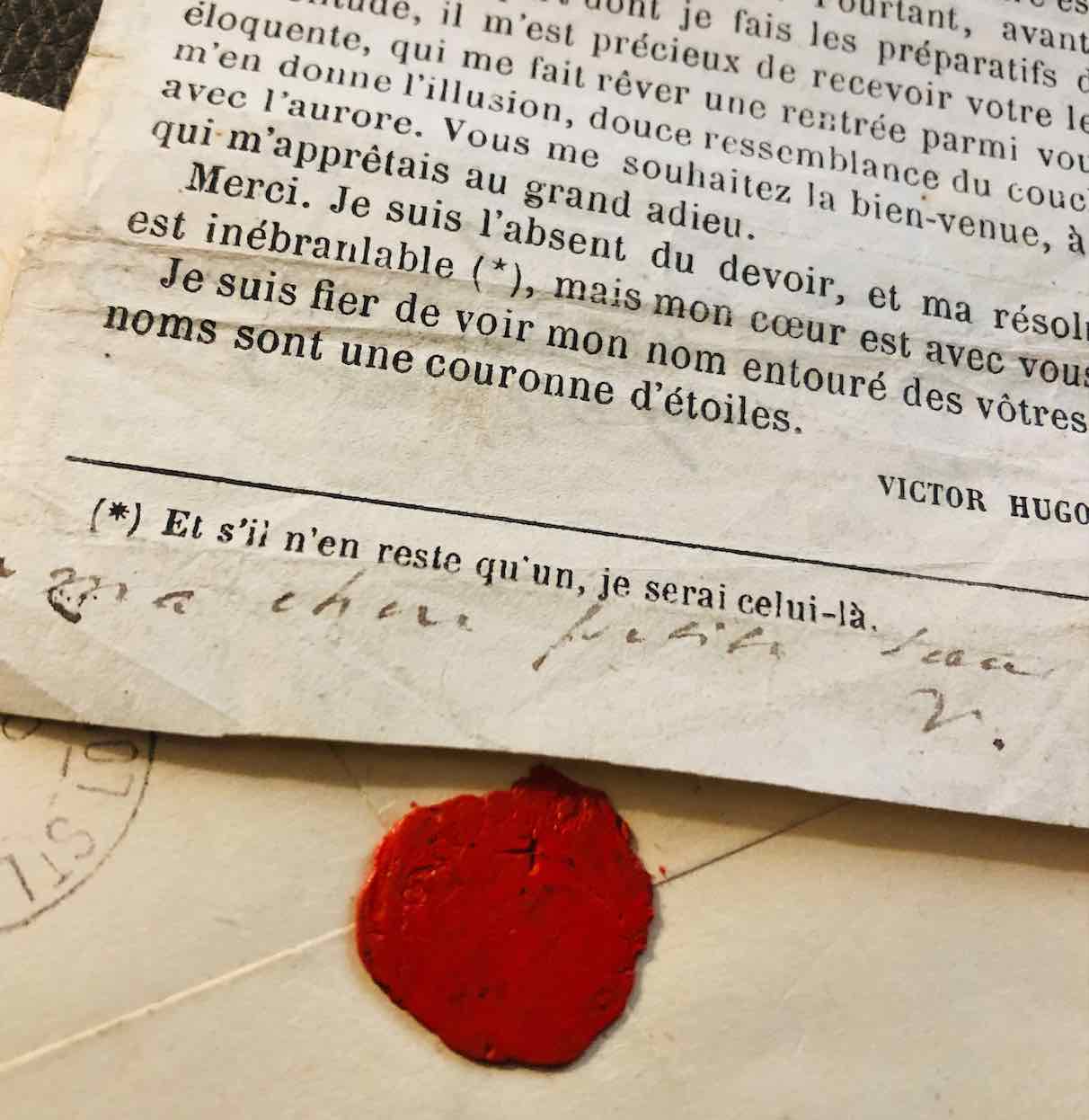
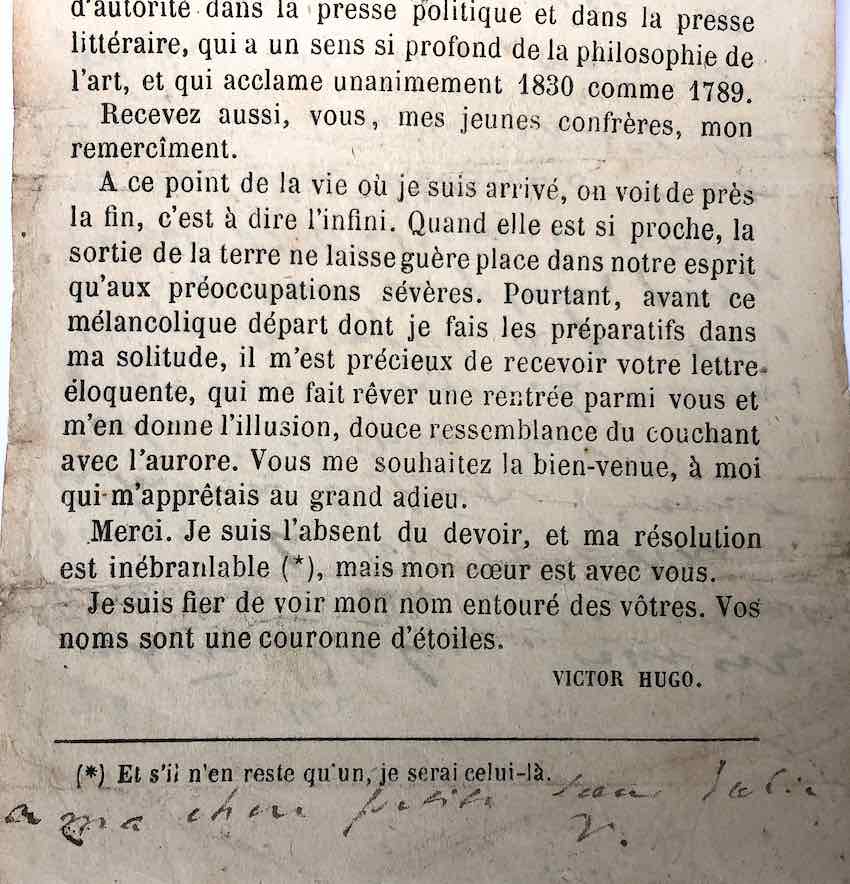
The front page contains the lengthy article documenting the exchange between contemporary poets and Hugo (see below for the full transcript). At the very end of Hugo's reply, he adds a handwritten dedication: "To my dear little sister Julie. V."
Julie Chenay (1822-1905) was the sister of Adèle Foucher, wife of Victor Hugo.
________________________________________________
Dear and illustrious master,
We have just greeted with the most enthusiastic applause the return of your Hernani to the stage. The new triumph of the greatest French poet has been an immense joy for all young poets ; the evening of June 20th will be a landmark in our lives. There was, however, a sadness in this celebration. Your absence was painful to your companions in glory from 1830, who could not shake the hand of their master and friend; but it was even more painful for the young poets, who had never been given the privilege of touching the hand that wrote the Legend of the Ages.
They wish, dear and illustrious master, to send you the homage of their respectful attachment and boundless admiration.
SULLY PRUDHOMME, ARMAND SILVESTRE, FRANÇOIS COPPÉE, GEORGES LAFENESTRE, LÉON VALADE, LÉON DIERX, JEAN AICARD, PAUL VERLAINE, ALBERT MÉHAT, ANDRÉ THEURIET, ARMAND RENAUD, LOUIS-XAVIER DE RICARD, H. CAZALIS, ERNEST D'HERVILLY.
Victor Hugo replied: Brussels, July 22, 1867.
Dear poets,
The literary revolution of 1830, a corollary and consequence of the revolution of 1789, is a phenomenon unique to our century. I am a humble soldier of this progress. I fight for the revolution in all its forms, literary as well as social. I have liberty as my principle, progress as my law, and the ideal as my model .
I am nothing, but the revolution is everything. Nineteenth-century poetry is founded. 1830 was right, and 1867 proves it. Your youthful renown is further proof. Our era has a profound logic, imperceptible to superficial minds, and against which no reaction is possible. Great art is part of this great century. It is its soul.
Thanks to you, young and talented, noble minds, the light will shine ever brighter. We, the old guard, have had the struggle; you, the young, will have the triumph. The spirit of the nineteenth century combines the democratic pursuit of Truth with the eternal law of Beauty. The irresistible current of our time directs everything toward this supreme goal: Freedom in the intellect, the Ideal in art. Leaving aside all that is personal to me, it can be affirmed today, and as we have just seen, that an alliance has been forged between all writers, between all talents, between all consciences, to achieve this magnificent result. The generous youth, to which you belong, desires, with imposing enthusiasm, the entire revolution, in poetry as in the state. Literature must be both democratic and ideal; democratic for civilization, ideal for the soul.
Drama is the People. Poetry is Man. Therein lies the tendency of 1830, continued by you, understood by all the great critics of our day. No reactionary effort, I insist, can prevail against these self-evident truths. High criticism is in accord with high poetry. To the best of my ability, I thank and congratulate this superior criticism which speaks with such authority in the political and literary press, which possesses such a profound understanding of the philosophy of art, and which unanimously acclaims 1830 as it did 1789.
Please accept, my young colleagues, my thanks as well. At this point in my life, I see the end, that is to say, infinity, up close. When it is so near, leaving this earth leaves little room in our minds for anything but somber concerns. Yet, before this melancholy departure for which I am preparing, in my solitude, it is precious to me to receive your eloquent letter, which makes me dream of returning among you and gives me the illusion of it, a sweet resemblance of sunset to dawn. You welcome me, I who was preparing for the great farewell. Thank you. I am absent from duty, and my resolve is unwavering*, but my heart is with you. I am proud to see my name surrounded by yours. Your names are a crown of stars. VICTOR HUGO.
And if only one remains, I will be that one. "To my dear little sister Julie. V."