Lucy Schwob known as Claude CAHUN (1894.1954)
Autograph manuscript signed – Sophie the Symbolist.
Five pages in-4° in purple ink. Signature crossed out. Slnd [circa 1920]
"Before the age of five, we had exhausted all the games of love: when one has started with the symbol, one has little taste for the thing itself."
A very rare manuscript by Claude Cahun – entitled Sophie the Symbolist – which appropriates the mythical character of the Countess of Ségur, Sophie de Réan.
Between 1920 and 1924, Cahun revisited the fates of several mythical female figures, such as Judith, Eve, Delilah, Sappho, Salome, and others. In the form of modernist tales, while still drawing on tradition, Cahun transformed these female figures into modern and independent women. "Sophie the Symbolist" appeared, during the author's lifetime, in the Journal littéraire (no. 45) on February 28, 1925, and was later published in the collection Héroïnes, which brought together all of Cahun's texts on these female figures.
_____________________________________________________
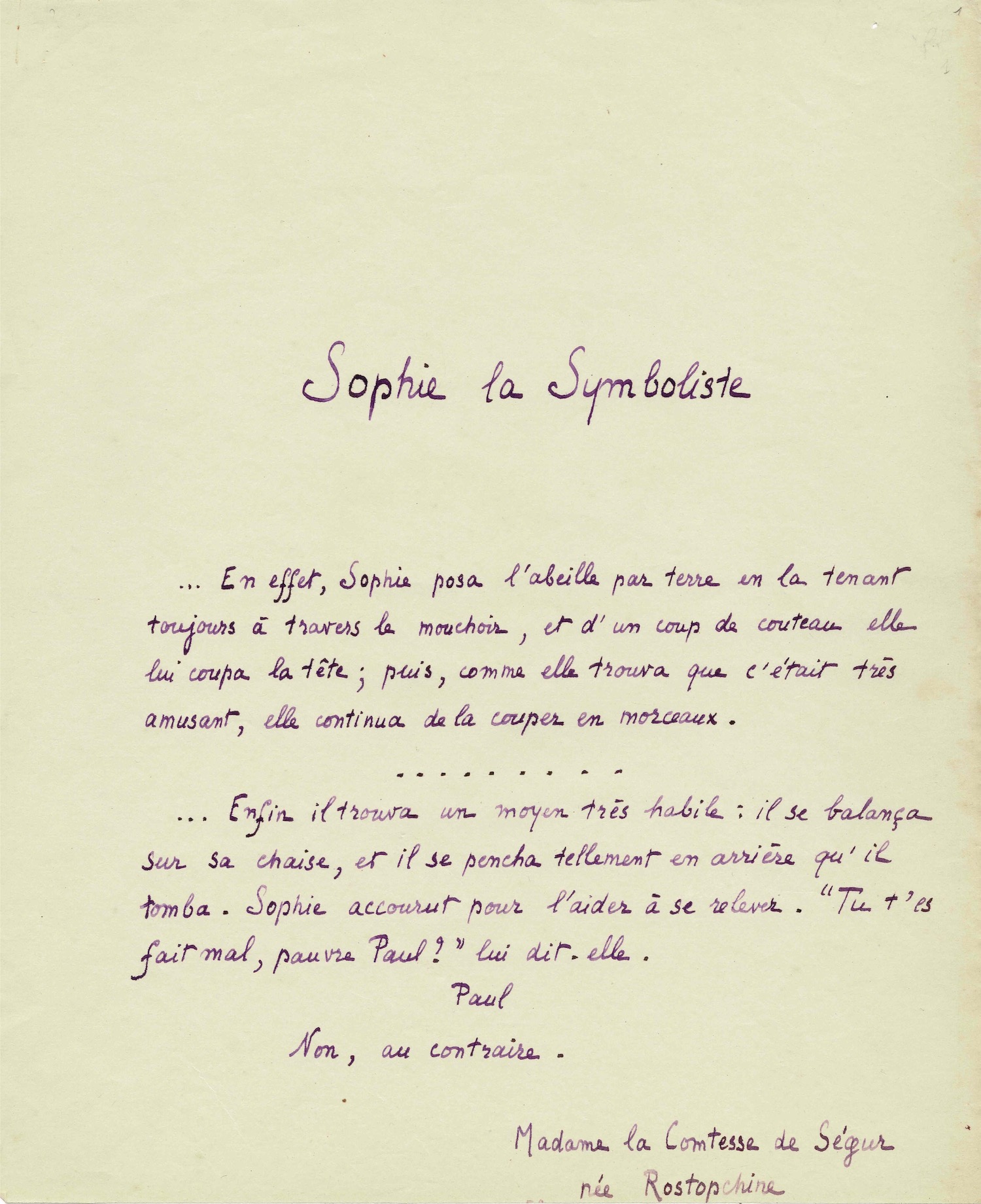
Sophie the Symbolist
… Indeed, Sophie placed the bee on the ground, still holding it through the handkerchief, and with a stroke of her knife she cut off its head ; then, as she found it very amusing, she continued to cut it into pieces.
……………..
Finally, he found a very clever way: he rocked on his chair, and leaned back so far that he fell. Sophie rushed over to help him up. "Are you hurt, poor Paul?" she said to him.
Paul
No, on the contrary.
Madame la Comtesse de Ségur née Rostopchine.
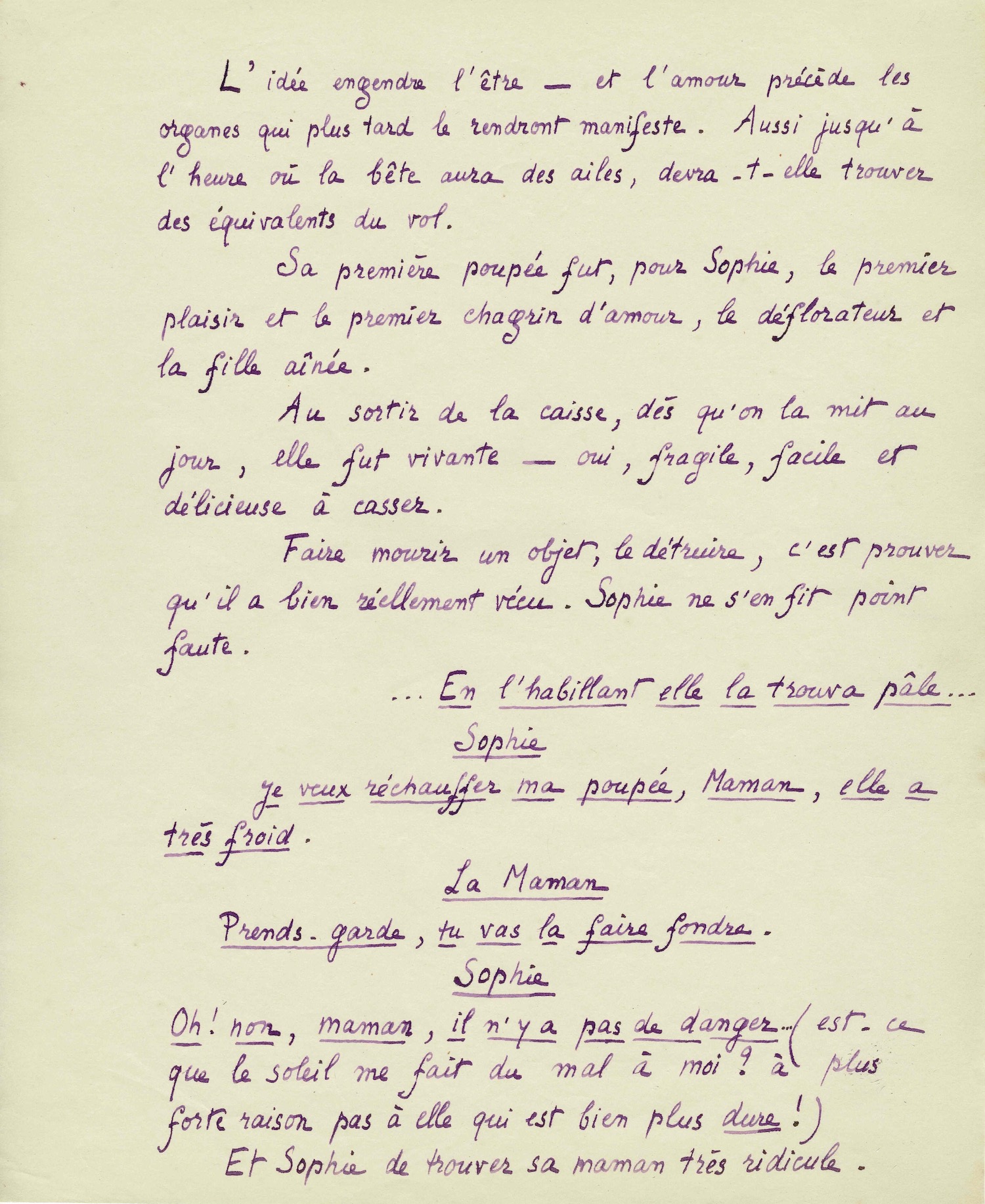
The idea gives birth to being – and love precedes the organs that will later make it manifest. Thus, until the beast grows wings, it will have to find equivalents to flight.
Her first doll was, for Sophie, the first pleasure and the first heartbreak, the deflowerer and the eldest daughter. From the moment she was taken out of the box, as soon as she was brought into the world, she was alive – yes, fragile, easy and delicious to break.
To kill an object, to destroy it, is to prove that it truly lived. Sophie did not fail to do so.
……………..
……………..
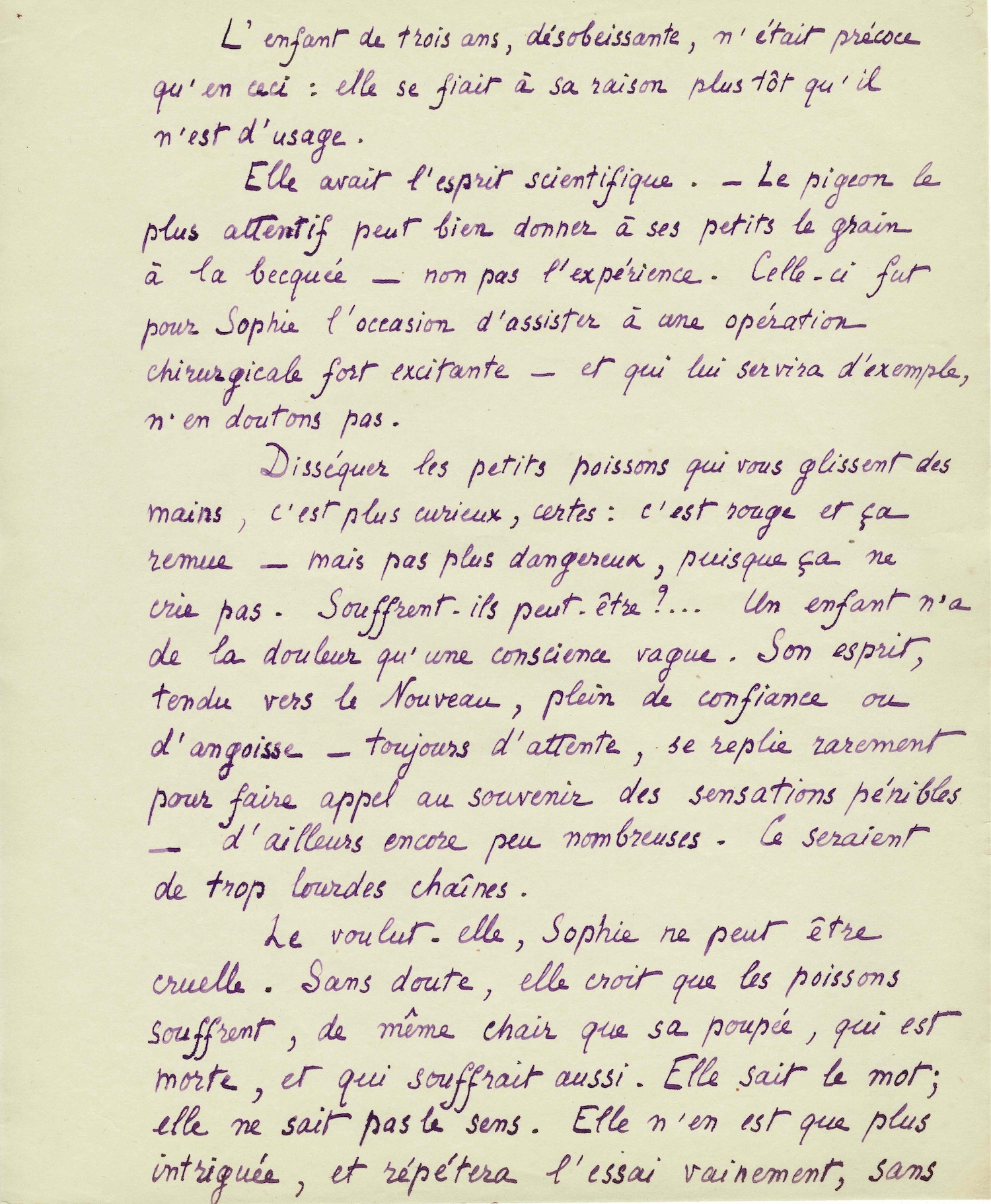
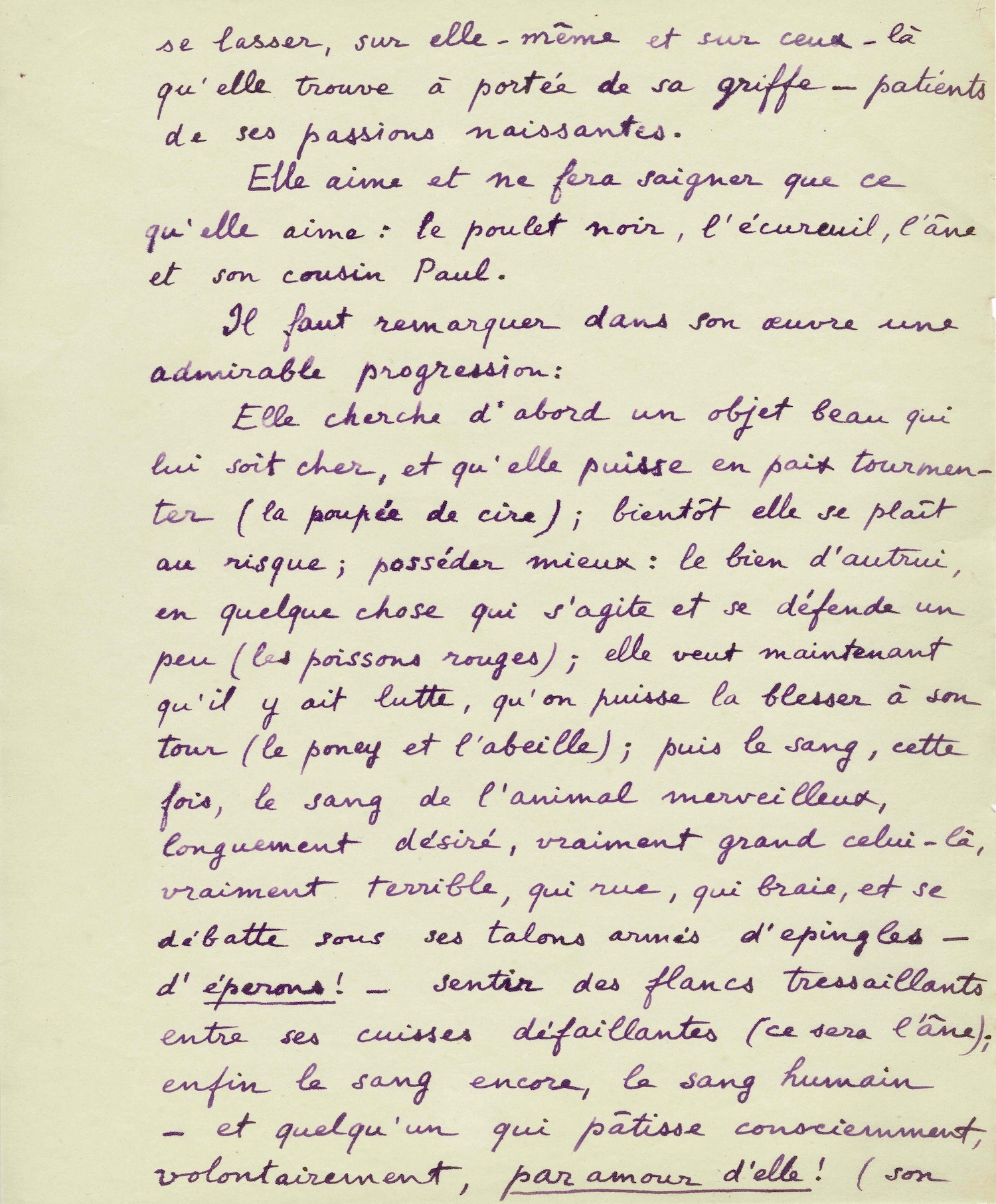
She loves, and will only make bleed, what she loves : the black chicken, the squirrel, the donkey, and her cousin Paul. One must note an admirable progression in her work:
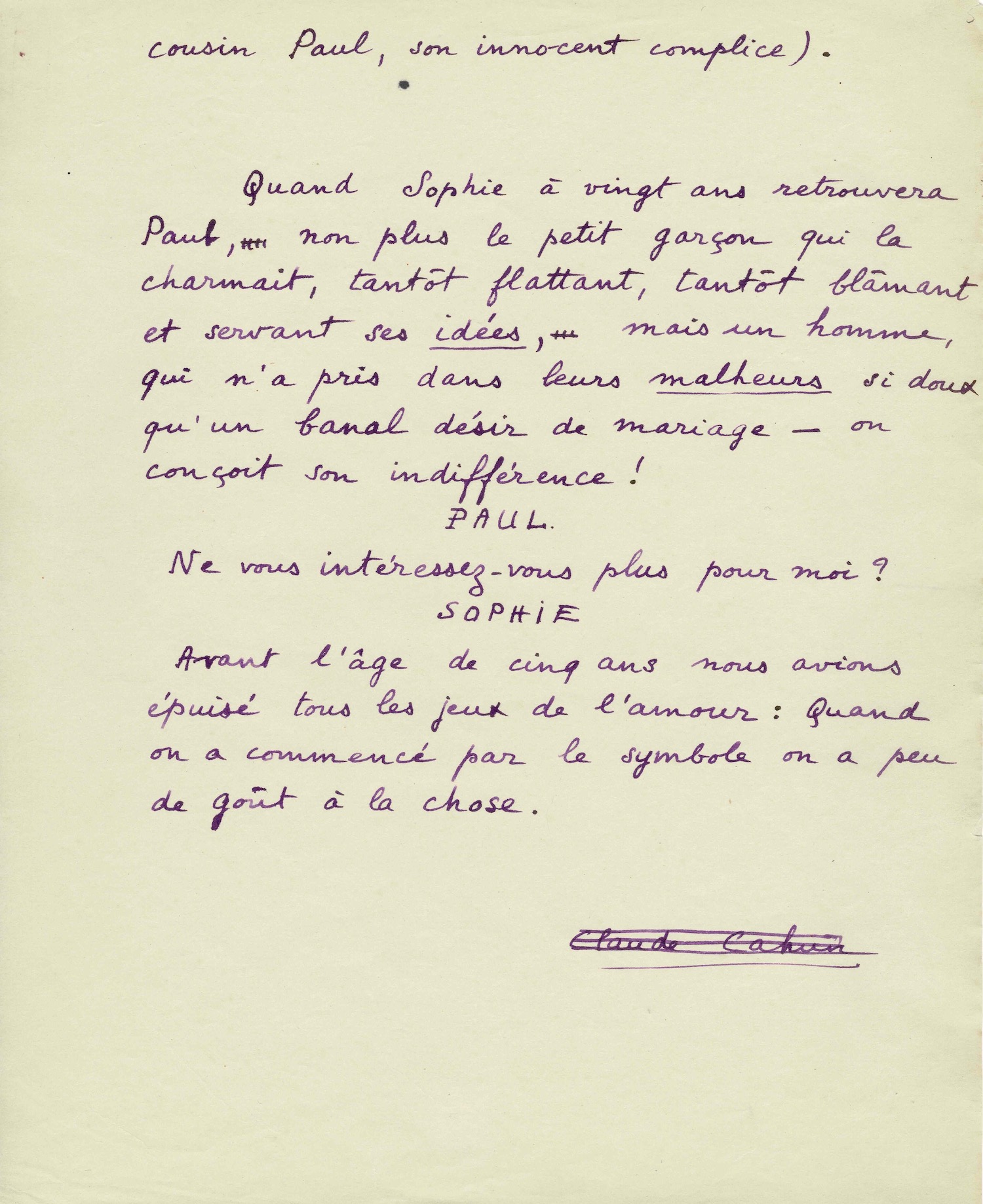
First, she seeks a beautiful object that is dear to her, and that she can torment in peace (the wax doll); soon she enjoys risk; possessing better: the property of others, in something that stirs and defends itself a little (the goldfish); now she wants there to be a struggle, for someone to be able to hurt her in turn (the pony and the bee); then blood, this time, the blood of the marvelous animal, long desired, truly great, truly terrible, which kicks, brays, and struggles under her heels armed with pins – with spurs! – to feel quivering flanks between her failing thighs (it will be the donkey); finally, blood again, human blood – and someone who suffers consciously, voluntarily, out of love for her ! (her cousin Paul, her innocent accomplice).
When Sophie, at twenty, meets Paul again, he is no longer the little boy who charmed her, sometimes flattering, sometimes blaming and serving her ideas, but a man who has taken from their misfortunes only a banal desire for marriage – one can understand his indifference!
PAUL.
Are you no longer interested in me?
SOPHIE
Before the age of five we had exhausted all the games of love: when one has started with the symbol one has little taste for the thing itself.
_____________________________________________________
Eight “heroines” were published during Cahun’s lifetime: Eve, Dalila, Judith, Hélène, Sapho, Marguerite, Salomé (in Mercure de France on February 1, 1925 ), then Sophie (in Journal littéraire on February 25, 1925).
Six other texts remained unpublished until 2006 and the publication of the collection Heroines: Penelope, Mary, Cinderella, the essential wife, Salmacis, and the one who is not a hero.
Heroines. Mille et une nuits editions. 2006. Edited by François Leperlier.