Camille MAUCLAIR (1872.1945)
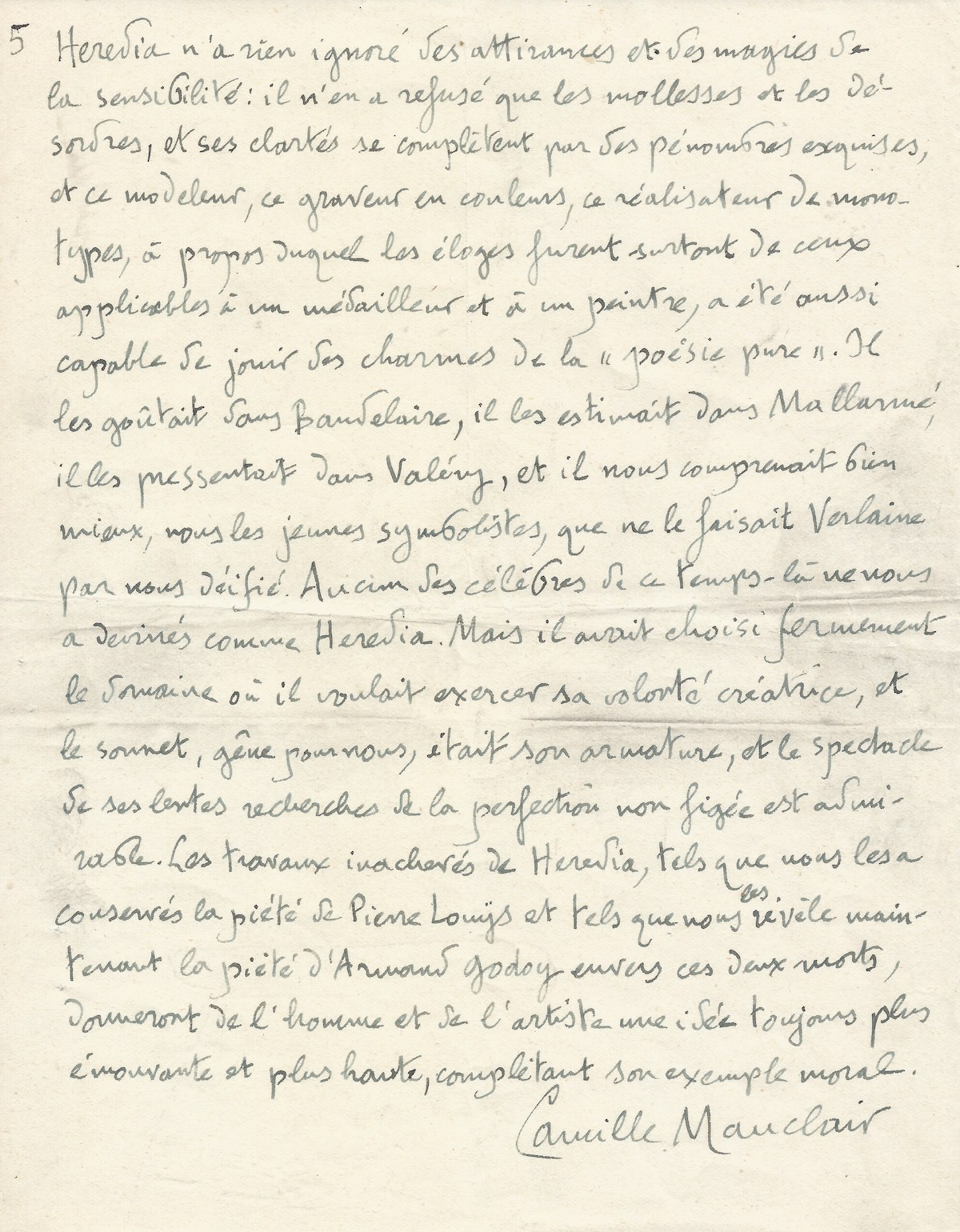
Autograph manuscript signed – Heredia.
Five quarto pages, numbered in the corner.
No place of issue. [1925 or 1926]
"I instantly fell in love with this man, of whom I then knew only a few groups of sonnets signed with a brilliant, fascinating, and mysterious name."
Following the publication of Armand Godoy's tribute book on Heredia, in 1925 by Alphonse Lemerre, Camille Mauclair praises the art of the sonnet and the magnanimity of the Franco-Cuban poet.
_______________________________________________________
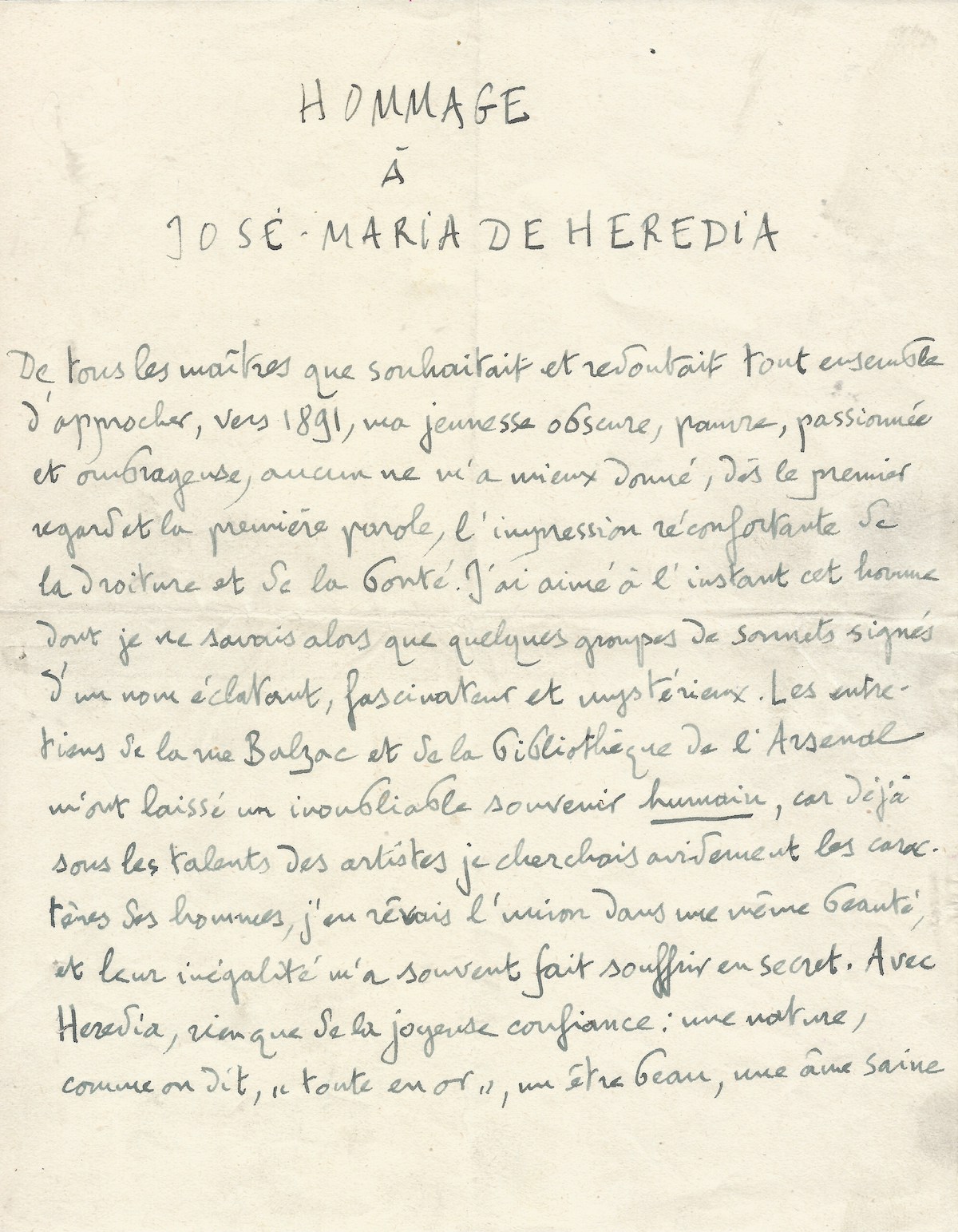
TRIBUTE TO JOSÉ MARIA DE HEREDIA.
"Of all the teachers that my obscure, poor, passionate, and brooding youth both wished and dreaded to approach around 1891, none gave me, from the first glance and the first word, a more comforting impression of integrity and kindness. I instantly loved this man of whom I then knew only a few groups of sonnets signed with a brilliant, fascinating, and mysterious name."
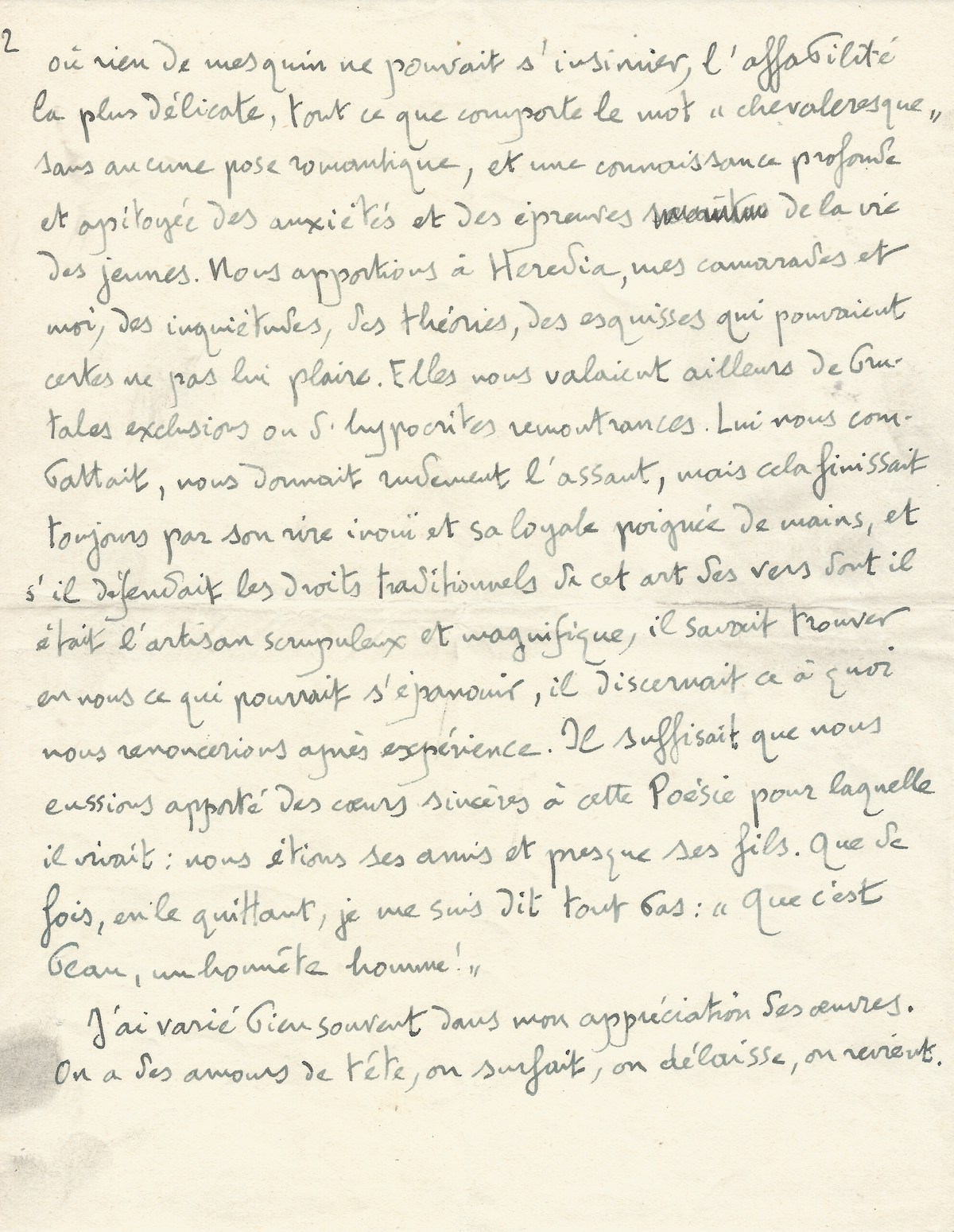
The conversations on rue Balzac and at the Bibliothèque de l'Arsenal left me with an unforgettable human , for even beneath the talents of artists I eagerly sought the character of men, I dreamed of their union in a single beauty, and their inconsistency often caused me secret suffering. With Heredia, there was nothing but joyful confidence: a nature, as they say, "all gold," a handsome man, a healthy soul where nothing petty could creep in, the most delicate affability, everything that the word "chivalrous" encompasses without any romantic posturing, and a profound and compassionate understanding of the anxieties and trials of young life.
My comrades and I brought to Heredia anxieties, theories, and sketches that might not have pleased him. Elsewhere, they earned us brutal exclusions or hypocritical rebukes. He would fight us, launch a fierce assault, but it always ended with his extraordinary laughter and his loyal handshake. And while he defended the traditional rights of this art, his verses of which he was the scrupulous and magnificent craftsman, he knew how to find in us what could flourish; he discerned what we would renounce after experience. It was enough that we had brought sincere hearts to this poetry for which he lived: we were his friends and almost his sons. How many times, upon leaving him, I said to myself quietly: "How beautiful an honest man is!"
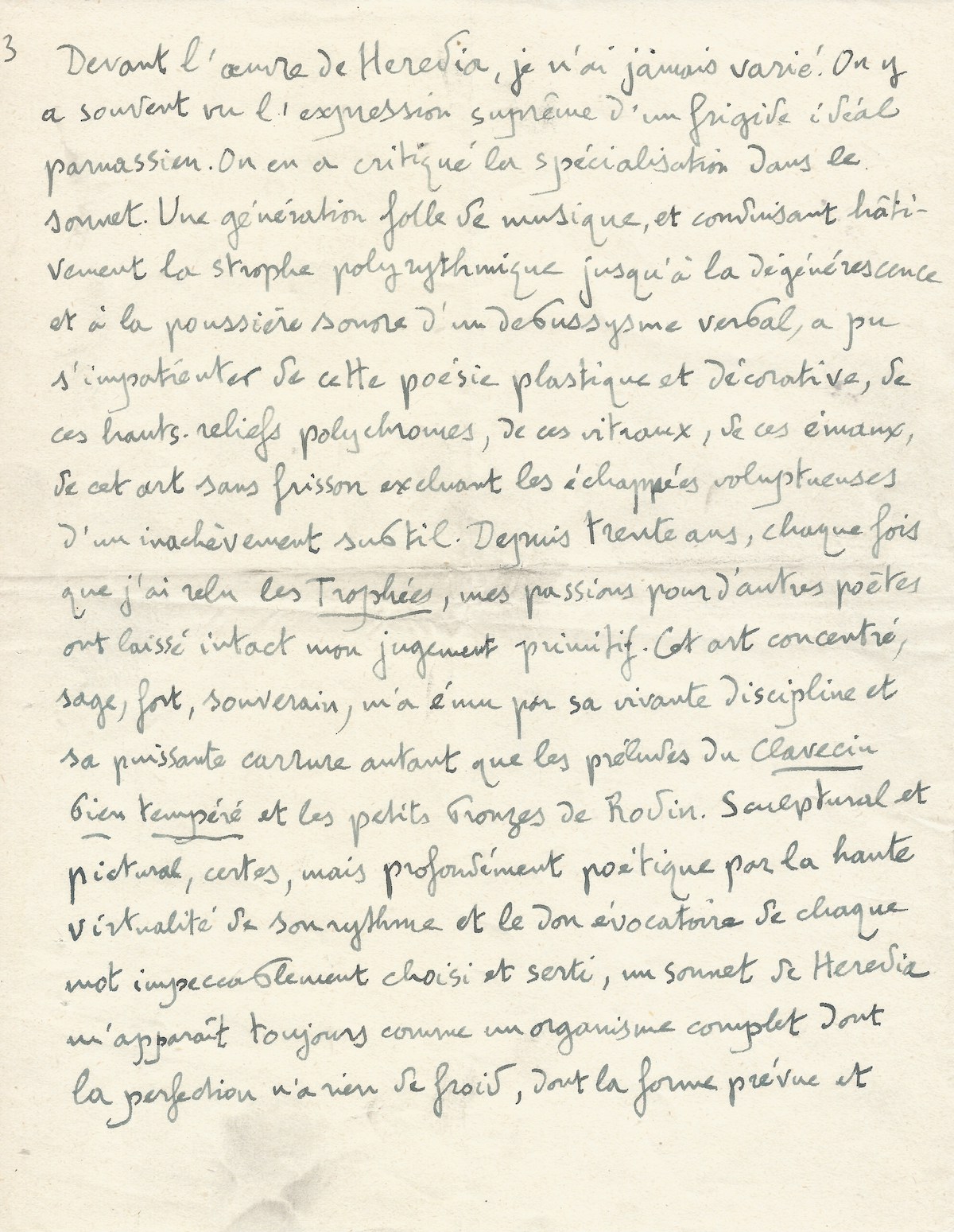
My appreciation of works has often varied. We have fleeting infatuations, we surf, we abandon, we return. But with Heredia's work, I have never wavered. It has often been seen as the supreme expression of a frigid Parnassian ideal. Its specialization in the sonnet has been criticized. A generation mad about music, hastily pushing the polyrhythmic stanza to the point of degeneration and the sonic dust of a verbal Debussy-esque style, may well have grown impatient with this plastic and decorative poetry, these polychrome high reliefs, these stained-glass windows, these enamels, this art without thrill, excluding the voluptuous escapes of a subtle incompleteness.
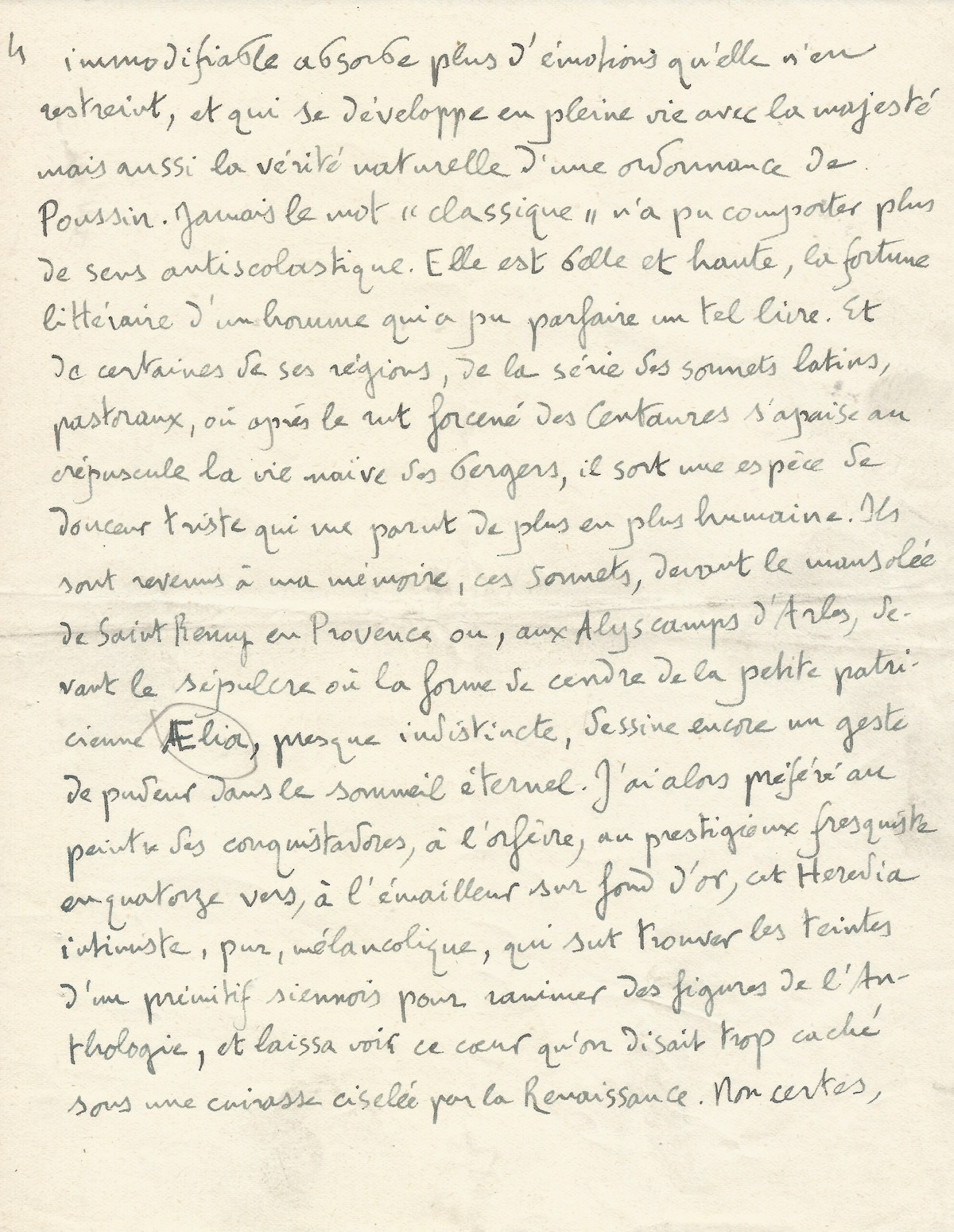
For thirty years, each time I have reread Les Trophées , my passions for other poets have left my original judgment intact. This concentrated, wise, strong, sovereign art has moved me with its vibrant discipline and powerful stature as much as the preludes to Rodin's Well-Tempered Clavier and the small bronzes of Rodin. Sculptural and pictorial, certainly, but profoundly poetic by virtue of the high potential of its rhythm and the evocative gift of each impeccably chosen and set word, a sonnet by Heredia always appears to me as a complete organism whose perfection is anything but cold immutable form absorbs more emotions than it restricts, and which unfolds in full life with the majesty but also the natural truth of a Poussin composition. Never has the word "classical" been more utterly anti-scholastic in meaning.
It is a beautiful and lofty literary fortune for a man who was able to perfect such a book. And from certain passages, from the series of pastoral Latin sonnets, where, after the frenzied rut of the centaurs, the simple life of the shepherds calms down at dusk, there emerges a kind of melancholy sweetness that seemed to me increasingly human. These sonnets came back to me before the mausoleum of Saint Rémy in Provence, or, at the Alyscamps of Arles, before the sepulcher where the ashen form of the little patrician Aelia, almost indistinct, still traces a gesture of modesty in eternal sleep. I then preferred to the painter of the Conquistadors, to the goldsmith, to the prestigious fresco painter in fourteen verses, to the enameller on a gold background, this intimate, pure, melancholic Heredia, who knew how to find the hues of a Sienese primitive to revive figures from the Anthology, and let see this heart which was said to be too hidden under a cuirass chiseled by the Renaissance.
Certainly not, Heredia was fully aware of the allure and magic of sensibility : he rejected only its weaknesses and excesses, and his luminosities are complemented by exquisite penumbras. This sculptor, this color engraver, this creator of monotypes, about whom the praise was mostly that bestowed upon a medalist and a painter, was also capable of enjoying the charms of "pure poetry." He savored them in Baudelaire, he esteemed them in Mallarmé, he sensed them in Valéry, and he understood us, the young Symbolists, far better than Verlaine, whom we deified.
None of the famous figures of that time foresaw us as Heredia did. But he had firmly chosen the domain in which he wished to exercise his creative will, and the sonnet, a hindrance to us, was his framework, and the spectacle of his slow search for an ever-evolving perfection is admirable. Heredia's unfinished works, as preserved for us by the piety of Pierre Louÿs and as now revealed to us by the devotion of Armand Godoy to these two deceased, will give an ever more moving and elevated idea of the man and the artist, completing his moral example. Camille Mauclair