Jane POUPELET (1874.1932)
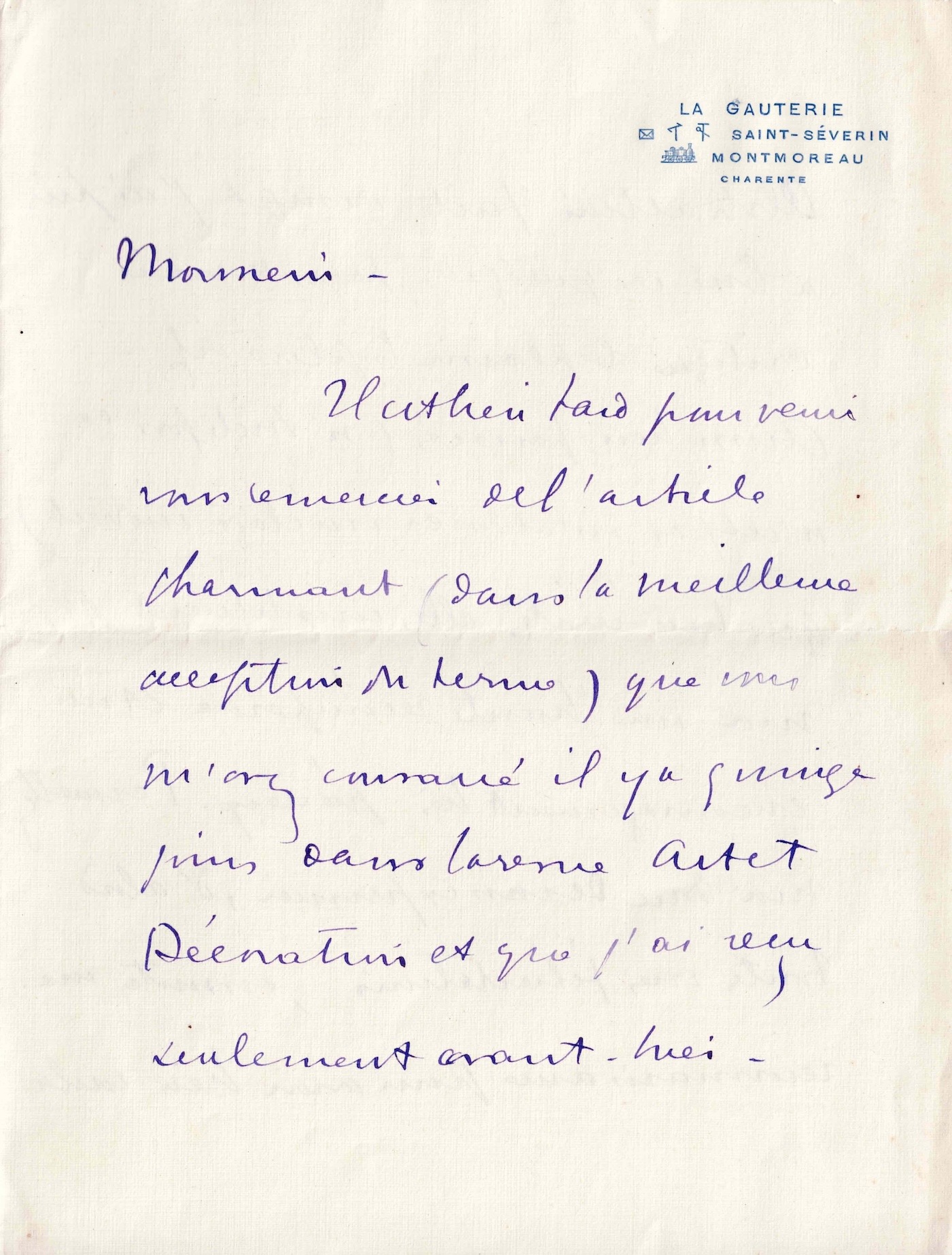
Autographed letter signed to the critic Maurice Guillemot.
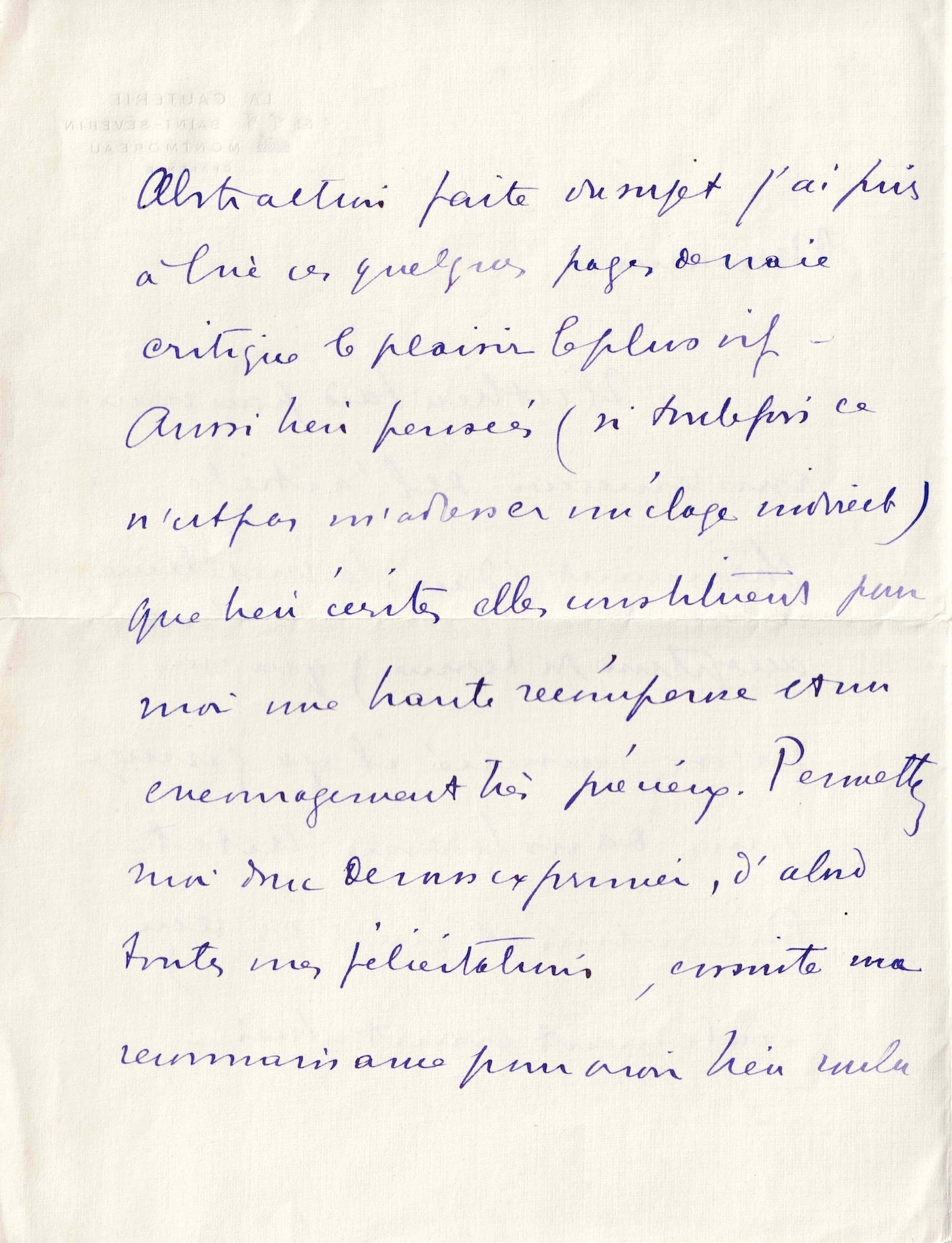
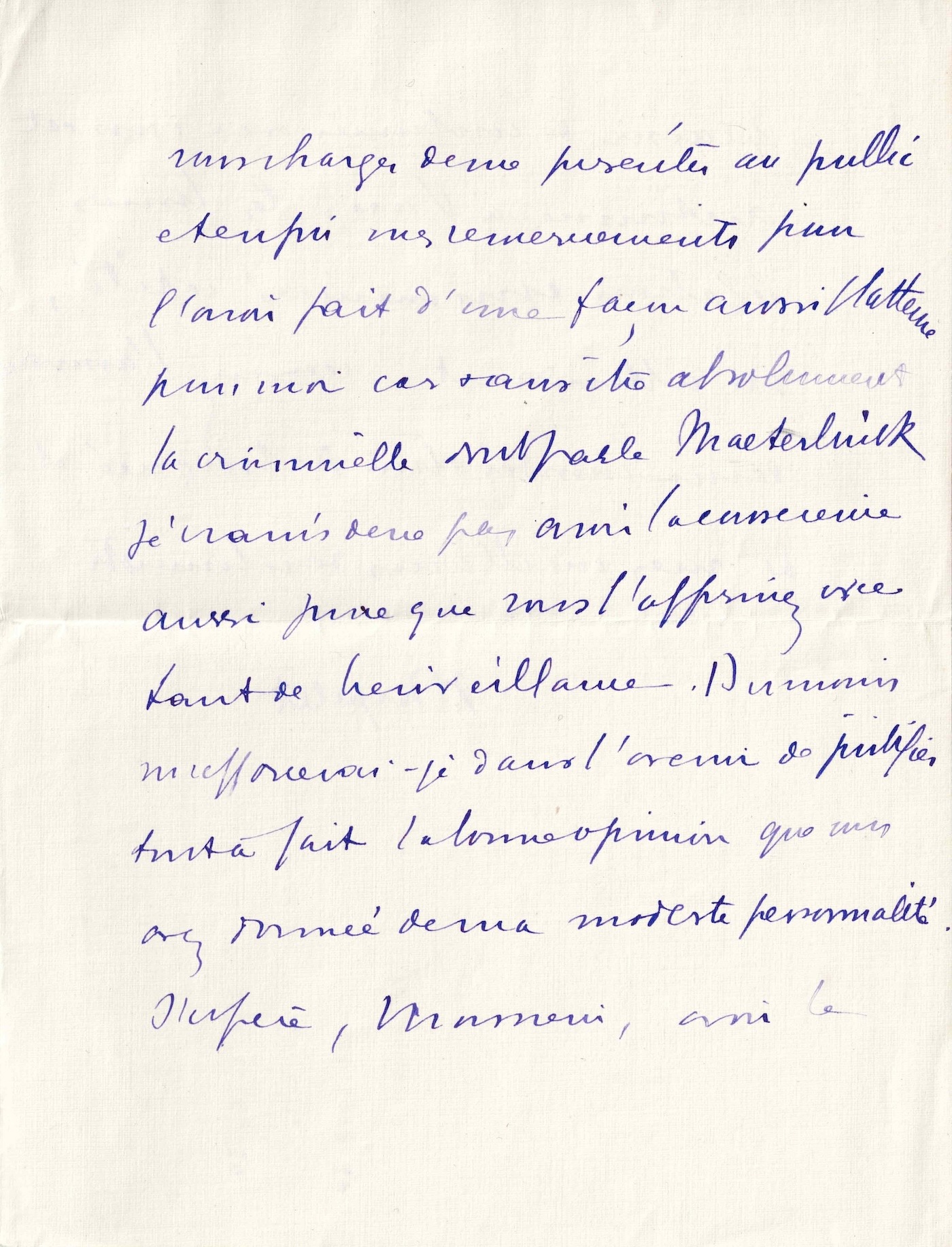
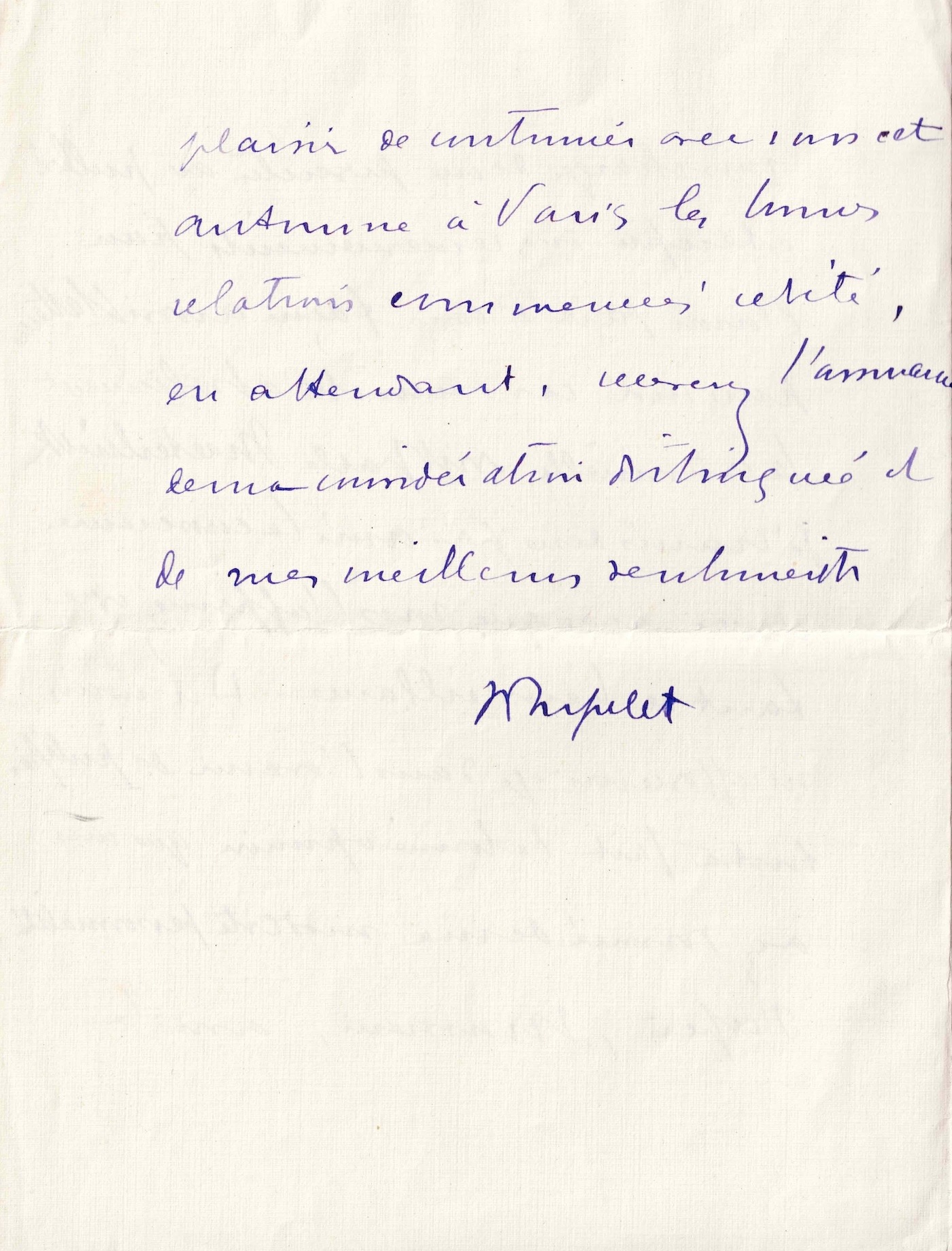
Four octavo pages on paper addressed to him.
La Gauterie [July 1913]
"I fear my conscience is not as pure as you claim."
A rare and beautiful letter from the French sculptor honored by the laudatory article Maurice Guillemot dedicated to her in the magazine Art et Décoration. Jane Poupelet humbly reflects on her work and on Guillemot's evocation of "criminality" in Maeterlinck.
_________________________________________________
"Sir, It is very late to thank you for the charming article (in the best sense of the term) that you devoted to me a fortnight ago in the magazine Art et Décoration and which I only received the day before yesterday.
Leaving aside the subject matter, I took the greatest pleasure in reading these few pages of genuine criticism. As well-conceived (if this isn't an indirect compliment) as they are well-written, they constitute a great reward and a most precious encouragement. Allow me, therefore, to express, first, my sincere congratulations, then my gratitude for having entrusted you with the task of introducing me to the public, and finally my thanks for having done so in such a flattering manner. For, while I am not quite the criminal Maeterlinck describes, I fear my conscience is not as pure as you so kindly assert. At least I will strive in the future to fully justify the favorable opinion you have formed of my modest character.
I hope, Sir, to have the pleasure of continuing with you this autumn in Paris the good relations begun this summer ; in the meantime, please accept the assurance of my distinguished consideration and my best regards. J. Poupelet."
_________________________________________________
For the July 1913 issue, Maurice Guilleminot published a very fine and lengthy illustrated article (pp. 51-56) on the French sculptress in the monthly modern art magazine, Art et Décoration . The critic concluded the article by referring to what Maeterlinck had written about sculpture: “Sculpture should be the most exceptional of all the arts. It should capture only a few extremely rare and absolutely, irreproachably beautiful moments of life, of forms, of human joys and sorrows. Any sculpted movement that is not admirable is a kind of permanent, obsessive, inexcusable crime.” Guilleminot, for his part, concluded his text: “Mademoiselle Jane Poupelet is in no way criminal in the sense that this word is used by the poet of Pelléas.”
A leading figure in early 20th-century sculpture, Jane Poupelet stood alongside other women artists, particularly Camille Claudel, whom she resembled in her fierce independence and strength of character. The first woman admitted to the École des Beaux-Arts et des Arts Décoratifs in Bordeaux, she met the sculptor Lucien Schnegg in 1900 and joined the "Schnegg circle," of which she was the only woman. She frequented the circles around Bourdelle and Rodin, and also associated with American artists and Anglo-Saxon feminist groups.
During the Great War, Jane Poupelet abandoned her art and devoted herself to creating dolls and painted wooden toys, which she sold to benefit war victims. From 1918, she modeled masks for the mutilated, the "broken faces" of the conflict, working for the American Red Cross alongside Anna Ladd. Her dedication earned her the Legion of Honour in 1928.
In a letter dated 1920, the sculptress confessed that after seeing so much suffering, she would never sculpt the same way again.