
"You absolutely have the face of a painter, and you should be a painter."
2.000€
[Alfred JARRY – Customs Officer ROUSSEAU] – Jean SALTAS (1865.1954)
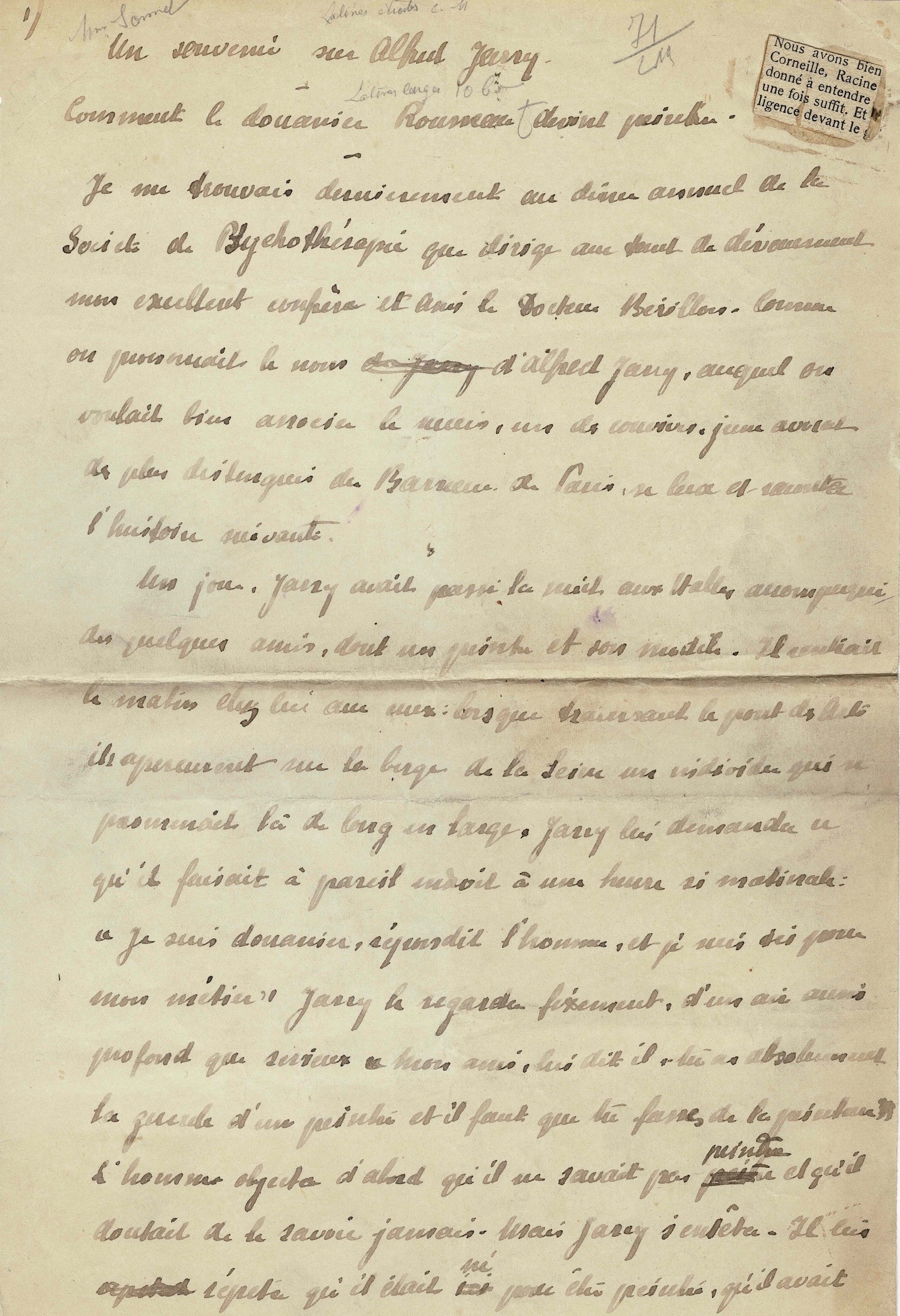
Signed autograph manuscript.
Nine folio pages on cream paper. No place or name available
A memory about Alfred Jarry – How the customs officer Rousseau became a painter.
A vivid and fanciful account – seemingly unpublished – of the first meeting between Alfred Jarry and Douanier Rousseau, resembling some of the “mystifying” stories of the author of Ubu-roi himself.
_________________________________________________
“ , including a painter and his model. He was returning home with them in the morning when, crossing the Pont des Arts, they noticed a man pacing back and forth on the bank of the Seine. Jarry asked him what he was doing there at such an early hour. ‘I’m a customs officer,’ the man replied, ‘and I’m here for work.’ Jarry looked at him intently, with an expression as profound as it was serious. ‘My friend,’ he said, ‘ you absolutely have the face of a painter, and you must take up painting.’ The man initially objected that he didn’t know how to paint and doubted he ever would. But Jarry persisted.” He repeated to him that he was born to be a painter, that he possessed unsuspecting genius, that this often happens with artists, that his vocation shone brightly on his face, and to prove it to him immediately, he placed the easel of the artist who accompanied him before him, while the model undressed. At the foot of a tree, he ordered him to paint the scene he thus had before his eyes: Eve in the Garden of Eden, waiting at the foot of the apple tree for her victim, poor Adam, our father.
The unfortunate customs officer was already beginning to believe that he had indeed been unaware of his true calling until then, so persuasive and animated was Jarry's tone. Brush in hand, he sketched on the canvas a semblance of a woman beside a semblance of a tree. The question of the apple tree remained, however, for it is known that it was with an apple that our mother Eve seduced the first man. The customs officer was quite perplexed. Jarry then advised him to take some red paint from his palette and, here and there on the tree, to indicate the apples by drawing circles, which the obedient student did. […] Jarry was very pleased with the result and delighted with his discovery: "That's very good, my friend," he said to the new painter when he had finished.
However, officers arrive and take everyone to the police station, where a report is filed followed by a court appearance for indecent exposure. Jarry pleads the case of the customs officer's discovered artistic "genius" so convincingly that the judge acquits everyone.
"The customs officer, moved to tears, profusely thanked the magistrate and, as a token of his gratitude, offered to paint his 'lady's' portrait for New Year's Day. He multiplied his visits to the magistrate's wife for this purpose, and she eventually succumbed to temptation and agreed to pose for the new artist. [...] Customs Officer Rousseau was now a painter. He did not forget the man who had revealed his vocation and launched him into this great career. After Jarry's death, among the most eclectic objects, a portrait was found in his room on Rue Cassette, which appeared to be the work of Customs Officer Rousseau. The figure was replaced by a large hole. It is said that one evening, or rather one morning when he returned home, Jarry, surprised and frightened at once by this image that perhaps resembled him at that moment, punched a hole in the canvas in that spot—a sacrilege a hundred times regrettable. [...]"
_________________________________________________
Henri Rousseau, known as Le Douanier (The Customs Officer), was born in Laval, like Alfred Jarry, in 1844 (some thirty years before his fellow countryman). While nothing seemed to predispose him to painting, it was around 1884, after becoming a customs officer in Paris, that he devoted himself to drawing and painting. From 1886 onward, he began exhibiting regularly at the Salon des Indépendants. Around 1894, Alfred Jarry discovered Le Douanier Rousseau, with whom he became friends, and introduced this "new" art to the circles of the Mercure de France , where, notably, a laudatory article appeared on "La Guerre" exhibited at the Salon des Indépendants in 1894. The names of Jarry and Le Douanier Rousseau remain universally known and frequently linked.
Dr. Jean Saltas (1865-1954), a Greek physician and writer born in Turkey and naturalized French in 1900, met Jarry in the Danville family's living room in 1897. Their friendship became more regular from 1905 onward, when they collaborated on the translation and adaptation of the novel * La Papesse Jeanne* . During the winter of 1905-1906, Saltas and Jarry worked tirelessly, often in very difficult conditions for Jarry: "He was already very exhausted, both mentally and physically," Saltas later recounted. "He would arrive at my house, often in bad weather, wearing slippers or shoes with holes in them, his feet soaking wet. Taking every precaution to avoid upsetting his considerable sensitivity, I would slip a hot brick under his feet, and then we would work. It was from this collaboration that *La Papesse Jeanne* emerged." This was Alfred Jarry's last work.
_________________________________________________
We are enclosing two autographed notes from Claude Terrasse addressed to an unknown recipient.
January 21, 1922: " I've been leading an impossible life since October. Right now I'm finishing a three-act play that's due to be performed at the Gaîté at the end of February – and the days and nights are barely enough. On top of that, we're rehearsing Ubu Roi and Paris at the Théâtre de l'Œuvre and the Théâtre Michel. So I don't have a minute to myself. "
February 24, 1922: " If you enjoy watching Ubu Roi, here are two armchairs. "