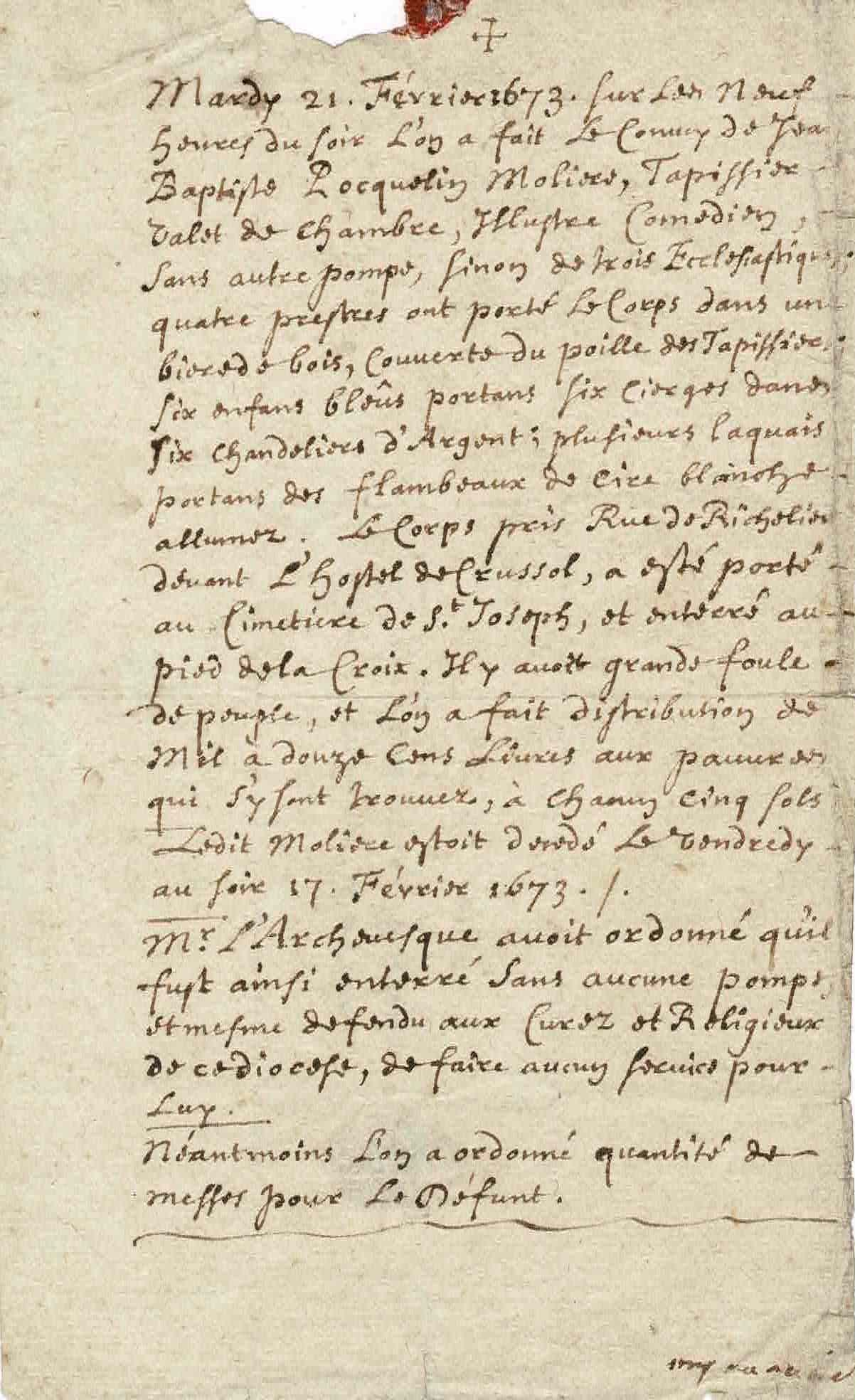
[MOLIÈRE]. Account of Molière's funeral.
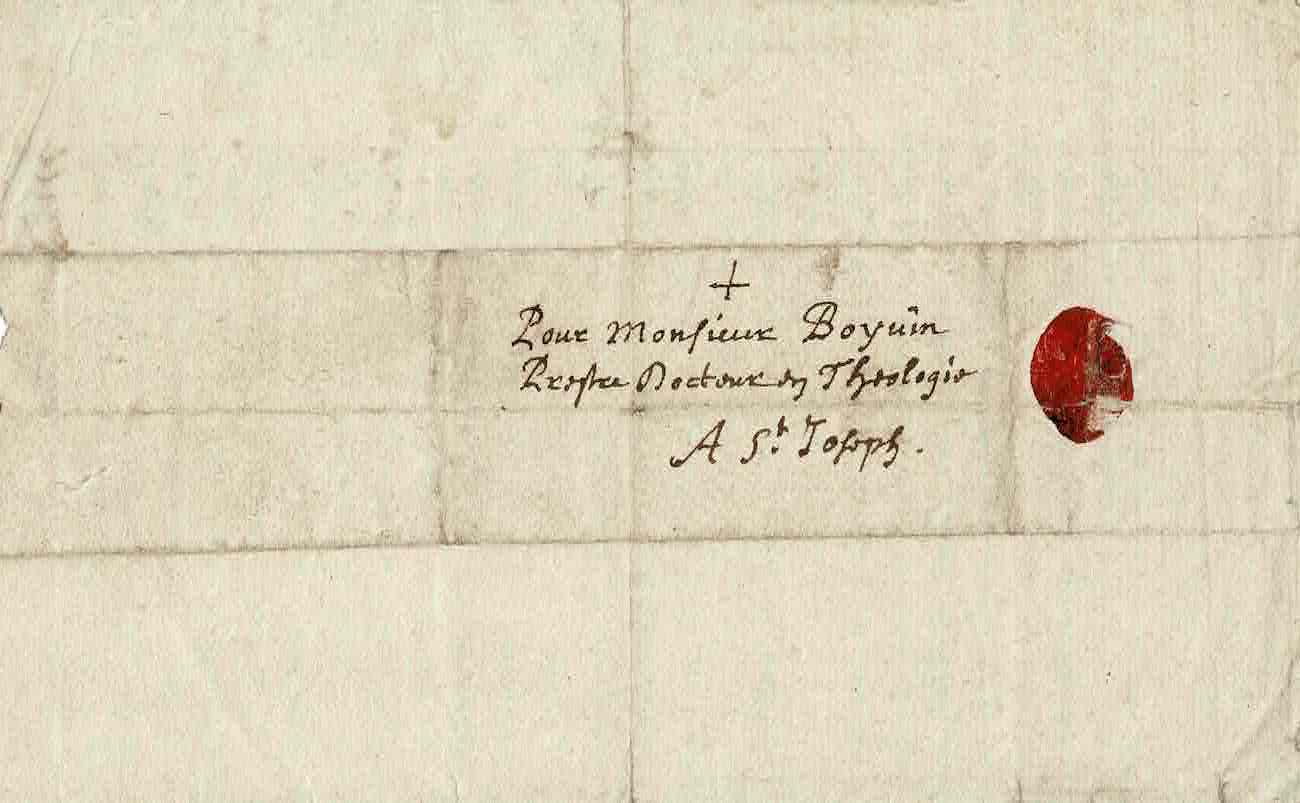
A detailed account of Molière's burial, supposedly addressed to Father Boyvin, “priest Doctor of Theology, at St. Joseph's.”
Handwritten letter, One page in-8°, address on the back: “For Mr. Boyvin / Priest Doctor of Theology / AS t Joseph”, remains of wax seal.
February 1673 [Conches leaflet? circa 1840?]
______________________________________________
On Tuesday, February 21, 1673, at about nine o'clock in the evening, the funeral procession of Jean Baptiste Pocquelin Molière, upholsterer, valet, and illustrious actor, was held without any other pomp, except for three clergymen. Four priests carried the body in a wooden coffin covered with upholsterer's wool. Six children in blue robes carried six candles in ten silver candlesticks; several footmen carried lit white wax torches. The body, taken from the Rue de Richelieu in front of the Hôtel de Crussol, was carried to the cemetery of Saint Joseph and buried at the foot of the cross. A large crowd was present, and a distribution of one thousand to twelve hundred livres was made to the poor who were there, five sols each. The said Molière had died on the evening of Friday, February 17, 1673.
The Archbishop had ordered that he be buried without any pomp and even forbade the priests and religious of the diocese to hold any service for him. Nevertheless, numerous masses were ordered for the deceased.
______________________________________________
The very form of the letter, offering only a detailed account of the burial, without a polite formula or signature, in the manner of a handwritten short story, is surprising.
This letter was first revealed by autograph collector Benjamin Fillon in 1850 in his *Considérations historiques et artistiques sur les monnaies* (note pp. 193-194). It was subsequently published by Jules Loiseleur in *Les Points obscurs de la vie de Molière* (1877, pp. 350-351). The document, which became the property of Jules Taschereau (1801-1874), has remained in his family to this day.
In 1972, in an article published in the Revue d'histoire du théâtre (IV, pp. 366-369), Madeleine Jurgens and Elizabeth Maxfield-Miller provided a reproduction with this commentary: “We had been rather hesitant about this letter because of its discovery by Benjamin Fillon and the fact that we had not been able to trace it at the time. Since then, this letter, which is indeed from the 17th century, has been very kindly communicated to us by the current owner of the Jules Taschereau collection, of which it is a part.”
Despite the assurances given by the two eminent Molière scholars and the reproductions they provided, Roger Duchêne only cites this letter in a note in his biography of Molière (2006, p. 728) with many reservations.