Salvador Dali (1904.1989)
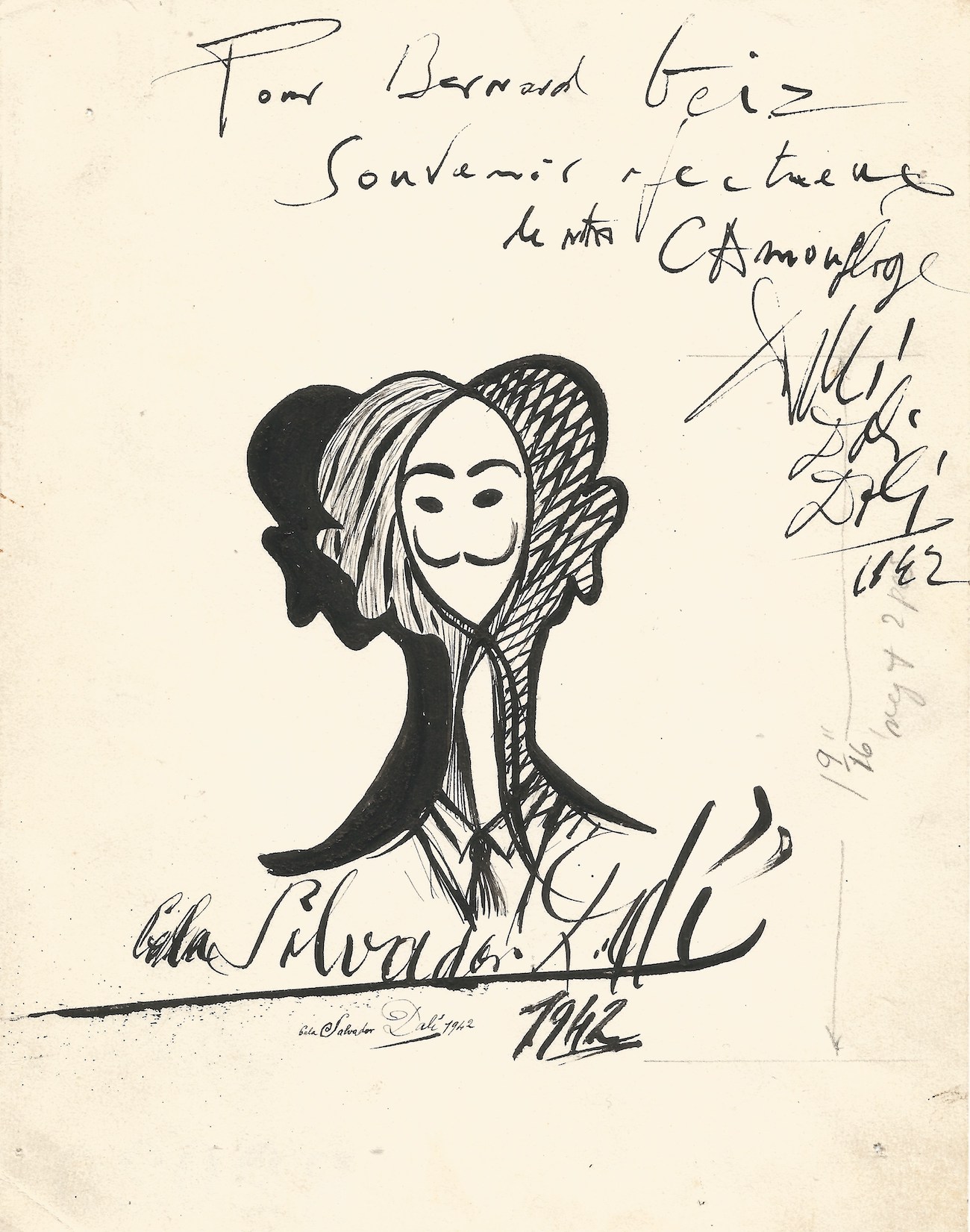
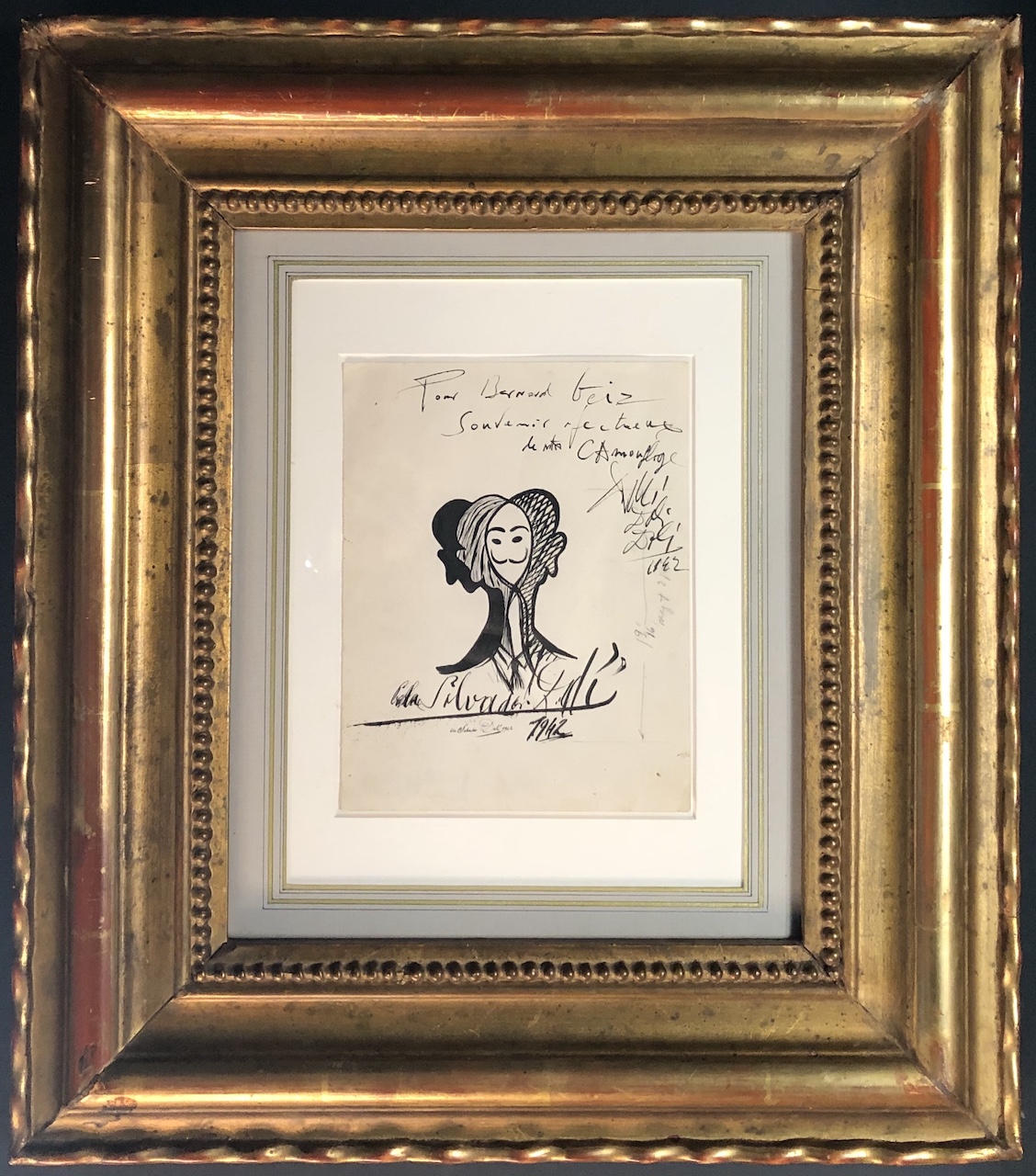
Original signed drawing – Camouflage – Self-portrait – Garcia Lorca.
India ink on heavy paper.
Signed five times by Dalí and dedicated to Bernard J. Geis, publisher of Esquire Magazine.
For Bernard Geiz, fond memories of our camouflage
Dalí Dalí Dalí 1942
Salvador Dalí Gala Salvador Dalí Gala 1942
An extraordinary document by the Catalan master, of astonishing modernity, creating his self-portrait in a double, and evoking in the background the silhouette of Federico García Lorca .
Certificate of authenticity from Messrs. Nicolas and Olivier Descharnes. The work is registered in the Descharnes Archives under reference d1273.
Dimensions 170 x 132 mm.
Handwritten annotations on the back.
Tiny pinholes in the corners. Otherwise in remarkable overall condition.
“Do your eyes have it?”
The answer will undoubtedly seem obvious: the mask with long mustaches pointing skyward, the mandorla-shaped face sketched in generous strokes of India ink… “It’s Dalí, of course!”—the Spanish prodigy, the king of Surrealism. That’s correct; at least in part: this fantastic drawing is indeed a rare self-portrait by the eccentric Catalan. But not only that, as we shall see…
This drawing was created—and published—to coincide with the appearance in the American magazine Esquire [i] , in August 1942, of an important article by Dalí: "Total Camouflage for Total War ." Over four illustrated pages, Dalí explains to readers, as World War II rages, the strategic importance of camouflage, understanding images and their reality, illusion and truth. In the middle of the article (page 130) [ii] , our drawing appears at the top of a sidebar entitled " A Portrait of Salvador Dalí, " in which Dalí answers questions presented in the form of a Proust Questionnaire.
In December 1942, Esquire republished this self-portrait at the head of an article by Raymond Gram Swing, Nativity of a New World , relating to the painting of Dalí.
In this creative context, at the heart of a dossier devoted to hidden images, how can we imagine that such a playful, imaginative, and inventive artist would have been content with a simple silhouette to represent himself in this drawing? We must therefore look at this drawing more closely, delve into its hidden symbolism, to answer the question posed by Dalí: “ Do your eyes have it?”
To try to understand the image, let's look at the accompanying text. In the midst of World War II, Salvador Dalí posed the challenge of psychologically controlling the enemy's vision. Controlling vision would ensure the triumph of one side over the other.
In this article from August 1942, Dalí tells us how Cubism, in his view, invented camouflage. His account makes Picasso the official inventor of human camouflage. He attributes the following words to his compatriot: " If you want to make an army invisible, all you have to do is dress the soldiers like harlequins " [iii] And Dalí explains " that an image can be made invisible—without transformation—simply by surrounding it with other images that make the viewer believe they are looking at something else ." His argument is illustrated with several works in which the magic of illusion triumphs. This is the painter's secret, explained here, who took advantage of a " paranoid mind " to see what the eyes of ordinary mortals could not perceive. " The discovery of invisible images was certainly part of my destiny." Following the precepts of Aristophanes and Vinci, an observer of mimetic and natural camouflage in animals, the painter plays with illusion, encouraging an immoderate use of the systematic delirium of interpretation.
Let's return to our drawing. It is with Dalí's surrealist eyes, in light of this article, that we must reconsider this self-portrait. It undoubtedly conceals another meaning, another image: it is camouflage. This is, in fact, the meaning of the dedication! On closer inspection, certain details stand out, fitting the text too closely to be mere coincidences. The hatching of the right-hand figure, forming regular diamonds, is not accidental: it is the costume of Harlequin, the first of the camouflaged figures, the one Picasso himself discusses. The figure to the left of the mask is spotted: it is a tiger's fur, the kind that, in Dalí's words in this same Esquire article, is a model of camouflage and illusion.
To further complete the analysis, it seems appropriate to compare our drawing with several other works by Dali represented below: The Self-Portrait Splitting into Three (Fundació Gala-Salvador Dalí , Figueres, cat. P191) , the Self-Portrait Splitting into Three Harlequins (Fundació Gala-Salvador Dalí , Figueres, cat. P1015) and Harlequin ( Museo de Arte Contemporáneo AS 07488 ).
Drawing on his experiences with Cubism, Dalí embraced the multiplication of viewpoints, favoring them over rational three-dimensionality to give greater prominence to the imagination. By using colors that did not mimic reality, Dalí established a system of thought that would culminate in the 1940s in his discourse on camouflage and paranoid vision.
Federico García Lorca . This drawing, seemingly clear at first glance, actually reveals several symbolic meanings, as we have seen: camouflage, illusion, magic, doubling, cubism, nature… Yet one last face is hidden within! A black silhouette, discreetly positioned in the background: that of Federico García Lorca [iv] , the Spanish friend, the brother, the mythical poet shot in August 1936 by the Francoists.
We will not return to the passionate and historic friendship between Lorca and Dalí, " An erotic and tragic love, because of the fact that we could not share it " [v] ; however, it is worth marveling at seeing Dalí accompany his own image with the eternal and benevolent shadow of Lorca, his soul brother who had disappeared six years earlier.
Until now ignored by the Dalinian archives and in private collection since its creation in 1942, this drawing now comes, for all the reasons mentioned above, to fuel the myth of the master of Port Lligat.
Finally, we will quote N. Descharnes' words upon discovering this treasure: " This drawing is historic!"
[i] We are enclosing the two Esquire from August and December 1942.
[ii] For publication in Esquire , the drawing was cropped and Dalí's dedication erased. Pencil annotations, in a different hand, are visible in the right margin of our drawing, traces of this layout.
[iii] It seems that the painter Guirand de Scévola was the first to have the idea of concealing cannons by exploiting Cubist aesthetics. His research focused on the relationship between form and light and their mutual distortion. The canvases, dappled with the colors of the surrounding countryside, rendered the weapons imperceptible. In the summer of 1915, the "death-defying" unit was born. Composed of 125 reservists, laborers, and house painters, it recruited carpenters, joiners, mechanics, and other tradespeople. Happy to leave the hell of the trenches, a large number of artists joined its ranks. André Mare, Fernand Léger, Georges Braque, and many others joined the section. Together they created fake plants, rocks, humans, railway tracks… and masks!
[iv] See the work Invitacio a la Son (Fundació Gala-Salvador Dalí , Figueres, cat. P172). The Descharnes Archives also keep a similar drawing, made in 1944, depicting Dalí and Lorca, under the reference d6344
[v] Letter from Salvador Dalí, about Lorca, to the newspaper El País in 1986.