Robert DELAUNAY (1885.1941)
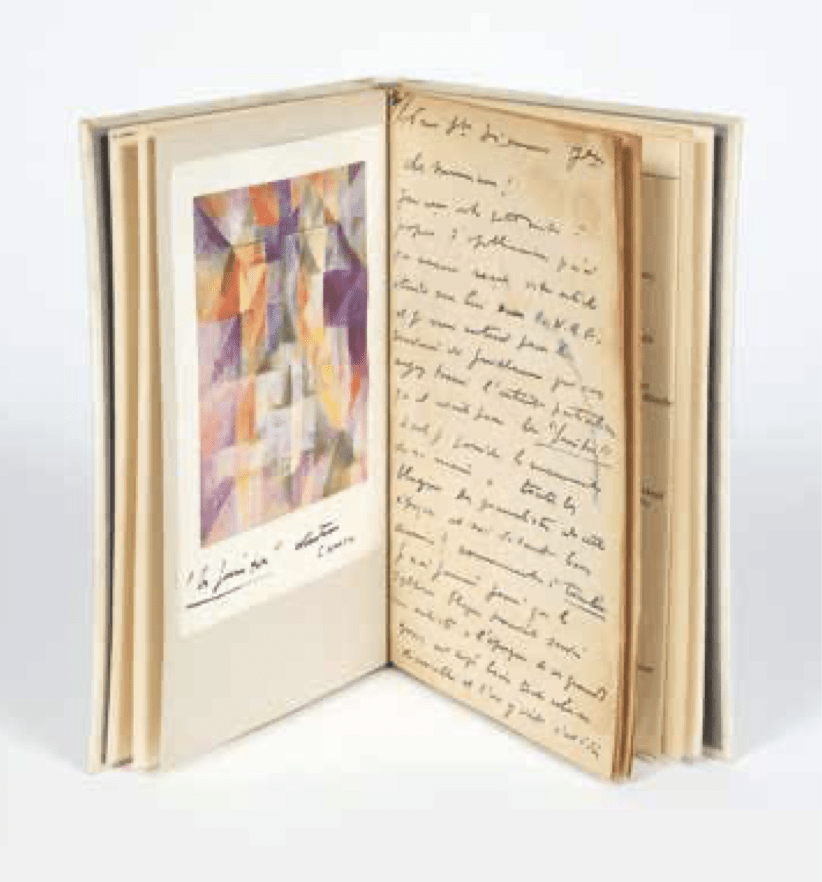
Autographed letter signed to André Rouveyre.
Ten octavo pages bound in Bradel-style vellum.
[Paris, no date]
"Guillaume, who had a long-term vision, had initially done a considerable amount of work on this painting, always following our passionate discussions."
An important and lengthy letter from Robert Delaunay to André Rouveyre, in which the painter nostalgically and in detail reflects on his friend Guillaume Apollinaire and his defense of Cubism. Delaunay discusses the conceptualization of Orphism and his series of paintings, the Windows , which inspired a famous poem by Apollinaire.
The letter was published in a journal in 1951: this publication was bound and folded, along with the handwritten letter. At the top is a reproduction of the Windows annotated by Robert Delaunay.
_______________________________________________________
Dear Sir, I received your short note about Apollinaire. I have not yet received your article-study on him in the NRF and I am pleased, for the sake of Guillaume's memory, that you have discovered his particular interest in Les Fenêtres , of which I possess the manuscript in his own hand.
All the jokes made by journalists of that era, and so-called good friends!, are starting to fall apart. I never thought the "joke" system could serve an artist. The era of those overgrown children is long gone; everything is being stripped away, and we can see—or rather, some people can see a little more clearly. Take, for example, the Windows he painted at my place during the month and a half he lived there, at 3 rue des Grands-Augustins, in my studio where I had set up a makeshift bed; our apartment was accessible through the bathroom. It was a period following his release from prison, a period straddling his move from Passy to Boulevard Saint-Germain. It was also a time when he was correcting the proofs of his Aesthetic Meditations which were to be called The Cubist Painters (I also have those manuscripts).
The passionate discussions we had there about so many things would take a small book to summarize. It was the period of my full reaction to Cubism through the colored elements I was introducing into painting (1912) for the first time after the Cubist analysis —a surgical analysis, as he called it. I was introducing the spirit of synthesis, and it was precisely these canvases, the Windows , that were on the easel he saw in the morning when he woke up; his yellow shoes were never far away! He had to , because his study aimed to summarize all the trends gravitating around Cubism—I say forced, often reluctantly, I must say, because this painting, as we can clearly see, is fundamentally the opposite of Cubism. These rhythmic colored elements are, of course, something other than Cubism .
I also have a manuscript that speaks volumes about this battle between us; he was forced to make Cubism fragmented , and the word Orphic (a purely literary term) was his. He was determined to bring everything together like a conductor in the face of the peril that surrounded us all; he was determined to create a united front of painting in the face of general incomprehension, where I place his poem "The Windows," so important, and I understand why he attached this importance to it, for it was new and incomprehensible to his journalist friends, who translated it into a joke: the Parisian spirit .
This front can be explained by that alone, but Guillaume, who had foresight, had first done a considerable amount of work on this painting, always following our passionate discussions. He improvised the word (simultaneous) within the pictorial technique. After painting pure reality , he had planned a book on Orphism that summarized the notes he had made on several occasions regarding pure painting (of which I also have the manuscripts).
I can say without boasting that The Windows had a great influence—I won't say a descriptive one —on his poetry, but on a certain part of his poetry from that period. I understand very well why you have rediscovered in him this particular interest he had in this poem. May these notes help you to discern it (I also have the manuscript The Beginning of Cubism ).
One of the paintings from the Windows series, reproduced in color , a proof of which I am enclosing, belongs to Cassou. My wife and I were completely misunderstood by most of our colleagues, who still clung to conformist Cubist analysis and who often, through Guillaume, offered flashes of insight. Today, with the benefit of hindsight, we see the underlying reasons for these divergences; we see a universal art whose roots lie in that era. An art that is no longer conformist in either spirit or form ; and Cubism may have been the last gasp of analysis, but synthesis triumphs.
Guillaume witnessed these births — the end of the decaying renaissance through him and us, and a new human reality, a pure painting reality. Despite our eventful life, the 1914 war, etc., we saved the traces, the first traces (there is the poem The Tower and the Wheel published as a postcard at Sturm in Berlin during our trip together, which he dedicated to me under a photographic reproduction of one of my paintings).
Here, dear sir, is a quick summary; it's certainly incomplete, but what's in it is accurate regarding Guillaume's visit to my studio. As I told you, there's a great deal to say about that time. Perhaps we could meet; perhaps you could come to the studio. Speaking in person is quicker for me than writing, especially at the end of the day. I know you were a friend of his; he often spoke of you to us. R. Delaunay.
PS A friend told me you published a book on GA, could you please send it to me?.
P.S. — Rereading this note in your reply, I'm not sure if I fully emphasized the document you're asking for. It's curious, because it's actually been that for some time now (I say curious because it seems to me that this should have been obvious to contemporaries) research has been conducted in the field of visual arts, research on the origins of so-called abstract, non-objective painting, but which essentially means painting belonging to a radically new spirit – new in every respect – a universal technique that has nothing to do with the still formalist Cubism, which hasn't freed itself from chiaroscuro, images of space, distortion, etc., etc., which I, at the time we're discussing, saw as conformist and as representing the end of the Renaissance, this old dependence on habits that have unfortunately become chronic. This research is currently being conducted by a group that will be presenting, chronologically around June, what came after Cubism, and from your note, I see similar movements in poetry. For we mustn't forget that this very important poem by Guillaume is the predominant work of the era in terms of the form and spirit it brought to it. This exhibition parallels what you tell me in your note about poetry. Windows— that which opens the mind to a new reality. Perhaps it is also a sign—surely—the very title, a window that looks far away. You may use these notes as you see fit. RD
_______________________________________________________
Apollinaire composed the poems of Calligrammes between 1912 and 1917. Between 1912 and 1913, Robert Delaunay created the series of Windows . In January 1913, Apollinaire and Delaunay traveled together to Berlin for the painter's exhibition at the Sturm Gallery. To open the eleven-plate catalogue album, Apollinaire wrote The Windows, which would appear at the very beginning of Calligrammes.
The dialogue between poetry and painting, which began at the end of the 19th century, then truly flourished. What did the collaboration around the window, a major motif in painting and literature, mean to these two creators? In this period of artistic effervescence, where the liberation from the constraints of representation began, the window presented itself as an ideal space where it was possible to experiment with other forms of expression.