Nicolas de Staël (1914.1955)
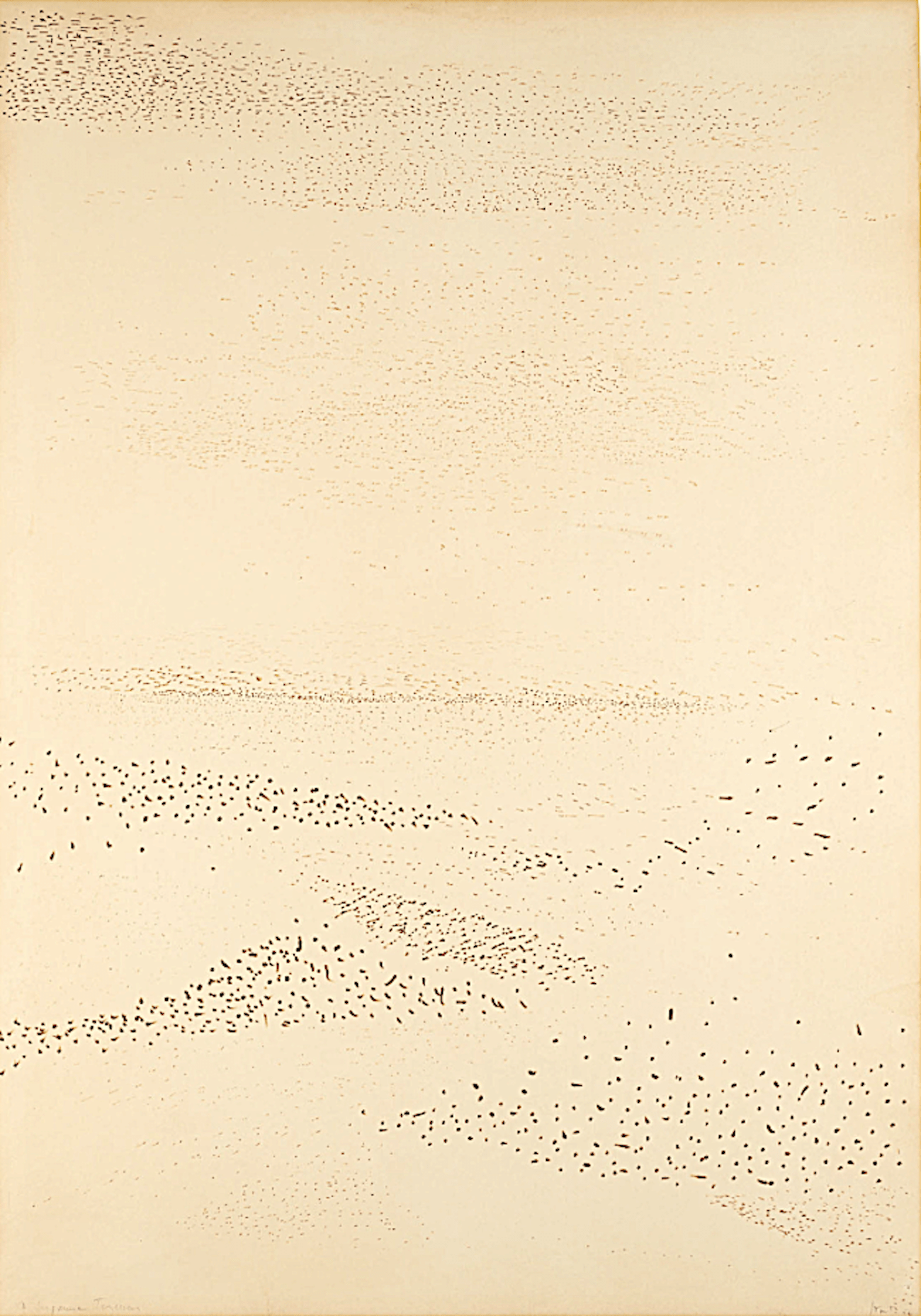
Original signed work – Landscape, 1952.
Felt-tip pen on paper. Dimensions 107 x 75 cm.
"I know that my life will be a continuous journey on an uncertain sea."
Extraordinary work, in spectacular format, by the Franco-Russian artist, signed and dated at the bottom right: Staël 52 , and dedicated at the bottom left: To Suzanne Tézenas.
A precious testimony of the Mediterranean landscapes of Nicolas de Staël, in eternal quest for the absolute aesthetic.
Bibliography:
. Laura Malvano, La mostra di Nicolas de Staël a Torino , 1960 (illustrated page 12).
. André Chastel, Nicolas de Staël , Archives Maeght. Paris, 1972, no. 3 (illustrated page 29).
. Nicolas de Staël , cat. exp., Tate Gallery, London, 1981 (illustrated page 155).
. Daniel Dobbels, Staël , 1994, Paris (illustrated page 49).
. Nicolas de Staël , cat. exp., Galleria Civica d’Arte Moderna, 1960 (illustrated page 80).
. Françoise de Staël, Nicolas de Staël, Catalogue raisonné of works on paper , 2013, no. 485 (illustrated p. 234).
Exhibitions:
. Bern. Kunsthalle, Nicolas de Staël , September-October 1957, no. 101.
. Paris. Galerie J. Bucher, 43 drawings by Nicolas de Staël , February-March 1958, no. 40.
. Arles. Musée Réattu, Nicolas de Staël , June-September 1958, no. 89.
. Hanover. Kestner-Gesellschaft, December-January 1959.
. Hamburg. Kunstverein. Nicolas de Staël, February-March 1960.
. Turin. Galleria Civica d'Arte Moderna, Nicolas de Staël , 1960, n°50 (illustrated p. 80).
. Saint-Paul-de-Vence. Maeght Foundation. Nicolas de Staël , 1972, no. 117 (illustrated p. 29).
Paris. Galerie Jeanne Bucher, 123 drawings by Nicolas de Staël , April-May 1979, no. 13
. Paris. Grand Palais, Nicolas de Staël , May-August 1981, no. 132 (illustrated p. 155).
Origin:
. Collection Suzanne Tézenas, Paris (acquired directly from the artist in 1952).
Anonymous sale, Camards & Associés, June 14, 2005, lot 107.
Schmit Gallery, Paris.
A fascinating personality with a tragic destiny, Nicolas de Staël stands out as a meteor in the constellation of post-war French artists. His suicide, his absolute quest for artistic truth, his refusal to oppose figurative and abstract art, the constant dialogue of his works with the poetry of René Char or the music of Pierre Boulez, and finally his desire to place himself in the lineage of the great masters, have made him one of the most authentic, singular, and endearing French artists of the second half of the 20th century.
Nicolas de Staël took on the colossal challenge of answering one of the great artistic questions of the 20th century: by enriching the great debate between abstraction and figuration with his works and his thought, he attracted the attention of critics who recognized the immensity of his talent. "I do not oppose abstract painting to figurative painting. A painting should be both abstract and figurative. Abstract as a wall, figurative as a representation of space . Nicolas de Staël , 1952.
The work presented here, Landscape , is dated 1952, a pivotal year in the painter's career. It was indeed in this precise year that Staël abandoned pure abstraction to embrace "abstraction-figuration." This expression perfectly describes our drawing, created a few weeks after the famous Parc des Princes .
Our work was created during a stay by the painter in the South of France, and the discovery of the violence of the light by the artist: " The light is simply dazzling here, much more so than I remembered. I will make you some seascapes, beach scenes, measuring the brilliance to the very end if all goes well, and some nocturnal shadow scenes. " (Letter to Jacques Dubourg, Le Lavandou, May 31, 1952).
The work we are presenting is perfectly illustrated by the words of Jean-Louis Prat, a great connoisseur of Staël, who expressed himself thus on the occasion of an exhibition devoted to the painter in 1995: " Between an abstraction that has nothing going for it but the name and a figuration that only imperfectly illustrates reality, Nicolas de Staël explored to the point of exhaustion the true domain of painting in its essence and spirit. "
Gradually, Staël also abandoned India ink for the felt-tip pen, which allowed him greater immediacy and instantaneity. And that was precisely the object of his quest: the light of a moment, the immanence of an instant in a specific place, the infinity of a second.
Our drawing, by its dimensions, its technique, and above all its subject: this ethereal space on the border of dream and reality, echoes that kept at the Museum of Fine Arts of Dijon, The Moon (Granville Donation) certainly made on the same day.
This drawing has graced the walls of the most prestigious museums and foundations in Europe. It can be found on display at the Kunsthalle Bern, the Maeght Foundation in Saint-Paul-de-Vence, the Tate Gallery in London, and the Grand Palais in Paris. No retrospective dedicated to the painter has been complete without this work, so perfectly does it represent the art of Nicolas de Staël: this fusion of form and thought, of written poetry and poetic image, of abstraction and figuration.
What words, better than those of Daniel Dobbels, can express with greater poetry the ineffable impression evoked by this Landscape ? This unknown expanse, this gravitation between earth and sky: “Thing that leads to Everything, passes and vanishes… the invisible lightning flash has occurred: it is its expanse, excessive in every respect… wider, vaster, more welcoming than any journey, any vision, any torn consciousness – and any negation. The vaster the expanse, the finer the edge… the more unheard-of the listening stretched between two stars.”
This work belonged to Suzanne Tézenas (1898–1991), the close friend whom Staël so admired. It was at a concert held at her Parisian salon that Staël was struck by the " color of the sounds ." He then turned to contemporary music: Pierre Boulez, Olivier Messiaen, and jazz, particularly Sidney Bechet, whom he admired and to whom he paid homage in * The Musicians* , now in the collection of the Musée National d'Art Moderne in Paris. Other paintings were inspired by music, such as *The Orchestra * of 1953, a large canvas also in the collection of the Musée National d'Art Moderne in Paris, and * Les Indes galantes * of 1952–1953, inspired by the eponymous opera-ballet by Jean-Philippe Rameau.
Let us conclude with the words of another giant of the last century: Romain Gary, writing to Nicolas de Staël in February 1954 after an exhibition at Paul Rosenberg's gallery: " You are the only modern painter who gives genius to the viewer. "