Categories: Autographs - Arts & Letters , New Releases , Nicolas de Staël
Nicolas de Staël exhausted by his work as a painter.
"Never say I have a lot of paintings, it's not true. I'm at the end of my collection."
Sold

"Never say I have a lot of paintings, it's not true. I'm at the end of my collection."
Sold
Nicolas de Staël (1914.1955)
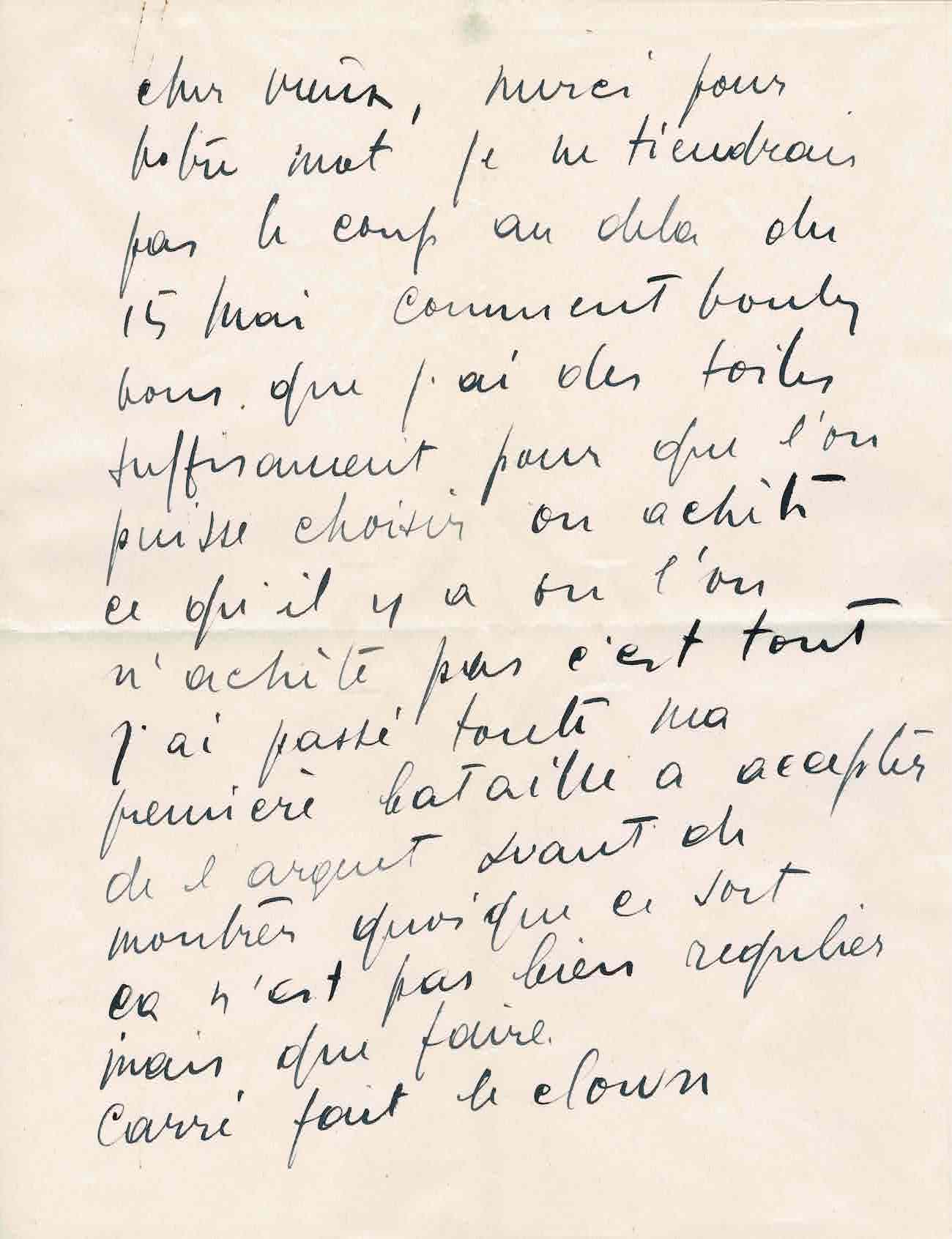
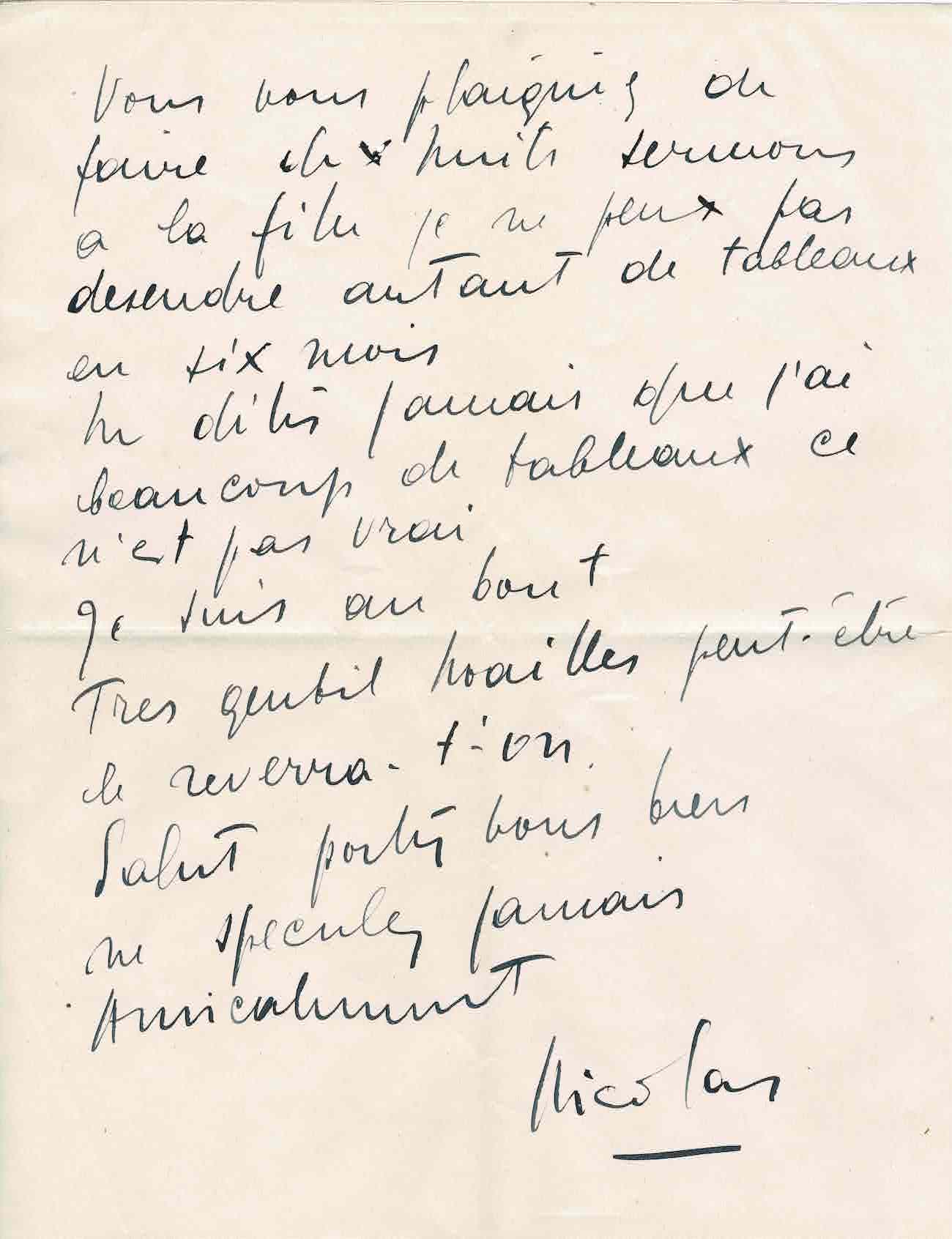
Autograph letter signed to a "dear old man" [probably Jacques Dubourg].
Two pages, large quarto. No place or date [Antibes, 1954-1955].
Unpublished letter in the correspondence.
"Never say I have a lot of paintings, it's not true. I'm at the end of my collection."
A striking letter from Nicolas de Staël, exhausted by his work as a painter.
______________________________________________________________________________________
“Dear old friend, Thank you for your note. I won't be able to hold out beyond May 15th. How do you expect me to have enough canvases for people to choose from? You buy what's available or you don't buy anything , that's all. I spent my entire first battle accepting money before showing anything; it's not very fair, but what can you do? Carré is clowning around [the gallery owner Louis Carré, one of his oldest supporters]. You were complaining about giving eighteen sermons in a row; I can't bring down that many paintings in six months. Never say I have a lot of paintings; it's not true. I'm at the end of my rope. Very kind of you, Noailles; perhaps we'll see him again [the patron Charles de Noailles]. Goodbye, take care. Never speculate. Yours truly, Nicolas.”
______________________________________________________________________________________
This unpublished letter, whose recipient, date, and place are unknown, can nevertheless be placed approximately towards the end of 1954-1955. Indeed, the expression of intense anguish in Staël's work is characteristic of this period in the painter's life; it had not been marked by such profound despair before. Furthermore, the familiar sincerity of what is expressed here, almost in a confidential tone, might suggest that Staël is writing to Jacques Dubourg (1897-1981), an art dealer and very close friend
One particular point raised here by the painter reveals the new pressure he has to bear, that of the art market, which he questions: “You buy what's there or you don't buy it, that's all. I spent my entire first battle accepting money before showing anything. It's not very regular, but what can you do?”
He then found himself in an extremely delicate situation: “Courted by art lovers from all over the world, at a precise moment when old and modern painting became “speculative” values, Staël signed in June 1953 (…) an exclusive contract for America, with the famous dealer Paul Rosenberg, based in New York. This was his fortune. It also meant, from then on, the obligation to produce, to satisfy the pressing demands of dealers and collectors (I)”.
In this letter, there is also mention of Charles de Noailles (1891-1981): “Very nice Noailles, perhaps we will see him again” , prestigious patron and discerning collector of the avant-garde, who had bought his first painting from Nicolas de Staël in 1948 (II).
There is also mention here of the Parisian gallery owner Louis Carré (1897-1977) with whom the painter had signed a contract in 1946 and whom he evokes here in a sarcastic allusion: “Carré is clowning around” , a probable sign of disinterest or at least, a lack of investment from the gallery owner in such a crucial and exhausting moment for the painter.
Indeed, exhibition projects followed one another in 1955: at the Grimaldi Museum for the summer; at the Jacques Dubourg Gallery for the month of June; at the Antibes Museum planned for August (an exhibition which will be maintained despite the suicide of the artist); and two projects in Europe: at the Tooth Gallery in England and at the Zurich Museum.
Staël worked on several canvases at once; the works left the studio too soon, sometimes even becoming damaged and requiring retouching. In our letter, he wondered: “How can you expect me to have enough canvases for people to choose from?” This reflection echoes two letters written in 1955 to Jacques Dubourg: “I can’t paint miles of still lifes and landscapes, it’s not enough ” (III), or “Don’t take me for a factory, I do what I can. We’ll see” (IV). In this sense, he extends his idea here: “Never say that I have many paintings, it’s not true .
He seems to be asking his friend for support that would escape the lies and the infernal rhythm of this environment that erodes his soul and prevents him from creating as an artist, forcing him to reproduce an expected and rigid aesthetic. As proof of his commitment to this idea, he returns to it just before his farewells in an imperative and serious pronouncement: “Never speculate .
In this poignant letter, Nicolas de Staël emphasizes above all the fragility of his strength, in a very concrete way, by mentioning the deadlines imposed upon him: “I cannot paint so many canvases in six months .” This recurring term in the painter’s expression is analyzed by Françoise de Staël: “This trivial expression, when placed in relation to a moment of spiritual tension, takes on another meaning: it is indeed each time a question of elevation. ‘Descending’ is understood as descending from the ideal into the illumination of color. To be constantly at that fire is consuming for a man” (V).
Nicolas de Staël himself confirms this inevitability in our letter: “I wouldn’t be able to hold out beyond May 15th .” This speaks volumes about the exhaustion and tension the painter was under, not to mention the premonitory weight this sentence might carry in light of his suicide on March 16, 1955.
He finally concludes his letter with a terse and unequivocal statement: “I am at the end .” At the end of his endless quest for renewal, at the end of his canvases, of his work; at the end of his strength. The meaning of this sentence is obviously multifaceted, but he himself describes this grave extremity to which he has reached: “I will go without hope to the very end of my anguish, to its tenderness. (…) I will go to the point of deafness, to silence, and it will take time. I weep alone before the paintings; they are slowly, very slowly, in reverse becoming human” (VI).
______________________________________________________________________________________
(I) – Staël , Guy Dumur, Flammarion, Paris, 1975, p.79
(II) – Nicolas de Staël , Centre Pompidou, Paris, 2003, p. 47.
(III) – Letter to Jacques Dubourg, November 6, 1954. Nicolas de Staël – Letters. Ed. Le Bruit du temps. 2014, pp. 612 to 615.
(IV) – Letter to Jacques Dubourg, Antibes, February 26, 1955. Nicolas de Staël – Letters. Ed. Le Bruit du temps. 2014, p. 680.
(V) – Catalogue Raisonné of the painted work , Françoise de Staël, Editions Ides et Calendes, Neuchâtel, 1997, p.161.
(VI) – Letter to Pierre Lecuire, Antibes, November 27, 1954. Nicolas de Staël – Letters. Ed. Le Bruit du temps. 2014, pp. 630 to 632.