Categories: Autographs - History & Science , NAPOLEON , New Arrivals
Napoleon I celebrates his return to power after exile on the Island of Elba.
"My finest campaign will not have cost the French a single drop of blood."
Sold

"My finest campaign will not have cost the French a single drop of blood."
Sold
NAPOLEON I (1769-1821)
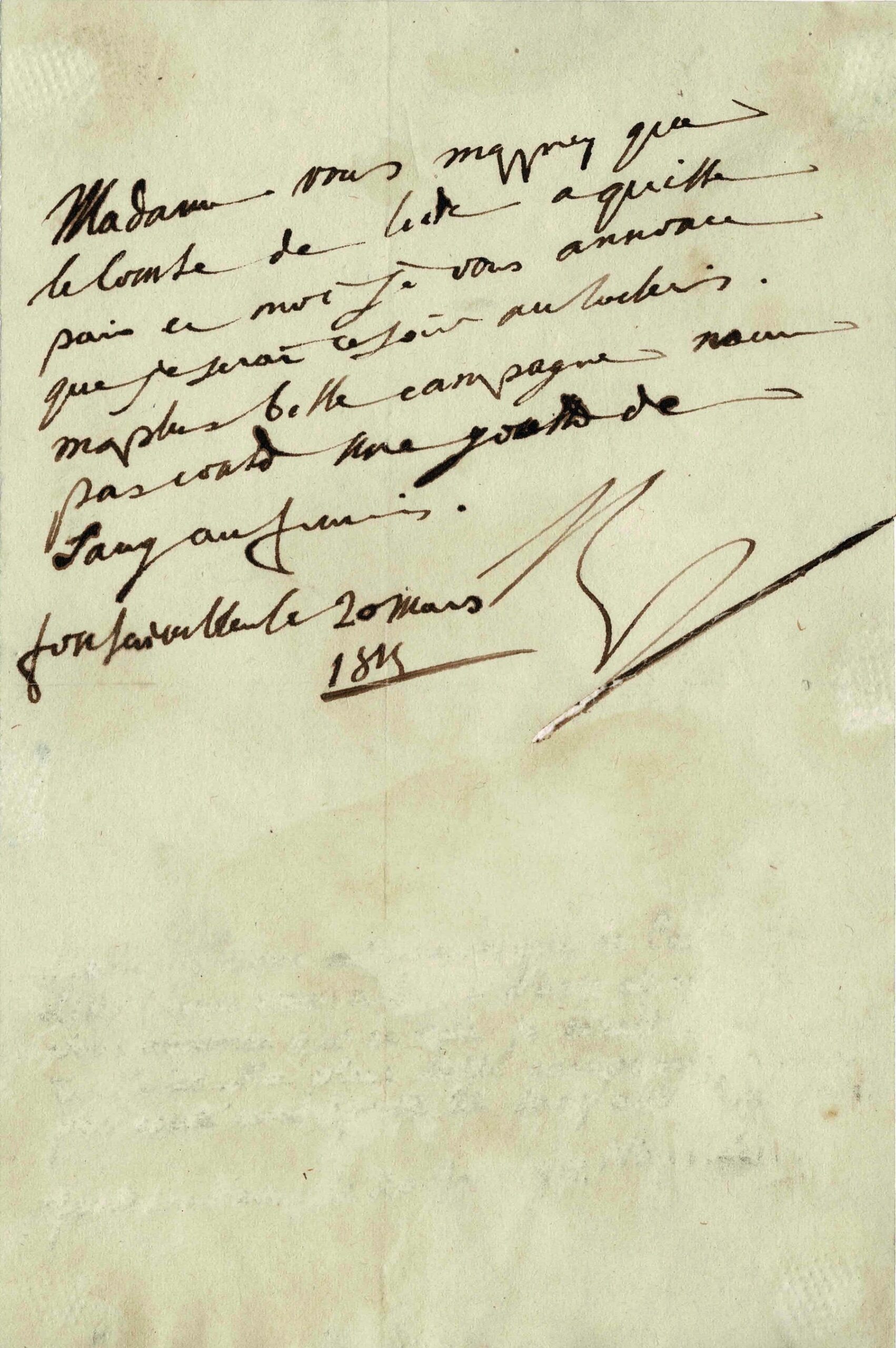
Autograph letter signed NP to Fortunée Hamelin.
Half a page, small octavo.
Fontainebleau. March 20, 1815.
"My finest campaign will not have cost the French a single drop of blood."
A precious letter from the Emperor, of the highest historical interest, celebrating his return to power after his first exile from the Island of Elba.
______________________________________
“ Madam, you inform me that the Count of Lille [Louis XVIII] has left Paris, and I announce to you that I will be at the Tuileries this evening. My finest campaign will not have cost the French a drop of blood. Fontainebleau, March 20, 1815. NP.”
______________________________________
On March 20, 1815, at ten o'clock, the Emperor, returning from his exile on the Isle of Elba, arrived at Fontainebleau. He settled into the château and learned of Louis XVIII's flight from three different sources: – through a courier from M. de Lavalette; – through a letter from Mme Hamelin (to whom this letter is a reply); – and from M. de Ségur.
Indeed, Mrs. Hamelin, upset to learn that Lavalette had dispatched a courier to Fontainebleau to inform Napoleon that the way to Paris was clear, and wanting to get ahead of him, sent another courier who outpaced Lavalette's.
The Emperor, touched by the eagerness of this devoted and influential woman, immediately replied with the note we present here. This brief, moving letter, the first written upon his arrival at Fontainebleau, sweeps aside in a single line the reproach so often leveled at the Emperor for victories too dearly bought: " My finest campaign will not have cost the French a drop of blood."
That same day, at 9 p.m., the Emperor triumphantly entered the courtyard of the Tuileries Palace, to the frenzied cries of " Long live the Emperor! ", thus marking the beginning of the period known as the Hundred Days . " The explosion was irresistible. I thought I was witnessing the resurrection of Christ, " testified Baron Thiébault.
Fortunée Hamelin (1776-1851), a friend of Joséphine de Beauharnais and a Creole like her, was a fervent and loyal supporter of the Emperor, who, appreciating her, entrusted her with numerous secret missions. From the moment of the landing at Golfe Juan, Fortunée Hamelin had posters plastered on the walls of Paris bearing the proclamations addressed by the Emperor to his army and the French people: “ Frenchmen, in my exile, I heard your complaints and your wishes: you demanded this government of your own choosing, which alone is legitimate. You accused me of my long slumber; you reproached me for sacrificing the great interests of the nation to my rest. I crossed the seas amidst perils of every kind; I arrive among you to reclaim my rights, which are also yours.”
______________________________________
Origin:
Drouot Rive Gauche sale, March 21 and 23, 1977 (represented on the cover of the catalogue) / Private collection.
Bibliography:
Napoleon Bonaparte, General Correspondence . Fayard Publishing, 2018.
Napoleon – André Castelot, Ed. Perrin, 2019, pp 554,555.
Memoirs of Fouché and Fleury de Chaboulon , Volume I.
A Marvelous Woman. Madame Hamelin – Alfred Marquiset. Ed. H. Champion. 1909.
Autographs – A. Nicolas. Maisonneuve & Larose, 1988, page 251.
Napoleon, autographs, manuscripts, signatures. Albert Ciana.