HENRY DE MONTHERLANT AND THE PURGE
« I defy anyone to find a single action, a single line, or a single statement of mine during the war, whether against the Russians, the British, the Americans, the communists, or the resistance. As for the Israelites, I acted only in their favor
_________________________________________
An exceptional collection of some 50 letters, notes, manuscripts and documents concerning the indictment of Montherlant at the time of the Liberation, the writer – like many other intellectuals – having been one of the targets of the Committee of French Writers from September 1944. Forced to account for his actions and words before the Purge Commission of the Society of Men of Letters, Montherlant established his defense, with the occasional help of lawyers, justifying himself in particular by his essay Solstice de juin (considered by some as a resignation in the face of defeat), his participation in collaborationist newspapers between 1941 and 1943, and the attitude of withdrawal which he adopted during the war years.
A collection of over 100 pages of various sizes, handwritten or typed, and two filing folders, titled in red pencil, with annotations, one of which is crossed out: “ The major memorandum is at the restoration. In the folder on my radiator. Here in the brown folder. / The thematic table above everything .” In addition to the manuscripts in Montherlant’s own hand, about fifteen of these documents have autograph underlinings, annotations, or postscripts. Some notes and drafts are on the back of letters addressed to him or on typed or printed sheets, including texts by the writer Alice Poirier, a passionate admirer of Montherlant with whom she corresponded for over twenty years.
At the Liberation, Montherlant's name appeared on the list of writers suspected of collaboration drawn up by the National Council of Writers. His case was then examined by the High Court, which referred the matter to the Civic Chamber in the spring of 1945. The latter did not pursue the case, while the SGDL's Purge Commission rendered its decision in October 1946: no charges were brought against Montherlant, who had respected the six-month professional ban imposed two years earlier.
The author gathered various elements for his defense, documents reused in 1952 for the collection Textes sous une occupation and for the writing of a Memoir for a re-edition of Solstice de juin and Équinoxe de septembre , envisaged from 1948 but which would only appear posthumously, in 1976.
We therefore find notes, letters received by the writer as exculpatory testimonies, press clippings, some fragments of these Texts under the occupation , typescripts with autograph corrections of the Memoir in which most of the arguments developed between 1945 and 1946 are repeated.
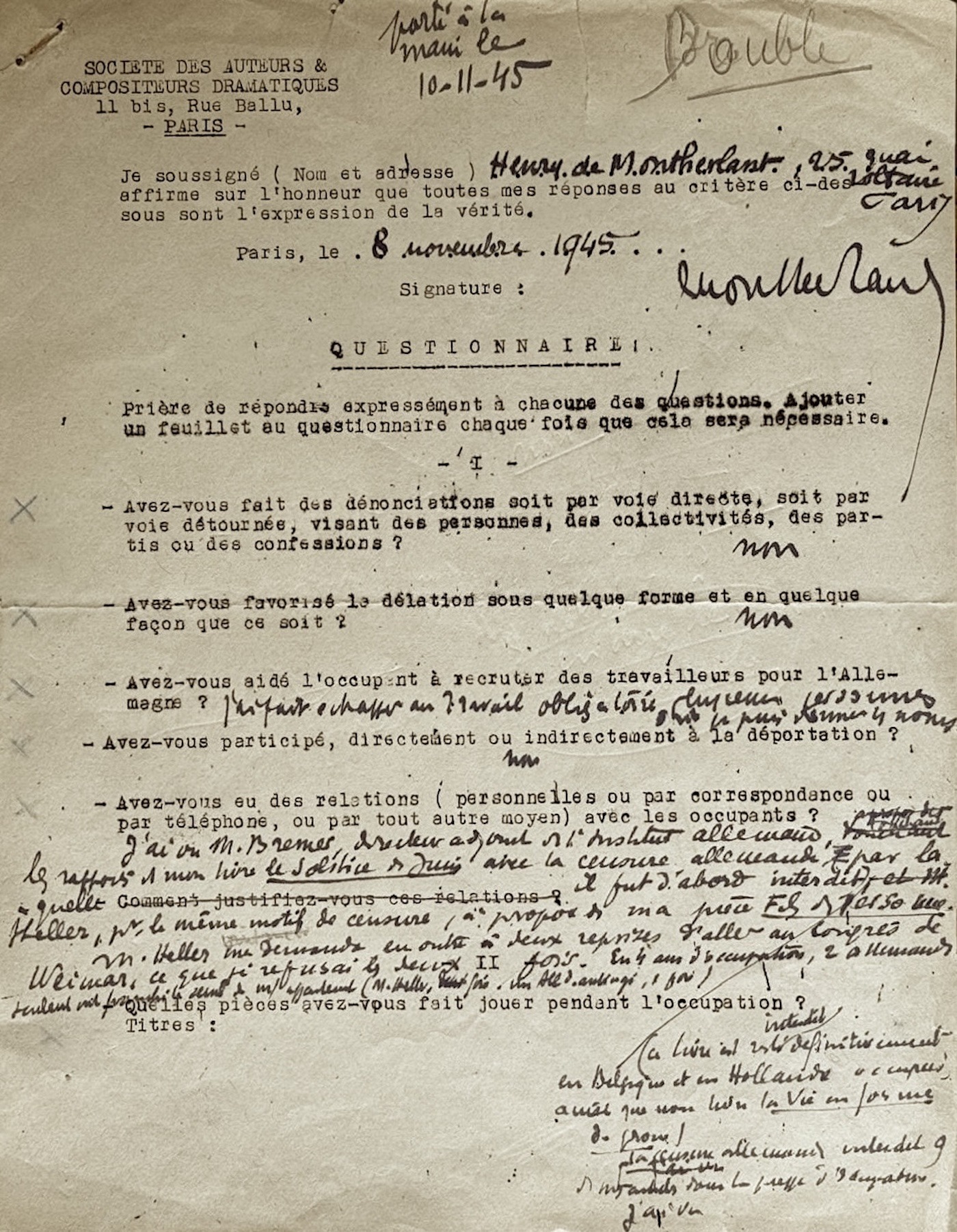
During the examination of his file, Montherlant had to answer, in particular, a questionnaire drawn up by the Society of Dramatic Authors and Composers (SACD) consisting of about fifty questions relating to possible collaboration with the occupying forces, possible sympathy for the regime and the policies of the enemy, asking for an account of publications and professional income, and which ends as follows:
“Even if you did not actually aid enemy propaganda, and if, through writing, speech, deed, or gesture, you were not an active collaborator, judge in your heart and conscience that you did not fail in your duty as a French intellectual entrusted with a mission of trust to the masses. And that your attitude, your behavior, in private as in public, was in accordance with the patriotic dignity that was appropriate after a humiliating defeat, during a materially and morally odious occupation, and in the face of an adversary who, wishing to degrade our country while appearing to call it to collaboration, starved our people, stifled our thought, our culture, and our freedom, tortured our compatriots, shot our hostages, and behaved as a mortal enemy of our genius and our civilization.” In the duplicate copy he kept, Montherlant noted: " I judge that I have not failed in this duty ."
List of documents:
Two signed letters from the Swiss Red Cross – Children's Aid , in Montherlant. October 25 and November 17, 1943. Thanks for the support he gave to this organization, through financial donations and by offering a signed copy of The Dead Queen for sale (Mrs. Micheli received 800 CHF for it).
Letter signed by Albert Buesche to Montherlant. March 7, 1944. Buesche, editor-in-chief of the newspaper Das Reich [a German weekly published between May 1940 and April 1945, featuring editorials by Goebbels], informs Montherlant that in one of his articles, "due to a printing error, one reads 'antisemitism' instead of 'antifeminism.' I deeply regret this error." (Letterhead of the Pariser Zeitung .)
Letter signed by René de Sariac to Mr. de Segrais, lawyer . September 20, 1944. Concerning the memorandum submitted by Montherlant "regarding the position he had adopted before the war and since the Armistice. I submitted this document to the Central Armistice Control Office, where I was informed that no arrest was planned and did not seem necessary in such a case." With an autographed postscript: " This matter was reportedly brought before the Directorate General of Special Services of the 2nd Bureau ."
Autograph letter signed by Georges Lecomte to Montherlant . February 20, 1945. After Montherlant sent the memorandum and met with the members of the Purge Committee of the Société des Gens de Lettres. He has studied it carefully and assures his colleague of his long-standing literary sympathy, acquired particularly since reading Le Songe .
Letter signed by Georges Robert, director of the SGDL in Montherlant . May 25, 1945. Copy of the opinion of the General Assembly of the society which ratified the decision taken concerning it by the Purge Commission on February 7, 1945.
Letter signed by lawyer Maurice Ribet to Montherlant , July 11, 1945. He informs him that the government commission has decided to dismiss his case as a "court of justice" matter. "This file will now be examined by another deputy prosecutor who must decide whether, if necessary, you should be referred to the Civic Chamber for national indignity." Ribet will meet with this second magistrate to plead Montherlant's case. Letter annotated by Montherlant.
Letter signed by Fernand Rouvray, Vice-President and Treasurer of the SACD Commission, to Montherlant , November 2, 1945. He sends him the questionnaire prepared by the SGDL's National Purge Committee, to be returned within 8 days. Montherlant annotates the letter, indicating that the questionnaire was delivered on November 10 and that he requested an acknowledgment of receipt on November 21. A letter from the SACD's Comptroller General, December 7, 1945, acknowledging receipt of the questionnaire, is also included.
A typed and signed copy of the SACD questionnaire, with handwritten answers and notes, marked " handwritten, 10.11.45 ". A typed copy of the questionnaire, which remained blank (under a sheet titled by Montherlant), is also included.
He answers "no" to all questions asking whether, in his plays performed during the Occupation ( The Dead Queen and Son of No One ), he might have served German propaganda or Hitlerian or fascist ideology, whether he collaborated on German or Italian films, whether he sold the copyright to any of his works to German or Italian companies, etc. He explains that the sixty or so articles he published between 1940 and 1943 (which he lists and for which he indicates the fees) are solely literary in nature. He recalls that June Solstice was initially banned by German censors, that he twice refused to attend the Weimar Congress, that his home was searched by the Gestapo in March 1944, etc.
A collection of handwritten notes, some partially typed and corrected (approximately 30 pages), including:
– Notes taken on the advice of Messrs. Leclair, Maurice Ribet, Georges Robert and Leclair, between November 6 and 11, 1945 (on the back of typed pages).
– Fragments of pleadings (including 4 pages on the back of typed sheets of a translation of Luis Vélez de Guevara's play dedicated to Inez de Castro [ The Dead Queen ]). He evokes the calumnies to which he is subjected, affirming that he has never ceased, " both in my writings and in my actions ," to demonstrate his hostility to the Vichy government and the German authorities, and returns to the banning of the June Solstice by the Germans, authorized by the spontaneous intervention of the deputy director of the German Institute, "without my intervention ."
– Financial account sheets. With a statement of his copyright royalties for the editions of La Reine Morte and Fils de personne (“ sums compared and approved by the Gallimard accountant, 9. 11. 1945 ”).
– List of his articles and their remuneration.
– Notes justifying his collaboration with the press during the Occupation. For example, regarding the article "Vilenies" (La Gerbe, February 4, 1943): "Our defeat is moral. I am summarizing what the intellectuals of 1970 were saying. Is it a crime to say it? No, it is not anti-patriotic. Mauriac said it "... or again, quoting a line from Solstice for which he was criticized, " we will see a Christian age rise again... (But) will we be there to 'betray' once again? ", he comments: " The word ' betray ' is used ironically since it is in quotation marks. These quotation marks indicate that it is not really about betraying, but about what the world calls betraying, and what the world calls betraying is surrendering to this rhythm of alternation in which each idea, the wheel turning, is replaced by an opposing idea ."
– Typed note on the June Solstice (“ The way in which even today the meaning of my recent and non-political works is knowingly distorted by a number of commentators (a fact acknowledged in their articles by men as unkind to me as Messrs. Gabriel Marcel and JJ Gautier, for example) continues the methods with which adversaries interpreted the June Solstice. The present makes the past perfectly understandable ”).
– Summary of a legal brief. Montherlant discusses his military service during the First World War, how he constantly predicted a new conflict with Hitler's Germany in his writings, advocating for French rearmament, vehemently opposing the Munich Agreement in * L'Equinoxe de Septembre* while clarifying his view of war as a sport, with defeat to be accepted "sportingly," and always reminding readers that * Solstice de Juin* is filled with attacks against Vichy policies, justifying his wartime stance and income, even claiming responsibility for certain acts of "resistance," such as having managed to save some young men from forced labor in Germany (STO). " I defy anyone to find a single act, a single line, or a single statement of mine during the war, whether against the Russians, the English, the Americans, the communists, or the resistance. As for the Jews, I acted only in their favor."
A – Refusal to remove a story favorable to Jews from a book of my own short stories, when this condition was imposed on me by a German publisher. B – Refusal to serve on the jury of the Balzac Prize, founded by a publisher to whom the Germans had given the Calmann-Lévy publishing house. C – Refusal to join the League of French Thought because Jews were excluded. D – Petition to the government for the reinstatement of the weekly magazine Marianne , suspended for publishing an article by a Jewish author. E – Two interventions on behalf of Mr. Benjamin Crémieux, who had been arrested. Phrases favorable to Jews in books published during the Occupation ».
Autograph letter signed by Henri d'Amfreville to Montherlant . October 24, 1946. Reporting a conversation overheard at the Café de Flore in 1943 between two patrons about an article by Montherlant published in La Gerbe . "Montherlant," said the young man, "has a fine way with irony; he really gets under the skin of the Germans. He added something like, 'He really got them.' These words struck me, and I even repeated them to several friends."
Typed report of the National Committee for the Purging of Writers, Authors, and Composers . Paris, October 29, 1946. Report drawn up after an interview with Montherlant and the lawyer Maurice Ribet and the examination of the defense brief submitted by the writer, imposing all the prohibitions of Article 3 of the ordinance of May 30, 1945, for a period of one year from October 1, 1944. It notably concerns * Solstice de juin * and articles published in German-influenced newspapers. It is noted that this "error of judgment," as the writer himself described his choices, "is particularly regrettable given the important place Montherlant occupies in our literature and the prestige of his name. [...] apart from these facts, Mr. de Montherlant's attitude, as revealed by the file, cannot be held against him; that it is necessary to take into account the fact that he has not published any new work since the Liberation.” With a typed list of the documents presented to the Purge Committee, including a list of articles published in La Gerbe , Le Matin , Aujourd'hui, Nouvelle Revue Française , Comœdia , and Germinal between 1940 and 1943. With a letter signed by the secretary of the National Purge Committee for Writers, dated November 8, 1946, giving notice of the decision of October 29.
Letter signed by Maurice Ribet to Montherlant , January 17, 1946. He asked the Government Commissioner to unfreeze Montherlant's bank account "given that no investigation has been opened and will be opened against him for any reason whatsoever." Underlined in red pencil.
Document signed by an Inspector of Direct Taxes . April 18, 1946. Relating to the solidarity tax: "Mr. de Montherlant is not liable for the enrichment contribution relating to the war years."
Two autograph letters signed by the Swedish writer and linguist Ernst Bendz to Montherlant. Gothenburg, December 14 and 24, 1946. Regarding a book he intends to write to do him justice, and after receiving Montherlant's defense explaining the underlying reasons for his abstention. He rejoices to know that Montherlant has been "rehabilitated" in the eyes of a few thousand fools. A few sentences are underlined in red pencil.
Letter signed by Maurice Ribet to Montherlant , November 14, 1946, sending him a copy of the decision rendered by the National Purge Committee. "The sanction pronounced is purely a formality, since it had vanished before it even had a chance to be implemented. I would obviously have, like yourself no doubt, preferred a more courageous solution, but in legal matters, one must, of course, be content with what is offered. Now is the perfect time to recall your chivalrous theory according to which, once the battle is over, adversaries must reconcile while waiting for 'the wheel to turn'."
Autograph draft of a letter from Montherlant to Henry Muller. April 23, 1947. Montherlant asks him to confirm what he learned while working at Grasset: his German publisher's intention to partially censor Mors et Vita by removing the short story entitled Un petit Juif (A Little Jew) , which he refused – and the banning of Solstice de Juin (June Solstice) in Belgium and the Netherlands. On the back of a letter from Victor Bataille thanking Montherlant for his new book [ Carnets ou Le Maître de Santiago? (Notebooks or The Master of Santiago ?)].
Autograph letter signed by Léon-Pierre Quint to Montherlant . March 10, 1958. Recalling their meeting during one of Quint's very rare stays in Paris in the spring of 1944. During this luncheon, Quint told Montherlant that he was Jewish. "I can still picture your reaction; you seemed amicably distraught. You must have been thinking silently: how bored he must be. And you told me, 'I knew nothing.' If I remind you of this memory, it's to express my trust in you then—total, of course, because I've never liked playing with fire. [...] Today, I think I know less than I did then where you stand. There's no 'occupation.' And you're not writing any news articles (whether in the present tense or the past participle)." It seems to me, moreover, that since 1944/45, what others call your nonchalance has changed form"... A statement by L.-P. Quint, dating from 1945, about Montherlant, will be inserted in the reissue of Solstice in 1976: "the only accusation that could be held against Henri de Montherlant is not that he took the wrong side, but that he did not take any side at all."
Press clippings and printed material, pasted in and annotated by Montherlant . Two articles concerning the Purge Committee (May 1945 and April 1946). English translation of a fragment of an article by the Resistance fighter Jacques Debû-Bridel (published in Horizon in July 1945), accusing Montherlant and Chardonne of benefiting from outrageous immunity despite having played into the hands of the Germans, with an article by the British writer Montgomery Belgion defending Montherlant. Excerpt from a report of the Extraordinary General Meeting of the Société des Gens de Lettres (February 24, 1946).
Collection of notes and handwritten or typed manuscripts, for Textes sous une occupation (Gallimard, 1953) and for the Mémoire (published posthumously).
– “ Notes from 1952 ”. Brief forewords for Texts under occupation (on the back of typed extracts from Equinoxe de septembre) .
– Autograph or typed fragments of some texts from this essay: – “ A man was standing in a subway compartment. During rush hour. It seemed to him that a woman, clinging fiercely to one of the metal supports, resisting all the turmoil of the throng, would have been killed rather than not remain pressed against him .” – A young French girl reads Goethe . – “ Sometimes it seems to me that everything that happens within me happens so far beyond all human understanding .” Severity for contemporary France . “ Now I think you can see how the deepest part of my nature led me to accept defeat for a time .”
– Working manuscript, partly typed, of the Memoir (30 pages). This version presents some variations from the final version. For example, it can be noted that he repeatedly mentions having managed to evade the Compulsory Work Service for several young men, a mention that no longer appears in the text published in 1976. It includes a page titled by Montherlant: “ End of the memoir in its first draft. For the Texts file” (on the back of a letter from the director of the SACD, June 12, 1952, concerning a contract for the translation of the Master of Santiago into Finnish).