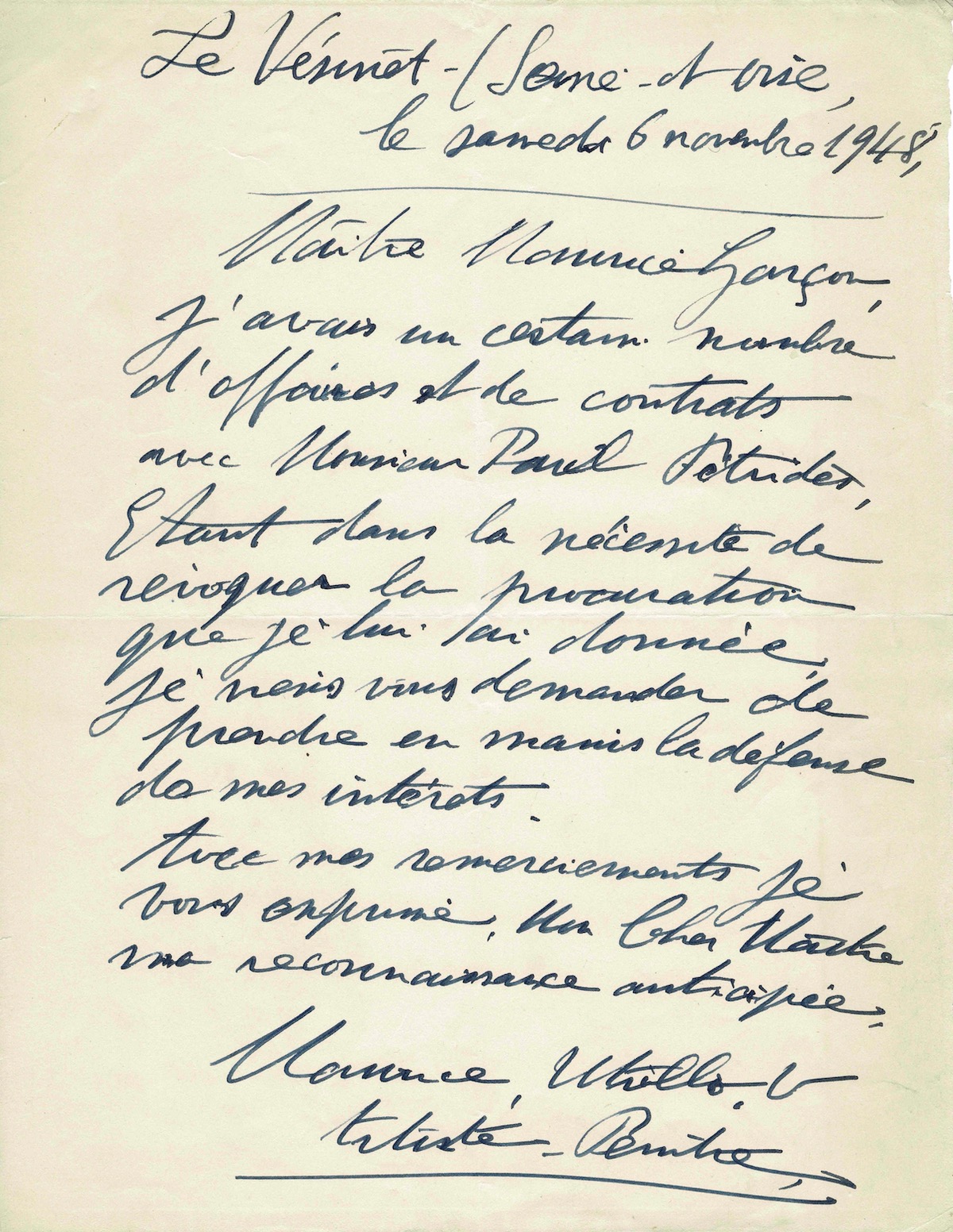

"I had a number of business deals and contracts with Mr. Paul Pétridès."
Sold
Maurice UTRILLO (1883-1955)
Autographed letter signed
A quarto page with frayed edges.
Le Vésinet. November 6, 1948
Utrillo clashed with his dealer Petridès in the famous "fake Utrillo" scandal.
"Master Maurice Garçon, I had a number of business dealings and contracts with Mr. Paul Pétridès. As I am now forced to revoke the power of attorney I granted him, I am writing to ask you to take charge of defending my interests . With my thanks, I express to you, my dear Master, my sincere gratitude in advance. Maurice Utrillo, Painter. "
Few painters have attracted forgers as much as Utrillo. During the first half of the 20th century, these forgers acquired such skill that many seasoned experts, with their noses practically glued to the canvas, were regularly fooled.
In 1935, Maurice Utrillo signed a contract with the art dealer Pétridès, reserving for him the entirety of his output for sale. This agreement was renewed several times, but then, following temporary difficulties, the painter Jean Pinson-Berthet, owner of a small gallery in the Faubourg Saint-Honoré, was led in 1945 to share the profits from the Pétridès contract. This arrangement lasted two years until Utrillo dismissed Pinson-Berthet after various disagreements.
Shortly after this break, twenty-four paintings attributed to Utrillo appeared on the market, which Pétridès declared to be forgeries. An investigation led to the discovery in Troc, Loir-et-Cher, at a country house belonging to Pinson-Berthet, of a freshly painted canvas signed Utrillo and two sketches: a street in Montmartre and the house of Mimi Pinson.
Pinson Berthet fled, leaving a letter in which he protested his innocence. He declared that he was the victim of a cabal, born of his disputes with Utrillo's wife, Lucie Valore (who, according to him, finished and signed her husband's canvases) and of his difficulties with Mr. Pétridès , who had secured a sales monopoly, so that he had an interest in declaring apocryphal all the canvases that did not pass through his hands.
Defended by Maurice Garçon, Utrillo saw this case judged in 1950, before the correctional court of Paris.