Charles Lutwidge DODGSON known as Lewis CARROLL (1832.1898)
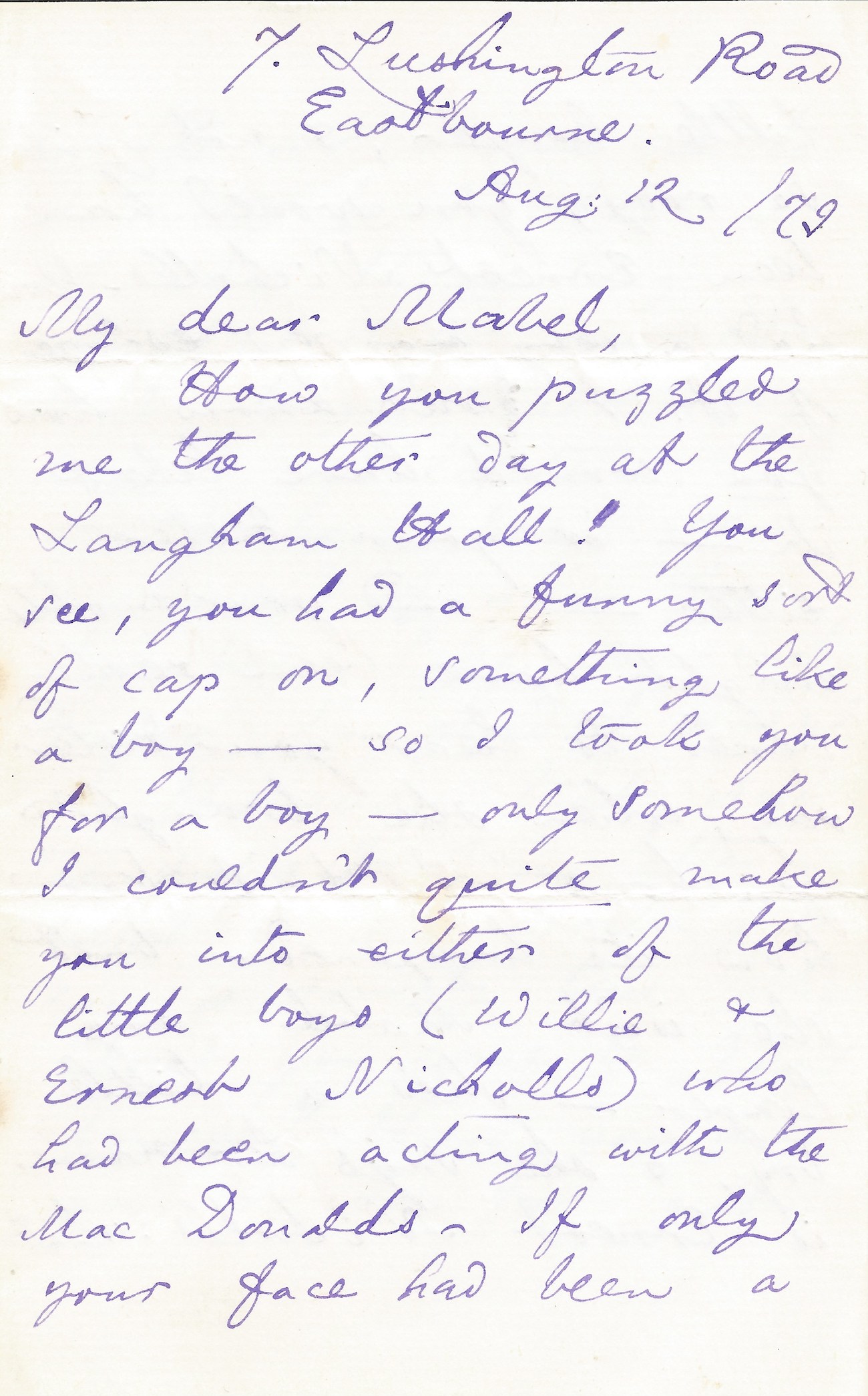
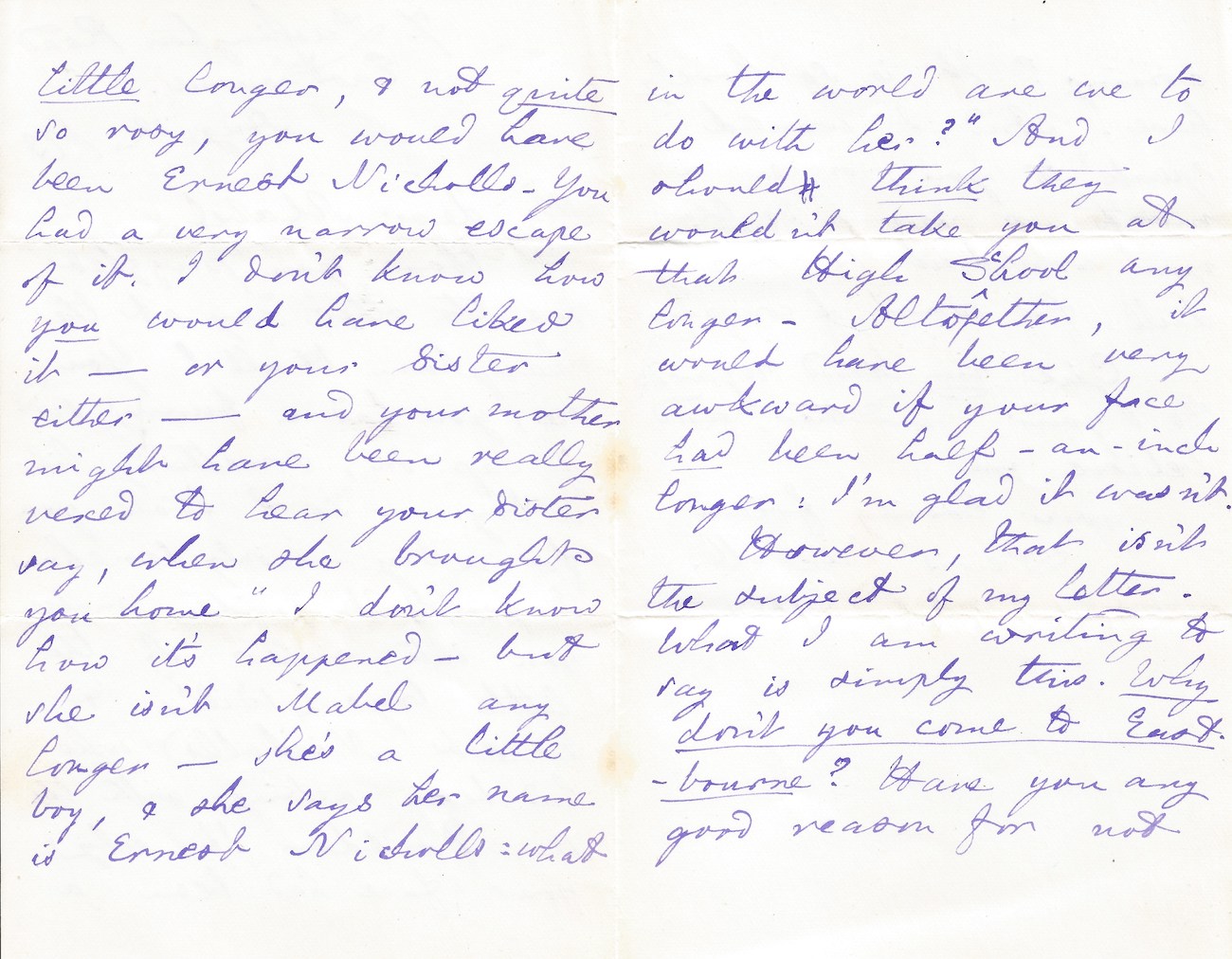
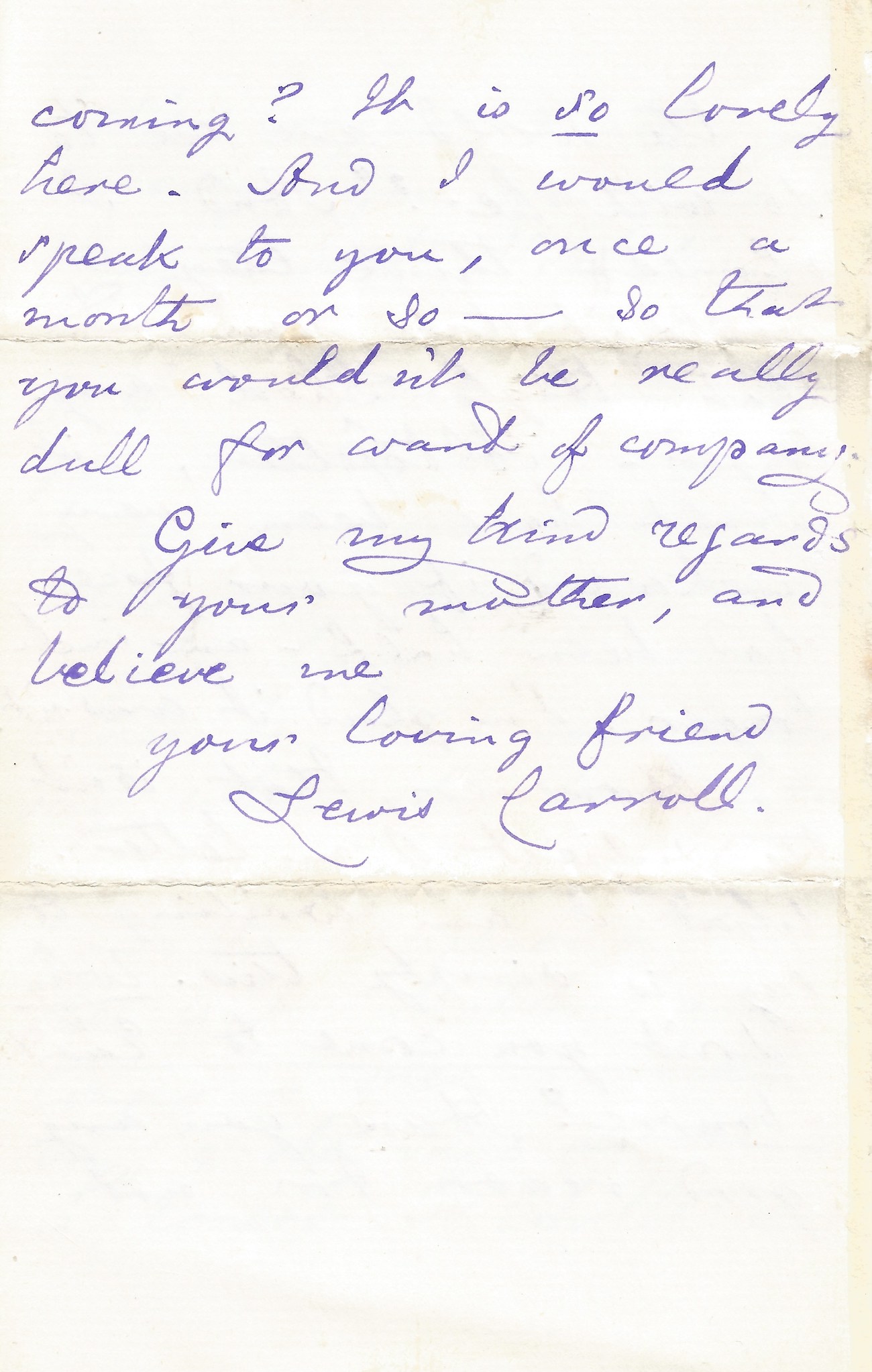
Autographed letter signed " Lewis Carroll " to Mabel Amy Burton.
Four pages in-12° in pink ink.
Eastbourne, August 12, 1879.
My dear Mabel, how you intrigued me the other day at Langham Hall!
An extraordinary letter, filled with typically Carrollian nonsense and absurdity, to young Mabel, his new 10-year -old friend
_______________________________________
" My dear Mabel, how you intrigued me the other day at Langham Hall! You know, you had a funny hat on your head, something like a boy's hat, so I took you for a boy , but for some reason I couldn't recognize you as one of the little boys (Willie and Ernest Nicholls) who were playing with the MacDonalds. If only your face had been a little longer and not quite so pink, you would have been Ernest Nicholls. You had a close call. I don't know if you or your sister would have liked that, and your mother might have been really upset to hear your sister say to her, as she brought you home, ' I don't know how it happened, but it's not Mabel anymore, it's a little boy and she says her name is Ernest Nicholls; what on earth are we going to do with her?' And I don't think they'd want you at school anymore." In short, it would have been very embarrassing if your face had been half an inch longer; I'm glad it wasn't. Besides, that's not the point of my letter. What I want to say is simply this: Why don't you come to Eastbourne? Do you have a good reason not to come? It's so lovely here. And I would speak to you once or twice a month, so you wouldn't be truly bored for lack of company. Give my regards to your mother and believe me always, your affectionate friend, Lewis Carroll .
_______________________________________
Letters to children occupy a very special and prominent place in Dodgson's correspondence, being associated, more than any other, with the very essence of his literary work. We also know, thanks to the various published volumes of his correspondence, that a very small proportion of letters (barely two out of a hundred) bear the mythical signature " Lewis Carroll ," since he always strove to remain anonymous, never alluding to his work in public.
Although the name of young Mabel Amy Burton appeared surreptitiously in the Journal kept by Charles L. Dodgson, no biographical element suggested that this encounter had foreshadowed one of the author's privileged relationships with his "child-friends," until the publication, in 2008, of some fifteen unpublished letters to Mabel and her family.
Indeed, as early as 1898, the very year of Dodgson's death, Mabel had refused to comply with the request of Dodgson's first acknowledged biographer to make their correspondence public. She later explained : " When Lewis Carroll's nephew wrote his uncle's biography, he wrote to me asking if I would entrust him with the letters I had, as he wished to print various passages from them. I refused, and here is why: one day at school, I had brought in one of the letters I had received from him and shown it to everyone, but when I told him that I had done this, he replied: 'My child, my letters to you are for you and no one else.' "
Thus, it was on August 16, 1877, that Mabel—aged 8—entered C.L. Dodgson's life, as evidenced by these few lines written in his diary: “ Went to the pier in the evening and made another happy acquaintance. My new friend is called Mabel Burton. She looks to be about 8 years old (…) I have never been friends with a child so easily and so quickly. ” The next day, he added: “ Went to the beach around 11 o'clock and soon saw my little friend from last night, Mabel, arrive, and I spent some time with her and her cousin. I promised her Alice. ”
A week later, on August 25th, he wrote to Mabel's father, unaware that he had been dead for several years: "Sir, I hope you will excuse the liberty I am taking in writing to you, as well as the one I took a few days ago in befriending your little girl, but I believe that even a man who, unlike myself, is not a great lover of children, could not help but be drawn to her. As I wish to leave a small book for her where she lives (a book I have often given as a gift to young friends), I have made two attempts, in vain, to find out where she resides (...) If you allow me to give her this book, would you be so kind as to tell me whether I should send it to London or, if not, to what address? The book is entitled Alice's Adventures in Wonderland. "
Our letter testifies once again to Dodgson's keen sense of the absurd, as well as his mastery of nonsense, humor, and the principle of reversal, so extensively deployed in his literary work. Starting from a banal observation about Mabel's hat, he playfully explores the confusion of genres and the question of identity, which is also fundamental to the phantasmagorical construction of Alice's universe.
Mabel will provide some details regarding the context of our letter: “ Lewis Carroll was a close friend of George MacDonald and his family (it was to them that he first read his Alice in Wonderland ), and when they presented the second part of The Pilgrim's Progress at Langham Hall, my mother, to fulfill L. Carroll's wish, allowed my older sister to take me with her (…) After the play, we met Lewis Carroll, and I remember him teasing me by calling me 'little boy.' I was wearing a black velvet cap with a pom-pom on the side, and my hair had been cut so short that I must have really looked like a boy. I felt I should tell him who I was then, whereupon, a few days later, I received this delightfully absurd letter.”
From 1885 onwards, the ties with Mabel weakened. As she became a teenager, the magic of her childhood had faded in Lewis Carroll's eyes.
_______________________________________
Original version:
“My dear Mabel, How you puzzled me the other day at the Langham Hall! You see, you had a funny sort of cap on, something like a boy – so I took you for a boy – only somehow I couldn't quite make you into either of the little boys (Willie & Ernest Nicholls) who had been acting with the Mac Donalds. If only your face had been a little longer, and not quite so rosy, you would have been Ernest Nicholls. You had a very narrow escape of it. I don't know how you would have liked it – or your sister either – and your mother might have been really offended to hear your sister say, when she brought you home “I don't know how it's happened but she isn't Mabel any longer – she is a little boy, and she says her name is Ernest Nicholls: what in the world are we to do with her?” And I should think they wouldn't take you at that High School any longer. Altogether, it would have been very awkward if your face had been half-an-inch longer: I am glad it wasn't. However, that isn't the subject of my letter. What I am writing to say is simply this. Why don't you come to Eastbourne ? Have you any good reason for not coming? It is so lovely here. But I would speak to you, once a month or so – so that you couldn't be really dull for want of company. Give my kind regards to your mother, and believe me your loving friend Lewis Carroll.”
Bibliography: "Lewis Carroll: Unpublished Letters to Mabel Amy Burton and Her Parents." Pierre E. Richard. Éditions de Maule. 2008