Jean Paul Sartre (1905.1980)
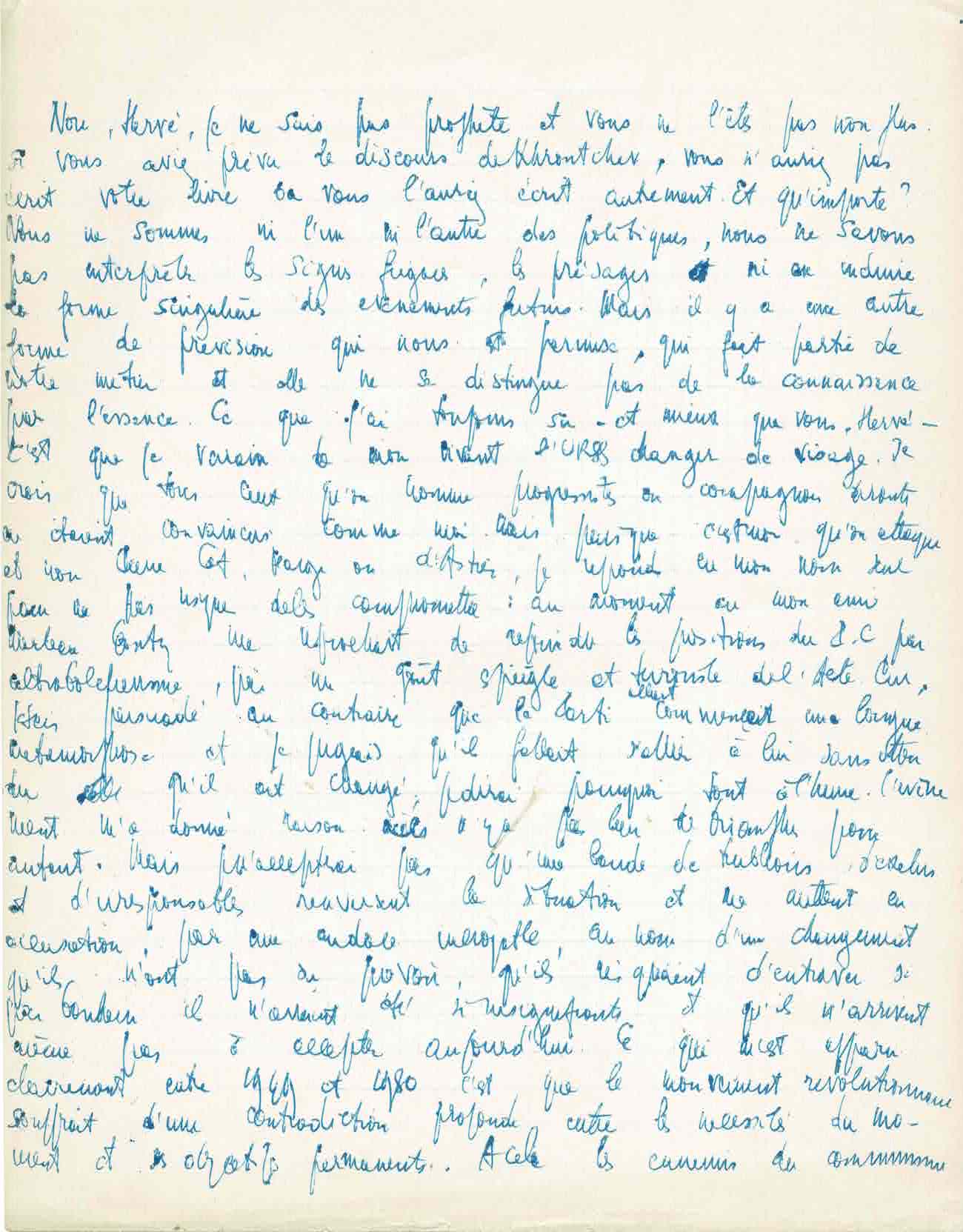
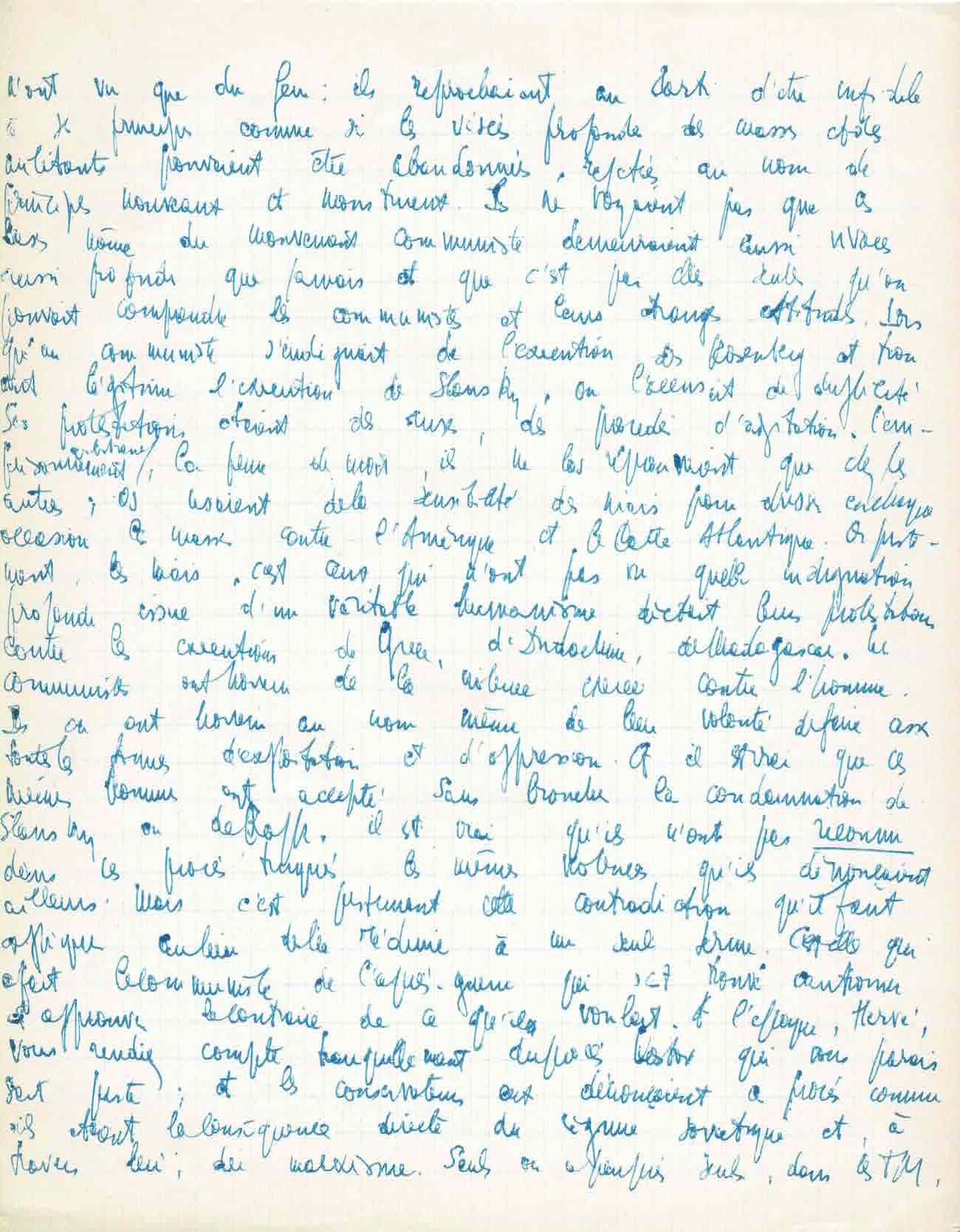
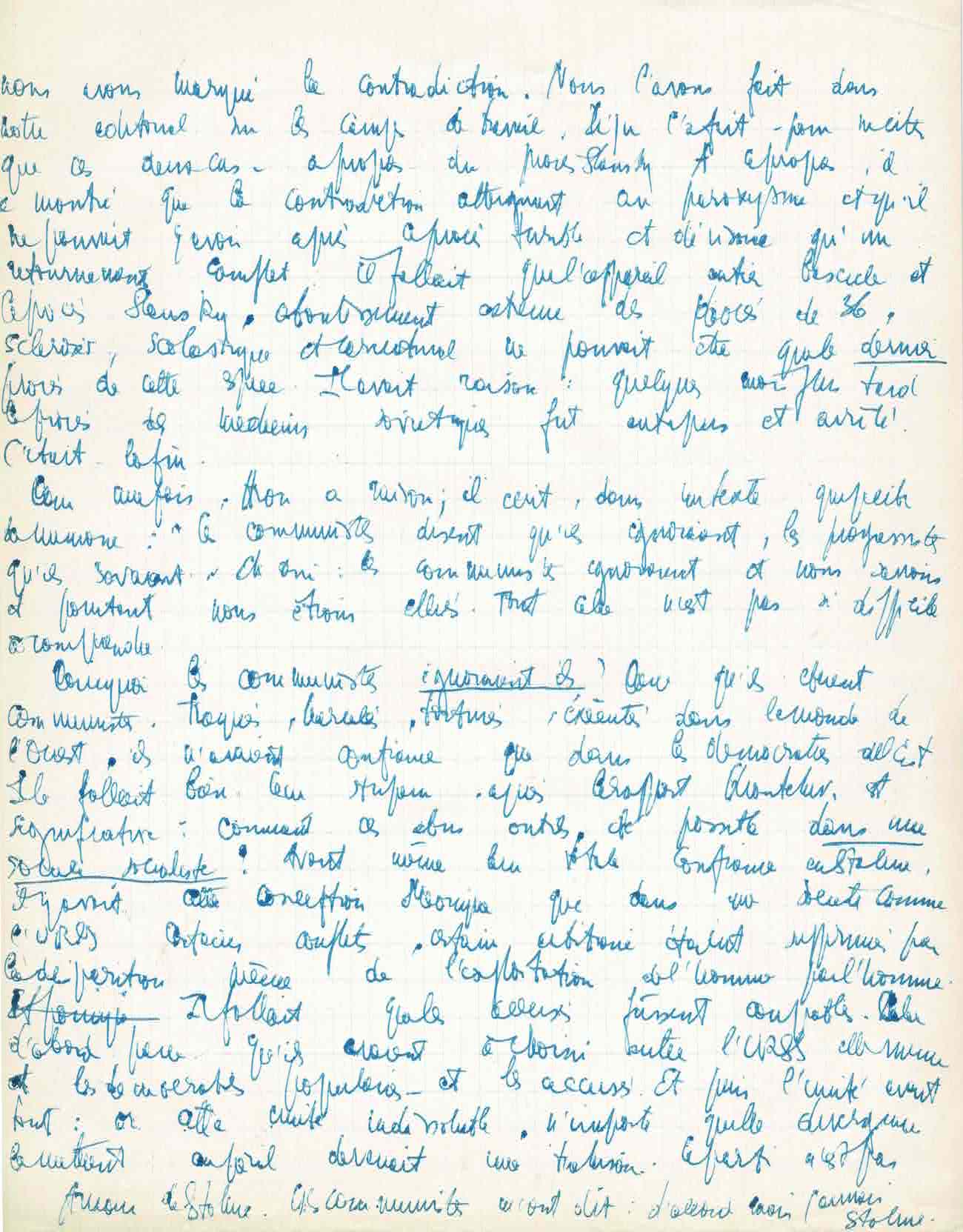
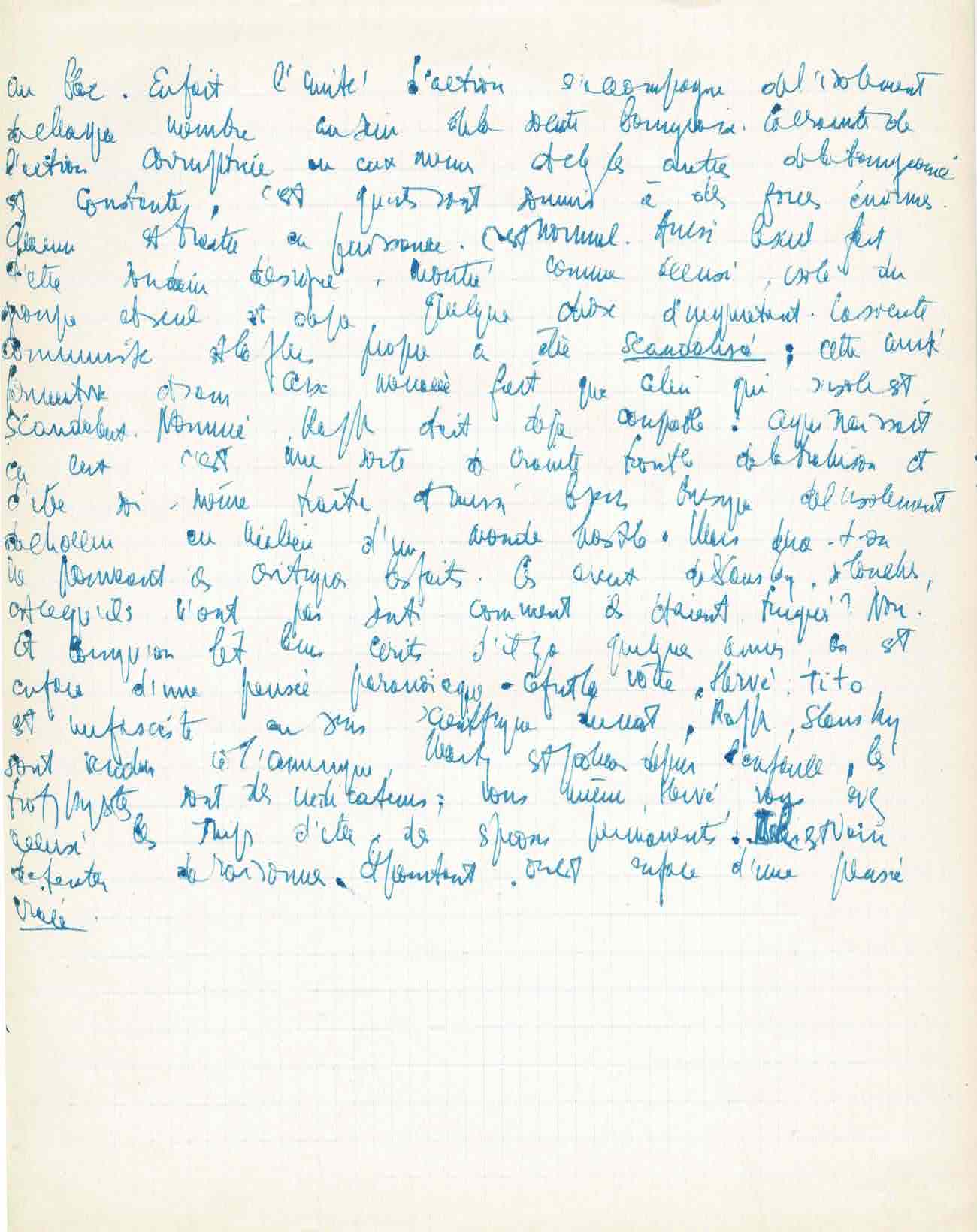
Autograph manuscript.
Four large quarto pages on graph paper.
No date given. [Spring 1956]
"What became clear to me between 1949 and 1950 was that the revolutionary movement suffered from a profound contradiction between the necessities of the moment and its permanent objectives."
Dense and important political manuscript, first draft, by the French communist philosopher developing, in the form of an open letter, his arguments of contradiction following the publication of the polemical and anti-Stalinist pamphlet by Pierre Hervé, La Révolution et les fétiches , while the resounding declarations of Nikita Khrushchev at the podium of the 20th Congress of the Communist Party of the Soviet Union – also denouncing the totalitarian excesses of Stalin – gave rise to a wave of shock and destabilization on all communist apparatuses in the world.
_____________________________________________________________________________________________________
“ No, Hervé, I’m not a prophet, and neither are you. If you had foreseen Khrushchev’s speech , you wouldn’t have written your book, or you would have written it differently. And what does it matter? Neither of us is a politician; we don’t know how to interpret fleeting signs, omens, or deduce the singular form of future events. But there is another form of prediction that is permitted to us, which is part of our profession, and it is essentially indistinguishable from knowledge. What I have always known—and better than you, Hervé—is that I will see the USSR change its face in my lifetime . I believe that all those called progressives or fellow travelers were convinced of this, just as I was.” But since it is I who am being attacked and not (…) or d’Astier, I will answer in my own name only so as not to risk compromising them: at the very moment when my friend Merleau-Ponty was reproaching me for joining the Communist Party's positions out of ultra-Bolshevism, out of a mischievous and terrorist taste for the Pure Act, I was convinced, on the contrary, that the party was beginning a long metamorphosis and I judged that it was necessary to ally with it without waiting for it to change. I will explain why later. Events have proven me right, but that doesn't mean we should celebrate. But I will not accept that a bunch of troublemakers, outcasts and irresponsible people reverse the situation and accuse me, with incredible audacity, in the name of a change that they failed to foresee, that they risked hindering if by chance they had not been so insignificant and that they cannot even accept today.
What became clear to me between 1949 and 1950 was that the revolutionary movement suffered from a profound contradiction between the necessities of the moment and its enduring objectives. The enemies of communism were completely taken in by this: they accused the party of being unfaithful to its principles as if the deep aspirations of the masses and the militants could be abandoned, rejected in the name of new and monstrous principles. They failed to see that the very foundations of the communist movement remained as vibrant and profound as ever, and that it was only through these foundations that one could understand the communists and their peculiar attitudes. When a communist expressed outrage at the execution of the Rosenbergs [Julius and Ethel Rosenberg, New York communist activists, executed in June 1953] [Rudolf Slansky, a communist activist executed in 1952] legitimate he was accused of duplicity. Their protests were mere ruses, tactics of agitation. Imprisonment and the death penalty were something they only condemned in others. They exploited the sensibilities of outsiders to divide the masses against America and the Atlantic. And these outsiders were precisely those who failed to see the profound indignation, born of genuine humanism, that dictated their protests against the executions in Greece, Indochina, and Madagascar. Communists abhor violence against humanity. They abhor it precisely because of their desire to end all forms of exploitation and oppression. And it is true that these same people accepted the condemnation of Slánský and Rajk without a murmur. It is true that they did not recognize in these rigged trials the same violence they denounced elsewhere. But it is precisely this contradiction that must be explained, rather than reduced to a single term. It was she who created the post-war communist who ended up endorsing and approving the opposite of what he wanted.
At the time, Hervé, you were calmly reporting on the Kostov trial [Traicho Kostov (1897-1949), leader of the Bulgarian Communist Party, sentenced to death and executed in 1949, following a rigged trial], which seemed just to you; while the conservatives were discovering this trial as if it were a direct consequence of the Soviet regime and, through it, of Marxism. Alone, or almost alone, in Les Temps Modernes, we pointed out the contradiction. We did so in our editorial on the labor camps. Péju did so—to cite only these two examples—regarding the Slánsky trial. In this regard, he demonstrated that the contradiction had reached its peak and that, after this terrible and farcical trial, only a complete reversal was possible: the entire system had to collapse, and the Slánsky trial, the external culmination of the 1936 trials, sclerotic, scholastic, and a caricature, could only be the last trial of its kind. He was right: a few months later, the trial of the Soviet doctors was initiated and halted. That was the end.
For once, Aron is right ; He writes, in a text I quote from memory: “The communists say they were ignorant, the progressives say they knew. Yes, indeed: the communists were ignorant and we knew, and yet we were allies. All this is not so difficult to understand. Why were the communists ignorant ? Because they were communists. Hunted, harassed, tortured, executed in the Western world, they trusted only the democracies of the East. They had to. Their astonishment after the Khrushchev Report significant : how were these abuses possible in a socialist society this [ theoretical] conception that in a society like the USSR, certain conflicts, certain arbitrary actions, were eliminated by the very disappearance of the exploitation of man by man. The accused had to be guilty. First, because they had to choose between the USSR itself and the people's democracies— And the accused. And then unity was everything: but any divergence that threatened this indissoluble unity became treason. The party is not love for Stalin. The communists told me: okay, but never Stalin as a whole. In fact, unity of action is accompanied by the isolation of each member within bourgeois society. The fear of corrupting influence within themselves and others in the bourgeoisie is constant. This is because they are subject to enormous forces. Everyone is a potential traitor. That's normal. So the mere fact of suddenly being desperate, shown as accused, isolated from the group and alone is already something disturbing.
Communist society is the most prone to scandal : this […] and constant threat makes anyone who isolates themselves scandalous. Once named, Rajk was already guilty. What was born in them was a kind of [troubling] fear of betrayal and of being a traitor themselves, and also [… …] of isolation in the midst of a hostile world. But, one might say, couldn't they criticize the facts? Slansky's confessions, so dubious, didn't they sense how fabricated they were? No. And when you read their writings from a few years ago, you're confronted with paranoid thinking. That was yours, Hervé. Tito is a fascist in the scientific sense of the word. Rajk and Slansky are in the pay of America. Marty has been [… since childhood], Trotskyists are informers; You yourself, Hervé, accused the Jews of being permanent spies. It's pointless to try to reason with them. And yet, we are faced with a true .
_____________________________________________________________________________________________________
A former member of the Resistance and professor of philosophy, Pierre Hervé (1913-1993) was elected Communist deputy for Finistère in October 1945. Re-elected in the November 1946 legislative elections, he simultaneously pursued a career as a journalist, first at Libération, then at L'Humanité, where he became deputy director. Leaving his political mandate in June 1948, he devoted himself to the weekly newspaper Action .
At the dawn of 1956, Hervé published " The Revolution and the Fetishes ," condemning the dogmatism of the Communist Party and urging the organization to free itself " from a fetishistic scholasticism to return to its authentic spirit and open itself to the immense aspirations of humankind ." The French Communist Party's response was almost instantaneous, and he was expelled just before the opening of the party's 20th congress.
As a result, several articles and open letters from Pierre Naville, Pierre Hervé and Jean-Paul Sartre were published; the latter hurling insults at each other for several months in an obscure political joust in light of the post-Stalinist Soviet situation.
Hervé will finally respond to the various criticisms his work had received in Letter to Sartre and to a few others at the same time (La Table Ronde, May 1956).