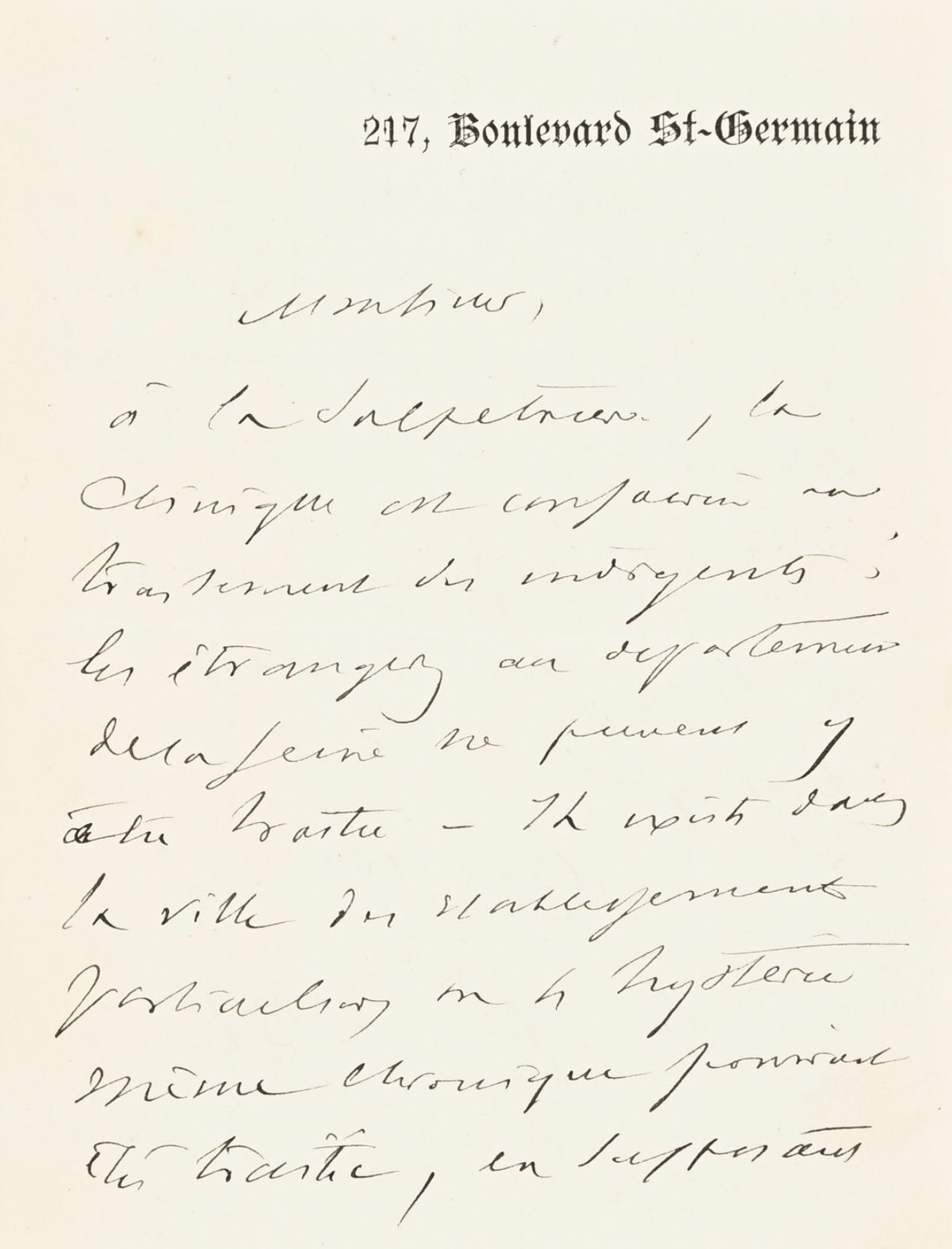
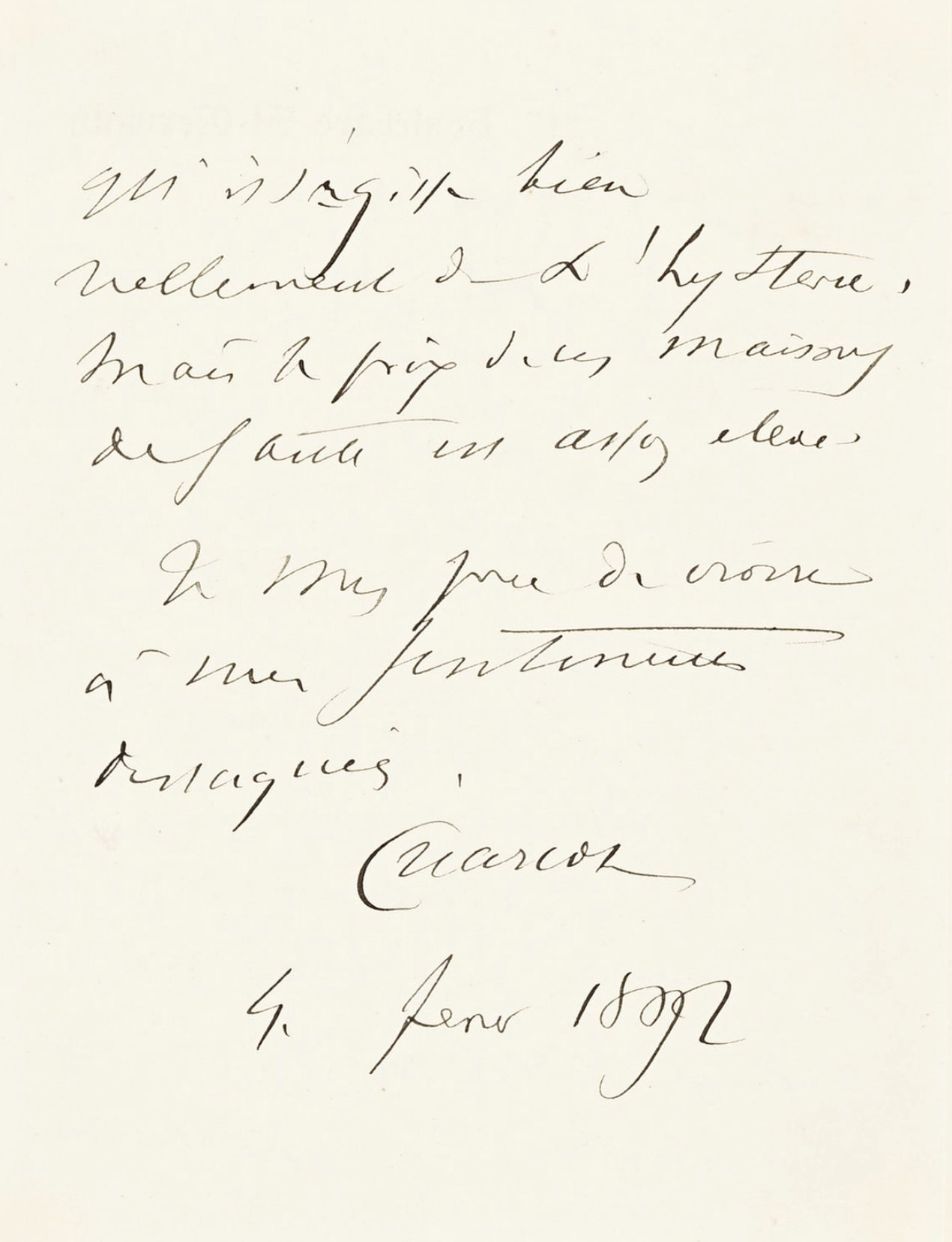
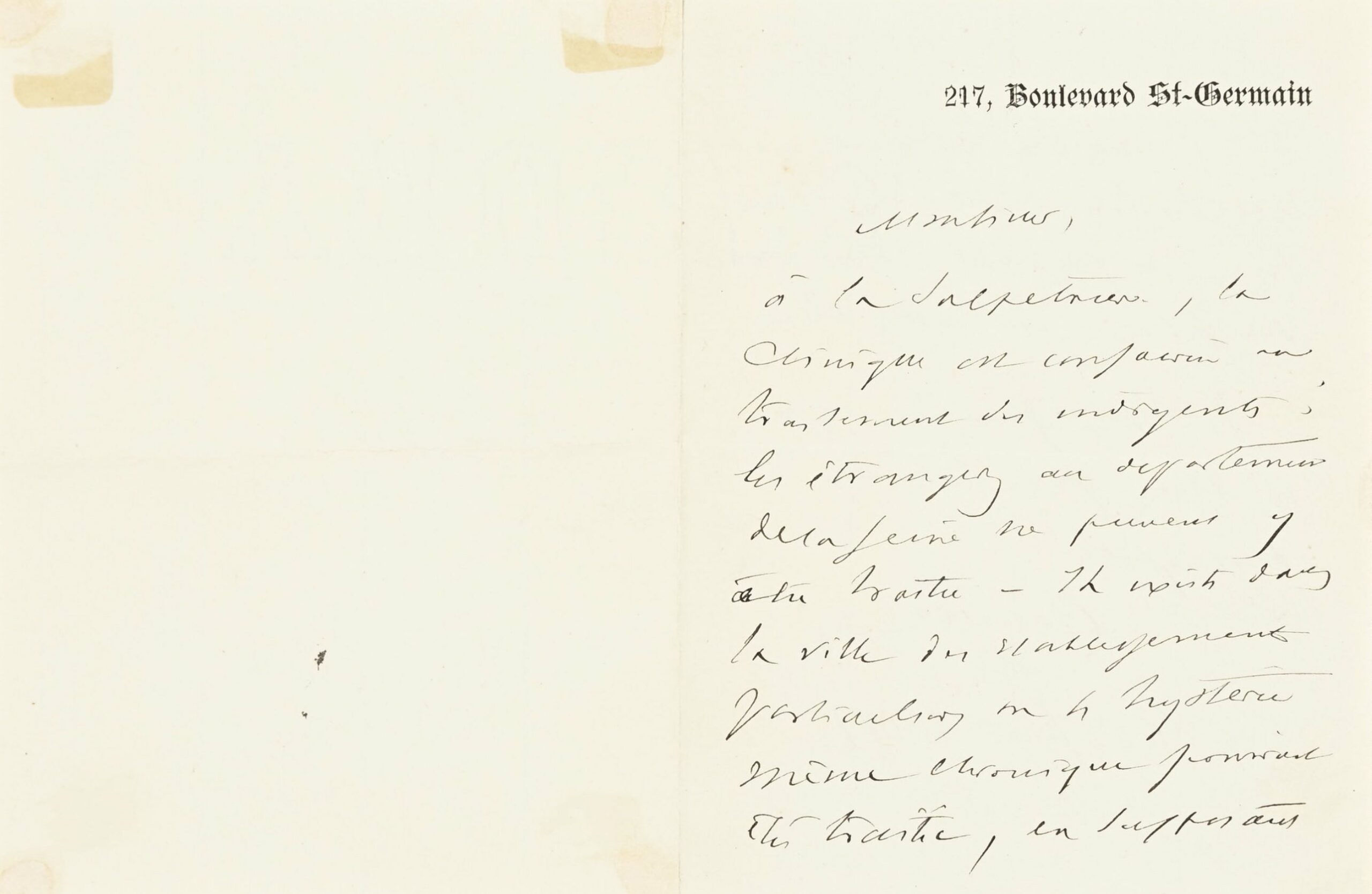
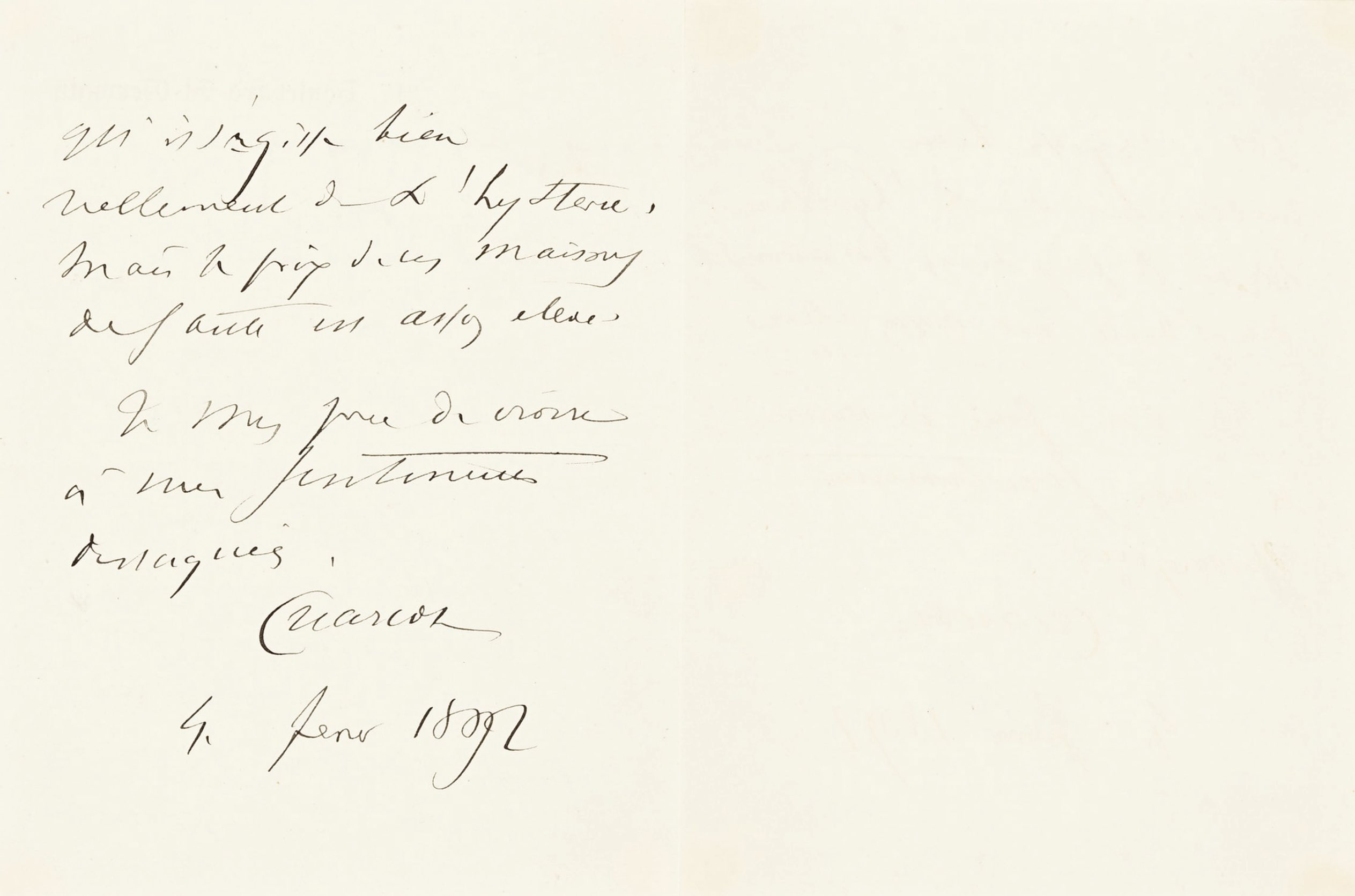

« Even chronic hysteria could be treated, assuming that it is indeed hysteria
1.800€
Jean-Martin CHARCOT (1825- 1893)
Autographed letter signed.
Two pages in-12° on paper with his address at the Hôtel de Varengeville.
Paris. February 4, 1892.
« Even chronic hysteria could be treated, assuming that it is indeed hysteria
The French neurologist, a leading figure at the Salpêtrière School, discusses the treatment facilities for chronic hysteria.
__________________________________________
“Sir, at the Salpêtrière, the clinic is dedicated to the treatment of the indigent ; those from outside the Seine department cannot be treated there. There are private establishments in the city where even chronic hysteria could be treated, assuming it is indeed hysteria. But the cost of these clinics is quite high. Please accept my sincere regards. Charcot.”
__________________________________________
Jean-Martin Charcot remains one of the most illustrious French clinicians and the initiator of modern neurology and psychopathology, in light of his work on hypnosis and his research on hysteria.
A professor of pathological anatomy at the University of Paris from 1860 to 1893, Charcot opened a neurological clinic in 1882 within the Salpêtrière Hospital in Paris, welcoming students from all over the world. The most famous of these, Sigmund Freud—a student from 1885 to 1886—testified to how decisive Charcot's work on hysteria was for his psychoanalytic research: "Charcot is one of the greatest physicians whose reasoning borders on genius, [...] no one has ever had such an influence on me." His work on the psychological origins of neurosis would be built upon Charcot's studies on hypnosis training.
Elected a member of the Academy of Medicine in 1873, his work on the nervous system led him to establish a very precise description of multiple sclerosis and amyotrophic lateral sclerosis; the infamous Charcot's disease.
However, it was this work on hysteria and hypnosis that revolutionized 19th-century medicine. These treatment methods, often criticized, gave considerable importance to electrotherapy. As early as 1875, the neurologist had an electrotherapy department organized for this purpose by the physician Romain Vigouroux, developing therapy using static electricity.
__________________________________________
TheHôtel de Varengeville, also Hôtel de Guerchy , is the private mansion that was Charcot's residence, located at 217 Boulevard Saint-Germain in the 7tharrondissement of Paris, where the Maison de l'Amérique latine (House of Latin America) is now located. Jean-Martin Charcot acquired the mansion from the Gontaut-Biron family in 1884. Upon the neurologist's death, his heirs sold the mansion to the Banque d'Algérie (Bank of Algeria). After Algerian independence in 1962, the property reverted to the Caisse des retraités de la Banque de France (Bank of France Pension Fund).