Jean Cocteau (1889.1963)
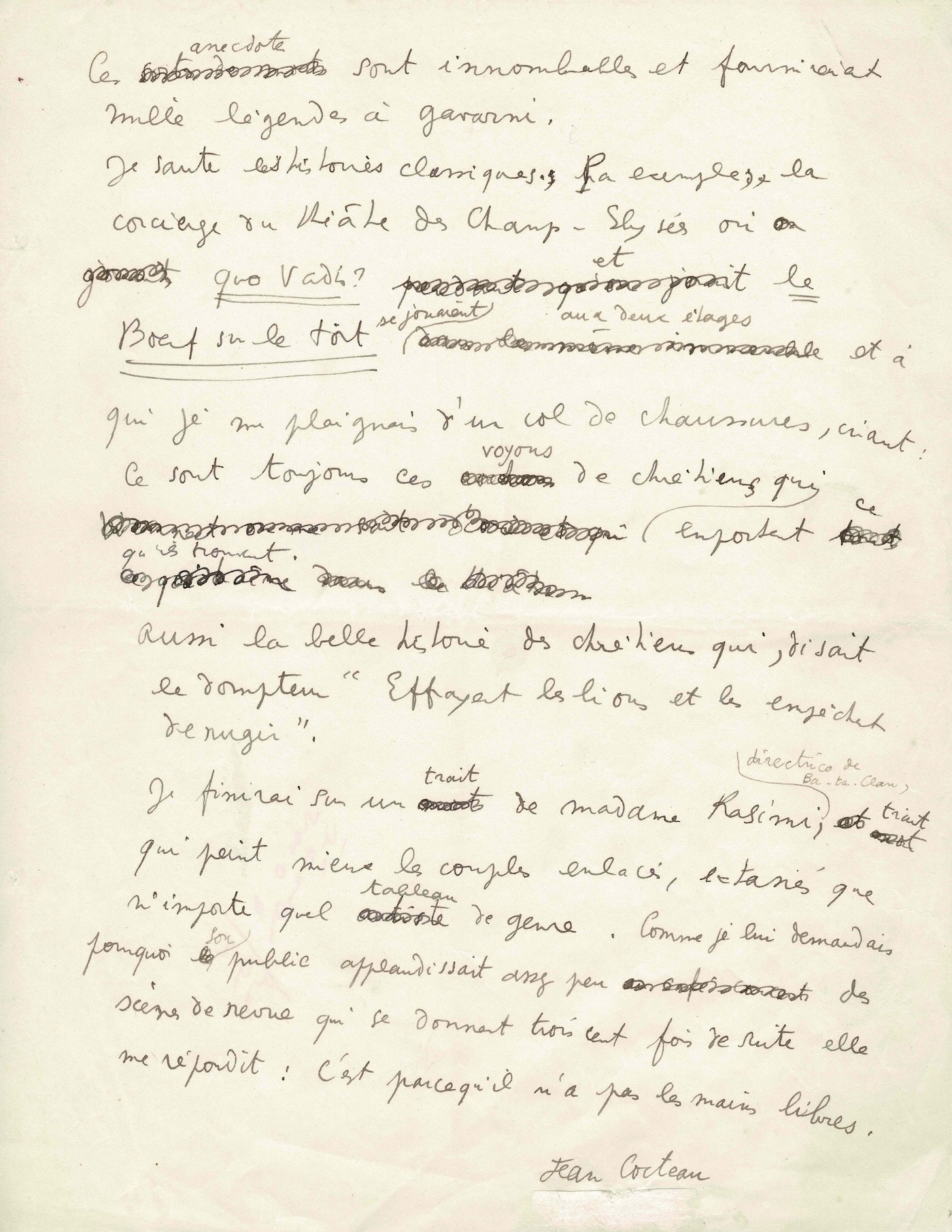
Autograph manuscript signed – Theatre memories .
Five pages, large quarto. No place or date.
Small paper collage below the signature.
A beautiful first draft of Cocteau's manuscript, in which he recalls with detachment the scandals, criticisms, and other absurdities that arose from his theatrical work. He dwells at length on the hostility provoked in 1917 by his ballet Parade and on his friends who collaborated on the piece: Guillaume Apollinaire, Pablo Picasso, and Erik Satie.
______________________________________________________________
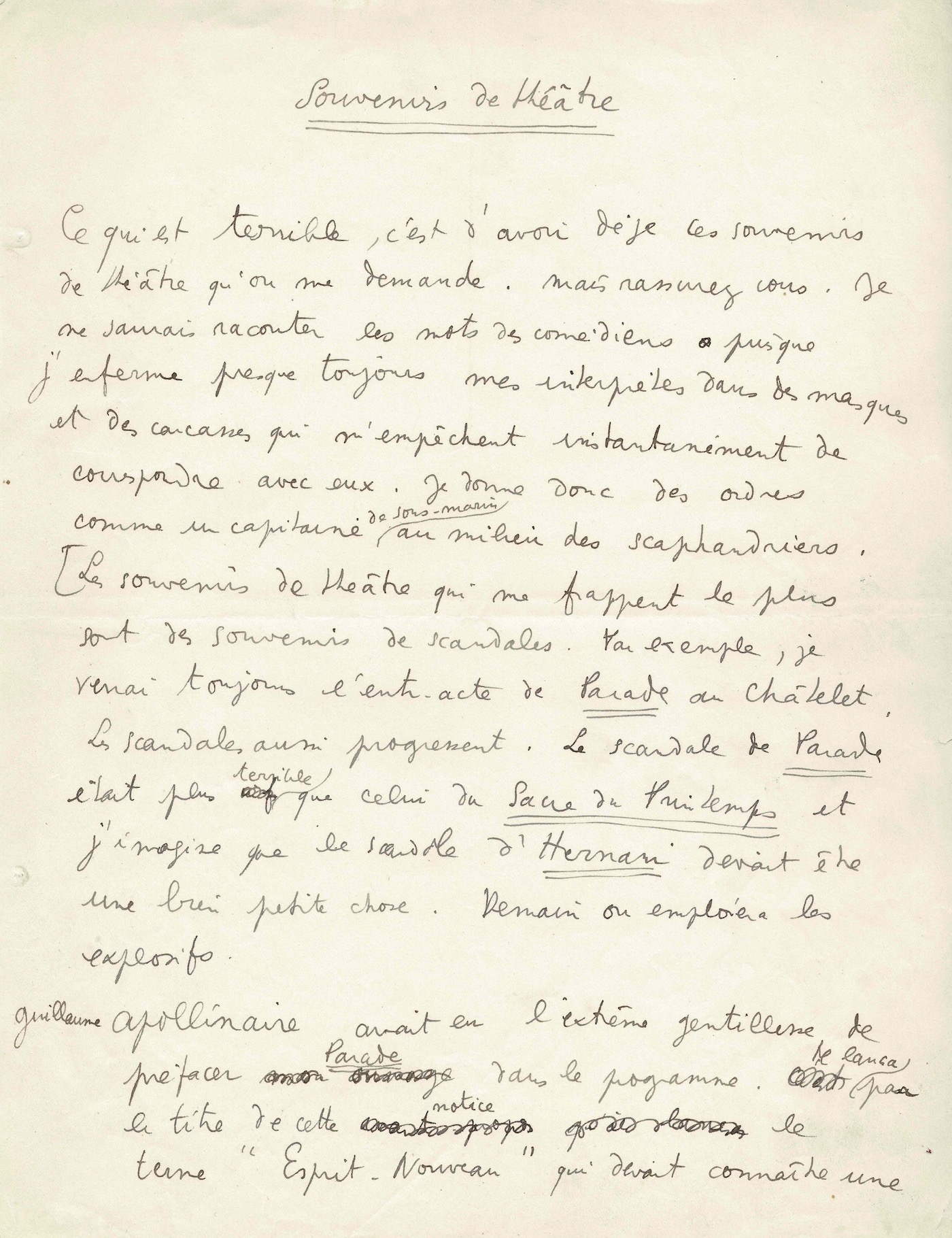
Theater Memories.
What's terrible is already having the theatrical memories they're asking me for. But rest assured. I couldn't possibly recount the actors' words, since I almost always enclose my performers in masks and costumes that instantly prevent me from communicating with them. So I give orders like a submarine captain amidst deep-sea divers.
The theater memories that strike me most are memories of scandals. For example, I will always picture the intermission of Parade at the Châtelet. Scandals, too, are escalating. Parade scandal was more terrible than that of The Rite of Spring Hernani scandal must have been quite minor. Tomorrow they'll be using explosives.
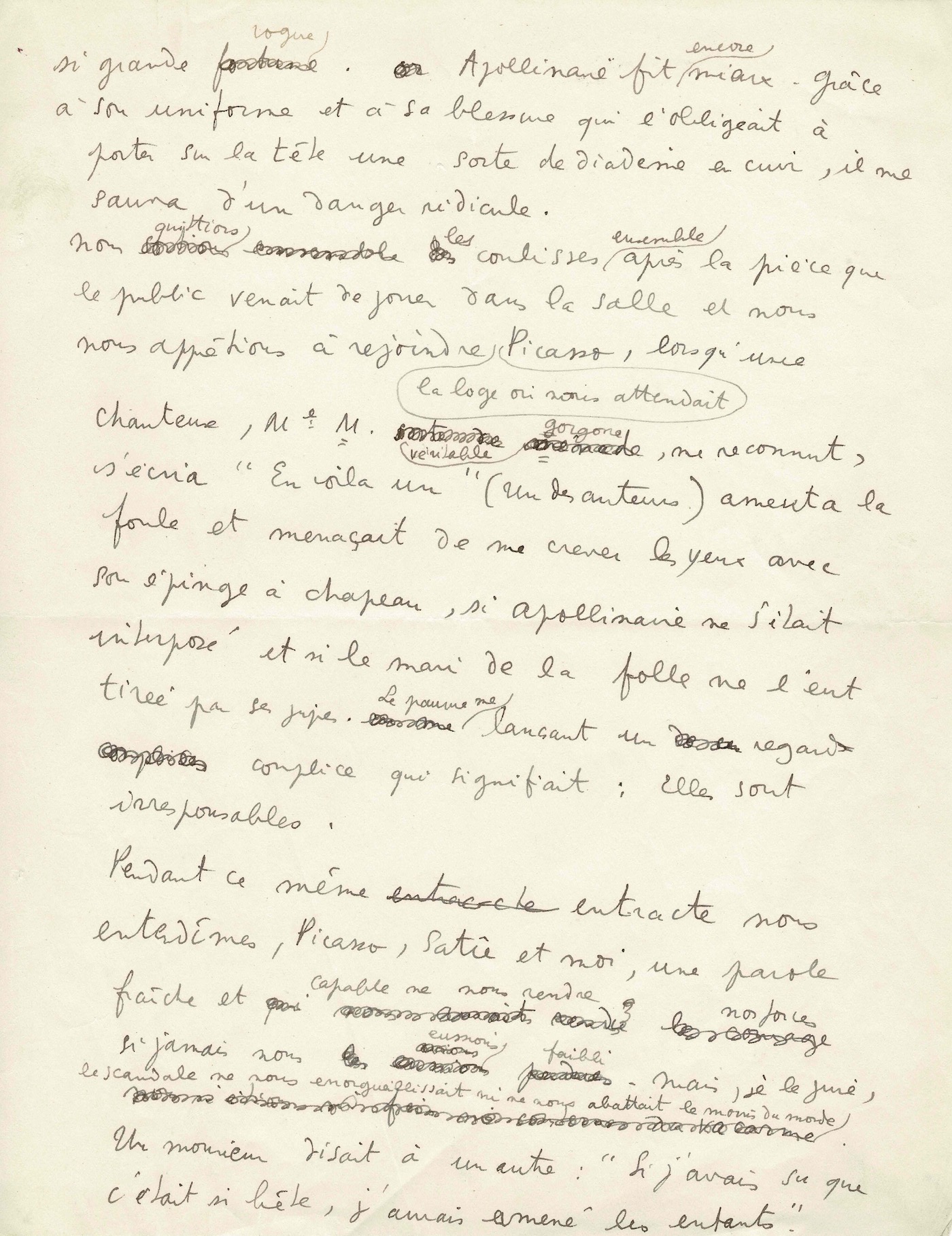
Guillaume Apollinaire had been extremely kind enough to write the preface to Parade in the program. The title of this piece introduced the term "Esprit-Nouveau" (New Spirit), which was to become so fashionable. Apollinaire did even better. Thanks to his uniform and an injury that required him to wear a kind of leather diadem on his head, he saved me from a ridiculous danger. We were leaving the wings together after the play the audience had just performed in the hall and were about to go to the box where Picasso was waiting for us, when a singer, Madame M., a veritable Gorgon, recognized me, cried out, "There's one!" (one of the authors), stirred up the crowd, and threatened to gouge my eyes out with her hatpin if Apollinaire hadn't intervened and if the madwoman's husband hadn't pulled her skirts. The poor man gave me a knowing look that said: they're irresponsible.
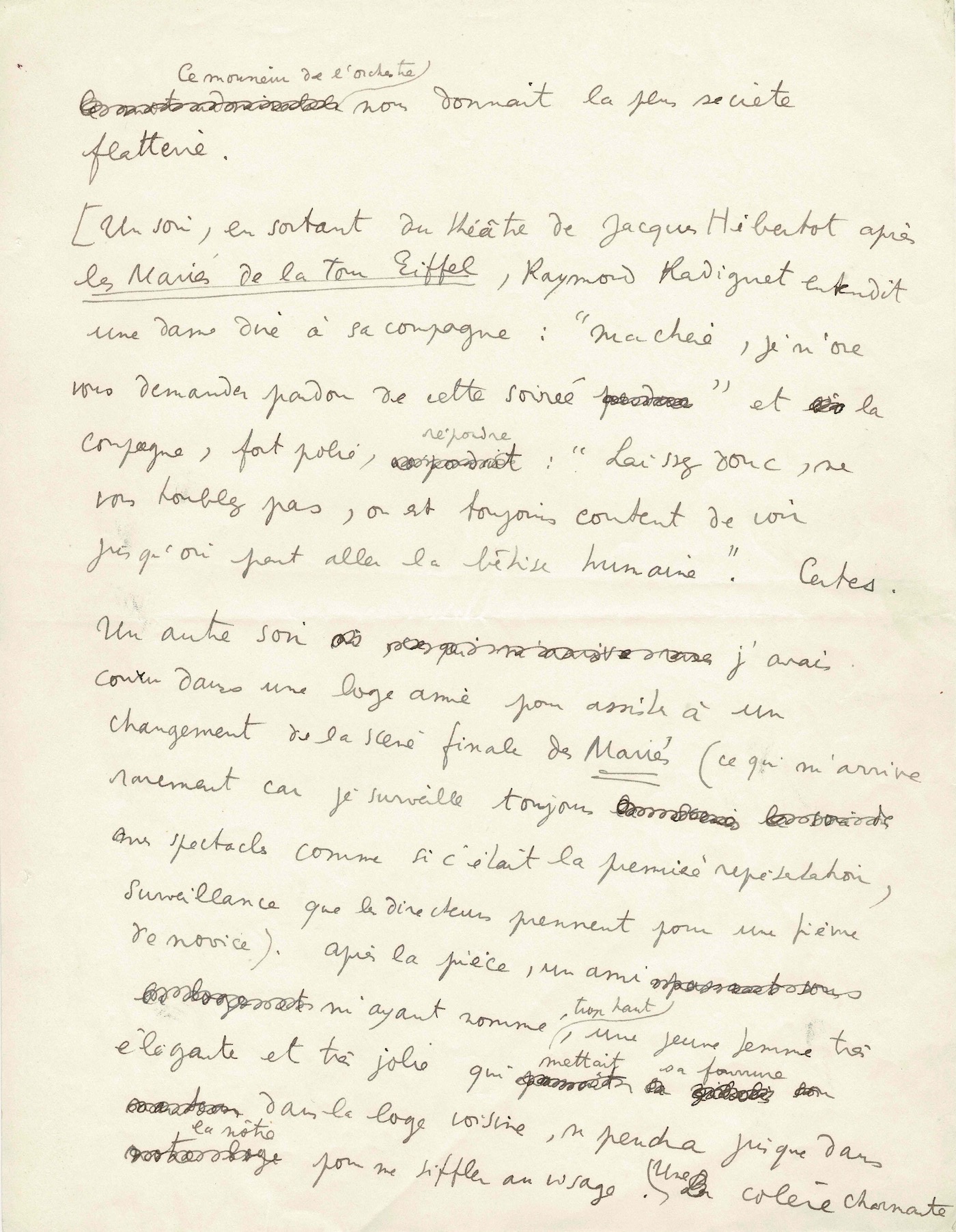
During that same intermission, Picasso, Satie, and I heard a refreshing remark, capable of restoring our strength should we have faltered. But, I swear, the scandal neither swelled our pride nor demoralized us in the slightest. One gentleman said to another, "If I had known it was so silly, I would have brought the children." This gentleman from the orchestra was offering us the most discreet flattery.
One evening, leaving Jacques Hébertot's theatre after The Wedding on the Eiffel Tower , Raymond Radiguet heard a lady say to her companion: "My dear, I dare not ask your pardon for this evening" and the companion, very polite, reply: "Leave it be, don't be upset, we are always happy to see how far human stupidity can go." Indeed.
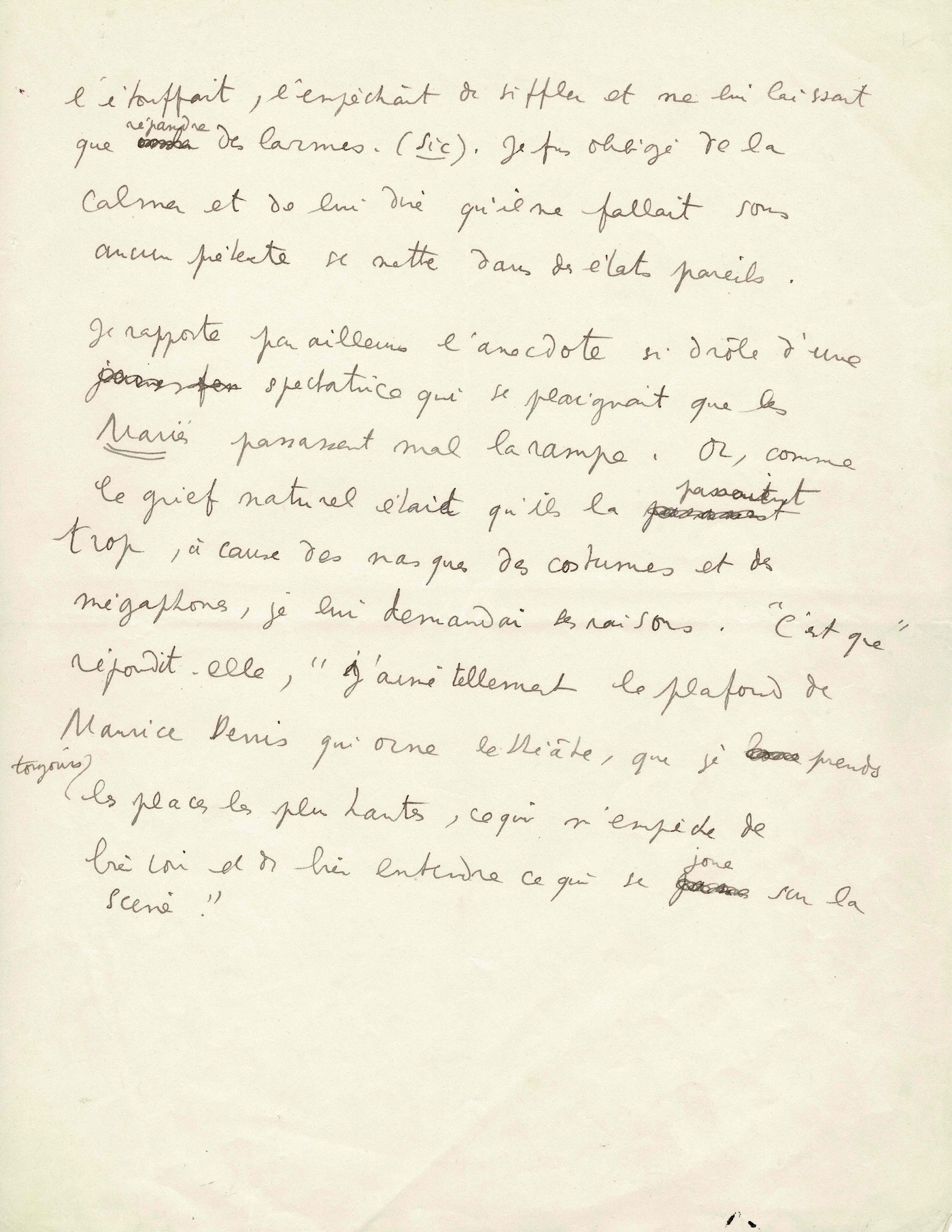
Another evening, I had rushed to a friend's box to watch a scene change during the final performance of The Newlyweds (something I rarely do, as I always monitor my shows as if it were the first performance, an attention the directors mistake for a novice's fever). After the play, a friend, having pointed out, rather loudly, a very elegant and pretty young woman who was putting on her fur coat in the next box, leaned over into ours to whistle in my face. A charming anger choked her, preventing her from whistling and leaving her only tears. I had to calm her down and tell her that she absolutely mustn't get so worked up.
I also recount the amusing anecdote of a spectator who complained that the actors in "Les Mariés" ( The Newlyweds) didn't project well over the footlights. Since the obvious complaint was that they projected too far over, due to the masks, costumes, and megaphones, I asked her why. "Well," she replied, " I love Maurice Denis's ceiling that adorns the theater so much that I always take the highest seats , which prevents me from seeing and hearing what's happening on stage properly."
These anecdotes are countless and would provide Gavarni with a thousand legends. I'll skip the classic stories. For example, the concierge at the Théâtre des Champs-Élysées, where Quo Vadis and Le Bœuf sur le toit were playing on two floors, to whom I complained about stolen shoes, shouting, "It's always those Christian thugs who take whatever they find!" And then there's the lovely story of the Christians who, the lion tamer said, "frighten the lions and prevent them from roaring."
I will conclude with a remark by Madame Rasimi, director of the Bataclan, a remark that paints embracing, ecstatic couples better than any genre painting. When I asked her why her audience applauded so little the revue scenes that were performed three hundred times in a row, she replied: "It's because they don't have their hands free." Jean Cocteau.