
"I asked that they write on my tombstone: 'Finally, I live.'"
Sold
Jean Cocteau (1889.1963)
Two typewritten pages with handwritten corrections and annotations.
Two pages in quarto. No place or date.
"I asked that they write on my tombstone: 'Finally, I live.'"
An interesting text by Cocteau successively evoking celebrity and posterity, Sartre and commitment, and Paris.
___________________________________________
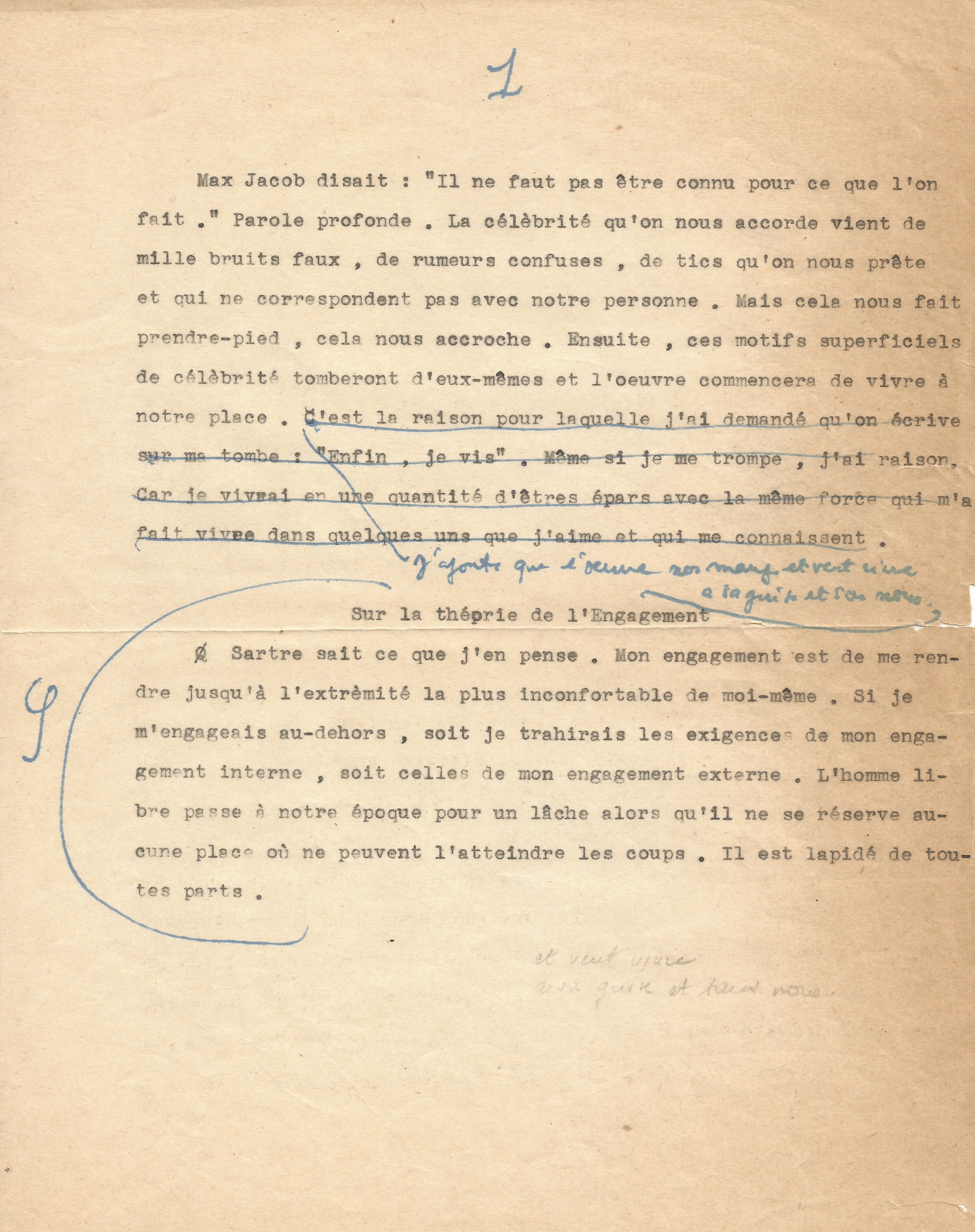
“ Max Jacob said, ‘You shouldn’t be known for what you do .’ Profound words. The fame we receive comes from a thousand false rumors, confused whispers, and tics attributed to us that don’t correspond to who we truly are. But it gives us a foothold, it clings to us. Then, these superficial reasons for fame will fall away on their own, and the work will begin to live in our place. That’s why I asked that it be written on my tombstone: ‘Finally, I live.’ Even if I’m wrong, I’m right. For I will live on in a multitude of scattered beings with the same force that has allowed me to live on in the few I love and who know me. I would add that the work consumes us and wants to live as it pleases, without us .”
On the therapy of commitment. Sartre knows what I think about it. My commitment is to push myself to the most uncomfortable extreme of myself. If I were to commit myself externally, I would either betray the demands of my internal commitment or those of my external commitment. In our time, the free man is considered a coward, yet he reserves no place for himself where he cannot be harmed. He is stoned from all sides.
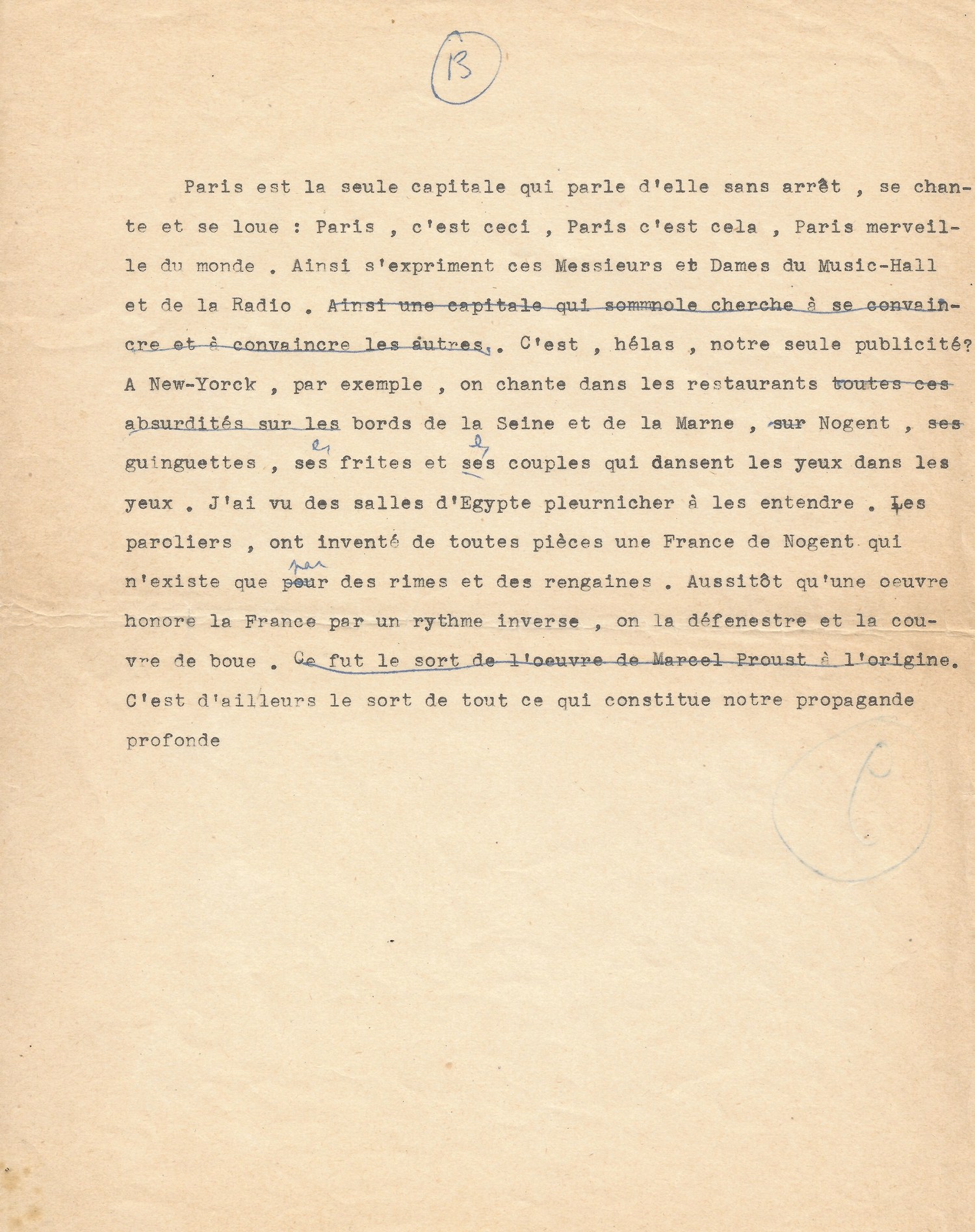
Paris is the only capital that talks about itself constantly, sings about itself, and praises itself : Paris is this, Paris is that, Paris, wonder of the world. This is how the gentlemen and ladies of the music hall and the radio express themselves. This is how a slumbering capital seeks to convince itself and others. This, alas, is our only form of advertising. In New York, for example, all these absurdities are sung in restaurants along the banks of the Seine and the Marne (…) I have seen audiences in Egypt weep at the sound of them. The lyricists have invented from scratch a France of Nogent that exists only through rhymes and catchy tunes. As soon as a work honors France with a contrary rhythm, it is thrown out the window and covered in mud. This was the fate of Marcel Proust's work in its origins. It is, moreover, the fate of everything that constitutes our deep-rooted propaganda.