Jean Cocteau (1889.1963)
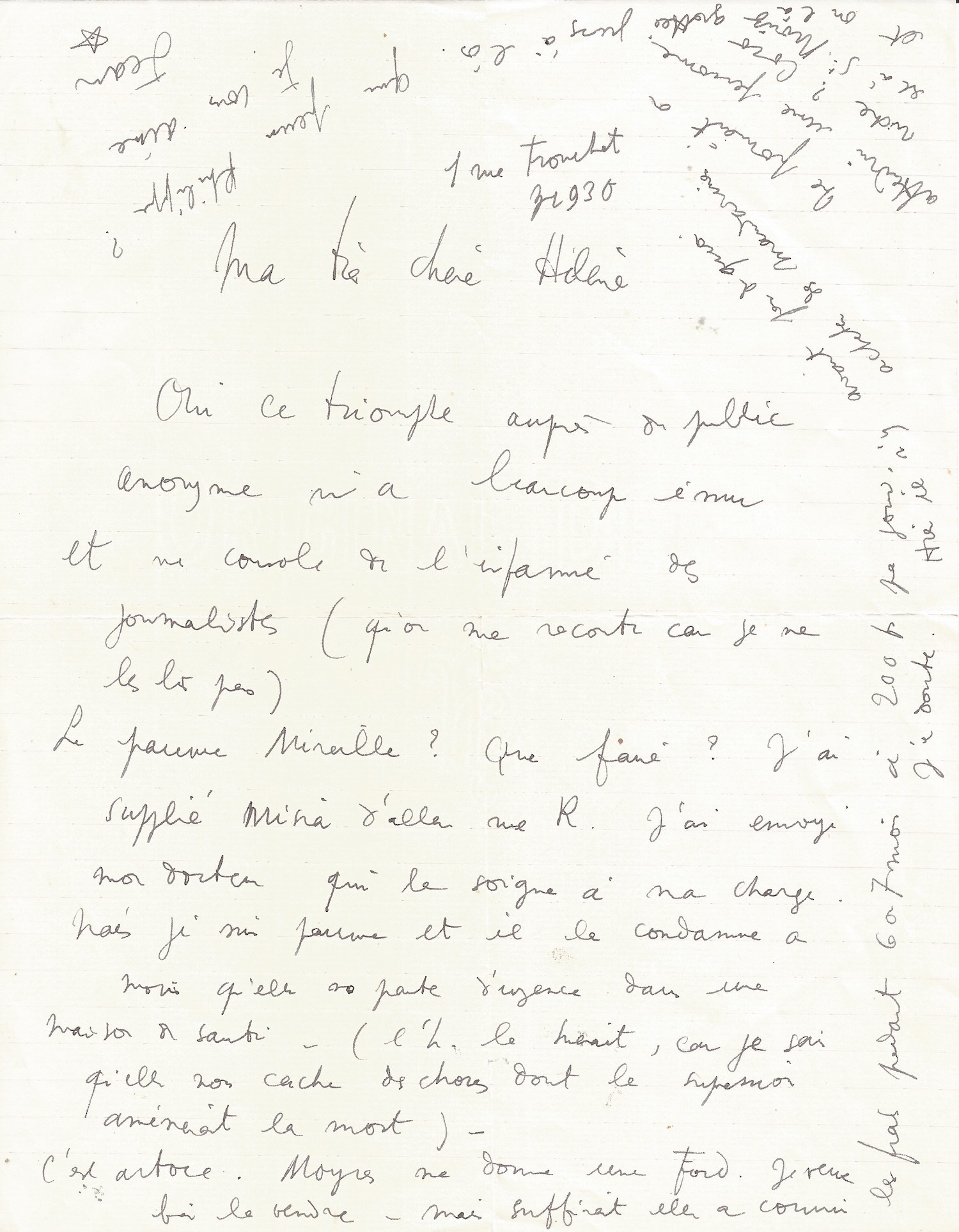
Autographed letter signed to Hélène Berthelot.
One page in quarto on lined paper. Trace of a stamp.
Paris [1931]
"Poor Mireille? What can be done?"
Cocteau, desperate over Mireille Havet's downward spiral, sought help from his close friends: Misia Sert, Louis Moyses, Hélène and Philippe Berthelot, as well as Coco Chanel.
____________________________________________________
"My dearest Hélène, Yes, this triumph with the anonymous public has moved me greatly and consoles me for the infamy of the journalists (that I am told about because I do not read them).
Poor Mireille [Havet] ? What can be done? I begged Misia [Sert] to go to Rue Raynouard. I sent my doctor, who is treating her at my expense. But I am poor, and he says she will die unless she goes to a sanatorium immediately. (The hospital would save her, because I know she is hiding things from us, the revealing of which would lead to her death.)
It's atrocious. Moyses [Louis Moyses, founder of the cabaret Le Bœuf sur le Toit ] is giving me a Ford. I'm willing to sell it—but would it be enough to cover the costs for six or seven months at 200 francs a day? I doubt it. Yesterday, there wasn't even enough to buy tangerines. Couldn't someone with a rich person be moved? Coco [Chanel] is in St. Moritz; they've squeezed her dry . What does Philippe think? I love you. Jean.
____________________________________________________
A tragic destiny indeed, Mireille Havet (1898-1932) enchanted Parisian literature at the beginning of the last century. Nicknamed the "Little Poetess" by Apollinaire, noticed by Georges Izambard – Rimbaud's literature teacher – she frequented the entire literary circles of 1920s Paris.
Free spirit, openly homosexual, passionate, night owl, Mireille Havet did not resist the temptations of artificial paradises and sank, irremediably, to the whims of her addictions, despite the unwavering support of Jean Cocteau and the Berthelot couple.
Struck by tuberculosis from 1929, marginalized, destroyed by drugs and disease, she died at the Montana sanatorium in Switzerland in March 1932.
Having fallen into oblivion, the poetic figure of Mireille Havet was resurrected in 1995 thanks to the rediscovery of the manuscript of her diary (1913-1929) by Dominique Tiry, granddaughter of Ludmila Stavitzky, the executor of Mireille Havet's will.
The thousands of pages of said journal were published, starting in 2003, by Éditions Claire Paulhan, allowing readers to discover, almost a hundred years later, the tragic fate of this prodigious poet.