Jean Cocteau (1889.1963)
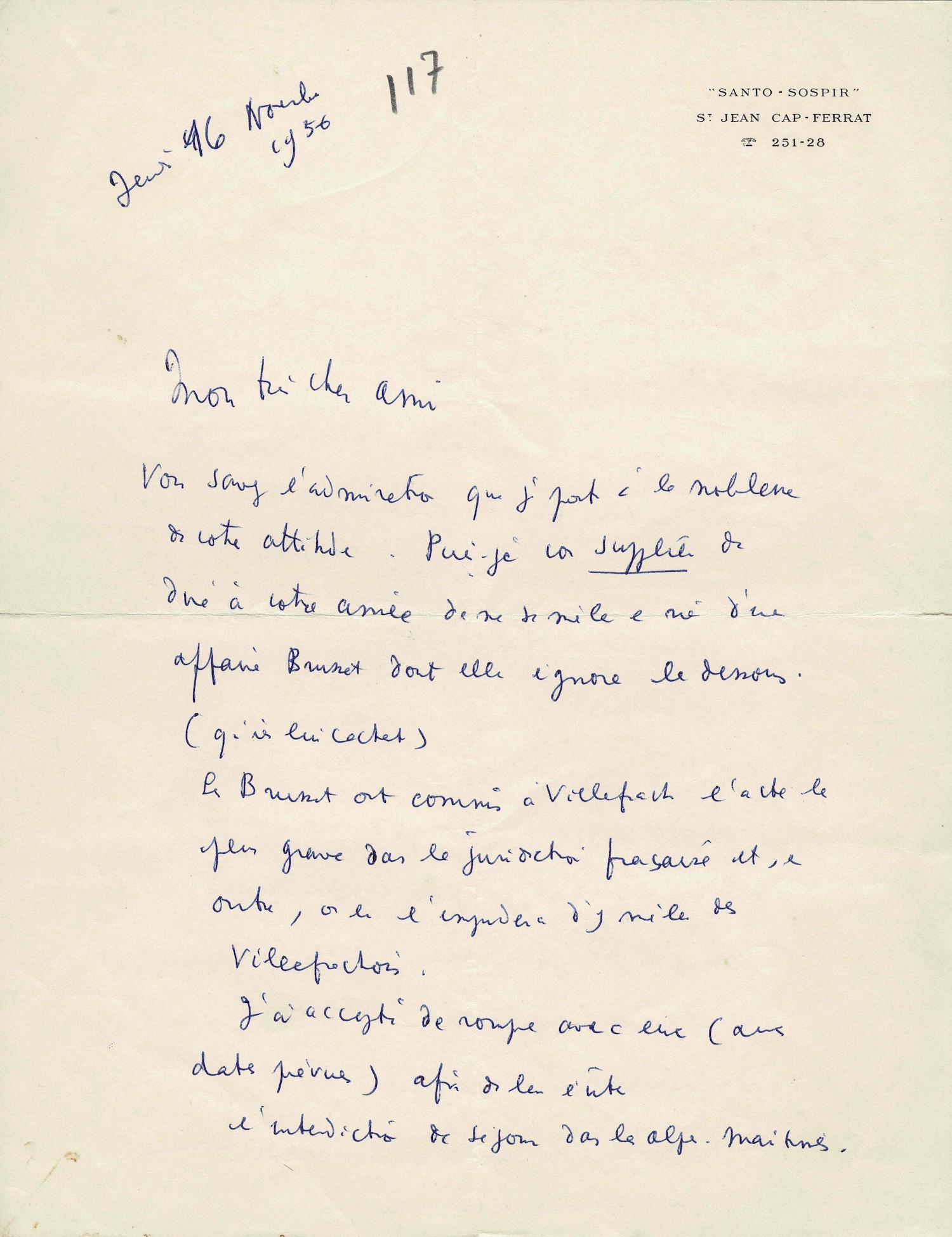
Autographed letter signed to a friend.
Santo Sospir letterhead
St Jean Cap Ferrat. Thursday, November 16, 1956.
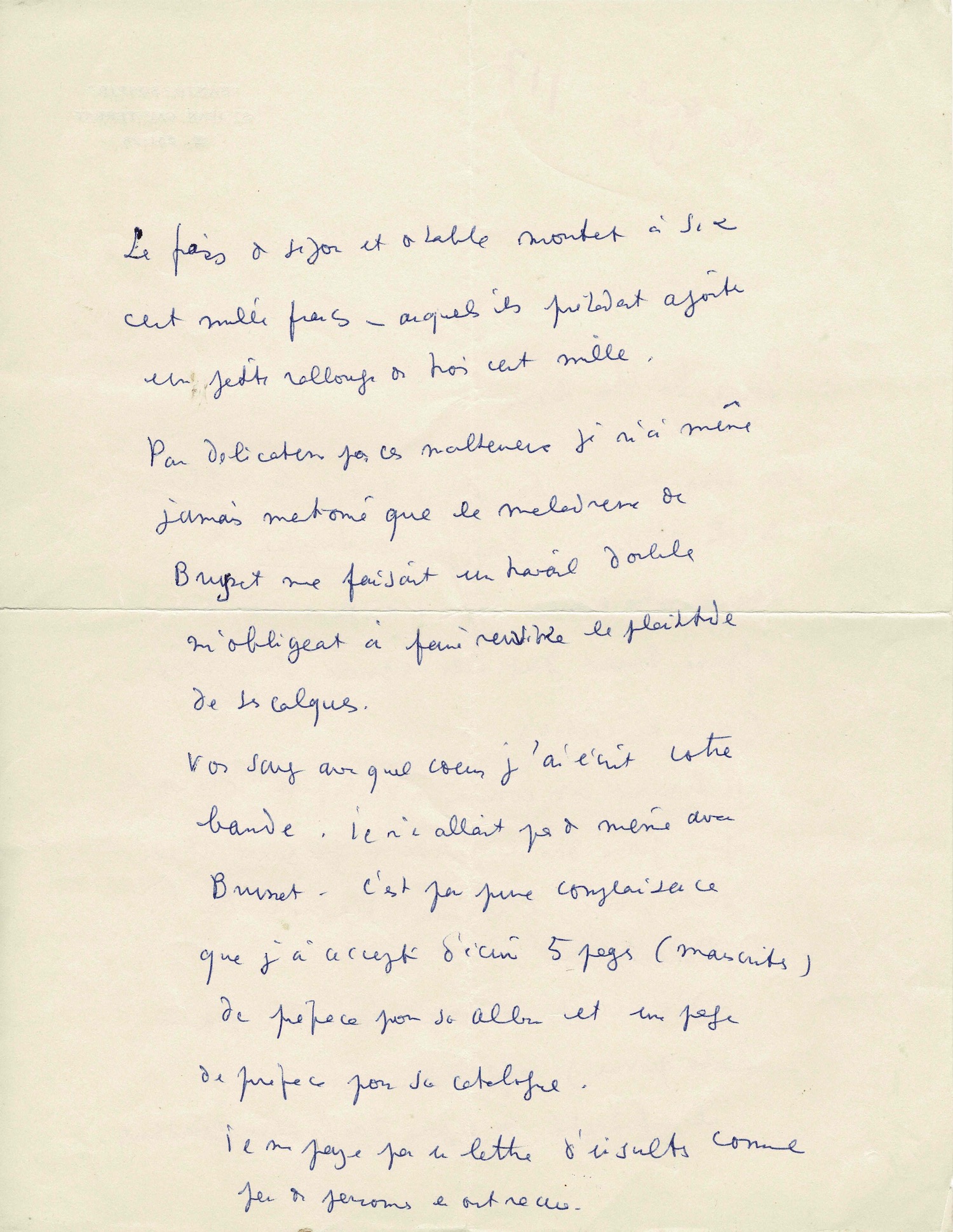
"I never mentioned that Brusset's clumsiness created double the work for me, forcing me to revive the flatness of his tracings."
A virulent letter against the painter Jean-Paul Brusset and his wife Margaret.
Cocteau was furious at the attitude of the Brusset couple following their artistic collaboration on the frescoes of the Saint-Pierre chapel in Villefranche-sur-Mer
________________________________________
"My dearest friend, you know how much I admire the nobility of your attitude. May I beg you to tell your friend to stay out of the Brusset affair, the details of which she is unaware (they are hiding from her). The Brussets have committed the most serious act within French jurisdiction in Villefranche , and furthermore, she will be prevented from involving the people of Villefranche. I have agreed to break with them (on the agreed dates)." […]
Out of consideration for these unfortunate souls, I never mentioned that Brusset's clumsiness created double the work for me, forcing me to recreate the blandness of his tracings. You know how wholeheartedly I wrote your comic strip. It wasn't the same with Brusset. It was purely out of courtesy that I agreed to write five (handwritten) pages of preface for his album and one page for his catalog. He repays me with a letter of insults the likes of which few have ever received.
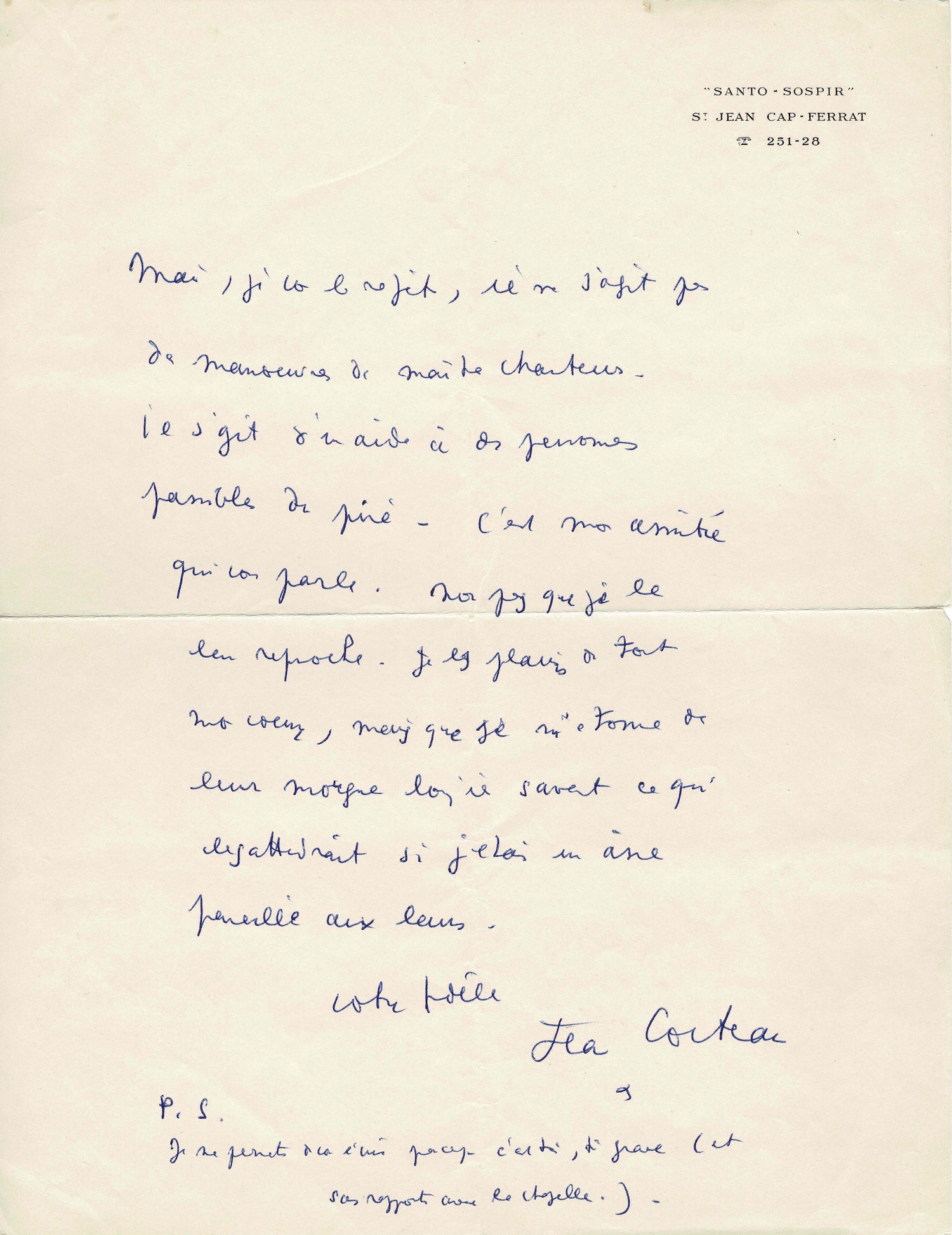
But, I repeat, this isn't about blackmail. It's about helping people who are capable of the worst. It's my friendship that speaks to you. Not that I blame them. I pity them with all my heart , but I'm astonished by their arrogance when they know what would await them if I were a soul like theirs. Jean Cocteau. P.S. I'm taking the liberty of writing to you because it's so, so serious (and unrelated to the chapel).
________________________________________
On October 20, 1956, Cocteau wrote the following to Margaret Brusset: “ Your husband has forgotten that I expressed to each person my gratitude for their kindness and courage, that without them I could do nothing. He has forgotten my preface, which I believe is more important than an article. As for the odious phrase about ‘the chapel that builds itself,’ it proves, alas, that Brusset understood nothing (and understands nothing of a very beautiful and moving phrase). I said that his assistant and the ceramist he discovered to be were so many miracles dictated by the chapel that gives us its orders. If he sees everything through such a narrow lens, he would be better off leaving and abandoning me. It will not be my first heartbreak (alas)…”