Jean Jaurès (1859.1914)
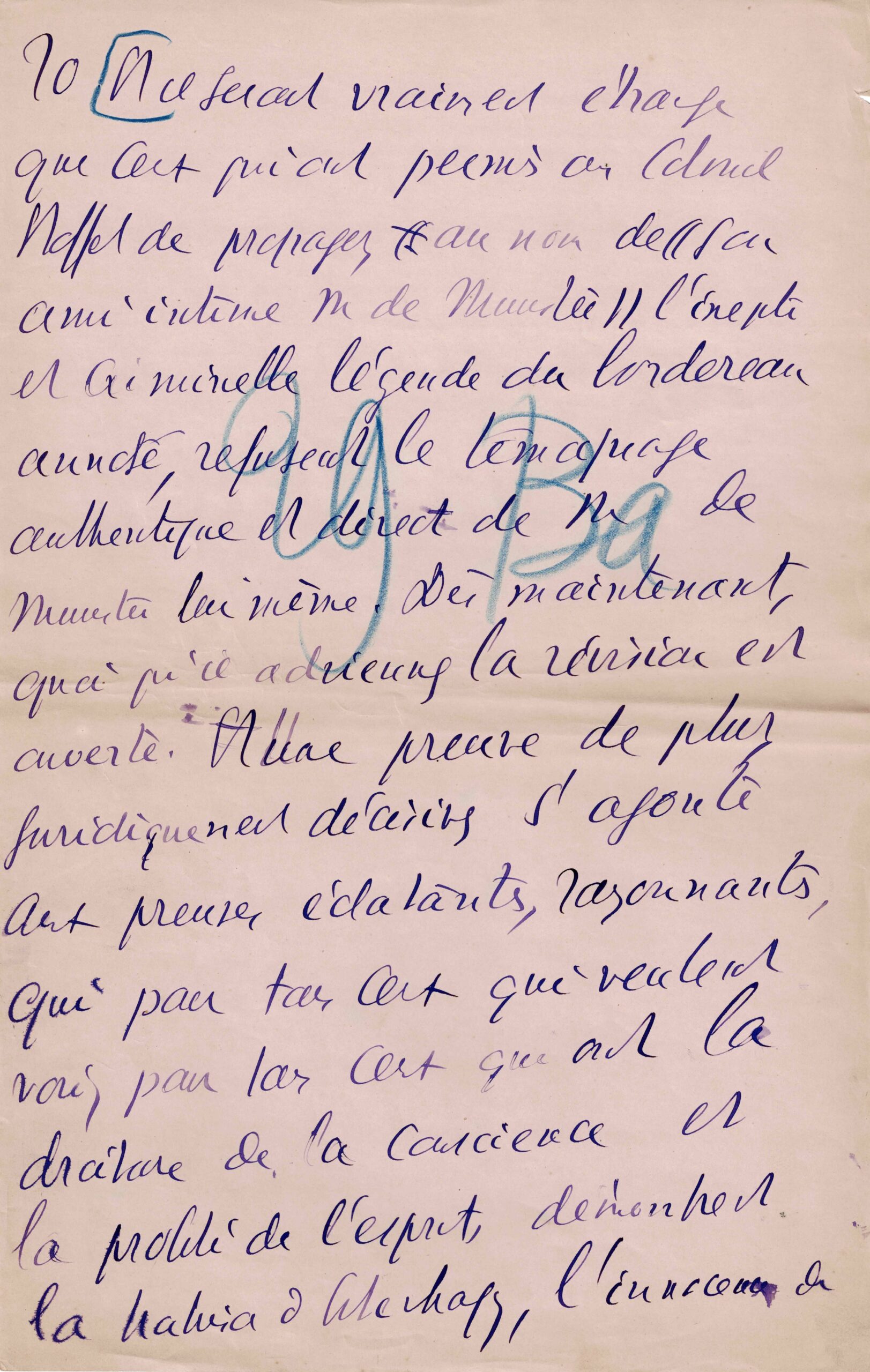
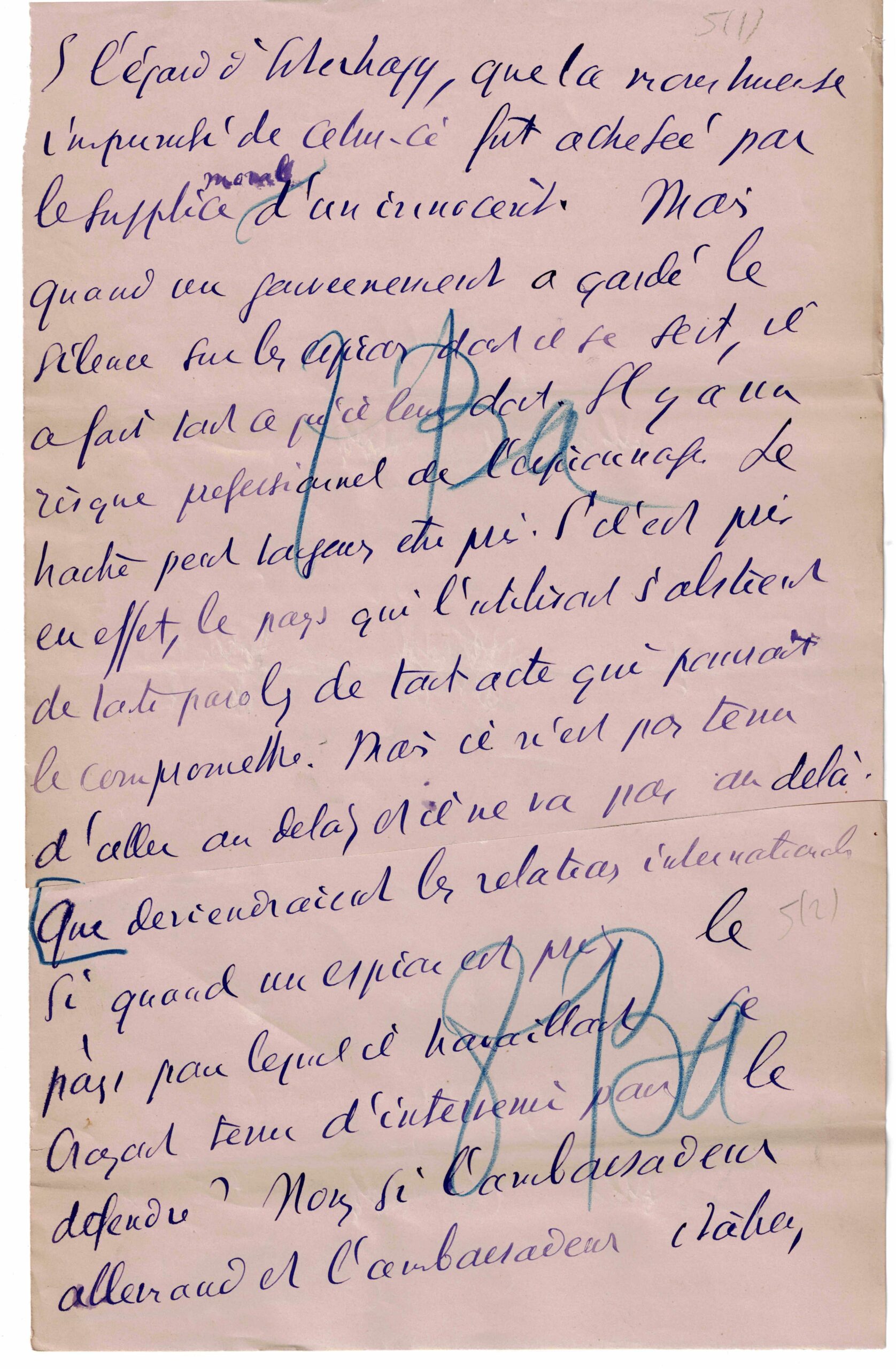
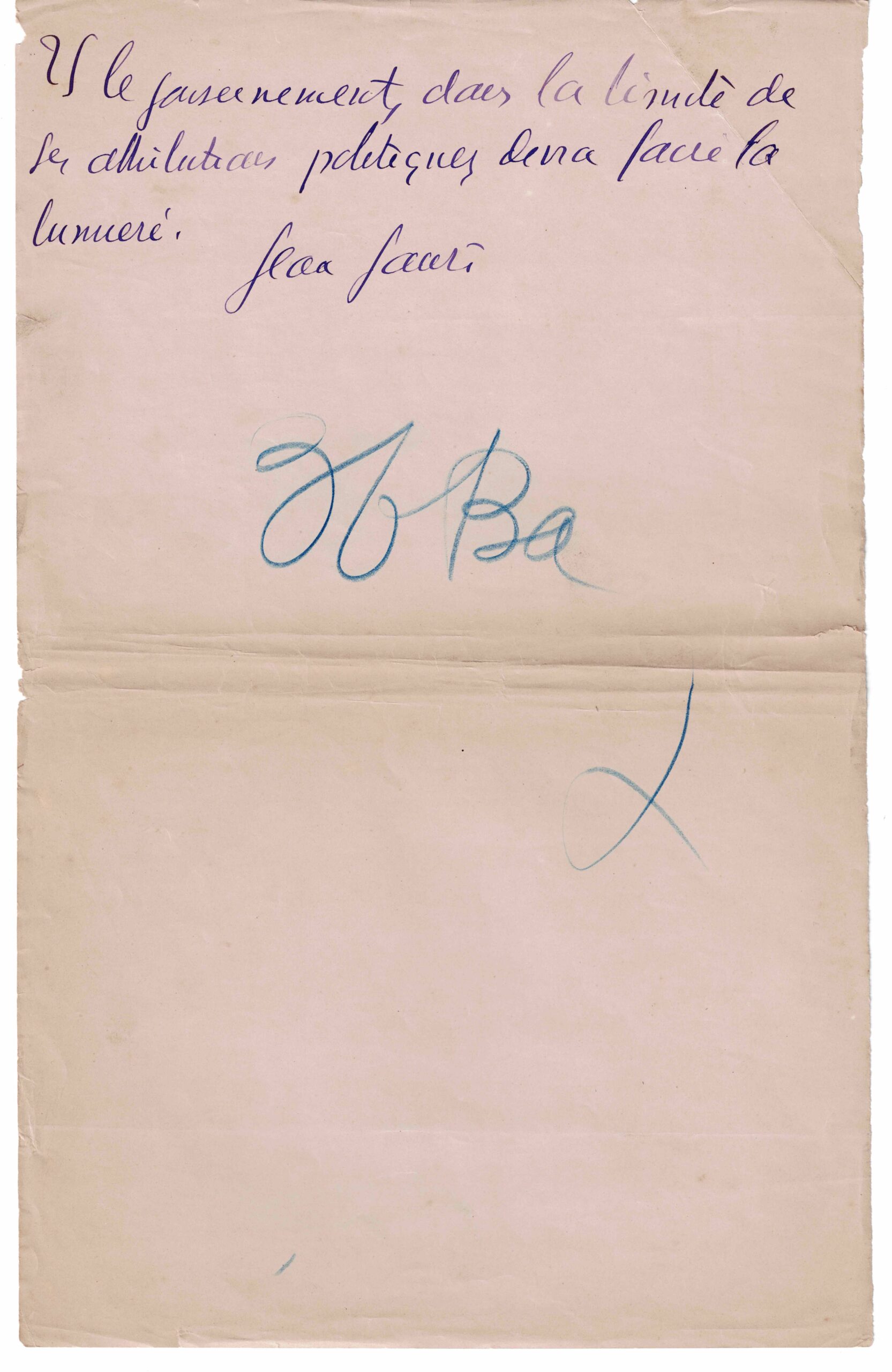
Autograph manuscript signed – New fact.
Twenty-four and a half folio pages (35 x 22.5 cm) on paper with frayed edges.
Typographic annotations in grease pencil. Montages.
[Paris. May 1st or 2nd, 1903]
« This is the irrefutable, invincible, and legally novel demonstration of Esterhazy's treason and Dreyfus's innocence »
Exceptional autograph manuscript signed: twenty-five folio pages in the hand of Jean Jaurès, corrected and amended, offering the text of the article published on the front page of La Petite République on Sunday, May 3, 1903. The tireless defender of Dreyfus announces the turning point of the Affair and the now inexorable march towards revision.
______________________________________________________
On April 28, 1903, the newspaper La Petite République published on its front page the letter that the late Count Georg Herbert zu Münster (1820-1902) had sent to Joseph Reinach on May 20, 1901. The former German ambassador to France from 1885 to 1900, who had been, against his will, one of the key figures in the Dreyfus Affair, was responding to Reinach's requests for documents for his History of the Dreyfus Affair. In this letter, revealed two years later by La Petite République, Münster solemnly reaffirmed that he had never met Dreyfus and that the latter had never been recruited as a spy. The document was essential evidence in the case for requesting a review of the trial that had convicted Captain Dreyfus.
« The publication of the letter addressed to Mr. Joseph Reinach by Mr. de Münster was a pivotal event in the Dreyfus Affair. This decisive testimony, published after the Rennes trial, was new evidence sufficient to overturn the unjust and absurd decisions of the military court and justify a review of the case.
It emerges with absolute certainty from Mr. de Münster's testimony that Esterhazy offered himself as a spy to the German military attaché, that he was accepted as such from 1893, that he acted as a spy for Germany during the two years preceding Dreyfus's trial, that it was Esterhazy who committed the treason and wrote the memorandum, and finally that Esterhazy, horrified in 1897 by the discovery of his handwriting, by Picquart's investigation, and by Scheurer-Kestner's actions, tried to extract false testimony against Dreyfus from Schwartzkoppen, who had thrown him out. […] This is the irrefutable, invincible, and legally novel demonstration of Esterhazy's treason and Dreyfus's innocence .
Jaurès then dismantles, with surgical precision and irrefutable logic, all the arguments against the sincerity of the Prince of Münster's testimony. The ambassador's statements, first in January 1895 and then again in November 1897, in which he asserted that he had never been in contact with Captain Dreyfus, were suspect in the eyes of the French government: indeed, for the anti-Dreyfusards, the country that employed a spy had a duty to "cover" for him when he was unmasked. "A miserable sophism," declares Jaurès, for whom: "If the German ambassador and the Italian ambassador, if Count Münster and Count Tornielli declared, repeated, that never, ever, in any form whatsoever, had either Italy or Germany had the slightest contact with Dreyfus, it was not to obey some kind of espionage protocol." It was because it seemed to them contrary to conscience and contrary to honor to allow an innocent man to be punished for Esterhazy's crime that their military attachés had been employed. By tolerating or ignoring the espionage maneuvers which, through an unexpected backlash, would strike an innocent man at his very heart, the two ambassadors would have been, to some extent, complicit in the error and the crime. That is why they spoke out. That is why they shouted the truth to willfully deaf people. If they were not listened to, if they encountered the most pernicious bias, at least they spared themselves, and the governments they represented, any moral solidarity with the abominable crime. And the insistence of their declarations, the unusual nature of their actions, should have alerted both our heads of state and public opinion .
Thus: " From now on, whatever happens, the review is open. One more piece of legally decisive evidence is added to the brilliant, radiant evidence which, for all those who wish to see, for all those with a clear conscience and an honest mind, demonstrates Esterhazy's treason, Dreyfus's innocence, and the crime or aberration of unjust and senseless judgments. "
The handwritten document, with its erasures, also reveals Jaurès's method of avoiding overly simplistic or sensational epithets in order to better focus his argument, making it all the more incisive and capturing the reader's attention. Thus, this "repugnant trial of Rennes" becomes this "sad trial of Rennes," and an "irreparable" error becomes "deplorable.".
In the war waged against injustice and manipulation, Jaurès' voice carried considerable weight and his action, in the press as well as in the Chamber of Deputies, was decisive in the revision of the trial which led to the rehabilitation of Captain Dreyfus.
The contributions of Picquart, Scheurer, and Zola are substantial enough that our patriotism, however narrow and touchy, will not be harmed by the collaboration of men who do France the well-deserved honor of believing that the fleeting victory of falsehood has not diminished the profound loyalty of its genius. On the decisive testimony of Mr. de Münster, the Court of Cassation will affix the seal of France.