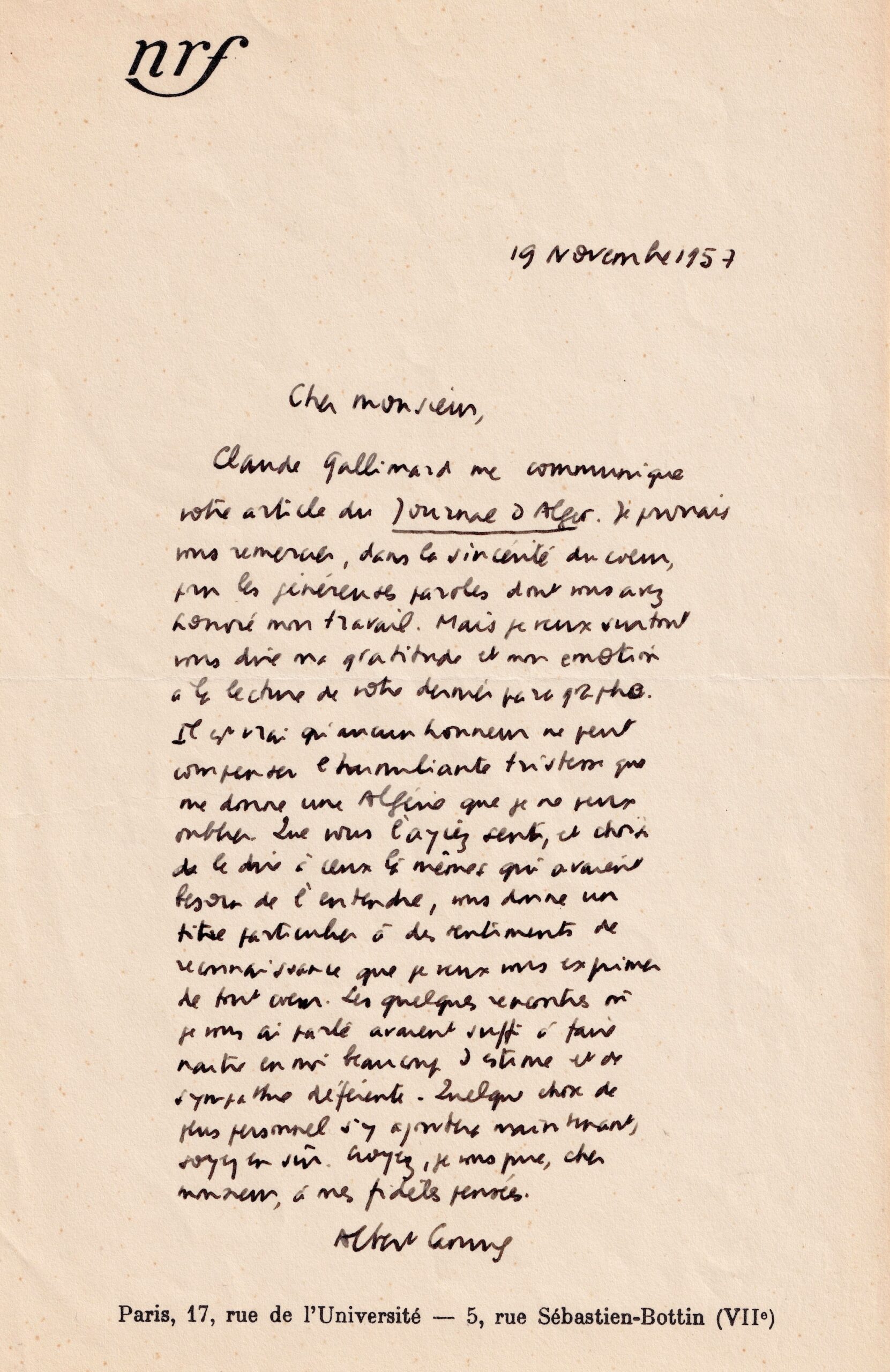
Honored with the Nobel Prize, Albert Camus, moved, suffers for his native Algeria.
"It is true that no honor can compensate for the humiliating sadness I feel for an Algeria I cannot forget."
Sold

"It is true that no honor can compensate for the humiliating sadness I feel for an Algeria I cannot forget."
Sold
Albert Camus (1913.1960)
Autographed letter signed.
One octavo page on NRF letterhead.
[Paris]. November 19, 1957.
"It is true that no honor can compensate for the humiliating sadness I feel for an Algeria I cannot forget."
An important and moving letter from Albert Camus, who had just been unanimously awarded the Nobel Prize in Literature a month earlier, on October 16th, "for his important literary work which illuminates, with penetrating seriousness, the problems facing the conscience of humankind in our time ." The French writer did not forget his native Algeria and expressed his heartfelt thanks to his correspondent for an article published in Le Journal d'Alger .
On that same day, November 19, Camus wrote a letter – which has become legendary – to his teacher Louis Germain, full of recognition and gratitude for the latter's teaching.
Camus will go to Stockholm on December 10th to receive his prize.
________________________________________________________________
Dear Sir, Claude Gallimard has forwarded to me your article from the Journal d'Alger . I could thank you, sincerely, for the kind words with which you have honored my work. But above all, I want to express my gratitude and emotion upon reading your last paragraph. It is true that no honor can compensate for the humbling sadness I feel for an Algeria I cannot forget. That you felt this, and chose to express it to those who needed to hear it, gives you a special claim to the feelings of gratitude I wish to convey to you wholeheartedly. The few encounters where I spoke with you were enough to inspire in me a great deal of esteem and deferential sympathy. Something more personal will now be added to this, you can be sure of that. Please believe, dear Sir, in my most sincere thoughts. Albert Camus
________________________________________________________________
A man of justice, Camus was deeply affected by the Algerian War. This is evidenced by his numerous public statements on the conflict, such as his " Appeal for a Civil Truce ," a speech delivered in January 1956 in Algiers, and again in Stockholm in 1957: " I am for a just Algeria where both populations must live in peace and equality. I have said and repeated that justice must be done for the Algerian people and that they must be granted a fully democratic regime, until the hatred on both sides became so great that it was no longer appropriate for an intellectual to intervene, as his statements risked exacerbating the terror […] I have always condemned terror. I must also condemn a terrorism that is exercised blindly, in the streets of Algiers for example, and which one day could strike my mother or my family. "
***
The letter to his teacher Louis Germain, written on the same day, November 19, 1957:
“Dear Mr. Germain, I let the noise that has surrounded me these past few days die down a little before writing to you from the bottom of my heart. I have just been given far too great an honor, one that I neither sought nor asked for. But when I heard the news, my first thought, after my mother, was for you. Without you, without the loving hand you extended to the poor little boy I was, without your teaching and your example, none of this would have happened. I don't make a big deal of this kind of honor. But this one at least gives me the opportunity to tell you what you have been, and still are, to me, and to assure you that your efforts, your work, and the generous heart you put into it are still alive in one of your former pupils who, despite his age, has never ceased to be your grateful student. I embrace you with all my heart. Albert Camus.”
***
Speech by Albert Camus, delivered in Oslo on December 10, 1957:
Your Majesty, Your Royal Highnesses, Ladies and Gentlemen,
In receiving the distinction with which your esteemed Academy has seen fit to honor me, my gratitude was all the more profound as I realized how far this award transcended my personal merits. Every man, and even more so every artist, desires recognition. I desire it too. But it was impossible for me to learn of your decision without comparing its impact to who I truly am. How could a man, still relatively young, rich only in his doubts and with a body of work still in progress, accustomed to living in the solitude of his labor or in the retreats of friendship, not have learned with a kind of panic of a decision that suddenly thrust him, alone and reduced to himself, into the center of a harsh spotlight? With what heart could he receive this honor at a time when, in Europe, other writers, among the greatest, are silenced, and at a time when his native land is experiencing unending misfortune?
I have known this disarray and inner turmoil. To find peace again, I had to, in short, come to terms with an overly generous fate. And, since I could not equal it through my own merits alone, I found nothing else to help me but what has sustained me throughout my life, even in the most adverse circumstances: my understanding of my art and the role of the writer. Allow me, then, in a spirit of gratitude and friendship, to tell you, as simply as I can, what this understanding is.
I cannot personally live without my art. But I have never placed this art above everything else. On the contrary, if it is necessary to me, it is because it is inseparable from everyone and allows me to live, as I am, on the same level as everyone else. Art is not, in my eyes, a solitary pleasure. It is a means of moving the greatest number of people by offering them a privileged image of shared suffering and joy. It therefore compels the artist not to isolate himself; it subjects him to the humblest and most universal truth. And he who often chose his destiny as an artist because he felt different quickly learns that he will only nourish his art, and his difference, by acknowledging his resemblance to everyone. The artist is forged in this perpetual back-and-forth between himself and others, halfway between the beauty he cannot do without and the community from which he cannot tear himself away. This is why true artists despise nothing; They force themselves to understand instead of judging. And if they have a side to take in this world, it can only be that of a society where, in Nietzsche's great words, the judge will no longer reign, but the creator, whether worker or intellectual.
The writer's role, therefore, is inseparable from difficult duties. By definition, he cannot today place himself at the service of those who make history: he is at the service of those who endure it. Otherwise, he finds himself alone and deprived of his art. All the armies of tyranny, with their millions of men, will not deliver him from solitude, even and especially if he consents to follow in their footsteps. But the silence of an unknown prisoner, abandoned to humiliation at the other end of the world, is enough to draw the writer out of exile each time, at least, that he manages, amidst the privileges of freedom, not to forget this silence, and to relay it, to make it resound through the means of art.
None of us is great enough for such a calling. But in every circumstance of his life, whether obscure or temporarily famous, thrown into the chains of tyranny or free for a time to express himself, the writer can rediscover the feeling of a living community that will justify him, on the sole condition that he accepts, as far as he can, the two burdens that constitute the grandeur of his profession: the service of truth and the service of liberty. Since his vocation is to unite as many people as possible, it cannot accommodate the lies and servitude that, wherever they reign, breed solitude. Whatever our personal failings, the nobility of our profession will always be rooted in two commitments difficult to uphold: the refusal to lie about what one knows and the resistance to oppression.
For over twenty years of a madcap history, lost and without help, like all men my age, in the convulsions of the times, I was sustained by this: by the obscure feeling that writing was now an honor, because this act entailed an obligation, and an obligation not only to write. It particularly compelled me to bear, as I was and according to my strength, with all those who were living through the same history, the misfortune and the hope that we shared. These men, born at the beginning of the First World War, who turned twenty when both Hitler's power and the first revolutionary trials were established, who were then confronted, to complete their education, with the Spanish Civil War, the Second World War, the concentration camp universe, and a Europe of torture and prisons, must now raise their sons and their works in a world threatened by nuclear destruction. No one, I suppose, can ask them to be optimistic. And I even believe that we must understand, without ceasing to fight against them, the error of those who, driven by a desperate escalation, claimed the right to dishonor and plunged headlong into the nihilisms of the era. But the fact remains that most of us, in my country and in Europe, rejected this nihilism and set out in search of legitimacy. We had to forge a way of living in times of catastrophe, to be reborn, and then to fight, openly, against the death instinct at work in our history.
Every generation, no doubt, believes itself destined to remake the world. Mine, however, knows that it will not remake it. But its task is perhaps even greater. It consists of preventing the world from falling apart. Heir to a corrupt history where failed revolutions, rampant technology, dead gods, and exhausted ideologies are intertwined, where mediocre powers can now destroy everything but no longer know how to convince, where intelligence has sunk to the point of becoming the servant of hatred and oppression, this generation has had to, within itself and around itself, restore, from its very negations, a little of what constitutes the dignity of living and dying. Faced with a world threatened with disintegration, where our grand inquisitors risk establishing the kingdoms of death forever, she knows that she must, in a kind of frantic race against time, restore a peace among nations that is not one of servitude, reconcile work and culture once more, and rebuild with all humankind an ark of the covenant. It is not certain that she can ever accomplish this immense task, but it is certain that throughout the world, she is already upholding her twofold commitment to truth and freedom, and, when necessary, knows how to die without hatred for it. She is the one who deserves to be saluted and encouraged wherever she is found, and especially where she sacrifices herself. It is to her, in any case, that, certain of your profound agreement, I would like to transfer the honor you have just bestowed upon me.
At the same time, having spoken of the nobility of the writing profession, I would have restored the writer to his true place, possessing no other titles than those he shares with his fellow combatants, vulnerable yet stubborn, unjust and passionate about justice, building his work without shame or pride in full view of everyone, constantly torn between pain and beauty, and ultimately dedicated to drawing from his dual nature the creations he obstinately tries to build within the destructive movement of history. Who, after this, could expect ready-made solutions and fine moral lessons from him? Truth is mysterious, elusive, always to be conquered. Freedom is dangerous, as difficult to live as it is exhilarating. We must march toward these two goals, painfully, but resolutely, certain in advance of our failings on such a long road. What writer, then, would dare, in good conscience, to become a preacher of virtue? As for me, I must say once again that I am none of these things. I have never been able to renounce the light, the joy of being, the free life in which I grew up. But although this nostalgia explains many of my errors and failings, it has undoubtedly helped me to better understand my profession, and it still helps me to stand, blindly, beside all those silent men who, in this world, can only bear the life they are given through the memory or the return of brief, unadulterated moments of happiness. Brought back thus to what I truly am, to my limitations, to my debts, as well as to my difficult faith, I feel freer to show you, in conclusion, the extent and generosity of the distinction you have just bestowed upon me, freer also to tell you that I would like to receive it as a tribute paid to all those who, sharing the same struggle, received no privilege from it, but on the contrary, experienced misfortune and persecution. Then I will have to thank you from the bottom of my heart, and make to you publicly, as a personal token of gratitude, the same ancient promise of fidelity that every true artist makes to himself every day, in silence.