
"In the Assize Court, there is no testimony other than that given by the witnesses themselves."
4.500€
Honoré de Balzac (1799-1850)
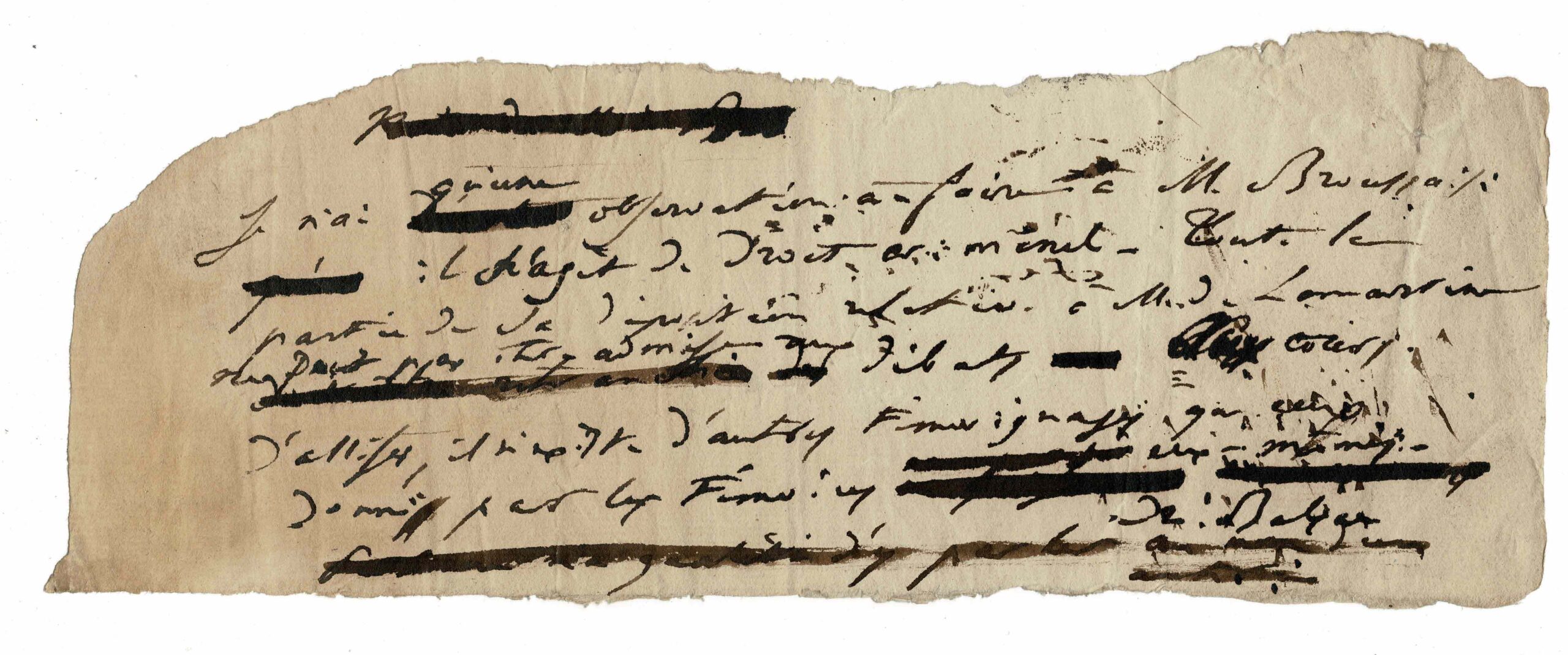
Autographed note signed.
An oblong octavo page on a fragment of brown paper.
Slnd [September 28, 1839]
"In the Assize Court, there is no testimony other than that given by the witnesses themselves."
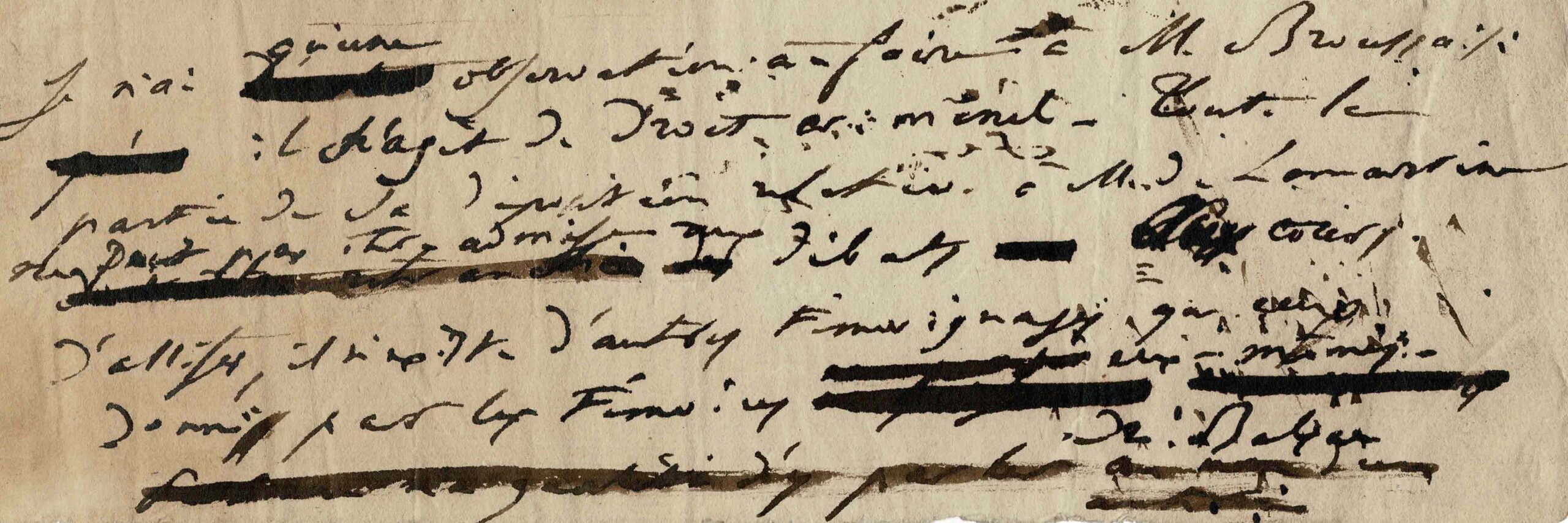
Autograph manuscript signed first draft of a note published by Le Siècle on September 29, 1839 in the context of the Peytel Affair.
____________________________________________________
" Note from Mr. de Balzac . I have only one observation to make to Mr. Broussais: that this is a matter of criminal law. The entire part of his deposition relating to Mr. de Lamartine should be excluded and cannot be admitted to the proceedings. In the Assize Courts, there is no testimony other than that given by the witnesses themselves [three words crossed out]. From Balzac. No one has the authority to speak there on behalf of another ."
____________________________________________________
A murky affair.
Sébastien-Benoît Peytel (1804-1839), a notary in Belley, was arrested for the murder of his wife and servant on the night of November 1, 1838. Sentenced to death, he appealed. Balzac, who had met him at the offices of the newspaper Le Voleur , where Peytel began his career, launched a press campaign with Gavarni to secure his acquittal.
His long Letter on the trial of Peytel, notary in Belley, intended for the defense of the accused, appeared in the newspaper Le Siècle in three parts, on September 27, 28 and 29, 1839. Doctor Casimir Broussais (son of the famous “emperor of medicine”), who was Peytel’s brother-in-law and against whom he had testified during the trial, feeling defamed by Balzac, had sent Le Siècle a letter in the form of a right of reply: this was published by the newspaper following the third and final part of Letter with, immediately after, an apostille by the latter, the first draft of which is found here.
The text published in Le Siècle differs slightly: "I have only one observation to make to Mr. Broussais; this concerns only criminal law: the entire part of his deposition relating to Mr. de Lamartine is rendered meaningless by the fact that in the assize courts, there are no testimonies other than those given by the witnesses themselves."
The writer's initiative, which drew ridicule from the press, proved futile. Peytel was condemned to death, and King Louis-Philippe, perhaps recalling Peytel's scathing " Physiology of the Pear ," published in 1832, refused to grant him clemency. The notary was executed on October 28, 1839.
____________________________________________________
Bibliography:
The Peytel Affair . Pierre-Antoine Perrod. Hachette, 1958.
Balzac, Gavarni, and the Peytel affair . Madeleine Berry.