Guillaume Apollinaire (1880.1918)
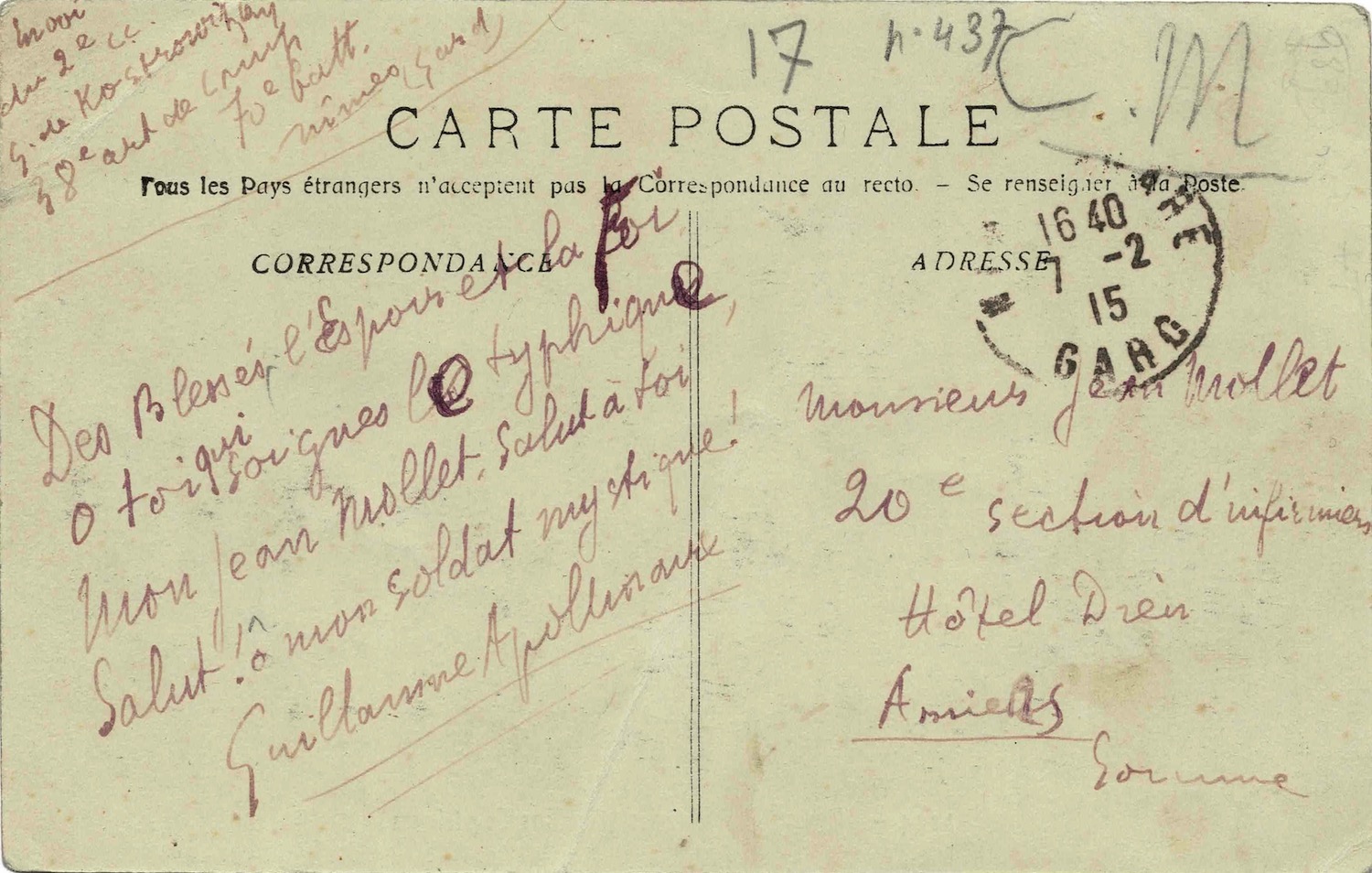
Autographed card signed to Jean Mollet.
Two oblong 12mo pages in violet ink.
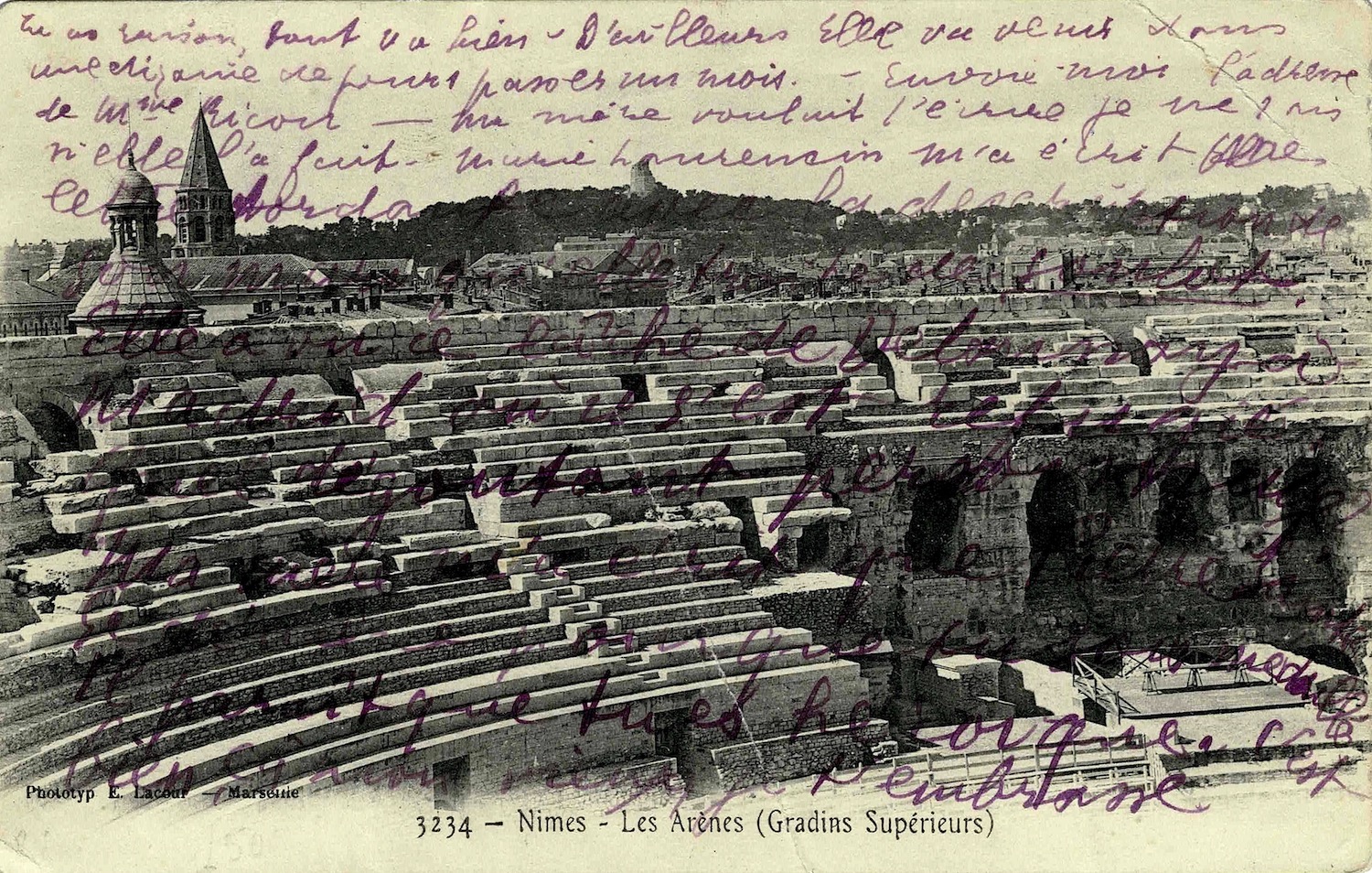
Front and back of an illustrated map of the Nîmes arenas.
Nîmes. [February 7, 1915]
A remarkable document from Apollinaire sending a quatrain to his faithful friend in homage to his devotion during the First World War.
__________________________________________________
Hope and Faith for the Wounded
O you who heal the typhus patient
My dear Jean Mollet, greetings to you
Hail! O my mystical soldier!
Guillaume Apollinaire.
In the text written on the illustrated side of the card, Apollinaire evokes two essential figures in his romantic life: Marie Laurencin and Louise de Coligny, the beautiful Lou who is about to join him in Nîmes:
"You're right. Everything's fine. Besides, she's coming in about ten days to stay for a month. Send me Mrs. Ricou's address. My mother wanted to write to you, I don't know if she did. Marie Laurencin wrote me a hilarious letter describing her husband, whom she calls a drunkard. She saw that coward Delaunay in Madrid, where he's taken refuge. What a disgusting character. My mother wrote to me that Pierre is pulling out all the stops to get you a medal. Apparently, you're very heroic. That's right, old friend. I send you my love."
__________________________________________________
Editor of Aesop's Feast , and close to Alfred Jarry, Apollinaire, and many other prominent figures in pre-war Parisian literary circles, Jean Mollet ( 1877-1964) was bestowed with the title "Baron Mollet" by the poet. In the 1950s, pataphysicians honored him by appointing him Satrap and then Vice-Curator of their College.
Marie Laurencin had left Apollinaire after a long and tumultuous affair. Having married Baron Otto von Wätjen in 1914, she went into exile with him in Spain at the start of the war. There, through Francis Picabia, she met Sonia and Robert Delaunay, who were also refugees in Spain.
Guillaume Apollinaire met Louise de Coligny-Châtillon in September 1914 during his stay in Nice, where he was awaiting his military conscription. He fell in love with her immediately. On December 6, 1914, he left to join the 38th Field Artillery Regiment, stationed in Nîmes, where Lou joined him in mid-December 1914. They spent more than a week at the Hôtel du Midi, exploring together a sensuality that would long fuel the dreams of the poet confronted with the horrors of war. Lou eventually withdrew from Apollinaire, and the break was finalized in March 1915, the day before Apollinaire left for the front.