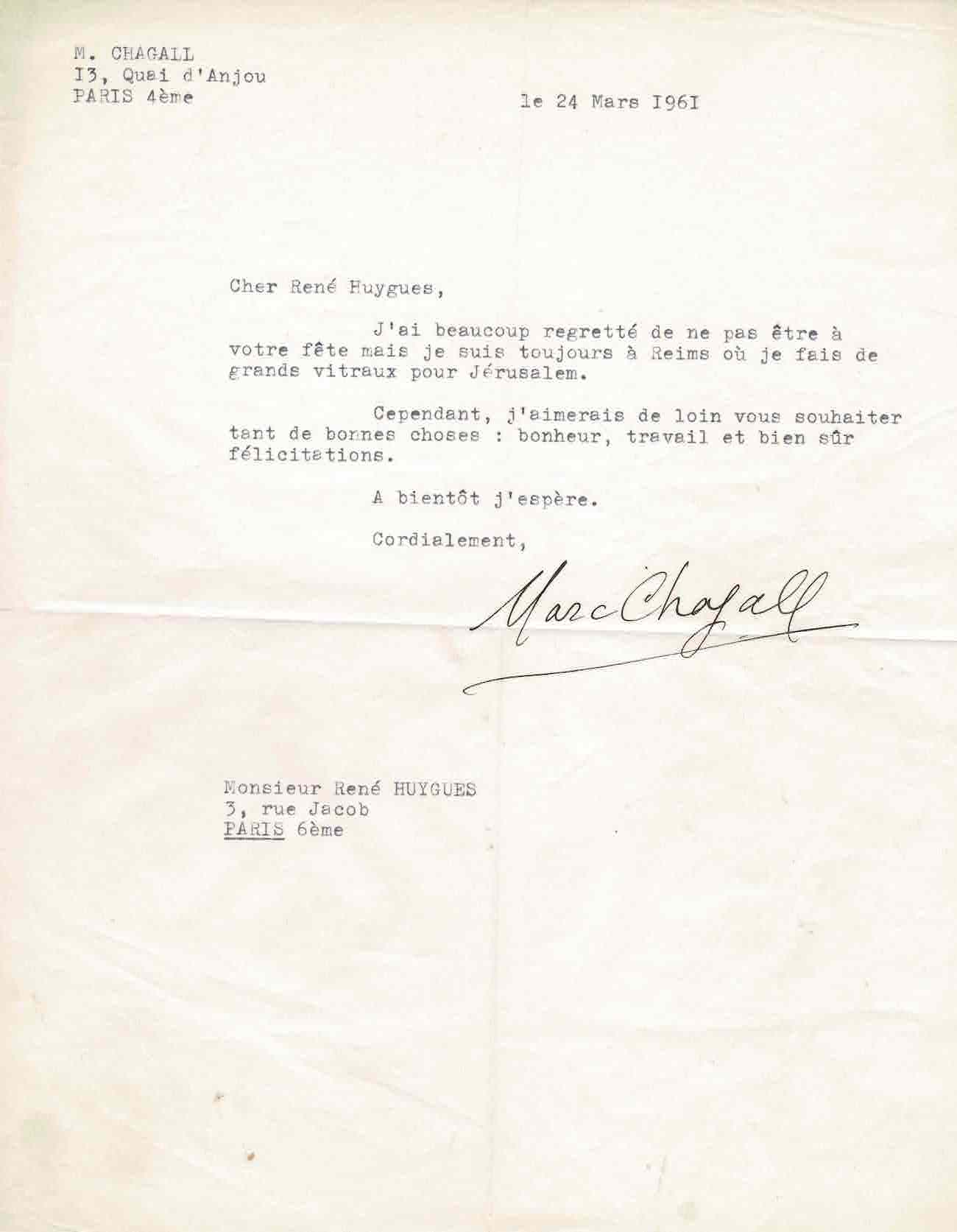

« I am still in Reims where I am making large stained-glass windows for Jerusalem.
Sold
Marc Chagall (1887.1985).
Typed letter signed to the academician and art historian René Huyghe.
One page in quarto on thin paper. Paris. March 24, 1961.
"I make large stained-glass windows for Jerusalem."
Chagall congratulates Huyghe on his entry into the Academy and informs him of his creation of stained glass windows for Jerusalem.
“Dear René Huygues [sic], I was very sorry not to be able to attend your party, but I am still in Reims where I am creating large stained-glass windows for Jerusalem. However, I would like to wish you all the best from afar: happiness, success in your work, and of course, congratulations. See you soon, I hope. Marc Chagall.”
During 1960 and 1961, Chagall created twelve stained-glass windows for the Hadassah Medical Center synagogue in Jerusalem. By this time, the Russian-Jewish painter had already designed two windows for the chapel in Assy and several for Metz Cathedral. He interrupted the Metz project to devote himself entirely to the Jerusalem stained-glass windows; he returned to them immediately after the Israeli project. This project, little studied in the historiography of modern stained glass, has been primarily discussed by the Jewish community, and with good reason: the twelve stained-glass windows for the Hadassah Medical Center synagogue are the only ones Chagall created for a Jewish place of worship. Thus, in the summer of 1961, Chagall exhibited the fruits of his labor in Paris: the twelve stained-glass windows designed for the Hadassah Medical Center synagogue in Jerusalem. The majority of these twelve stained-glass windows would later be exhibited in New York in the fall of the same year, before the complete cycle was definitively sealed and inaugurated in Jerusalem in February 1962.
René Huyghe (1906-1997) was elected to the Académie française on June 2, 1960, to the seat formerly held by Robert Kemp, with 15 votes against 10 for the novelist Paul Vialar. He was formally inducted in the grand amphitheater of the Sorbonne on April 22, 1961.