
"I have so much to deal with from the film journalists who are harassing me."
Sold
Georges Méliès (1861.1938)
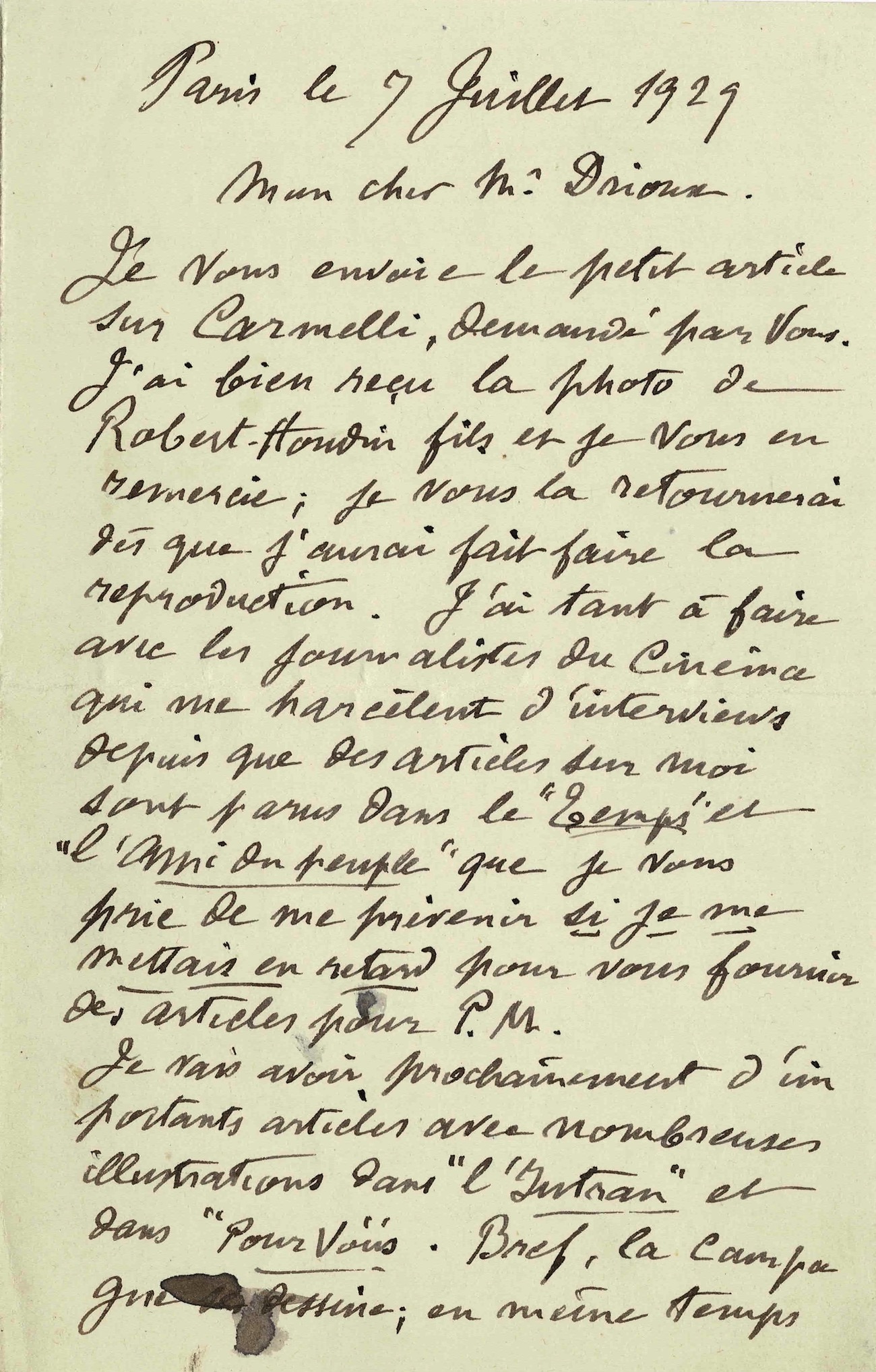
Autographed letter signed to Auguste Drioux.
Four pages in-12°
Paris. July 7, 1929.
"I have so much to do with film journalists..."
A moving and insightful letter from Méliès, finally rehabilitated, approached by Drioux for his magic show. Méliès reflects on his film career and his detractors, mentions Maurice Noverre, his first biographer, his quest for the Legion of Honour, and recounts the dreary daily life of his toy shop at the Gare Montparnasse.
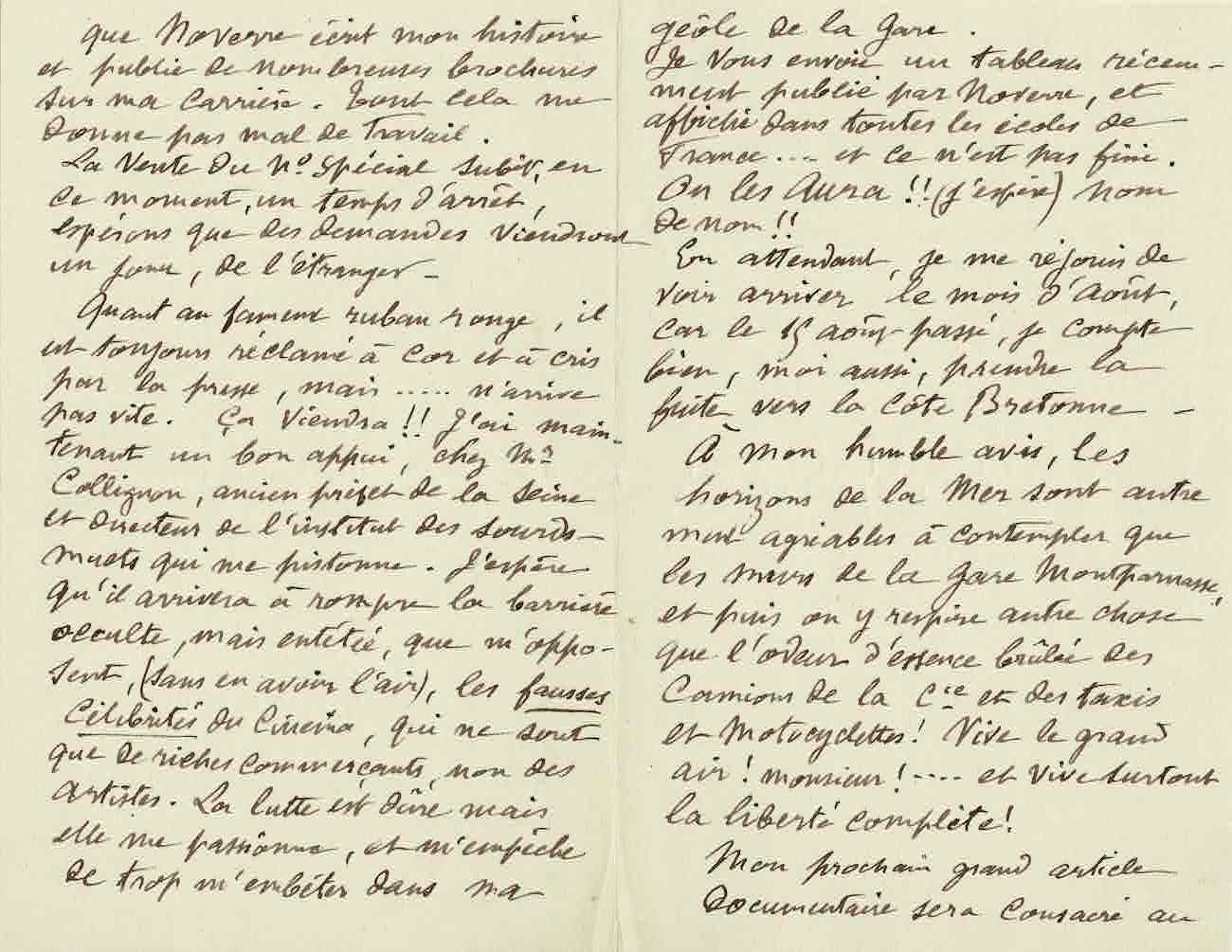
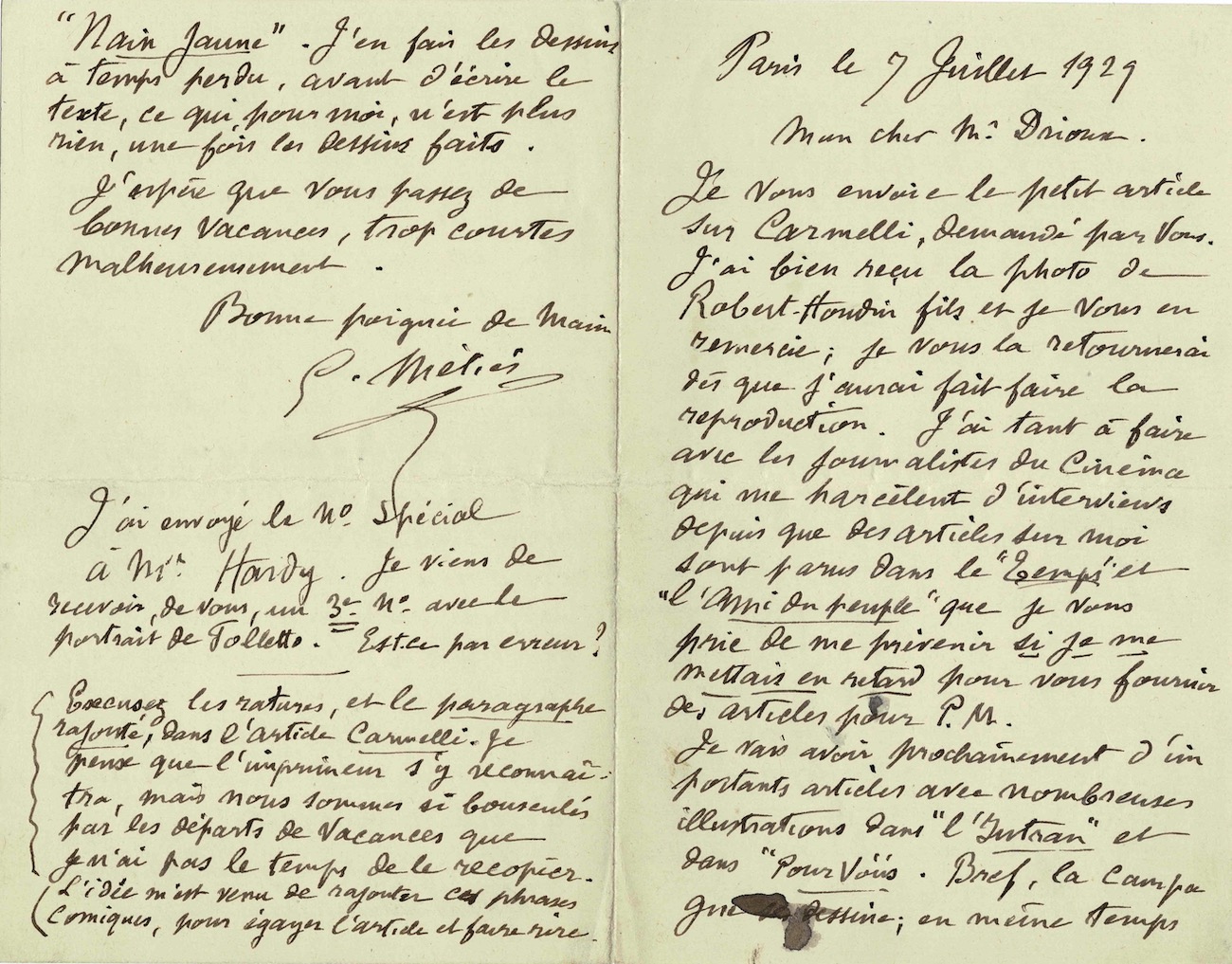
"My dear Mr. Drioux, I am sending you the short article on Carmelli that you requested. I received the photograph of Robert Houdin Jr. and thank you for it; I will return it to you as soon as I have had it reproduced. I am so busy with the film journalists who have been bombarding me with interviews ever since the articles about me appeared in 'Le Temps' and 'L'Ami du Peuple' that I would be grateful if you could let me know if I am running late in providing you with articles for PM [Passé Muscade, the magazine founded and edited by Drioux] . I will soon have some important articles with numerous illustrations in 'L'Intran[sigeant]' and in 'Pour vous'."
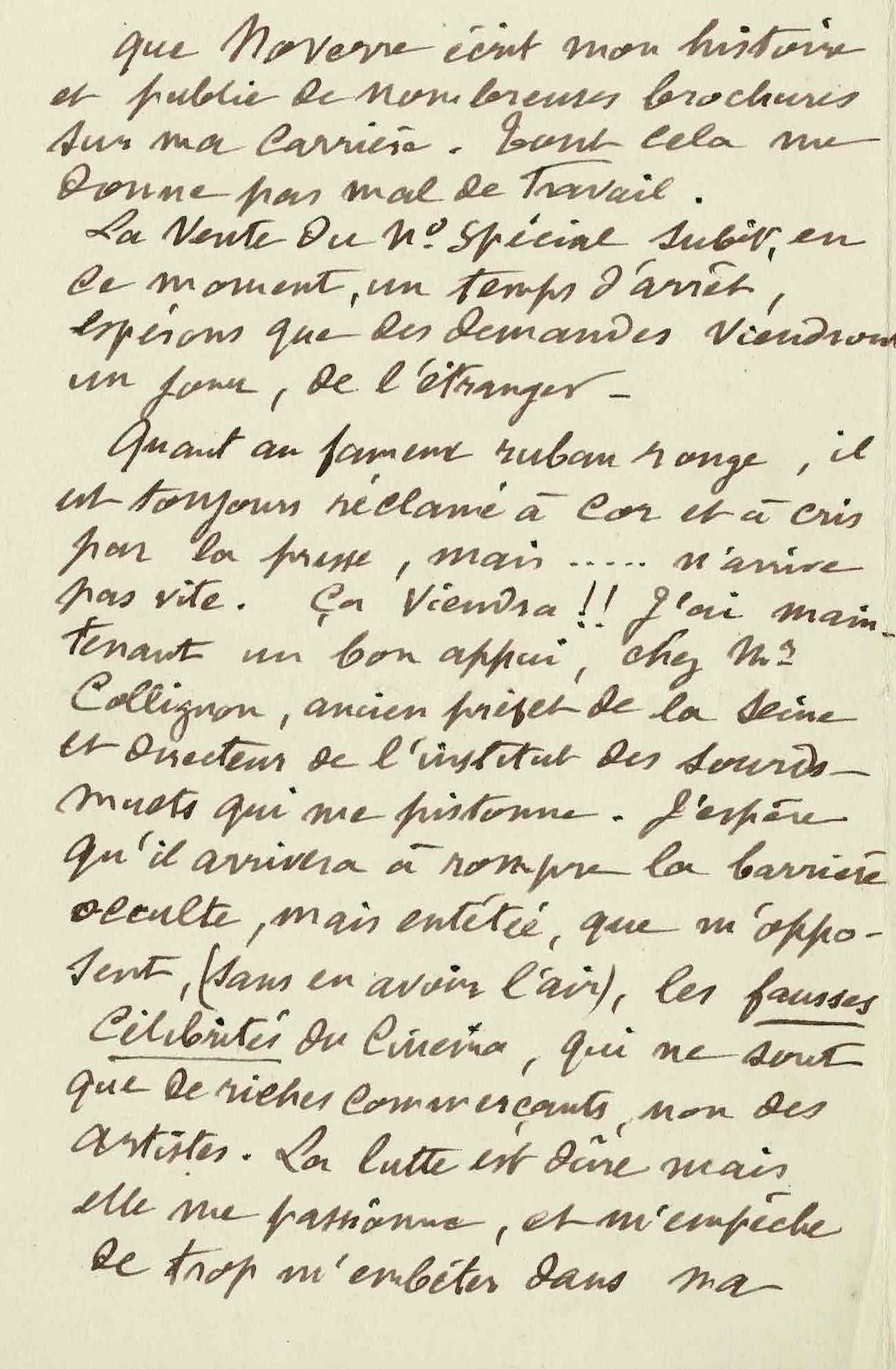
In short, the campaign is taking shape; at the same time, Noverre [Maurice Noverre, considered the first film historian] is writing my history and publishing numerous pamphlets about my career . Sales of the special issue are currently on hold; let's hope that orders will one day come from abroad. As for the famous red ribbon, it's still being demanded, wrongly and clamoring for by the press, but… it's not arriving anytime soon. It will! I now have a good supporter in Mr. Collignon, former Prefect of the Seine and director of the Institute for Deaf-Mutes, who will pull some strings for me. I hope he will manage to break down the hidden, but stubborn, barrier erected against me (without appearing to do so) by the false celebrities of cinema , who are nothing more than wealthy businessmen, not artists. The struggle is tough but it fascinates me, and keeps me from getting too bored in my station cell.
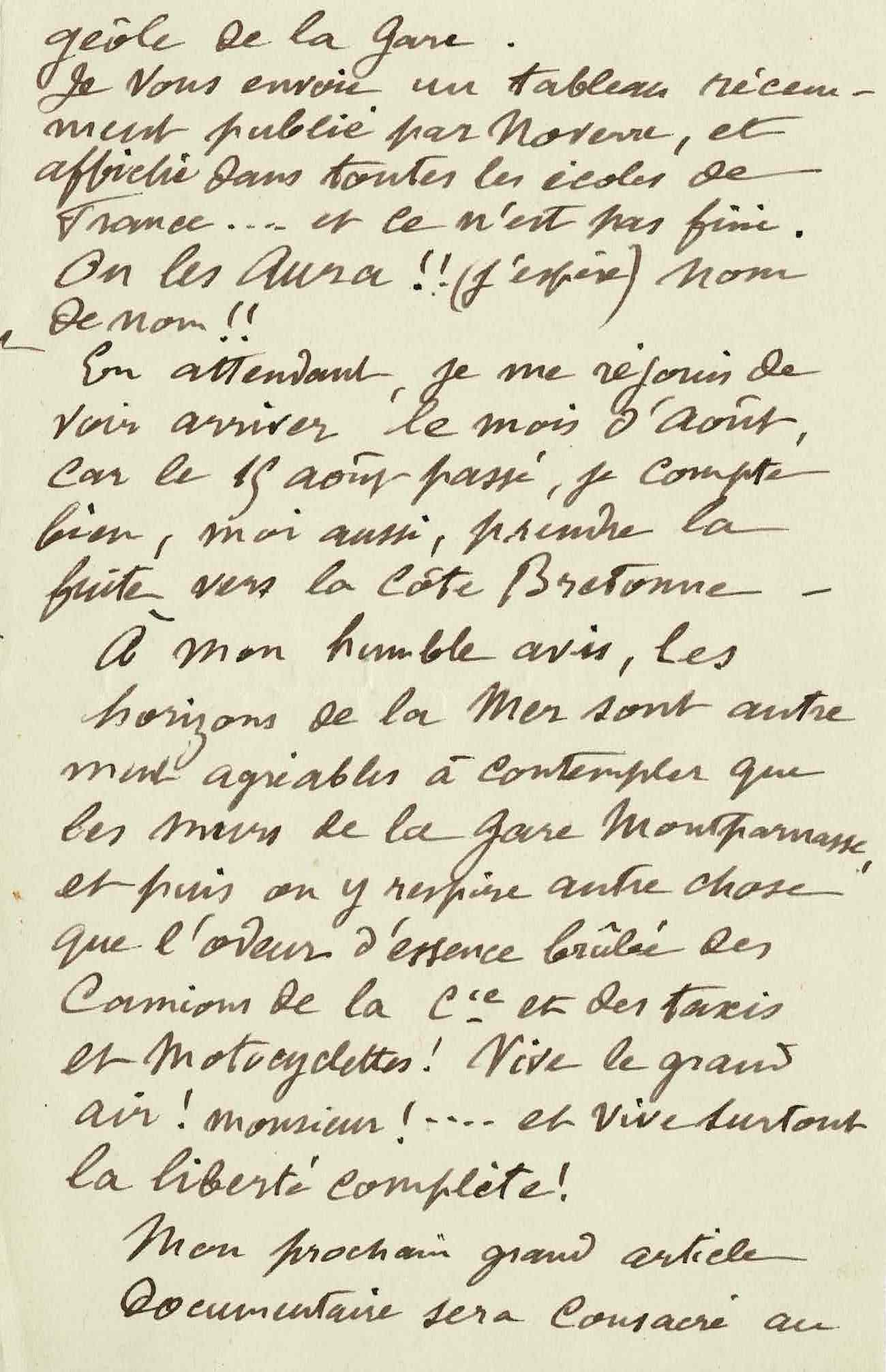
I'm sending you a painting recently published by Noverre, and displayed in every school in France… and it's not over yet. We'll get them!! (I hope so) by Jove!! In the meantime, I'm looking forward to August; because after August 15th, I fully intend to escape to the Breton coast. In my humble opinion, the sea views are far more pleasant to contemplate than the walls of Montparnasse station , and besides, you breathe something other than the smell of burning gasoline from the company trucks, taxis, and motorcycles. Long live the fresh air! sir! … and above all, long live complete freedom!
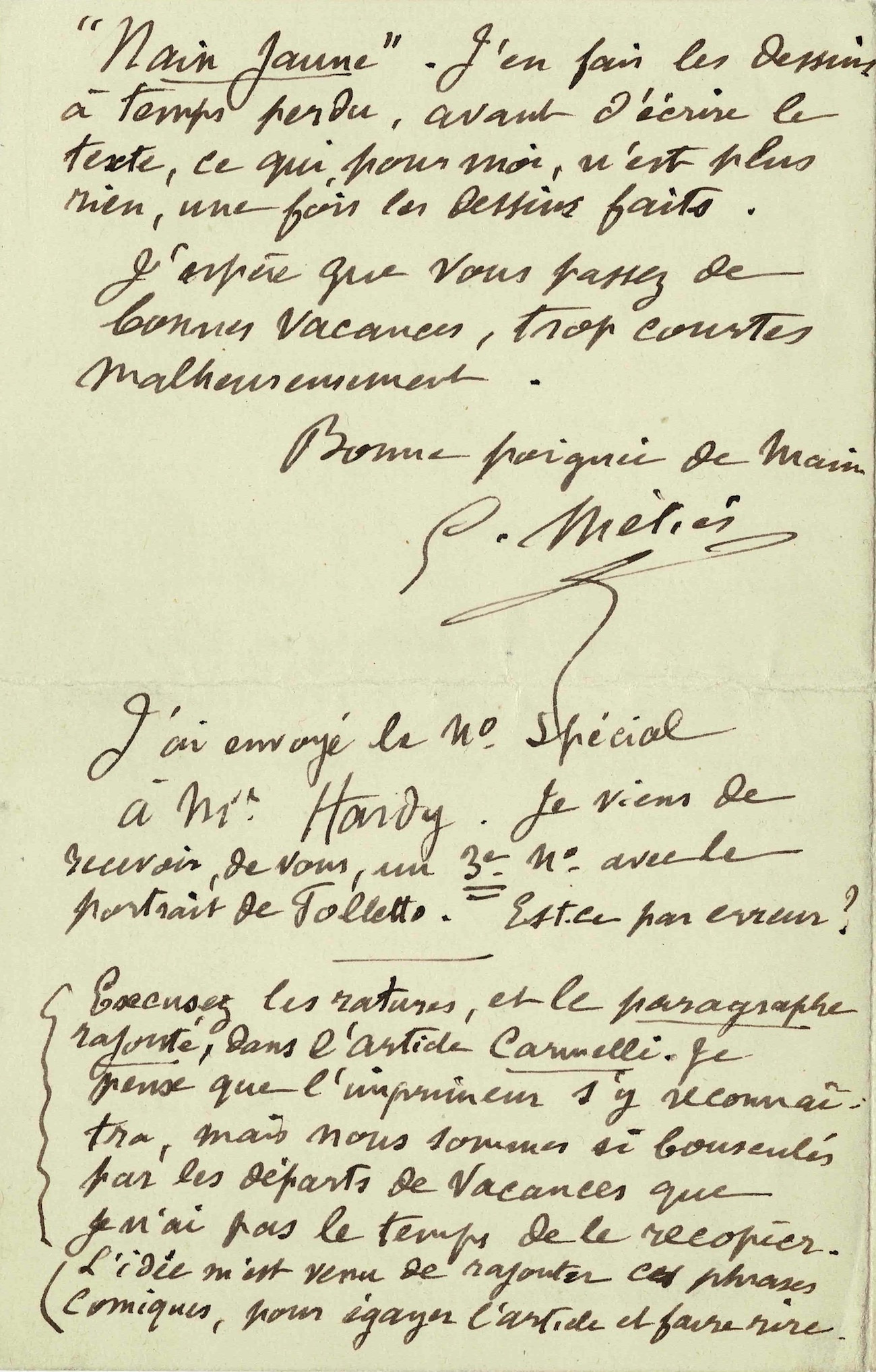
My next major documentary article will be about "The Yellow Dwarf." I'm doing the drawings in my spare time, before writing the text, which, for me, is nothing once the drawings are done. I hope you're having a good holiday, all too short unfortunately. Best regards. G. Méliès.
I sent the special issue to Mr. Hardy (…) Please excuse the crossed-out words and the added paragraph in the Carmelli article. I think the printer will recognize it, but we're so rushed off our feet with everyone going on holiday that I don't have time to retype it. The idea came to me to add these humorous sentences to liven up the article and make people laugh .
—————————————-
Georges Méliès ceased all filmmaking activity in 1913. A widower, ruined by the First World War, and forgotten by the art world, he remarried, to Jehanne d'Alcy. She ran a small toy and candy shop within the Montparnasse train station. Méliès then took over the business with Jehanne. During the long hours spent running the toy shop, seven days a week, Méliès was bored and suffered in this confined environment—as he testifies in this letter; but he continued to draw (even sketching himself chained to the walls of the station).
It was in this very place that Léon Druhot, editor of Ciné-journal, found him. One morning, like any other, a café owner passing by greeted Méliès with a resounding " Good morning, Mr. Méliès! " Léon Druhot , who happened to be there, couldn't believe his ears; he had imagined Méliès to be long dead. He called out to him: "Are you related to Georges Méliès, who made films before the war?" – "Why, it's me."
Thanks to Druhot, Méliès emerged from obscurity. The filmmaker then fought fiercely for recognition of his role as the inventor of cinematic spectacle and his technical discoveries.
The surrealists discovered his work and the profession finally recognized him. Sponsored by Louis Lumière, Georges Méliès finally received the Legion of Honour – the famous red ribbon mentioned in this letter – on October 22, 1931, during a banquet of 800 guests at the Claridge.
—————————————-
Auguste Drioux (1884-1937), the recipient of this letter, was a renowned magician from a very young age. In 1916, he founded the Revue Passez Muscade , a quarterly bulletin for magicians. In addition to his regular publications, Drioux published a special issue in honor of Georges Méliès (1929), who is mentioned in this letter.
Maurice Noverre met Méliès and visited his studio in Montreuil in the 1920s. His description of the first permanent film studio, now defunct, was not published until 1929, in Le Nouvel Art Cinématographique (June 1925 – April 1930), a magazine of which he was the founder, director and editor.
Considered the first historian of French cinema, Noverre championed the forgotten, the plagiarized inventors, and those dispossessed of their works. A specialist in Georges Méliès, with whom he maintained a long correspondence (preserved at the Cinémathèque française), he was the first to describe in great detail the layout of his early studios and produced a body of essential texts on the filmmaker.
He was also one of the organizers of the " Méliès Gala ," which took place at the Salle Pleyel on December 16, 1929. This gala, a cornerstone of Méliès' cinematic legacy, featured screenings of some of the artist's greatest hits, including the legendary A Trip to the Moon. His granddaughter, Madeleine Melthête-Méliès, wrote of it with emotion:
“ When I first saw eight rediscovered films of my grandfather Gala Pleyel . In 1943, I became secretary at the Cinémathèque Française . Henri Langlois told me, ‘I have the whole world’s cinema on my shoulders; take care of Méliès ,’ which I did. Not a year goes by without finding a film, a drawing, a letter. It’s always a doubly emotional moment because, in addition to that of the collector, there’s that of the granddaughter finding traces of her grandfather, the magician who performed card, cigarette, and coin tricks for her while talking to her about Homer and Offenbach. ”