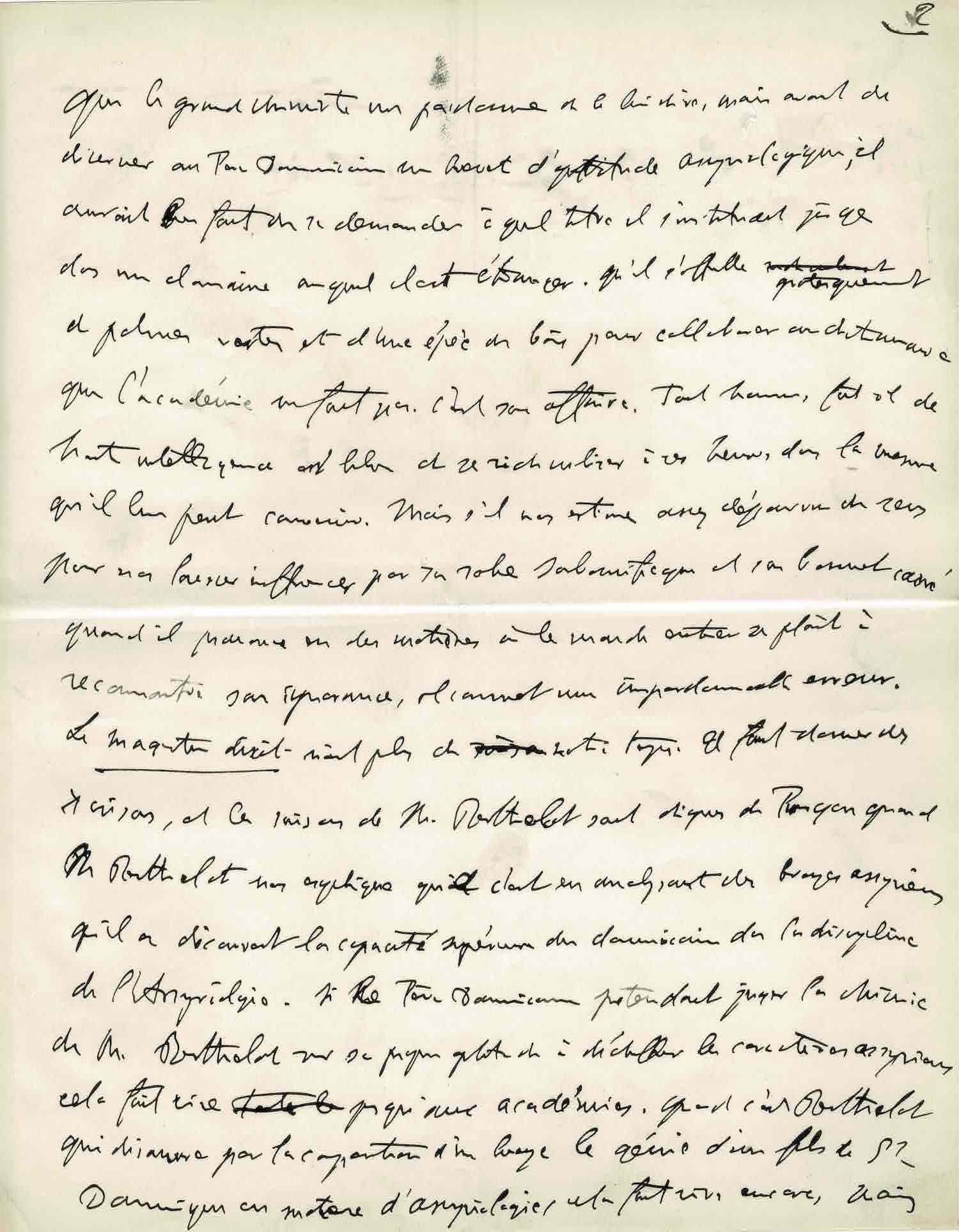
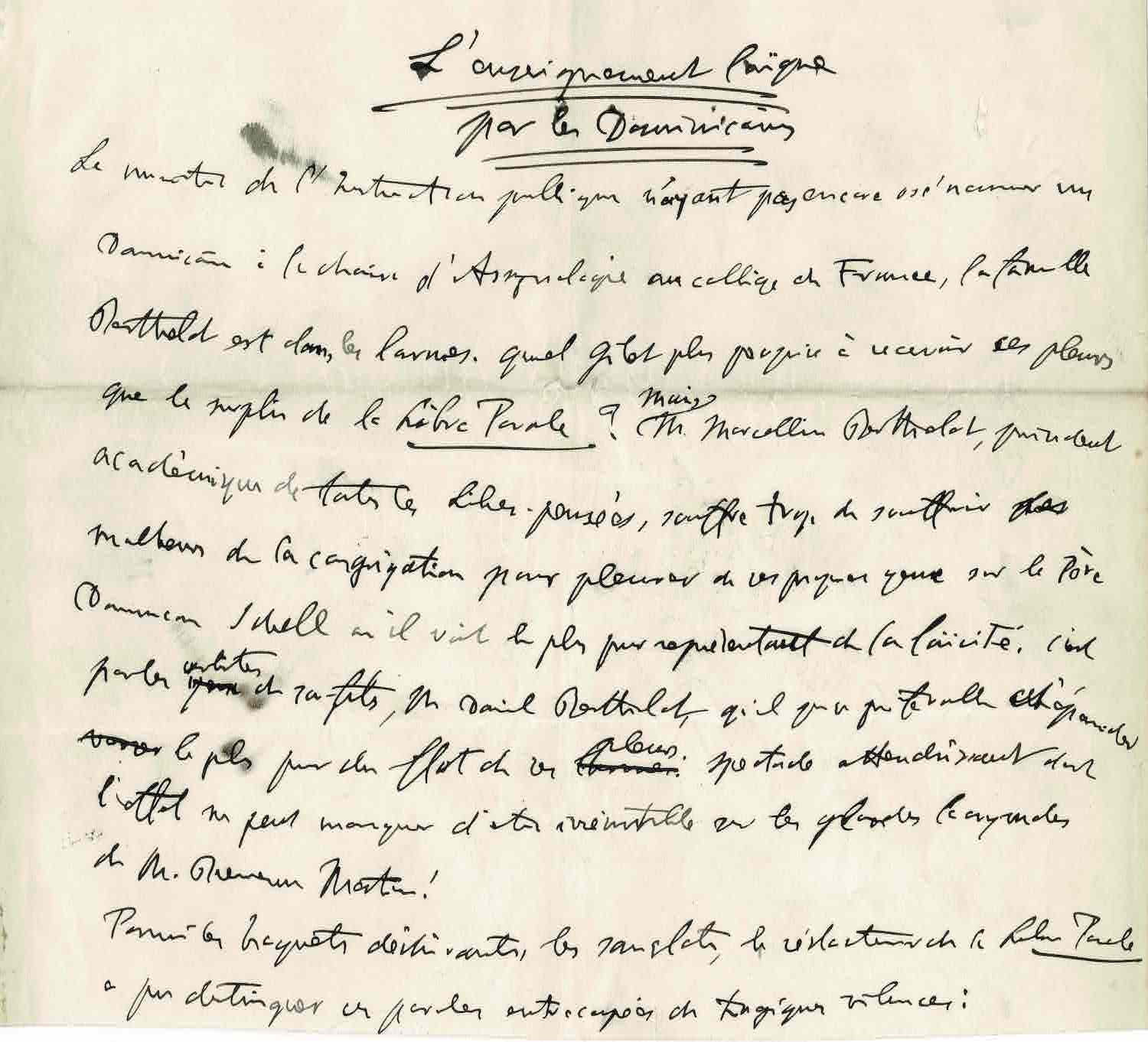
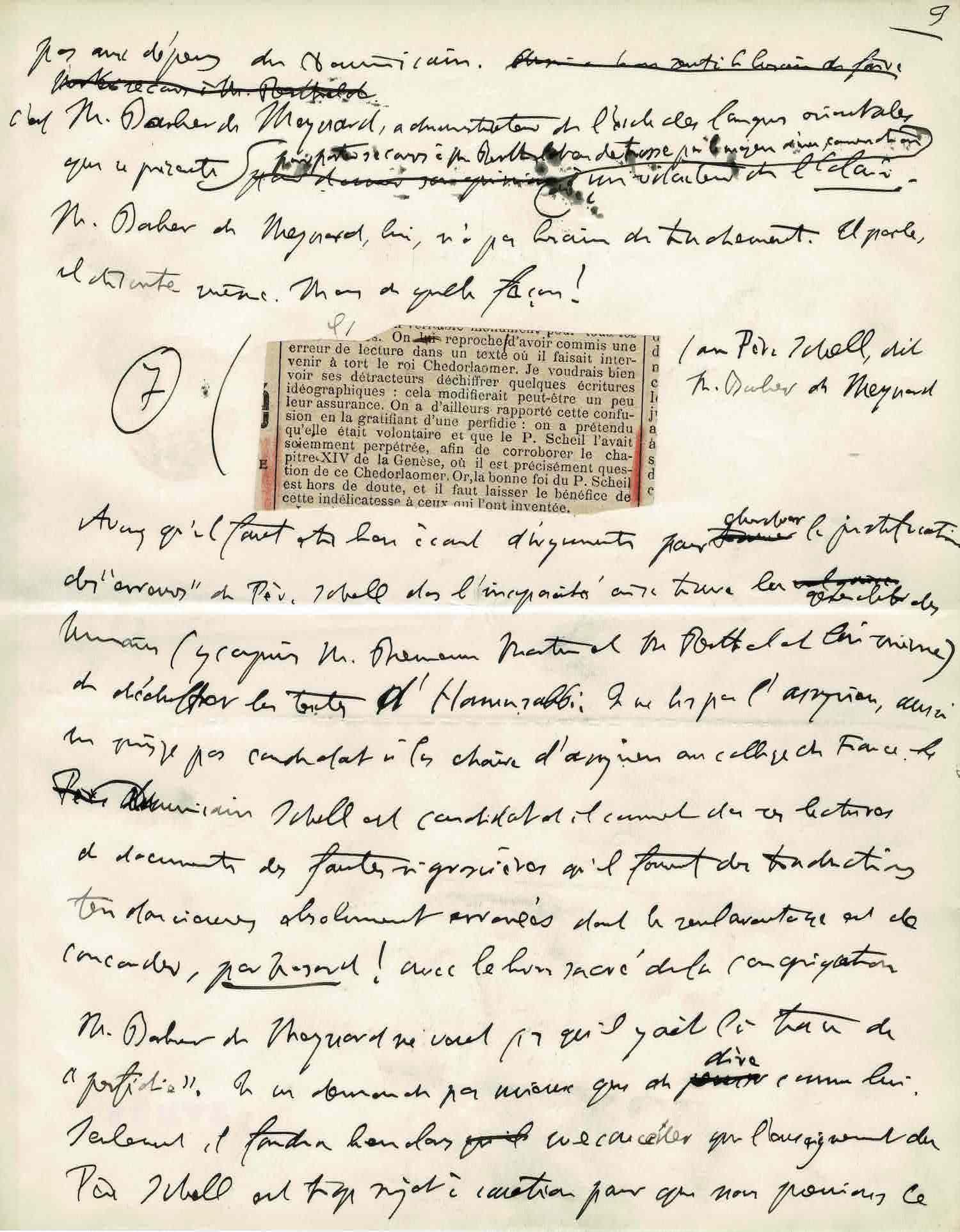
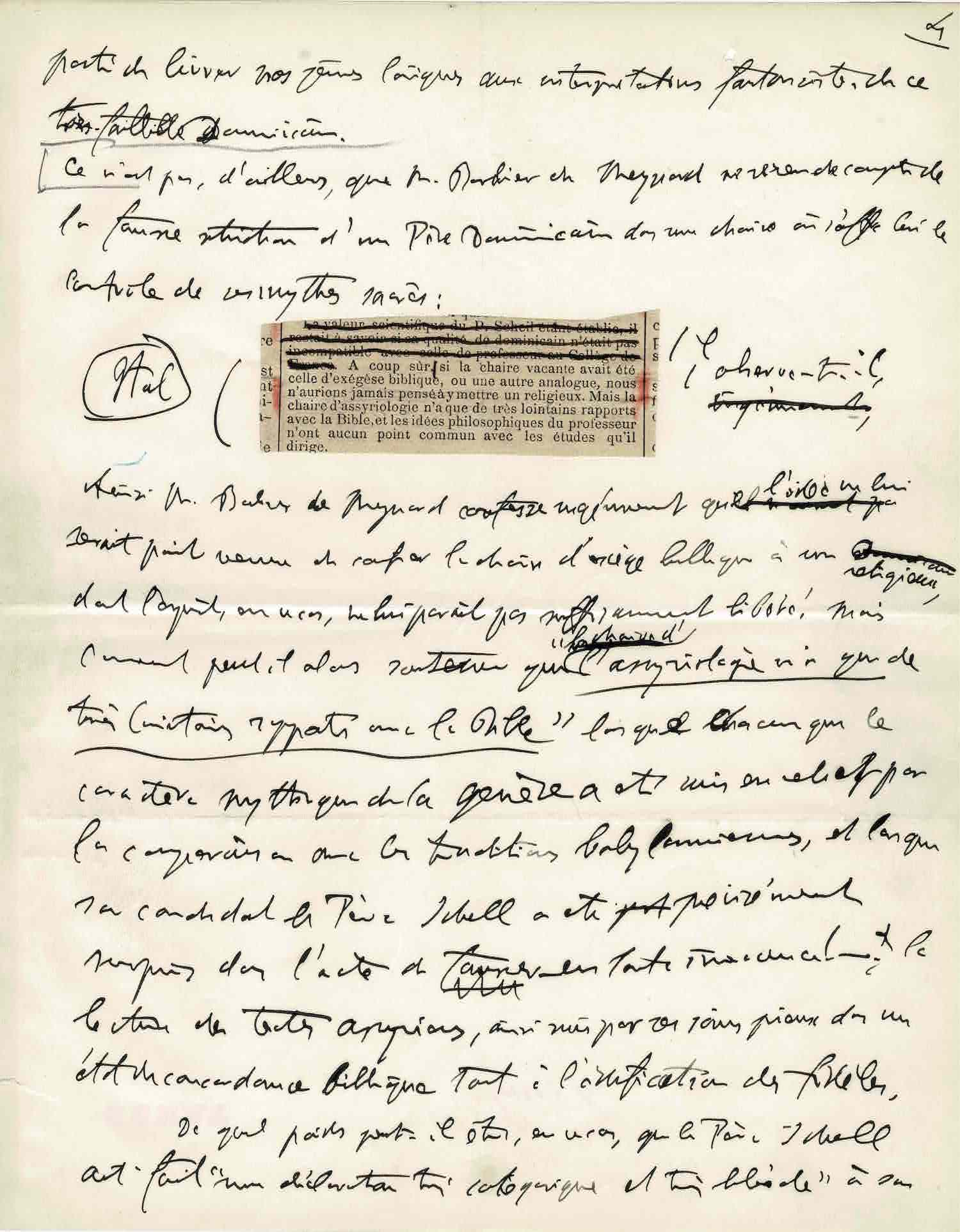
Georges CLEMENCEAU – Autograph manuscript – Secularism and Dominicans.
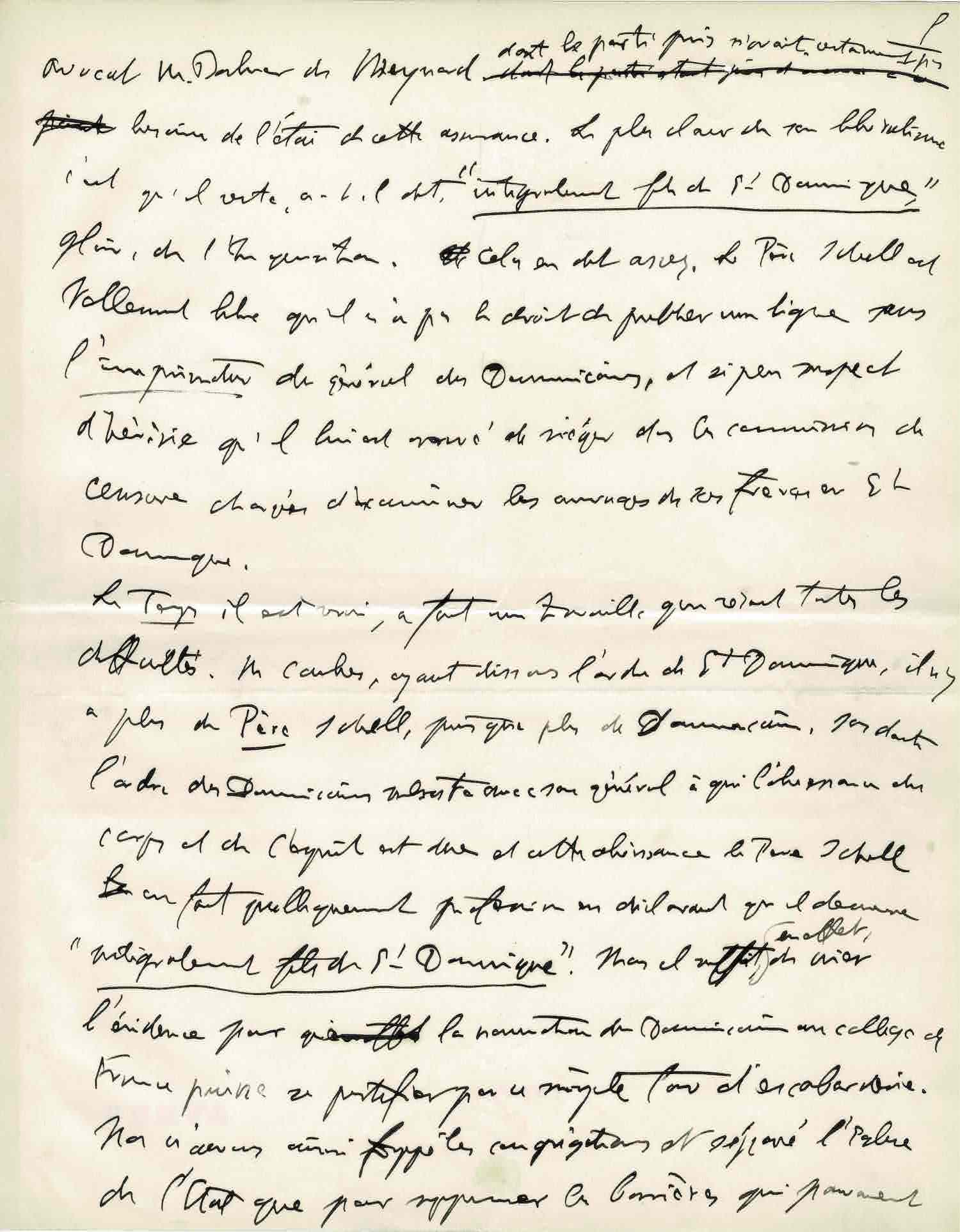
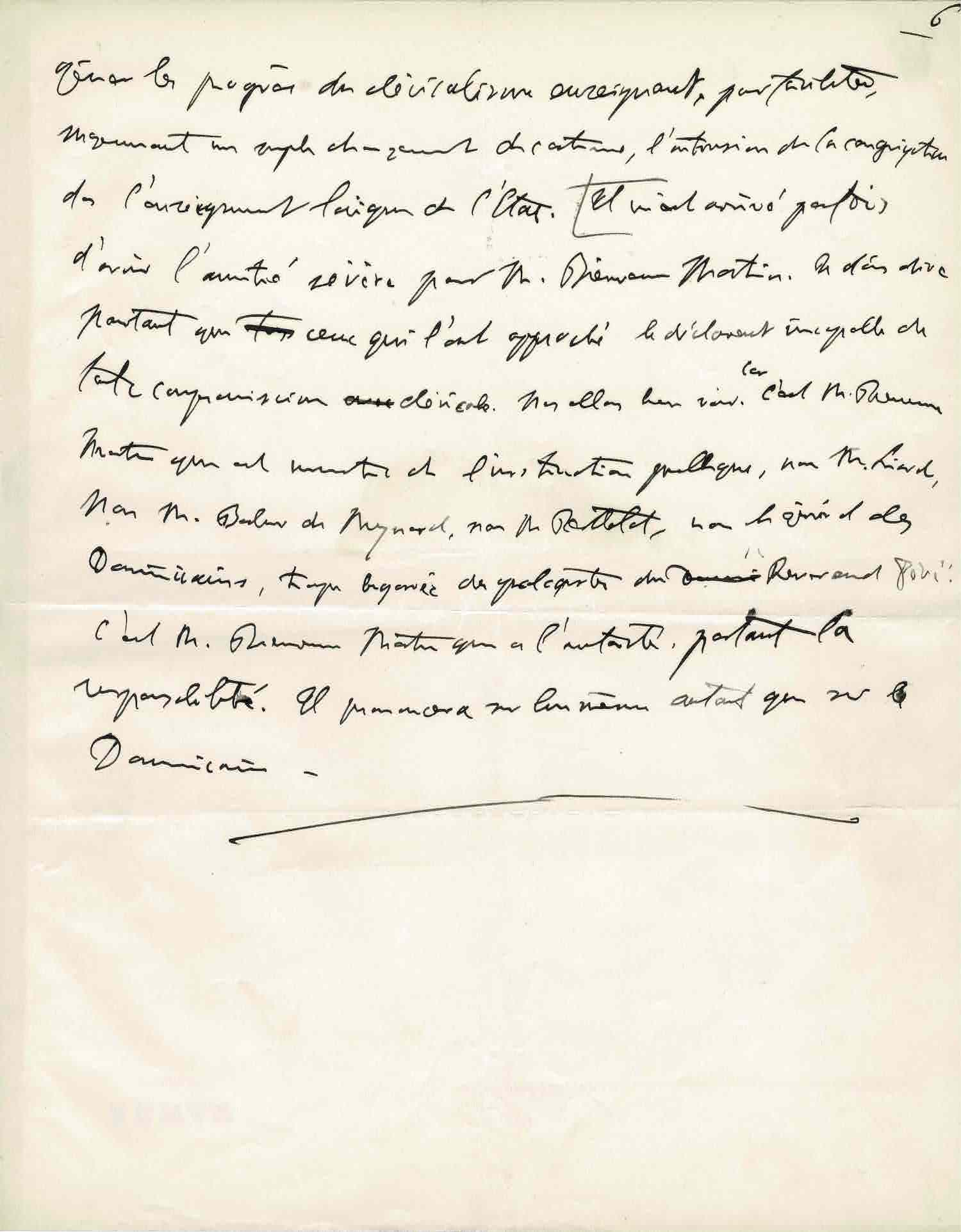
Autograph manuscript of the article that appeared on the front page of L'Aurore on January 7, 1906.
1.800€

Autograph manuscript of the article that appeared on the front page of L'Aurore on January 7, 1906.
1.800€
Georges Clemenceau (1841-1929)
Autograph manuscript – Secular education by the Dominicans.
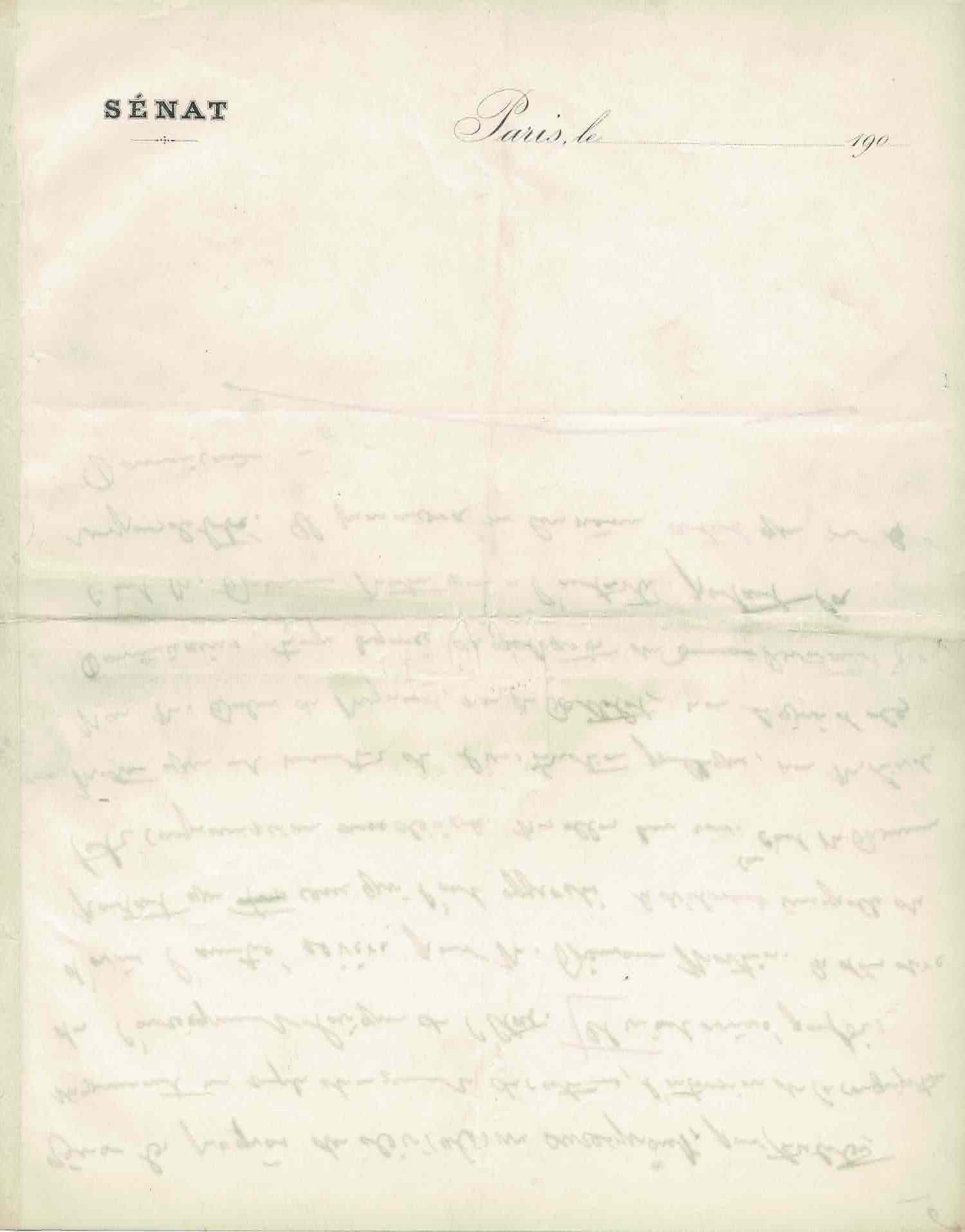
Six quarto pages on the reverse of sheets with Senate letterhead.
No place or date [January 1906]
Autograph manuscript of the article that appeared on the front page of L'Aurore on January 7, 1906.
_____________________________________________________________
« Since the Minister of Public Instruction has not yet dared to appoint a Dominican to the chair of Assyriology at the Collège de France, the Berthelot family is in tears. What vest could be more fitting to receive these tears than the surplice of Free Speech ? But Mr. Marcellin Berthelot, academic president of all freethinkers, suffers too much from the misfortunes of the Congregation to weep with his own eyes for the Dominican Father Scheil, whom he sees as the purest representative of secularism. It is through the eyes of his son, Mr. Daniel Berthelot, that he deems it preferable to pour out the purest of his tears. A touching spectacle whose effect cannot fail to be irresistible on the tear ducts of Mr. Bienvenu-Martin!
Amidst the heart-rending sobs and sobs, the editor of Libre Parole was able to distinguish these words interspersed with tragic silences:
[The following passage, in red, reproducing the statements of Daniel Berthelot, probably taken from La Libre Parole and which was to be attached to the manuscript, has not been preserved:]
“My father did indeed propose Father Scheil’s candidacy and voted for him. He considers him to be the first Assyriologist in France and is of the opinion that his place is in our first chair of Assyriology.
He doesn't even understand that questions of opinion or religious or other beliefs could be raised in such a matter.
He sees the man, the scholar, without taking any other consideration into account.
Father Scheil is a man of very high learning: he has done remarkable work in Assyriology, and my father has known him for a long time.
“You are no doubt aware that archaeology has many points of connection with chemistry. For example, by analyzing bronze objects, one can determine their chronological order through the proportions and materials of the alloy. My father therefore had to collaborate with Father Scheil, and it was then that he came to know and appreciate him.”.
– And do you believe that Father Scheil will be appointed?
“I don’t know: we know that the minister is being strongly urged in the opposite direction. But my father hopes that Mr. Bienvenu-Martin will be able to free himself from these influences and, aware of his responsibility, will act justly and sensibly by entrusting Father Scheil with the chair to which he has more right than anyone else.”
May the great chemist forgive me for saying this, but before awarding the Dominican Father a certificate of Assyriological competence, he would have done well to ask himself by what right he appoints himself judge in a field with which he is completely unfamiliar. Let him grotesquely adorn himself with green palm fronds and a wooden sword to contribute to the dictionary that the Academy is not compiling; that is his prerogative. Every man, even one of great intelligence, is free to make a fool of himself at times, to the extent that he sees fit. But if he considers us so lacking in sense as to be swayed by his Sorbonne-esque robes and square cap when he pronounces on matters in which the whole world delights in acknowledging his ignorance, he is making an unforgivable mistake.
The "magister dixit" ( master of pronouncements) is no longer in vogue. Reasons must be given, and Mr. Berthelot's reasons are worthy of Purgon when he explains that it was by analyzing Assyrian bronzes that he discovered the Dominican's superior ability in the discipline of Assyriology. If the Dominican Father were to presume to judge Mr. Berthelot's chemistry based on his own aptitude for deciphering Assyrian characters, it would laughable even to the Academies. When it is Berthelot who discovers, through the composition of a bronze, the genius of a son of St. Dominic in matters of Assyriology, it is still laughable, but not at the Dominican's expense.
It was Mr. Barbier de Meynard, administrator of the School of Oriental Languages, who came forward to help Mr. Berthelot in distress, by means of a conversation with an editor of L'Éclair . Mr. Barbier de Meynard, however, needed no interpreter. He spoke, he even debated. But how! “Father Scheil is accused,” says Mr. Barbier de Meynard, “of having made a misreading in a text where he wrongly included King Chedorlaomer. I would like to see his detractors decipher some ideographic writing: that might perhaps temper their confidence a little. Moreover, this confusion has been reported as a perfidious act: it has been claimed that it was deliberate and that Father Scheil knowingly perpetrated it in order to corroborate Chapter XIV of Genesis, where this Chedorlaomer is specifically mentioned. However, Father Scheil's good faith is beyond doubt, and the benefit of this indiscretion should go to those who invented it.”
Admit it, one must be utterly lacking in arguments to seek justification for Father Schell's "errors" in the inability of the general human population (including Mr. Bienvenu-Martin and Mr. Berthelot himself) to decipher Hamurabbi's texts . I do not read Assyrian, and therefore I am not a candidate for the chair of Assyrian at the Collège de France. The Dominican Schell is a candidate, and yet he makes such egregious errors in his readings of documents that he provides biased and utterly erroneous translations whose only merit is to coincide, by sheer chance !, with the congregation's sacred book. Mr. Barbier de Meynard refuses to acknowledge any trace of "perfidy" in this. I couldn't agree more. However, you will then have to concede to me that Father Schell's teaching is too questionable for us to take the side of exposing our young lay people to the fanciful interpretations of this very fallible Dominican.
It is not, moreover, that Mr. Barbier de Meynard fails to realize the false position of a Dominican Father in a chair where he has control over his sacred myths: “Certainly,” he observes, “if the vacant chair had been that of biblical exegesis, or another similar one, we would never have thought of putting a religious man in it. But the chair of Assyriology has only very distant relations with the Bible, and the professor’s philosophical ideas have no point in common with the studies he directs.”
Thus, Mr. Barbier de Meynard ingenuously confesses that the idea would never have occurred to him to entrust the chair of biblical exegesis to a religious figure, whose mind, in this case, does not seem to him sufficiently free. But how can he then maintain that “the chair of Assyriology has only very distant connections with the Bible” when everyone knows that the mythical character of Genesis has been highlighted by comparison with Babylonian traditions, and when his candidate, Father Schell, was caught in the very act of falsifying—quite innocently!—the reading of Assyrian texts, which he had so piously brought into a state of biblical concordance, entirely for the edification of the faithful?
What weight can it possibly carry, in this case, that Father Schell made “a very categorical and very liberal declaration” to his lawyer, Mr. Barbier de Meynard, whose bias certainly didn't require the cover of such assurance? The clearest expression of his liberalism is that he remains, he said, “entirely a son of St. Dominic,” the glory of the Inquisition. That says it all. Father Schell is so free that he doesn't have the right to publish a single line without the imprimatur of the Dominican Superior General, and so little suspected of heresy that he has even served on the censorship boards charged with examining the works of his fellow Dominicans.
Le Temps , it is true, has made a discovery that resolves all difficulties. Since Mr. Combes dissolved the Dominican Order in France, there is no longer a Father Schell, because there are no more Dominicans. Undoubtedly, the Dominican Order survives with its Superior General, to whom obedience of body and mind is owed, and Father Schell publicly professes this obedience by declaring that he remains “entirely a son of St. Dominic.” But it suffices, in fact, to deny the obvious for the Dominican's appointment to the Collège de France to be justified by this trickery. We would thus have struck at the religious orders and separated Church from State only to remove the barriers that could hinder the progress of clerical teaching, to facilitate, by means of a simple change of habit, the Congregation's entry into the secular education system of the State.
I have sometimes been rather critical of Mr. Bienvenu-Martin. I must say, however, that those who have been close to him declare him incapable of any clerical compromise. We shall see. For it is Mr. Bienvenu-Martin who is Minister of Public Instruction, not Mr. Liard, not Mr. Barbier de Meynard, not Mr. Berthelot, not the Dominican general, that motley crew of apologists for the “Reverend Father.” It is Mr. Bienvenu-Martin who holds the authority, and therefore the responsibility. He will pronounce judgment on himself as much as on the Dominican. »
________________________
Supported by several prominent figures, including Marcellin Berthelot, Father Scheil (not Schell, as Clemenceau wrote), a Dominican, was a candidate for the chair of Assyriology at the Collège de France. While the law separating Church and State had just been passed (December 9, 1905) and continued to fuel passions, the stakes of the appointment to the chair of Assyriology extended far beyond scholarly circles.
In an article entitled "Saint Dominic at the Collège de France," published in L'Aurore a few days earlier, on December 30, 1905, Georges Clemenceau had already summarized them: " It is well known how closely Assyriological studies are linked to biblical exegesis. It is now established, for example, that the Genesis accounts of creation, the fall of man, and the flood were borrowed from the cycle of Babylonian legends. Such discoveries inevitably show the Holy Scriptures in a somewhat different light from that in which a cleric is obliged to view them. Catholic dogmas are sometimes severely challenged as a result. [...] It is therefore necessary that a serious Assyriologist be an absolutely independent mind ." A Dominican friar could therefore not hold a chair of Assyriology, which is not a branch of theology, but a science, as he emphasizes again here.
As for Combes' attempt to justify himself by explaining that there are no more Dominicans in France, the order having been dissolved, Clemenceau calls it "a trick of deceit".
The affair grew to such proportions that it was the subject of a debate in the House…
Georges Clemenceau launched a scathing attack on Marcellin Berthelot, an active supporter of Father Scheil, denying the chemist any authority over a science foreign to him. Berthelot had been convinced of the Dominican's competence after analyzing the chemical composition of an Assyrian bronze; his scientific conclusions corroborated Father Scheil's historical claims. Clemenceau burst out laughing: " If the Dominican Father were to presume to judge Mr. Berthelot's chemistry based on his own ability to decipher Assyrian characters, it would be laughable even to the Academies. " And the judgment was unequivocal: " Let him grotesquely adorn himself with green palm fronds and a wooden sword to contribute to the dictionary that the Academy isn't producing, that's his business. Every man, even one of great intelligence, is free to make a fool of himself at times, to the extent that he sees fit." But if he considers us so lacking in sense as to be influenced by his Sorbonne-style robe and his square cap when he pronounces on matters in which the whole world delights in acknowledging his ignorance, he commits an unforgivable error. ” (In the printed text, the adverb “grotesquely” was removed and “Sorbonne-style robe” was replaced by “Sorbonne robe”: the text gained in sobriety what it had lost in humor.)
As an interesting side note, the square in front of the Collège de France is now named Place Marcellin Berthelot.