George Sand (1804.1876)
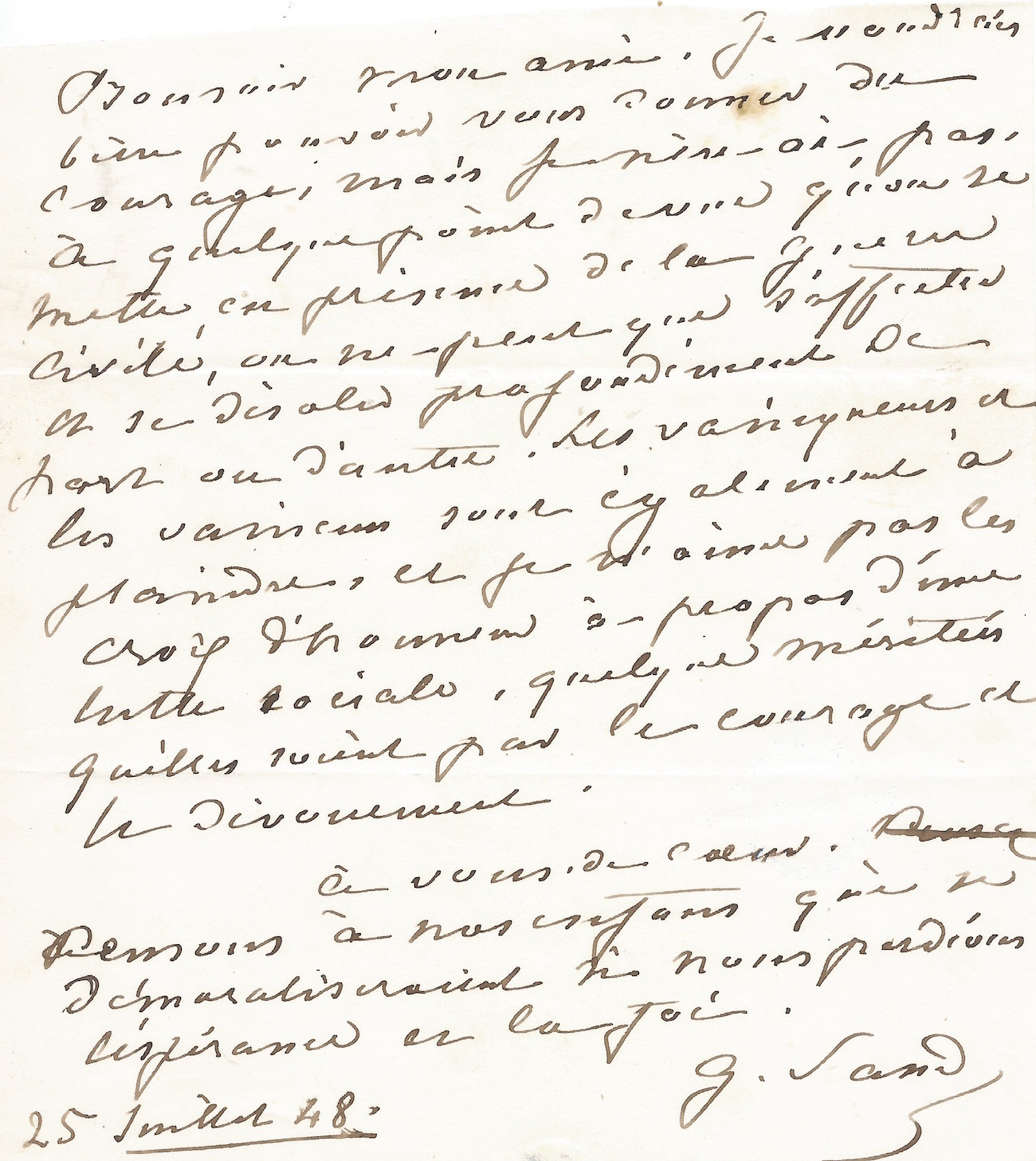
Autographed letter signed.
One page in-8°. Trace of a collector's stamp.
Letterhead cut off without affecting the text.
[Nohant] July 25, 1848.
"Let us think of our children who would become demoralized if we lost hope and joy."
A moving letter from George Sand lamenting the social situation and the civil consequences of the bloody days of June 1848.
________________________________________________________________
"Good evening my friend. I wish I could give you courage, but I don't have any , from whatever point of view one puts oneself, in the presence of civil war, one can only be deeply affected and saddened on one side or the other.
The victors and the vanquished are equally to be pitied, and I dislike medals of honor awarded for social struggles , however deserved they may be through courage and devotion. With all my heart. Let us think of our children who would become demoralized if we lost hope and joy. G. Sand
________________________________________________________________
For George Sand, the 1840s were a period of fervent political engagement, expressed through numerous publications in the national press. A champion of socialist and republican ideals, Sand participated in many actions in support of oppressed populations.
However, the failure of the 1848 revolution and the bloody June Days marked the end of her political activism and the beginning of her disillusionment. Having withdrawn to Nohant in May 1848, Sand only participated in political debate to criticize Louis Napoleon Bonaparte in various journals.
“The February Revolution was the result of a spontaneous expression of popular sovereignty manifested by the unanimous surge […]. Do not be frightened, do not pretend to faint, do not say that we are calling for civil war […]. There will be no riots, the people no longer want them. There will be no conspiracies, the people thwart them. There will be no bloodshed, the people abhor it. There will be no threats, the people have no need to make them […]. The people will not lay a finger on your precious representatives. They will not shout at them: Death to the bourgeoisie! To the lamppost, you and yours! […] If you were even richer and more cunning, you might perhaps be able to produce the appearance of a majority to ignite civil war. Well, civil war would not obey you; it would sweep you away first.” But, in your learned calculations, you have forgotten the supreme law, the great power, the great voice of humanity. It will come, and the thought of civil war will vanish like a bad dream. It feels itself, it knows itself now, the unanimous voice of the people! » George Sand, “The Majority and Unanimity,” La Cause du peuple, April 23, 1848.