[Eugène DELACROIX] George SAND (1804.1876)
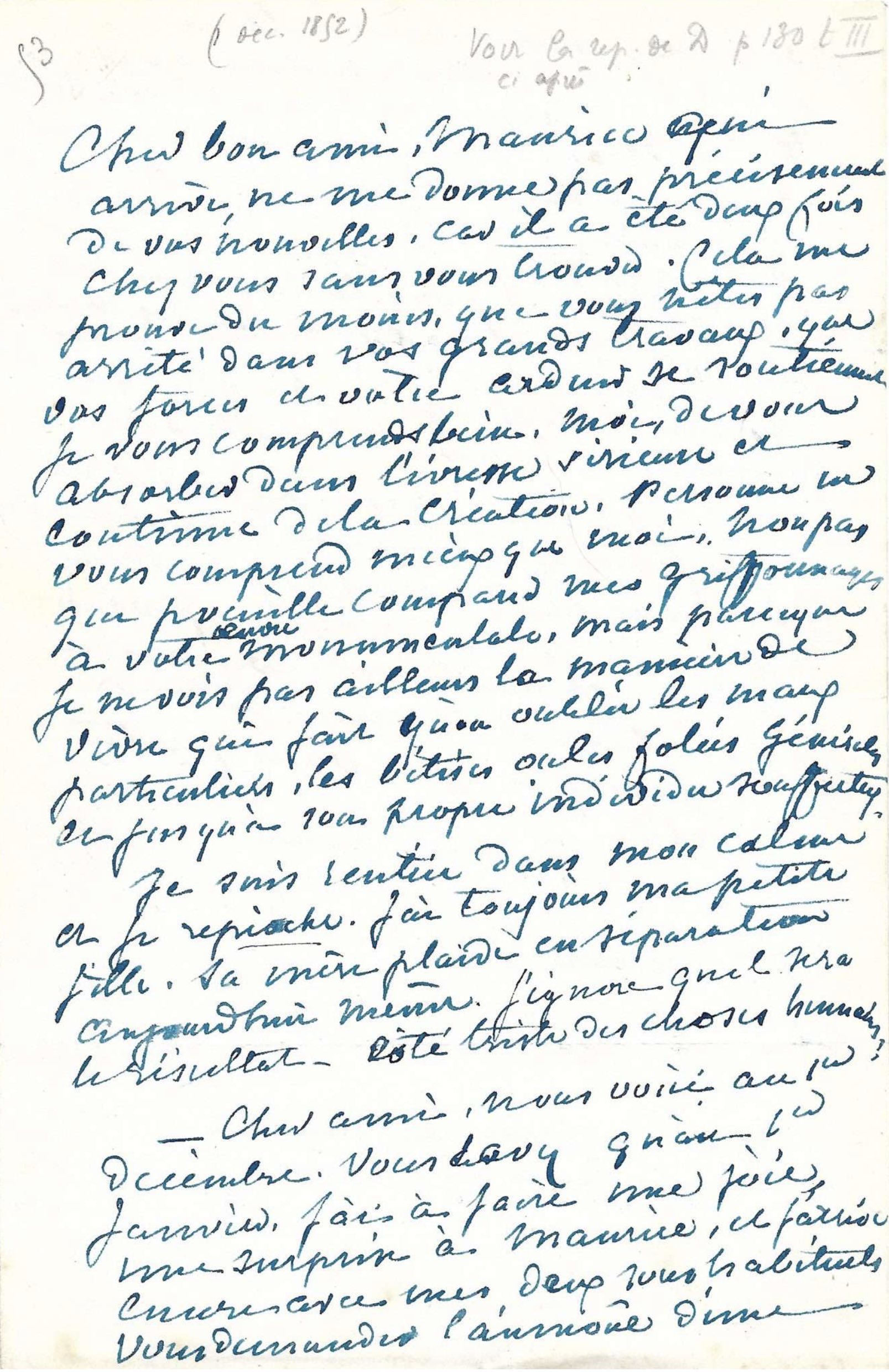
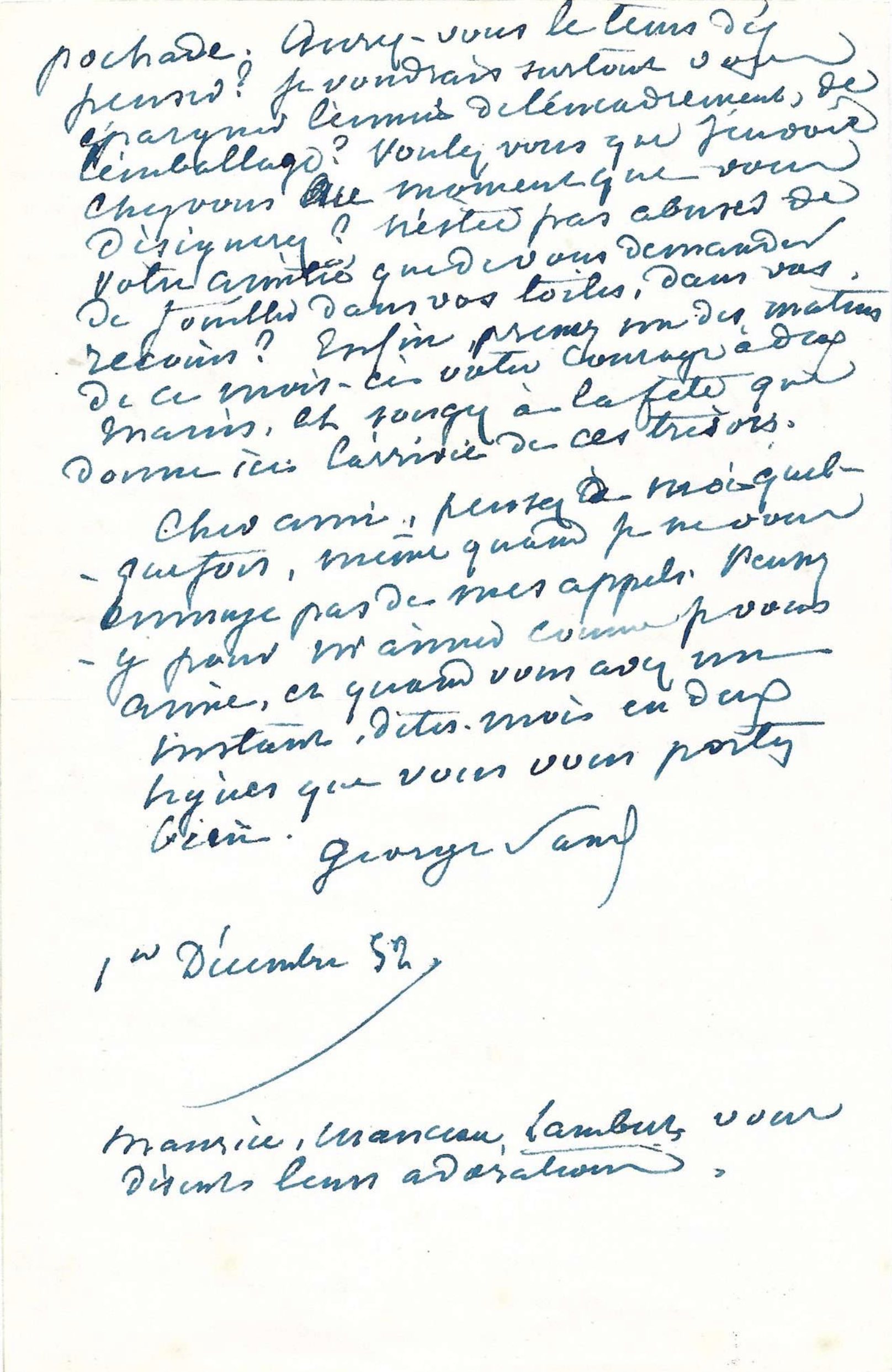
Autographed letter signed to Eugène Delacroix.
Two octavo pages in blue ink.
Slight trace of assembly on the fourth sheet.
[Nohant], December 1 [ 18]52.
« I understand you perfectly, this way you get absorbed in the serious and continuous intoxication of creation. No one understands you better than I do
An extraordinary testament to the unwavering friendship between the novelist and the painter: Sand expresses all her admiration for Delacroix's painting and asks him for the gift of a canvas ( Lélia ).
__________________________________________________
“ My dear friend, Maurice [his son] , who is arriving, hasn’t given me any precise news of you, as he’s been to your house twice without finding you. This proves to me, at least, that you haven’t stopped in your great works, that your strength and ardor remain strong. I understand you well, this way of absorbing yourself in the serious and continuous intoxication of creation. No one understands you better than I; not that I want to compare my scribbles to your monumental work, but because I see no other way of life that makes one forget individual ills, general foolishness or follies, and even one’s own ailing self.”
I've calmed down and I'm back at it. I still have my granddaughter. Her mother is filing for separation today. I don't know what the outcome will be – the sad side of human nature!
My dear friend, here we are on December 1st . You know that on January 1st , I have a joyful surprise to give Maurice, and yet here I am again, with my usual meager resources, asking you for the small favor of a sketch . Will you have time to think about it? I would especially like to spare you the trouble of framing and wrapping. Would you like me to send it to you at a time you specify? Isn't it taking advantage of your friendship to ask you to rummage through your canvases, in your hidden corners? In short, take courage one morning this month and think of the celebration the arrival of these treasures will cause here.
My dear friend, think of me sometimes , even when I don't bother you with my calls. Think of me so you can love me as I love you , and when you have a moment, tell me in a few lines that you are well. George Sand. December 1 , 1852 . Maurice, [Alexandre] Manceau, [Eugène] Lambert send you their adoration .
__________________________________________________
George Sand returned from Paris on October 27th, while her son Maurice arrived a month later, on November 29th. Unable to meet the master at his studio (Delacroix was then working on the mural decoration for the Salon de la Paix at the Paris City Hall), Maurice informed his mother. It was therefore on December 1st that the novelist decided to take up her pen to declare her profound love for her friend's art.
Delacroix replied a week later: “ Yes, my dear, I will send you something, and it is something that you have already liked and that you saw [e] begun. It is a little surprise I wanted to give to Maurice and to you. You will therefore allow me to send a New Year's gift to that child whom I love as much as I love you. The subject is the same as the one you already have in pastel or watercolor: Lélia in the cave, etc. […] The sight of a letter from you is a ray of happiness, and it has always been so: never has the slightest bitterness spoiled this pure feeling. You take me with my little quirks, which are the effect of my frail health and my fragile nerves, and through them you discern the deep feeling that binds me to you …”
Furthermore, Delacroix's remark – " the subject is the same as the one you already have in pastel or watercolor : Lélia in the cave" – reminds us that George Sand already owned two works by Delacroix on the same subject.
Unlike Cleopatra , which George Sand had paid two hundred francs for the previous year, Lélia was a gift from Delacroix, humbly inscribed " to Maurice and to you ." It is a small oil on canvas (24 x 18 cm). The scene, inspired by the second version of George Sand's novel (1839), depicts "Lélia in the monk's cave before the body of her lover."
Included in the A. Lauth-Sand donation in 1923, the pastel is located in the Musée de la Vie Romantique (J. 1995, no. 18 – inventory no. D89.73)
On December 30th, George Sand wrote : " This superb and beloved arrived this evening. I had it opened in the bedroom with secrecy, for I cherish the day of surprise, according to old customs. I therefore enjoyed it alone… "
Sand also refers to family matters: on August 31, 1852, the judgment of legal separation of the Clésinger couple (Solange Clésinger-Sand, daughter of George Sand, and Auguste Clésinger) was pronounced before the Court of First Instance of the Seine. Initially, their child, Jeanne-Gabrielle, known as Nini, was entrusted to George Sand. Solange arrived in Nohant on January 5, 1853, and stayed there until February 12. This was undoubtedly the petition for separation of property. On January 28, Clésinger appealed the judgment of August 31, 1852. Sand was very attached to Nini, but the child died shortly after her parents' separation, in Paris on January 14, 1855, from scarlet fever that was poorly treated.
This letter testifies to the unwavering friendship between the novelist and the painter. Begun in 1834, it ended with Delacroix's death in 1863.
__________________________________________________
Origin:
Achille Piron (universal legatee of Delacroix)
Marc Loliée Library
Bibliography:
George Sand – Correspondence , Lubin, vol. XI, pp. 486-487, letter no. 5729.
Sand-Delacroix – Correspondence , ed. Françoise Alexandre, p. 195.