General Henri GOURAUD (1867.1946)
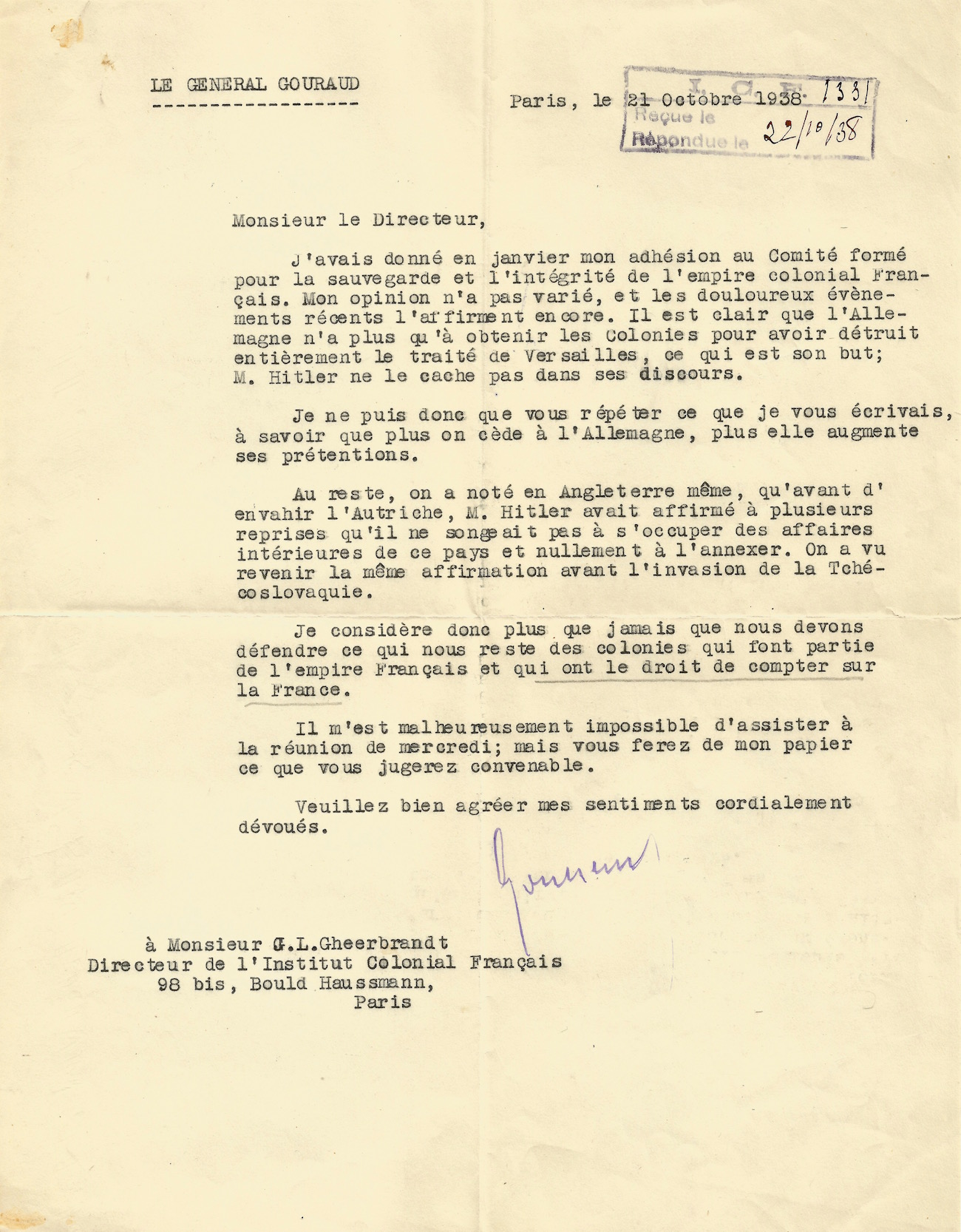
Letter signed to Alain Gheerbrant, Director of the French Colonial Institute.
One page in quarto. Paris. October 21, 1938.
"It is clear that Germany only needs to obtain the Colonies to have completely destroyed the Treaty of Versailles. Hitler makes no secret of this in his speeches ."
A remarkable letter from Gouraud expressing concern about the fate of the French colonies in the face of Adolf Hitler's annexationist ambitions.
“Sir, In January, I gave my support to the Committee formed for the safeguarding and integrity of the French Colonial Empire. My opinion has not changed, and recent painful events confirm it. It is clear that Germany now only needs to acquire the Colonies, having completely destroyed the Treaty of Versailles, which is its objective; Mr. Hitler makes no secret of this in his speeches . I can therefore only repeat what I wrote to you, namely that the more concessions are made to Germany, the more it increases its demands. Moreover, it has been noted even in England that, before invading Austria, Mr. Hitler repeatedly stated that he had no intention of interfering in the internal affairs of that country, nor of annexing it . The same assertion was repeated before the invasion of Czechoslovakia.” I therefore believe more than ever that we must defend what remains of the colonies that are part of the French Empire and that have the right to rely on France . Unfortunately, I am unable to attend Wednesday's meeting; but you may do with my paper as you see fit.
General Gouraud distinguished himself in the colonies (French Sudan, Mauritania, Chad) and later, during the First World War, in the Argonne and the Dardanelles. High Commissioner of the French Government to the Levant from 1919 to 1923, then Military Governor of Paris from 1923 to 1937, he was one of the leading figures in the history of French colonization, following in the footsteps of Gallieni and Lyautey. Under the Sykes-Picot Agreement of 1916, which divided the Ottoman Empire between the British (Iraq, Transjordan, and Palestine) and the French (Syria and Lebanon), Gouraud was sent by Clemenceau as High Commissioner to the Levant. He landed in Beirut on December 21, 1919. In 1920, Gouraud had to contend with the ambitions of King Faisal of Saudi Arabia, who wished to seize Syria, of which he had been proclaimed king. Gouraud urgently requested reinforcements from Paris and had 35,000 men at his disposal, including units of the French Foreign Legion. The French then repelled the Arabs at Khan Meyssaloun on July 24, 1920. Henri Gouraud then demonstrated pragmatism by dividing Syria into several entities with different statuses in order to respect the "compact identities." Thus, the "Greater Lebanon," encompassing Sunni, Shiite, Christian, and Druze communities, was proclaimed during the Zahle Speech. In 1937, revered by Parisians, General Henri Gouraud retired from military life. In 1940, deeply affected by the German invasion, he left Paris for Royat, near Clermont-Ferrand. He did not return until 1945, before dying on September 16, 1946, the same year as the independence of Syria and Lebanon. On September 26, the government of General de Gaulle paid tribute to him with a national funeral at the Navarin Farm Monument in Souain, in the Marne department. He rests in the crypt of the same monument "among the soldiers he loved so much."