Frédéric Chopin (1810.1849)
Autographed letter signed to Camille Pleyel.
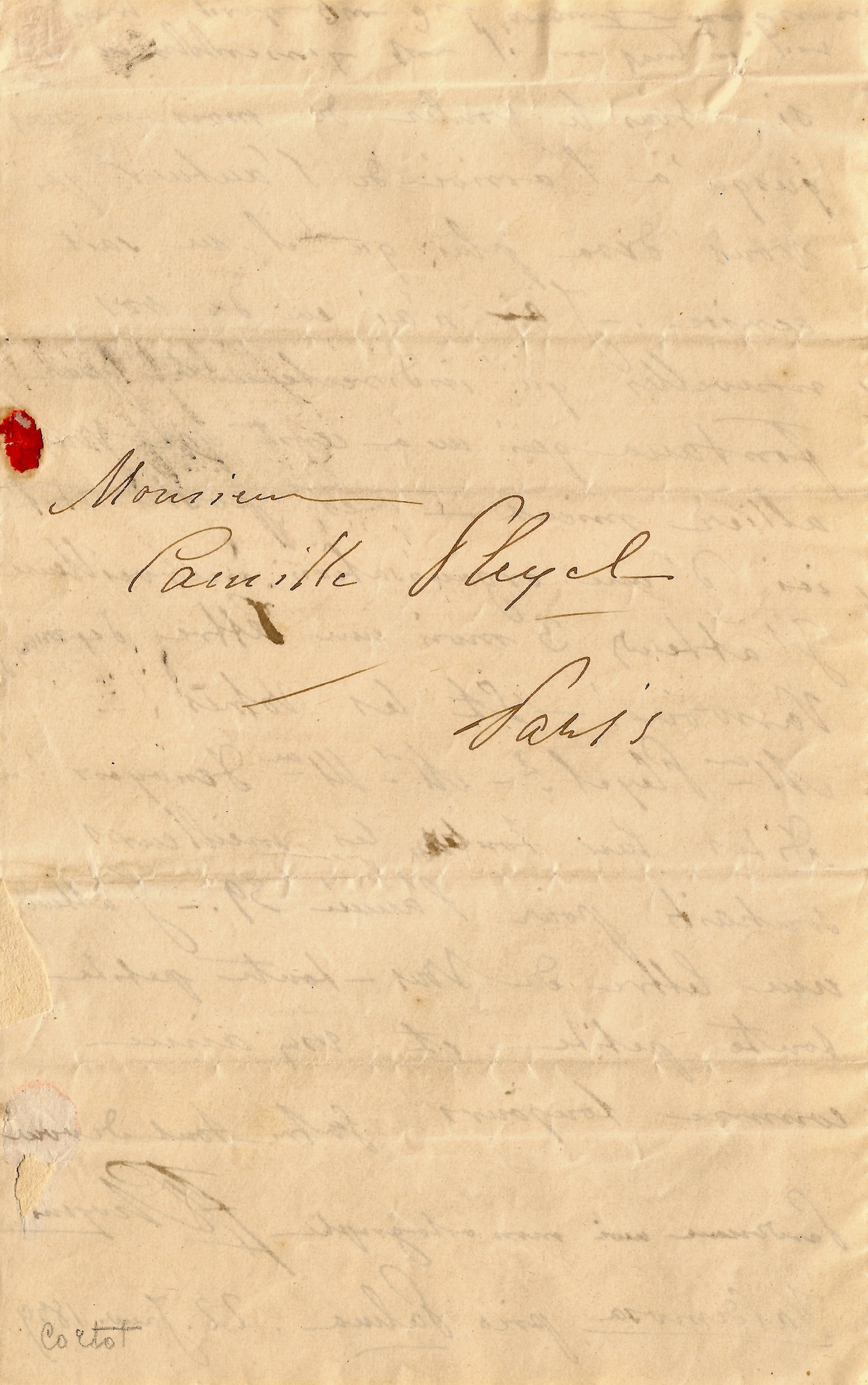
Three octavo pages. Remains of a red wax seal. Autograph address.
Charterhouse of Valldemosa, near Palma de Mallorca. January 22, 1839.
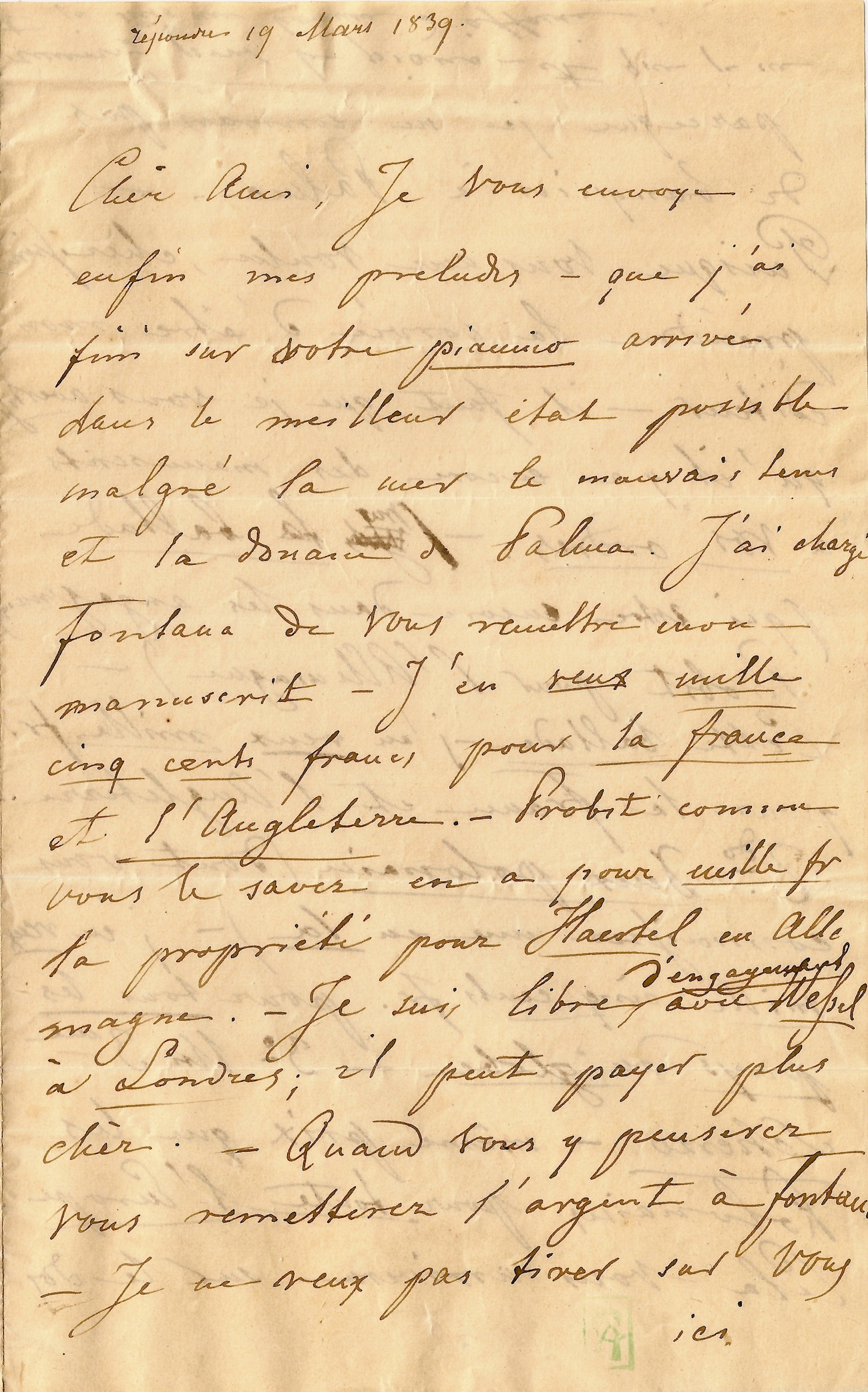
"I am finally sending you my Preludes – which I finished on your pianino, which arrived in the best possible condition."
An extraordinary and invaluable letter from Chopin sending his Preludes to Camille Pleyel. One of the composer's very few letters sent from Majorca, and the last before his return to France in March 1839.
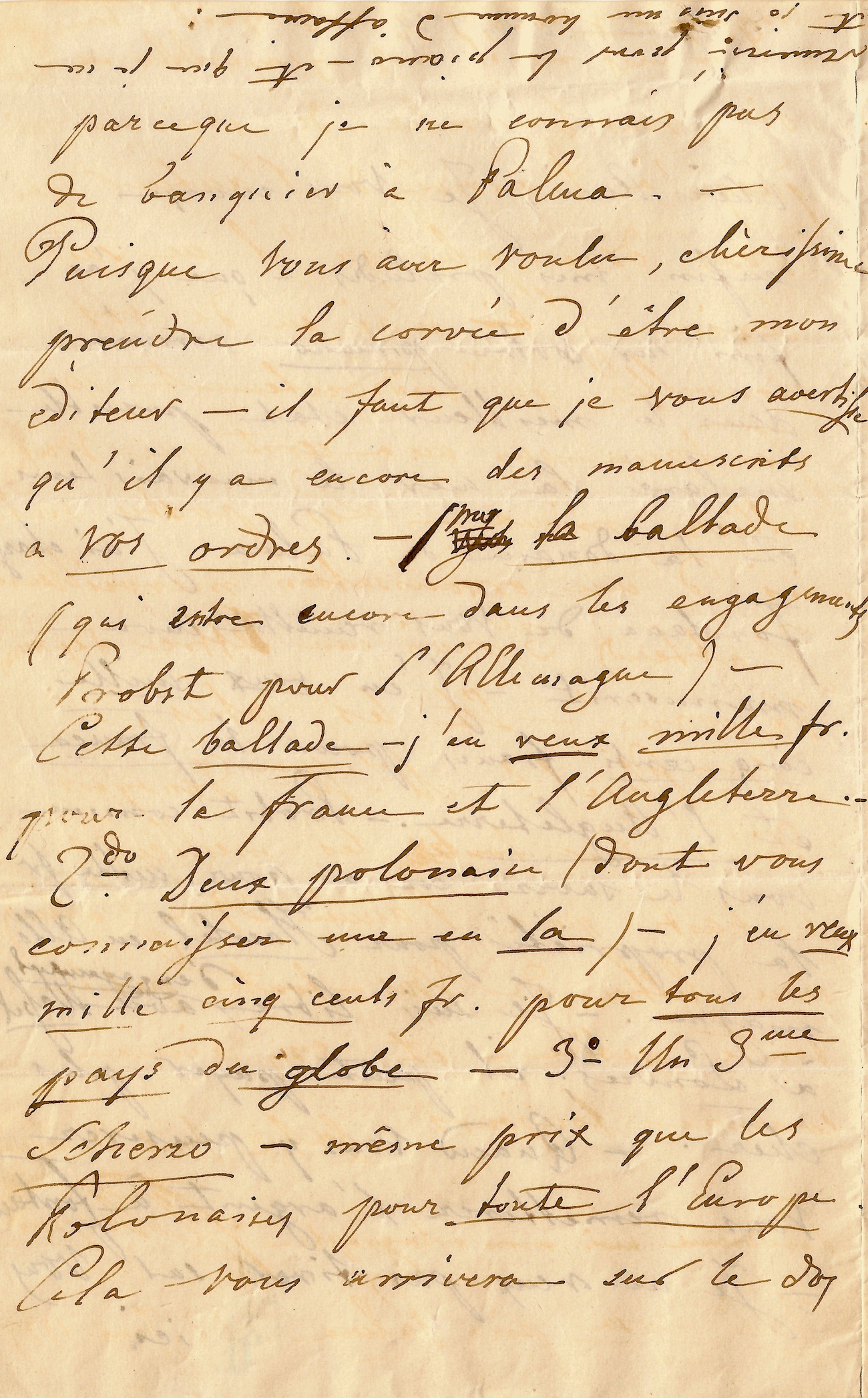
“My dear friend, I am finally sending you my Preludes—which I finished on your piano, which arrived in the best possible condition despite the sea, the bad weather, and the Palma customs. I have instructed Fontana to deliver my manuscript to you. I want 1,500 francs for France and England. Probst, as you know, owns the rights to Haertel in Germany for 1,000 francs. I am free of any obligation to Wessel in London; he can pay more. When you think of it, you will give the money to Fontana. I don't want to press you here because I don't know any bankers in Palma. Since you, my dearest friend, have agreed to take on the task of being my publisher, I must warn you that there are still manuscripts available for your consideration .”
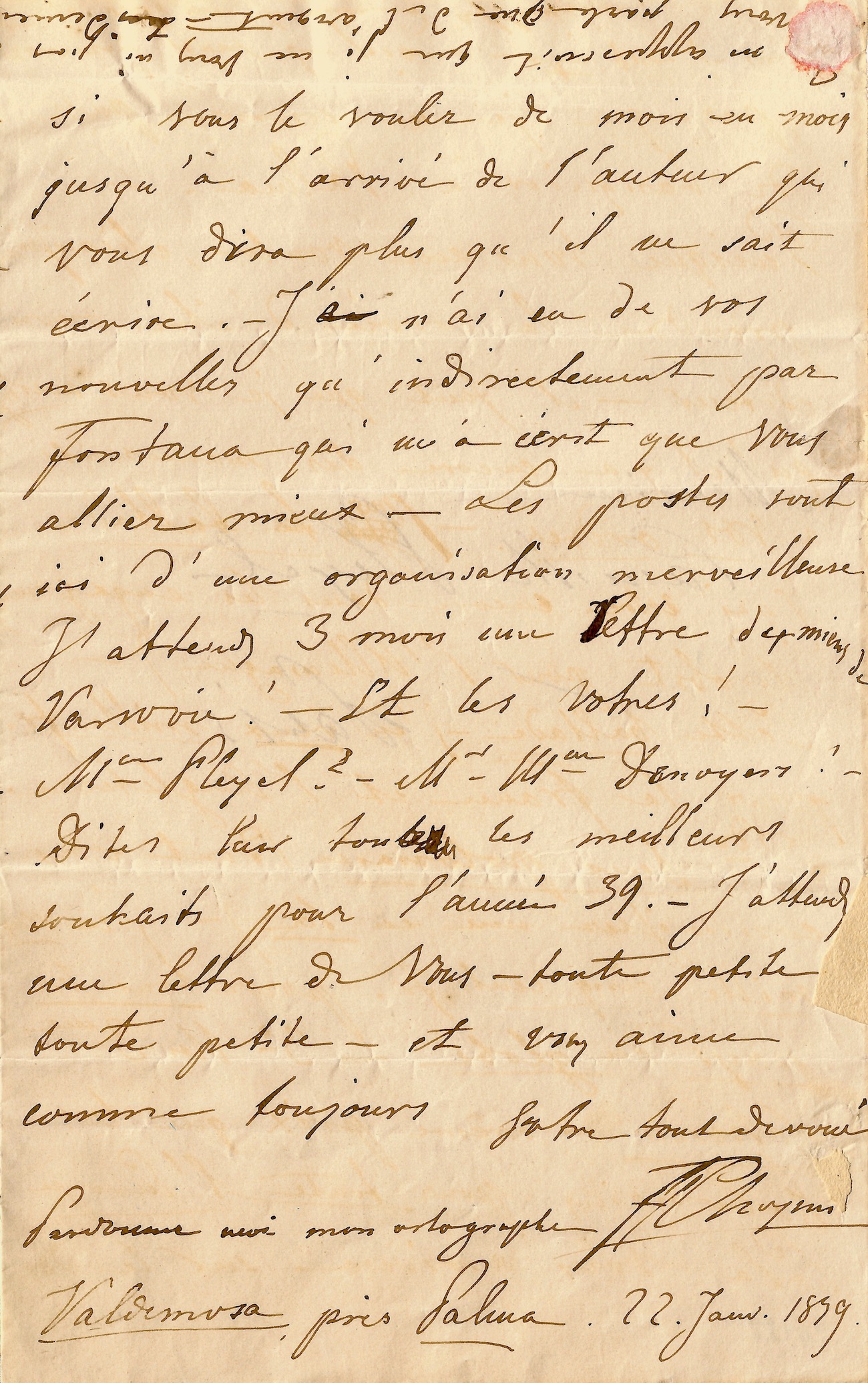
1. The Ballad (which still falls under Probst's commitments for Germany). This Ballad – I want 1,000 francs for France and England. 2. Two Polonaises (one of which you know in A) – I want 1,500 francs for all countries of the world . 3. A third Scherzo – same price as the Polonaises for all of Europe , if you wish, month by month, until the arrival of the author who will tell you more than he can write.
I only heard from you indirectly through Fontana, who wrote that you were better. The postal service here is wonderfully organized. I've been waiting three months for a letter from my family in Warsaw! And from yours? Mrs. Pleyel? Mr. and Mrs. Denoyers? Give them all my best wishes for 1939. I'm waiting for a letter from you, a tiny, tiny one, and love you as always. Yours very devotedly, F. Chopin. Please forgive my spelling. I realize I haven't thanked you for the piano, and that I only talk about money. I'm definitely a businessman !
Correspondence of Frédéric Chopin, BE Sydow, Volume II, No. 290, p. 291.
Formerly in the Alfred Cortot collection (stamp on the first sheet ).
A tiny imperfection in the right margin, not affecting the text.
George Sand initiated this stay on the island of Majorca, perhaps to remove her two children, Solange and Maurice, from the control of their father, Baron Dudevant, or to improve young Maurice's feverish condition. What began as an idyllic holiday turned into a nightmare, despite the majestic allure of the Valldemossa Charterhouse, a former Carthusian monastery abandoned since 1835, where George Sand, her two children, and Chopin settled in mid-December 1838. Having arrived on the island in November 1838, they would not leave until the following spring (March 1839), forced to spend the winter trapped by the isolation of the inhospitable monastery. " Chopin could not overcome the restlessness of his imagination. The cloister was full of terrors and phantoms, " wrote George Sand in "Histoire de ma vie" (History of My Life). Several of the Preludes composed at Valldemosa were born from his anxieties, including the famous Prelude No. 15, known as " The Drop of Water ": " His composition that evening was indeed full of the drops of rain that resounded on the sounding tiles of the Charterhouse, but they had translated in his imagination and in his song as tears falling from the sky onto his heart. His spirit was flayed alive; the fold of a rose petal, the shadow of a fly made it bleed " (id, ibid).
Besides the Preludes , Chopin composed or finished several major works there, to which he refers in this letter:
– the Ballade in F major (Opus 38, published in 1840 under the publisher's title " La Gracieuse ". This ballade is dedicated to Schumann, who himself had dedicated his Kreisleriana to Chopin).
– The Two Twin Polish Women (this is opus 40, dedicated to his friend the pianist Julien Fontana).
– the Third scherzo. : (opus 39 dedicated to Adolf Gutmann (student of Chopin), published in 1840 (by Breitkopf & Härtel and Troupenas).
– The “ Twenty-Four Preludes ” (Opus 28) are dedicated to Camille Pleyel (and to J.-C. Kessler for the German edition)
" It was there (at Valldemosa) that he composed the most beautiful of those short pieces which he modestly called Preludes. They are masterpieces. Several bring to mind visions of deceased monks and the sound of funeral chants that haunted him; others are melancholic and sweet: they came to him in sunny and healthy hours, to the sound of children's laughter under the window, to the distant sound of guitars, to the song of birds under the damp foliage, to the sight of small pale roses blooming on the snow. Still others are of a somber sadness and, while charming the ear, break the heart, " George Sand also wrote.
Ignace and Camille Pleyel are among the great piano makers of the 19th century, along with Érard. Chopin met Camille Pleyel through Édouard Herbault, Herbault's business partner. They hit it off immediately. The son of Ignace Pleyel (an Austrian composer, Haydn's favorite pupil, music publisher, and founder of the piano factory, who settled in Paris in 1795), Camille Pleyel, who succeeded his father in 1831, was an excellent pianist trained in England. He shared with Chopin " a noble simplicity and an expressive art of the cantabile ," as Jean-Jacques Eigeldinger describes in his book on the friendship between Chopin and Pleyel. " Today, there is only one man who knows how to play Mozart, and that is Pleyel ," Chopin often said of him. Upon his arrival in Paris at the end of 1831, Frédéric Chopin became devoted to a single piano, the Pleyel, whose subtle tones he appreciated. Chopin resisted to the end the temptation of the comfort offered by Érard instruments, preferring the sonic " truth " of the Pleyel.
Barely having set foot on the island of Majorca, Chopin demanded a piano from Pleyel; he wrote to him in a letter of November 1838: “ My piano hasn’t arrived yet. How did you send it? By Marseille or Perpignan? I dream of music but I don’t make any, because here we don’t have pianos… It’s a wild country in that respect .” After various delays (the piano, coming from Marseille, had been held at the Palma customs office, with a ransom demanded), the piano finally arrived at the Chartreuse. Chopin refers to it as a “ pianino, ” that is to say, an upright piano with six octaves.