
"This ordeal is painful for me, and yet, I hope for great consolation through work.". »
8.000€
François Pompon (1855.1933)
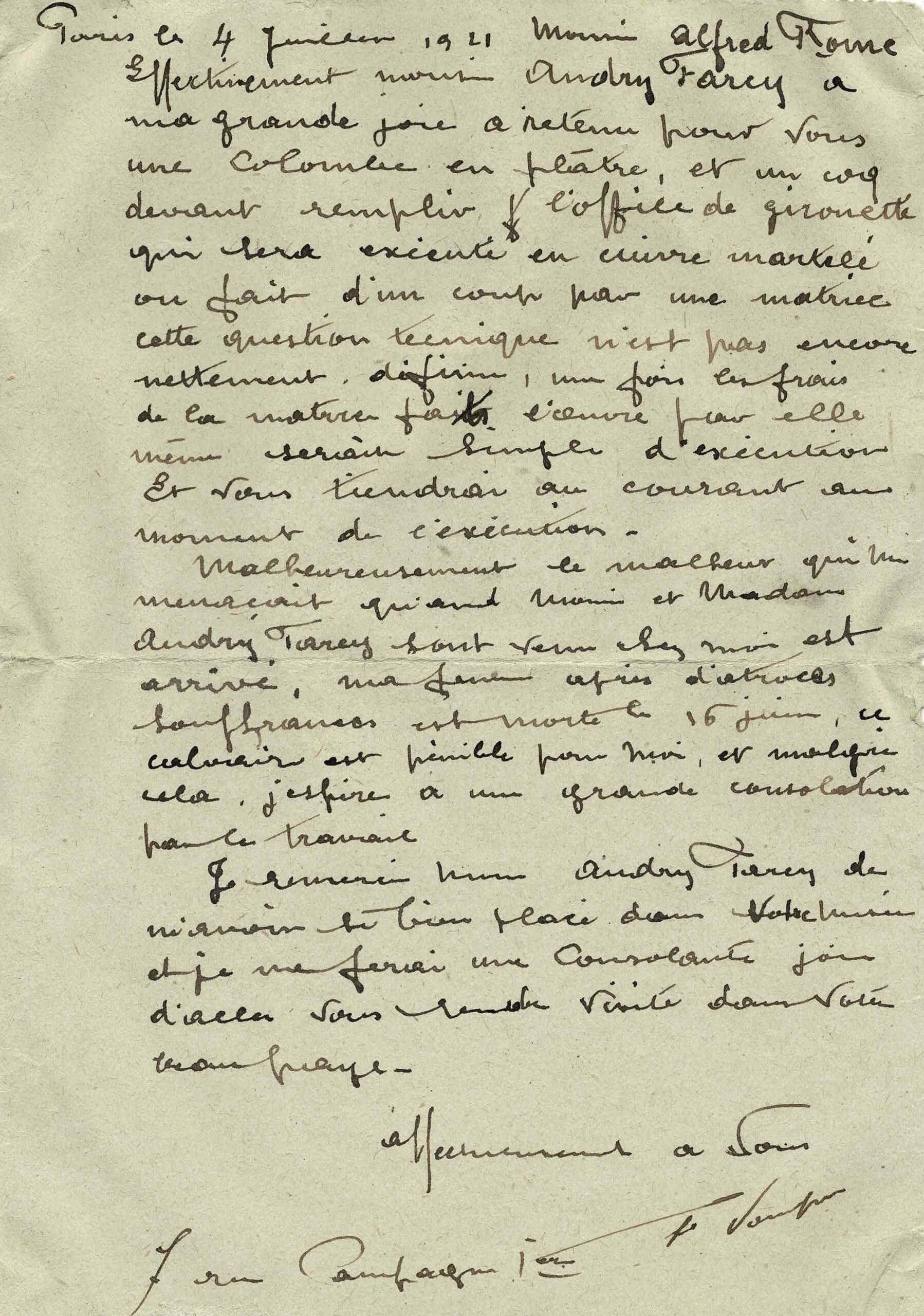
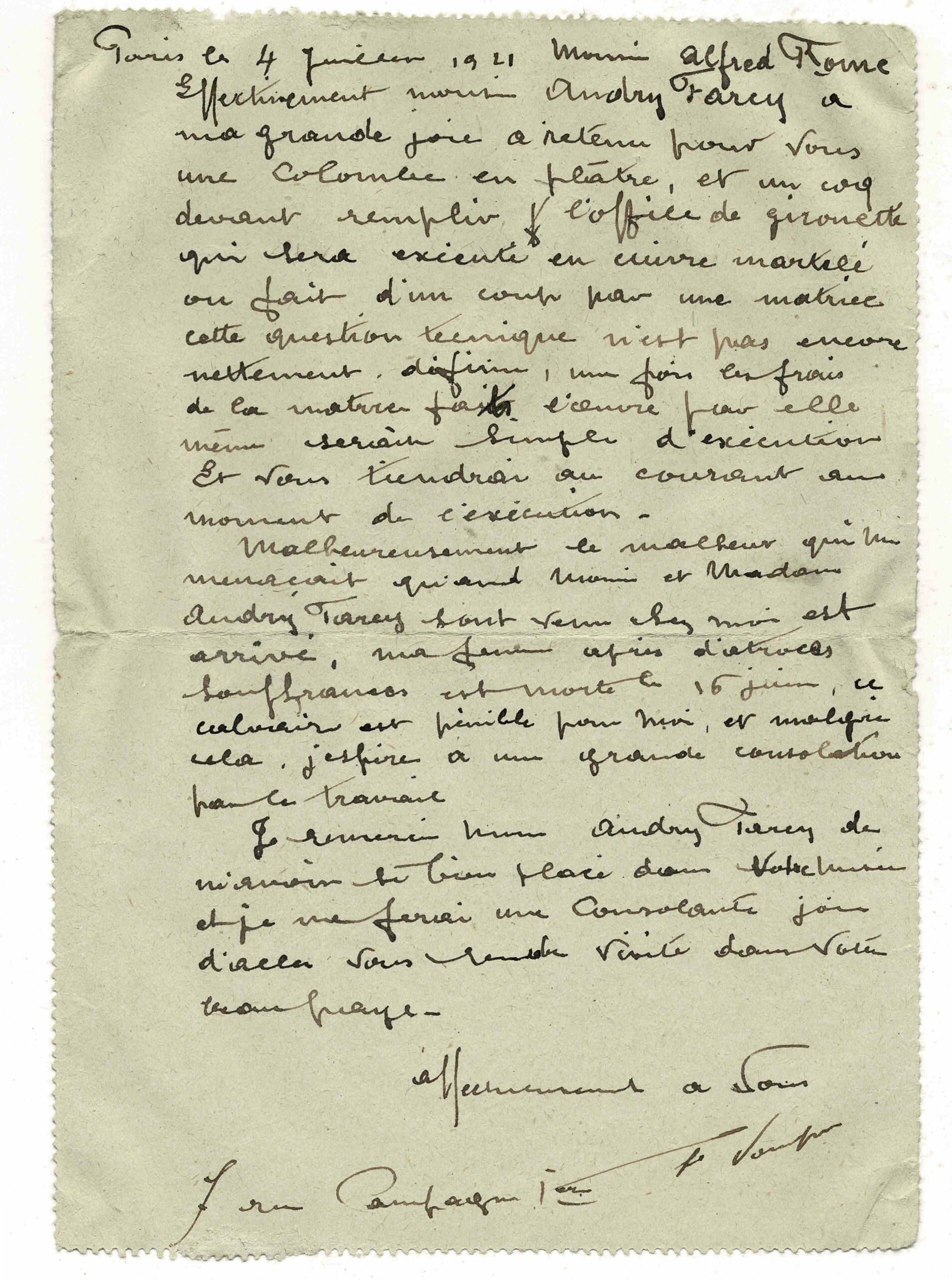
Autographed letter signed to the architect Alfred Rome.
One page in-12° on paper with serrated edges.
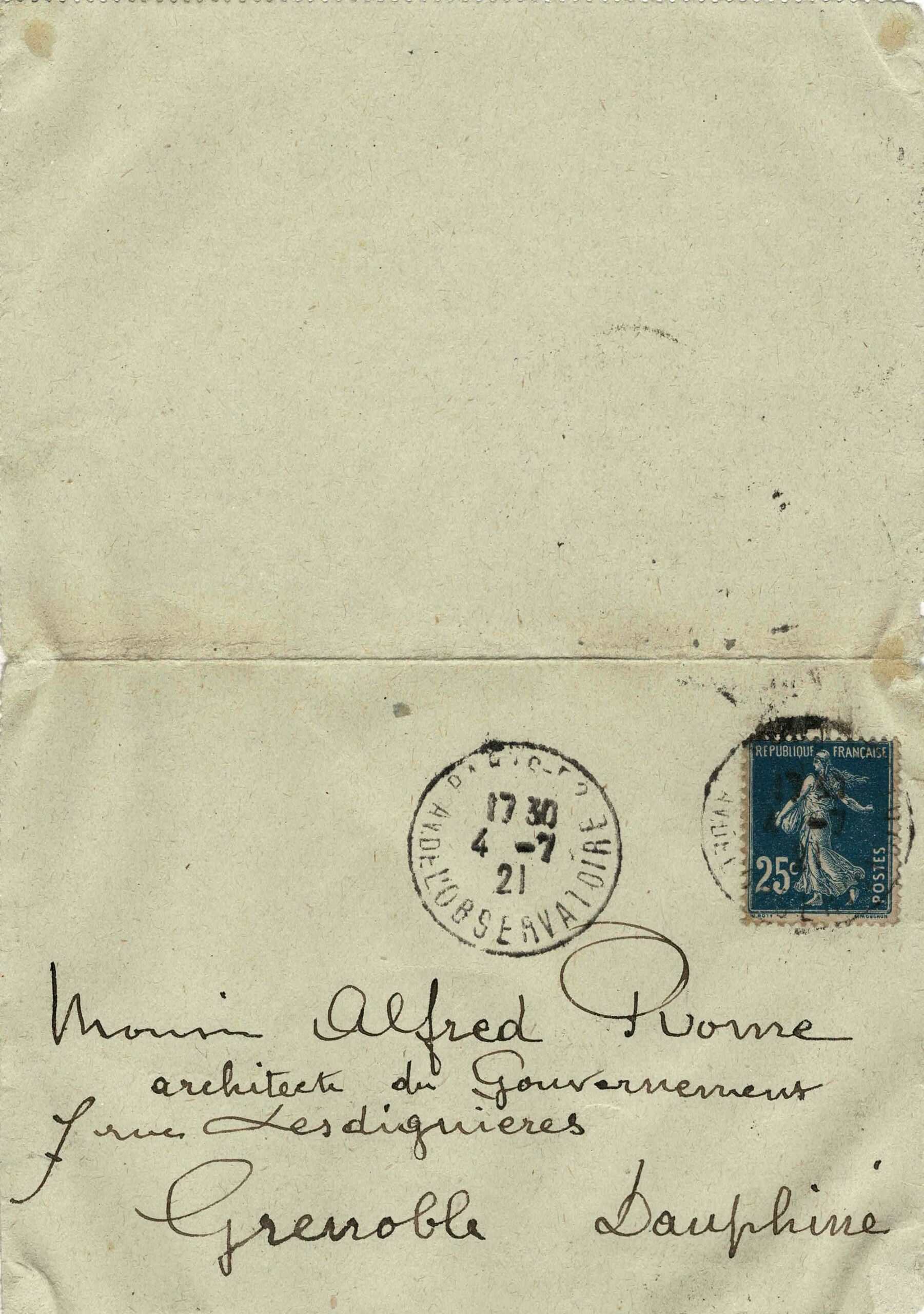
Autographed address and postal cancellations.
Paris. July 4, 1921.
"This ordeal is painful for me, and yet, I hope for great consolation through work.". »
Overwhelmed by the death of his wife, the French sculptor nevertheless rejoiced to see two of his works – a dove and a weather vane rooster – selected to enter the collections of the Grenoble museum.
________________________________________________
"Mr. Alfred Rome. Indeed, to my great delight, Mr. Andry Farcy has selected for you a plaster dove and a rooster to serve as a weathervane, which will be made of hammered copper or cast in one piece from a die. This technical detail is not yet clearly defined. Once the cost of the die is covered, the work itself will be simple to execute. I will keep you informed at the time of execution."
Unfortunately, the misfortune that threatened me when Mr. and Mrs. Andry Farcy came to my home has come to pass; my wife, after atrocious suffering, died on June 16th. This ordeal is painful for me, and yet, I hope for great consolation through work .
I thank Mr. Andry Farcy for placing me so well in your museum , and I will be delighted to visit you in your beautiful country. Yours affectionately, F. Pompon.
________________________________________________
Pierre-André Farcy, known as Andry-Farcy (1882-1950), settled in Grenoble in 1907. In 1910, he was hired as an advertising illustrator and then as an art critic by the newspaper Le Petit Dauphinois . Before and during the First World War, he contributed to two short-lived but important Grenoble-based magazines, La Cimaise and Les Trois Roses . Appointed director of the Grenoble Museum in 1919, Andry-Farcy succeeded in elevating it to the status of France's leading museum of modern art by the early 1920s. He also skillfully leveraged Le Petit Dauphinois , the main local newspaper, as a powerful communication tool to keep readers informed of all his activities at the museum. Finally, thanks to his close ties with the art world, and particularly with artists, he secured numerous donations, which he promptly displayed in the museum. He continued his work until the end of his career in 1949, the year he brought the young Pierre Soulages into the Grenoble collections. If the Grenoble museum is now among the great European museums, it owes this in large part to Andry-Farcy who, thanks to his tenacity and charisma, succeeded in establishing the art of his time.
It was probably through Andry-Farcy that Pompon and Alfred Rome met. After studying at the École des Beaux-Arts, Rome was appointed regional architect of Historical Monuments for the Isère department. A discerning collector, Rome moved with ease among the region's influential and passionate art figures, notably forming a close friendship with Andry Farcy, who assembled the first collection of modern art in France at the Grenoble Museum. He declared: "My plans are clear: to continue opposing the decisions of my predecessors. I am opening the doors to young people, to those who distinguish themselves in a new style. These are the guiding principles that will allow me to create the first truly modern museum in France." It was as a result of these progressive attitudes that Farcy and Rome were drawn to the work of François Pompon, three of whose pieces—The Duck, The Vulture, and The Brown Bear—would enter the museum's collections.
It therefore seems that the two works mentioned in this letter by Pompon were not ultimately selected by the museum.