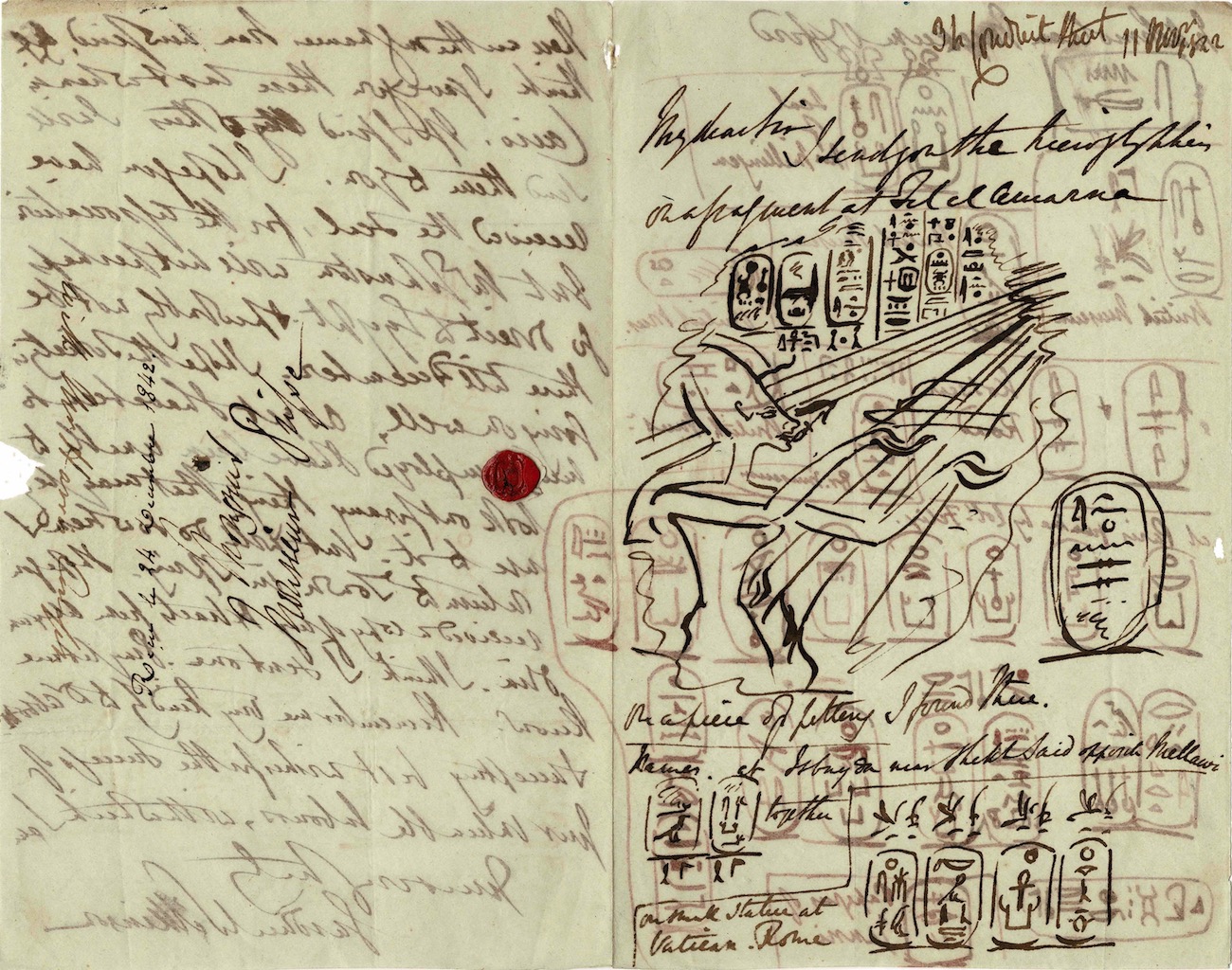
A fascinating letter from the English Egyptologist, John Gardner Wilkinson.
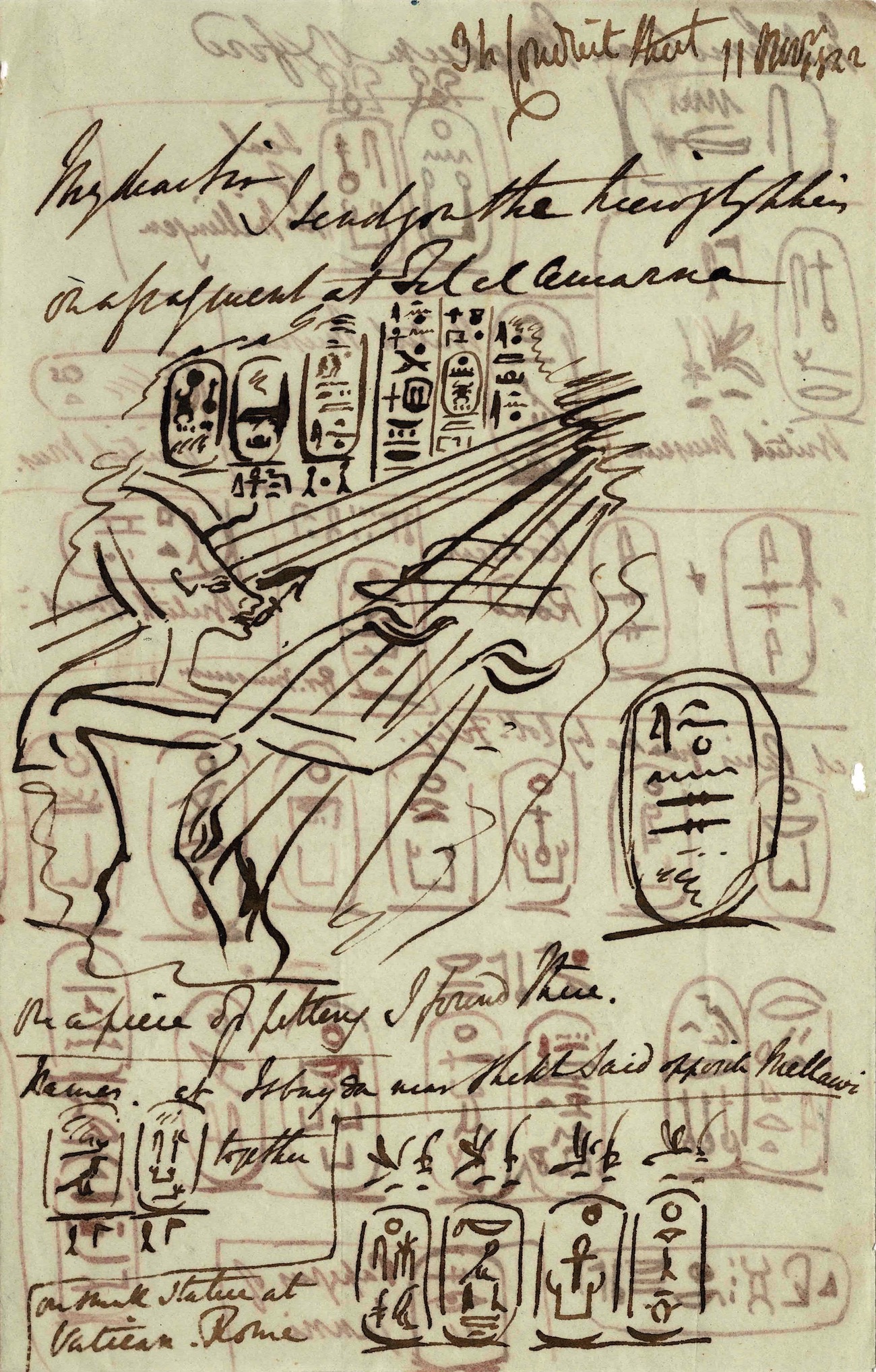
“I send you the hieroglyphics of a fragment at Tel-el-Amarna of a piece of pottery I found there. »
65.000€
“I send you the hieroglyphics of a fragment at Tel-el-Amarna of a piece of pottery I found there. »
65.000€
Sir John Gardner Wilkinson (1797.1875)
Autographed letter signed to the Egyptologist Émile Prisse d'Avesnes.
Three octavo pages, in English, illustrated with hieroglyphs.
[London] November 11, 1842.
“I send you the hieroglyphics of a fragment at Tel-el-Amarna of a piece of pottery I found there. »
A fascinating illustrated letter from the father of British Egyptology, describing his discoveries to his French colleague, Prisse d'Avesnes. Wilkinson sketches a classic scene of worship from the Amarna period and the reign of Akhenaten. The mythical pharaoh, the instigator of monotheism in Egypt, is depicted bathed in the benevolent rays of the solar disk Aten.
________________________________________________________
Original version:
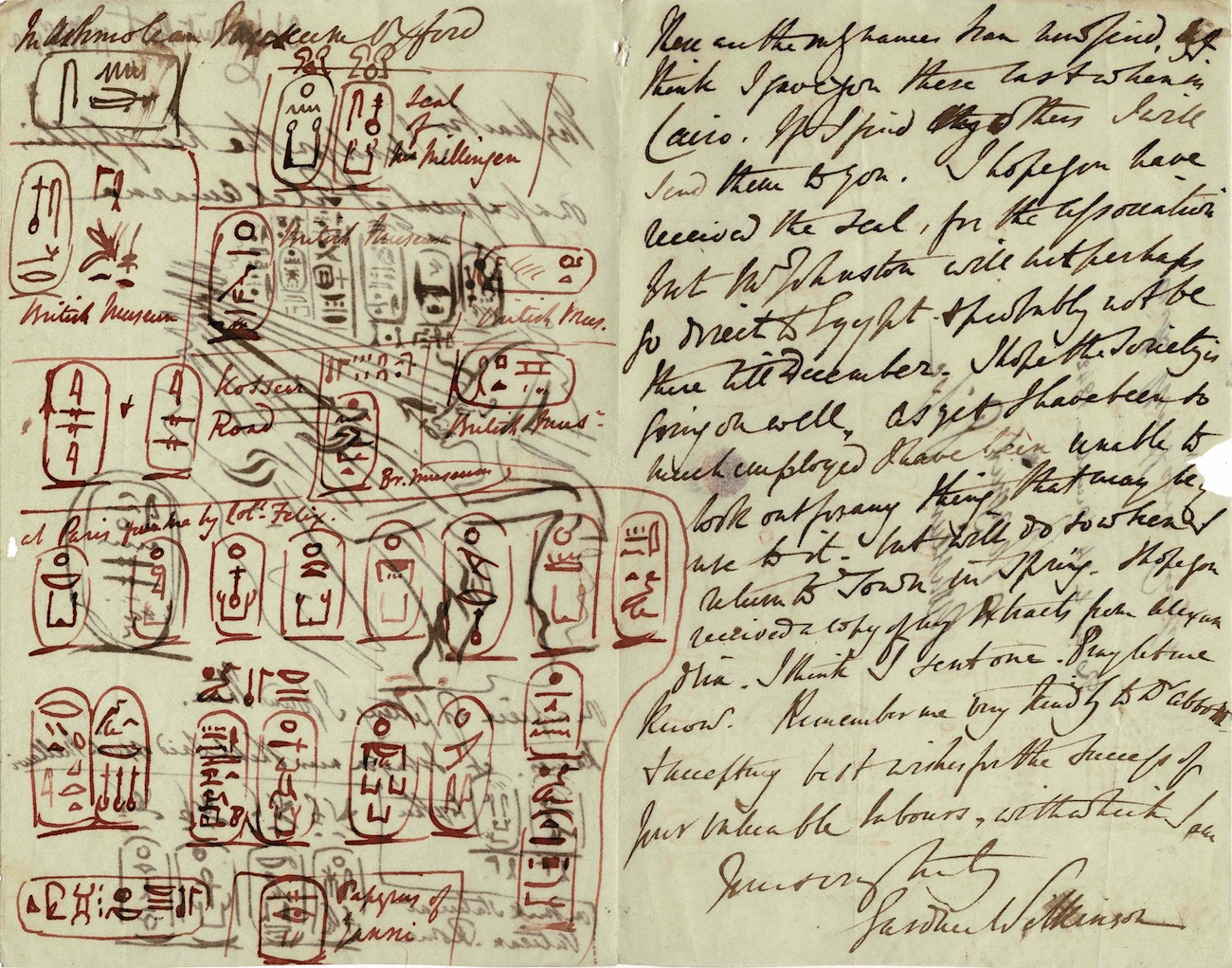
My dear Sir, I send you the hieroglyphics of a fragment at Tel-el-Amarna of a piece of pottery I found there.
Names at Isbayda near Shekh Said said opposite Mellawi
[Hieroglyph] together
On small statue at Vatican – Rome [H]
In Ashmolean Museum Oxford [H]
[H] Seal of Mr Millingen
British Museum [H]
[H] British Museum.
[H] British Mus.
[H] Kosseir Road
[H] Br. Museum.
[H] British Mus.
At Paris painted by Col[one]l Felix [H]
[H] Papyrus of Janni
Here are the instances from new find, & I think I gave you these last when in Cairo. If I find others I will send them to you. I hope you have received the seal, for the association but Mr. Johnston will not perhaps go direct to Egypt & probably not be there until December. I hope society is going on well. As yet I have been too much employed & have been unable to look out on for any thing that may be [of] use to it, but will do so when I return to town in Spring. I hope you received a copy of my extracts from Alexandria. I think I smell one. Pray let me know. Remember me very kindly to Dr Abbott and accept my best wishes for the success of your valuable labors. With which I am yours very truly. Gardner Wilkinson.
________________________________________________________
French version:
My dear Sir, I am sending you the hieroglyphs from a fragment of a piece of pottery that I found at Tel-el-Amarna.
Names in Isbayda near Shekh Said opposite Mellawi
[Hieroglyphs] together
On a small statue in the Vatican – Rome [H]
At the Ashmolean Museum in Oxford [H]
[H] Seal of Mr. Millingen
British Museum [H]
[H] British Museum
[H] British Mus.
[H] Kosseir Road
[H] Br. Museum.
[H] British Mus.
In Paris, painted by Colonel Félix [H]
[H] Papyrus of Janni
Here are the examples of new discoveries, and I believe I gave them to you last time in Cairo. If I find any more, I will send them to you. I hope you have received the seal for the association, but Mr. Johnston may not go directly to Egypt and probably will not be there until December. I hope the society is well. So far, I have been too busy and have not been able to see to anything that might be of use to it, but I will do so on my return to town in the spring. I hope you have received a copy of my extracts from Alexandria. I believe I have sent one. Please let me know. Recall my best regards to Dr. Abbott and accept my best wishes for the success of your valuable work. With which I am truly yours. Gardner Wilkinson.
________________________________________________________
Arriving in Egypt in 1821 at the age of 24, John Gardner Wilkinson traveled the country for 12 years, making numerous hieroglyphic records of the monuments and tombs he explored. In August 1822, at Akhmim in Middle Egypt, he met another explorer, Frédéric Cailliaud (1787-1869), who, like him, had come to the site to copy hieroglyphic inscriptions. Following Cailliaud's example, Wilkinson copied the Royal Tablet of Abydos.
In 1824, Wilkinson became the first explorer to visit the tombs of notables in the northern part of the Amarna site, the ancient capital founded by Pharaoh Akhenaten.
The drawing on the first page of the letter depicts a classic scene of worship from the Amarna period—that is, the reign of Akhenaten. The scene shows him bathed in the benevolent rays of the solar disk Aten. Unfortunately, Wilkinson provides no details here regarding the exact location of the scene, which remains unknown to Egyptologists to this day.
Although Wilkinson reproduced this same drawing of Akhenaten in his 1843 work, * Modern Egypt and Thebes: Being a Description of Egypt, Including Information Required for Travellers in That Country * (page 73) , the original decoration has never been found. Clearly, it was destroyed—like many other relics in the Amarna capital—by the depredations of travelers, tourists, and other purveyors of history.
Wilkinson's drawing is one of the few depictions showing King Akhenaten wearing the Atef crown. Only one other fragment representing the king with this crown is known to date: the one in the Metropolitan Museum of Art in New York.
Returning to England in 1833 for health reasons, Wilkinson went back to Egypt in 1842 for a few months and conducted further explorations. At the same time, another explorer and Egyptologist was present in the land of the pharaohs: Émile Prisse d'Avesnes (1807-1879). From 1836 to 1844, he traveled throughout Egypt. In his travel journals, he noted, recorded, and drew the ancient monuments, thus accumulating considerable documentation which led, in 1848, to the publication of his work: Egyptian Monuments, Bas-Reliefs, Paintings, Inscriptions, etc., Based on Drawings Made on Site .
In 1842, Prisse d'Avesnes, together with Dr. Abbott, an Egyptologist and collector, founded a literary society, library, and center for scientific relations in Cairo: the Egyptian Literary Association . Prisse d'Avesnes served as vice-president, and Abbott as secretary. A year after its creation, the association boasted over one hundred members, including Champollion-Figeac (the decipherer's older brother) and John Gardner Wilkinson.
This previously unpublished letter from Wilkinson to Prisse d'Avesnes demonstrates that the two Egyptologists knew each other and exchanged information regularly.
Beyond the material from Amarna, Wilkinson sent his colleague numerous lists of royal names. The sending of these royal names may be related to Prisse d'Avesnes' project to dismantle the ancestral chamber of Karnak, which began in the spring of 1843 (see Karine Madrigal and Jean-Claude Goyon, La chambre des ancêtres du temple d'Amon-Rê à Karnak, Lettres inédites d'Émile Prisse d'Avesnes à Jacques-Joseph Champollion-Figeac , Éditions Khéops, 2016).
The royal names sent by Wilkinson were taken from objects in the collections of the Louvre Museum, the British Museum, the Ashmolean Museum in Oxford, and the Vatican Museums. Others came from records made on-site at Egyptian monuments: for example, at the Kossayr Road site, where Wilkinson recorded cartouches of King Djedkare-Isesi, a pharaoh of the Old Kingdom. The Egyptologist likely found these cartouches in the necropolis of high-ranking officials buried during the Old Kingdom.
Similarly, several cartouches found at the site of " Isabayda near Sekh Said opposite Mellawi " were transmitted by Wilkinson to Prisse d'Avesnes. These were also reproduced in his work Modern Egypt and Thebes (pages 70-71) as well as in the papers of Nestor l'Hôte – one of Champollion's companions during the 1828-29 trip to Egypt (BnF, NAF 20396, folio 272v).
It is worth noting that, on May 27, 1843, Prisse d'Avesnes sent a letter to Jacques-Joseph Champollion-Figeac in which he reproduced these same hieroglyphs, which actually appear on the jamb of a door in the tomb of Mererou Bebi at Sheikh Said. These are the cartouches of King Userkaf from the beginning of the 5th Dynasty .
Wilkinson also mentions a "seal of Millingen". Here he is referring to the collector James Millingen (1774-1845) (cf. Le Bars-Tosi, Florence, "James Millingen, the Nestor of modern archaeology", in M. Royo et alii (eds.), From scholarly travel to the territories of archaeology , proceedings of the INHA/University of Tours conference [Paris, June 2010], Paris, De Boccard, 2012, pp. 171-186.).
Finally, Wilkinson sent Prisse d'Avesnes copies of royal cartouches made by Major General Orlando Félix (1790-1860) in Paris. Orlando Félix, a traveler and Egyptologist, had also worked on Egyptian dynasties.
Among the cartouches from the Vatican Museum, we can see that of Ramses on the far left.