Antonin ARTAUD (1896-1948)
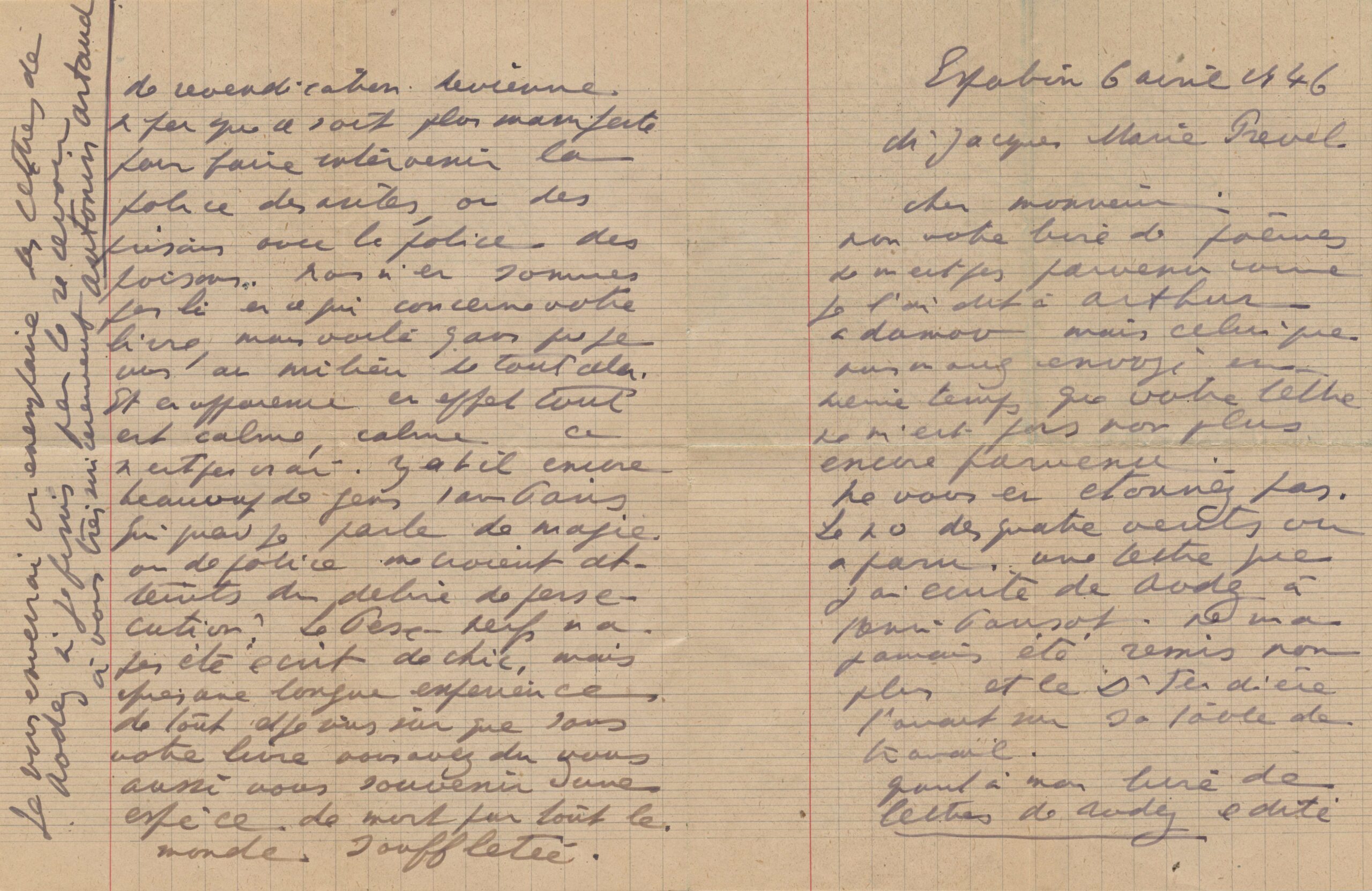
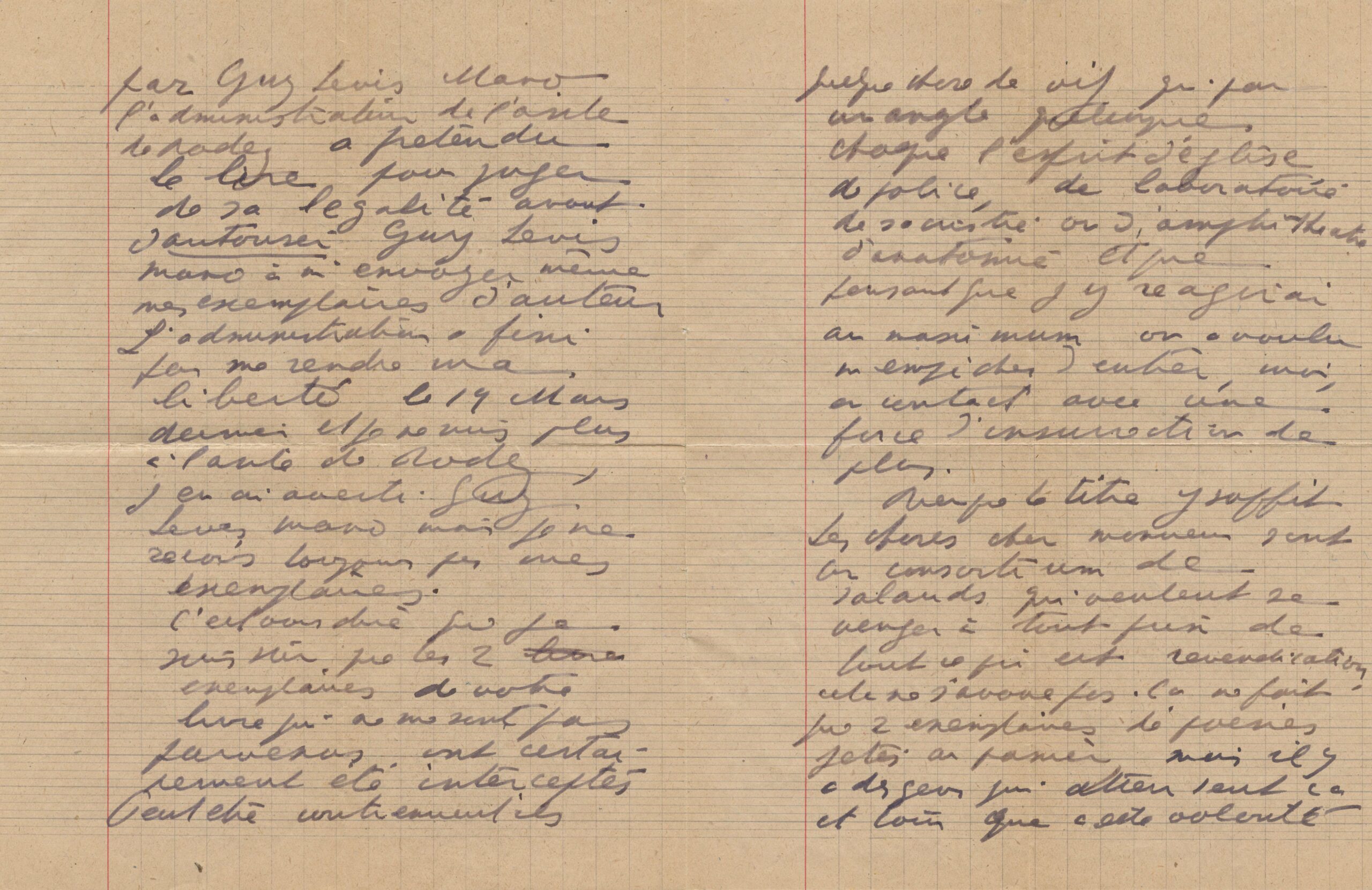
Autographed letter signed to Jacques Marie Prevel.
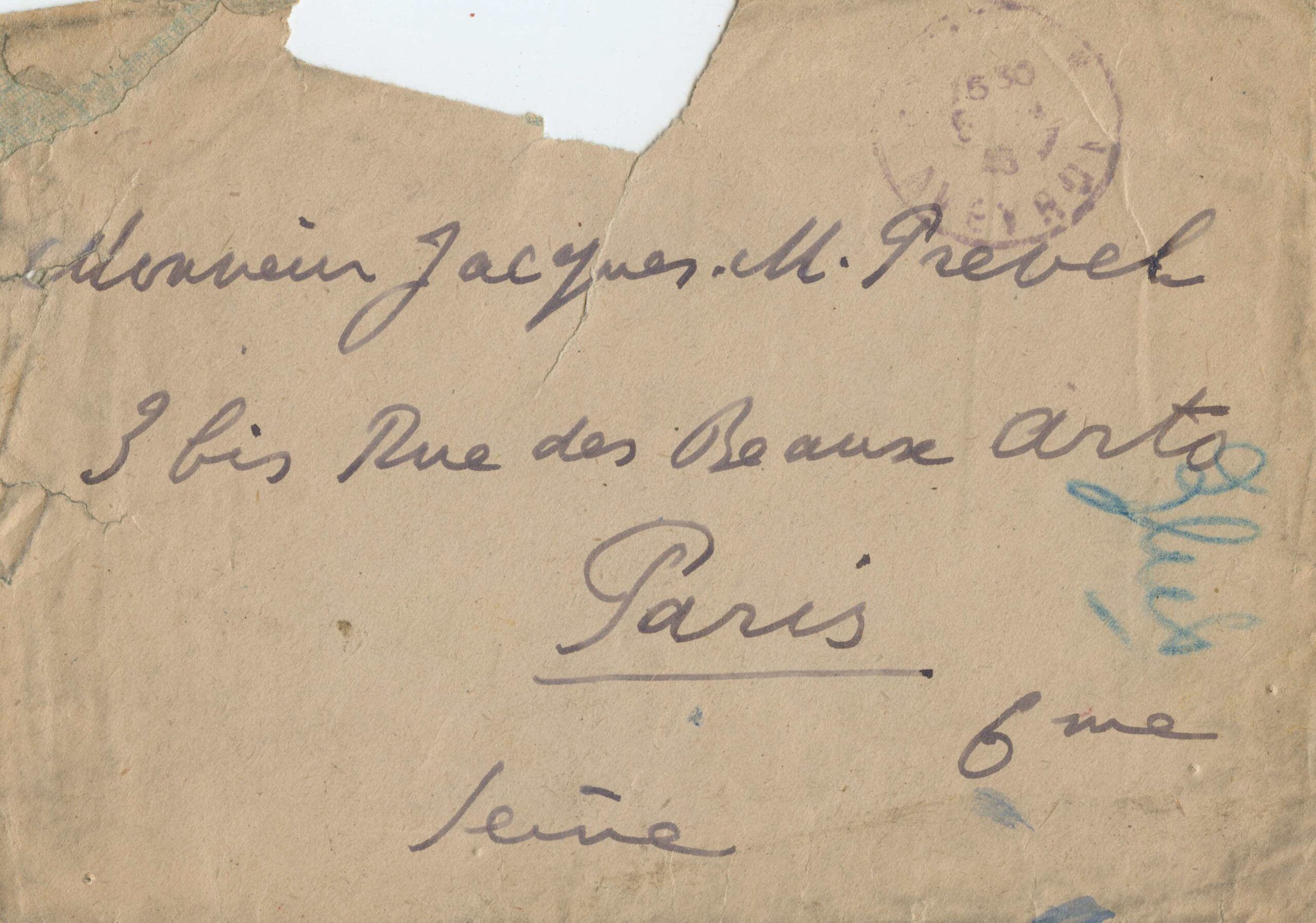
Four quarto pages on school paper. Autograph envelope.
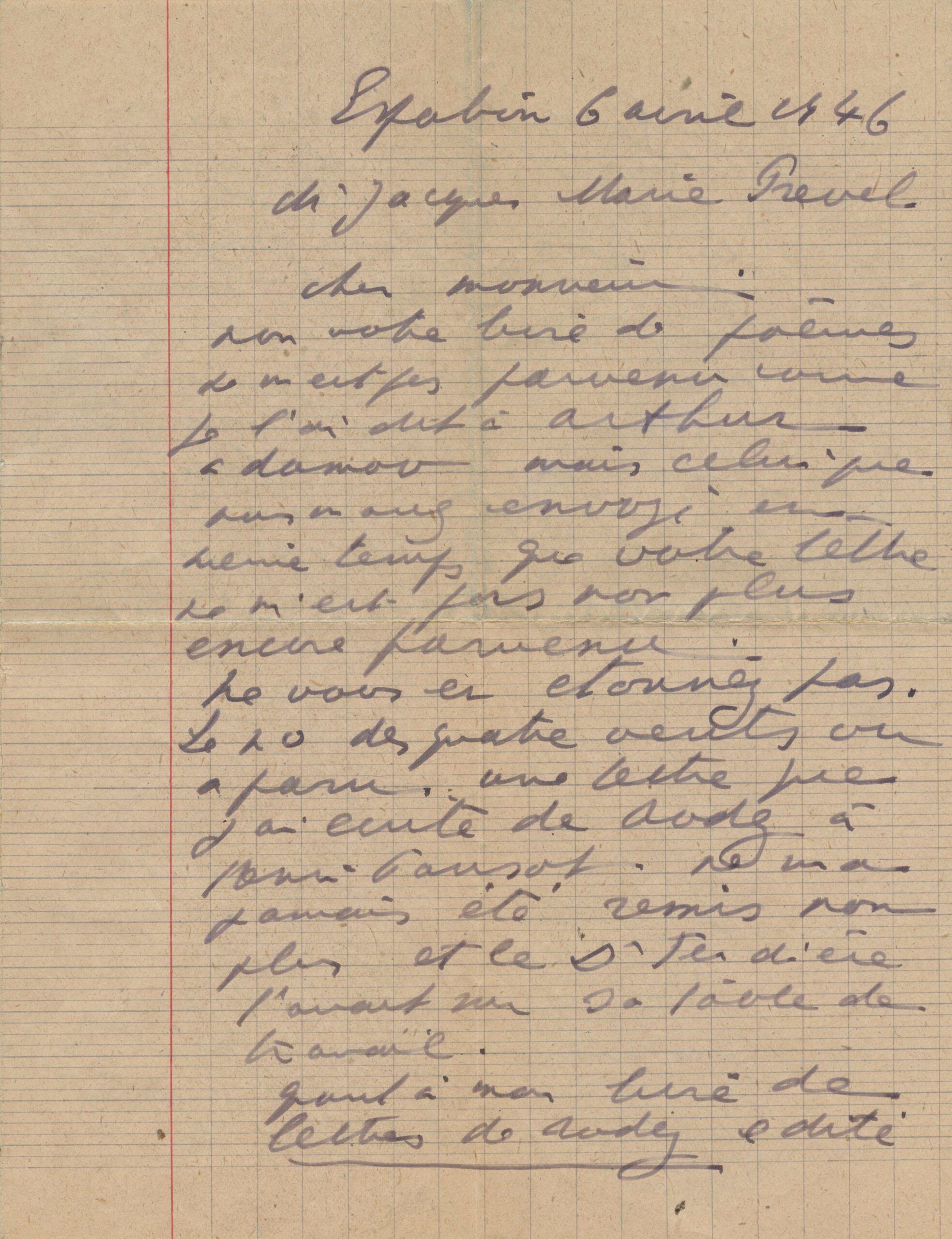
Espalion. April 6, 1946.
"The administration finally granted me my freedom on March 19th and I am no longer in the Rodez asylum."
Released from the Rodez asylum, Antonin Artaud, in a paranoid outburst, described to the man who would become one of his last faithful followers the oppressive treatment he believed he was suffering. Referring to his " Nerve-Weigher" and the recent publication of his " Letters from Rodez ," he knew he was being hunted: " On the surface, everything is calm, calm. It's not true."
______________________________________________________________
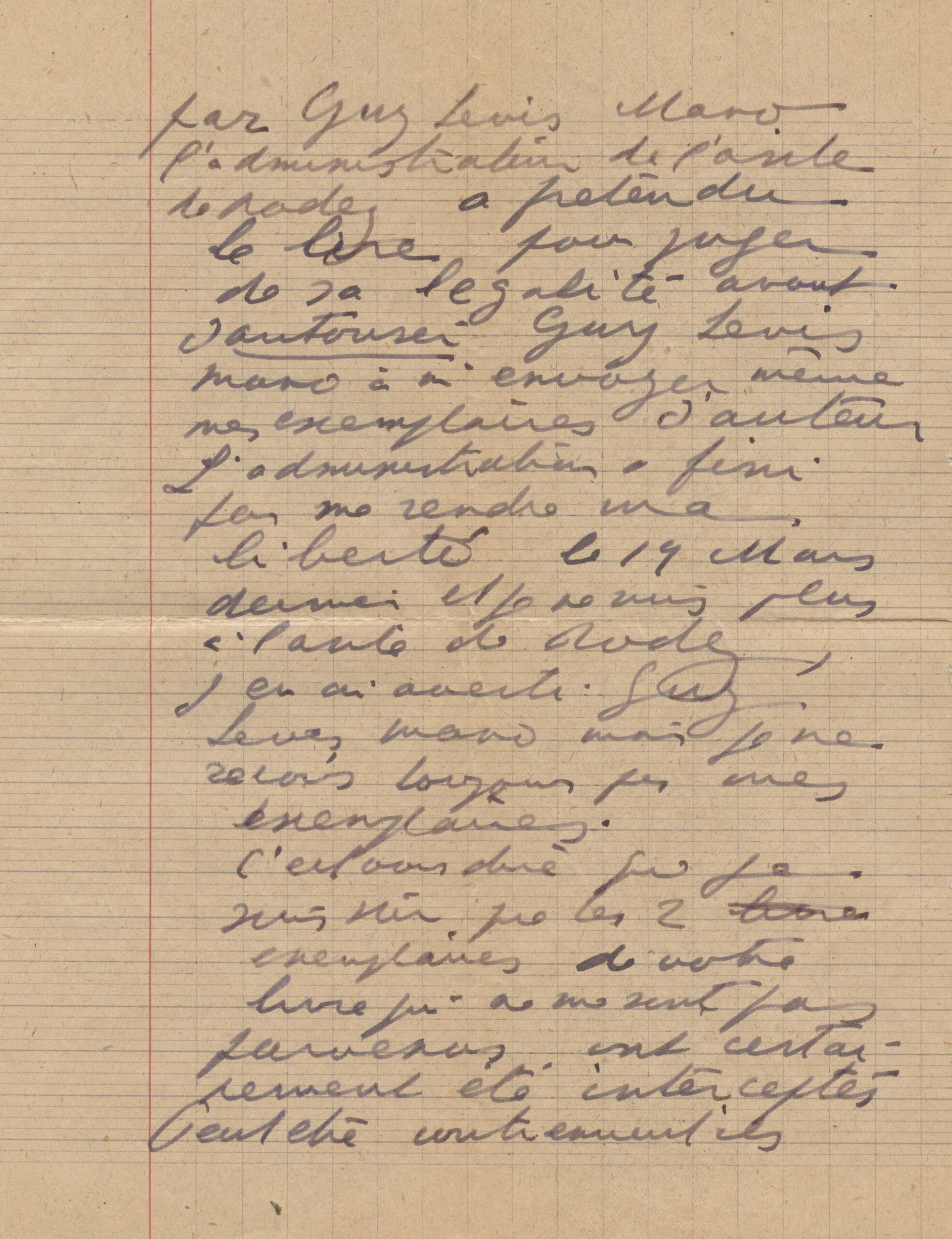
“Dear Sir, no, your book of poems has not yet reached me, as I told Arthur Adamov, but neither has the one you sent me along with your letter. Don't be surprised. The issue of *Les Quatre Vents * [a journal founded by Henri Molko and edited by Henri Parisot and Gaston Bonheur] in which a letter I wrote from Rodez to Henri Parisot appeared was never delivered to me either, and Dr. Ferdière had it on his desk. As for my book of letters from Rodez, published by Guy Lévis Mano, the administration of the Rodez asylum claimed to have read it to assess its legality before authorizing Guy Lévis Mano to send me even my author's copies.”
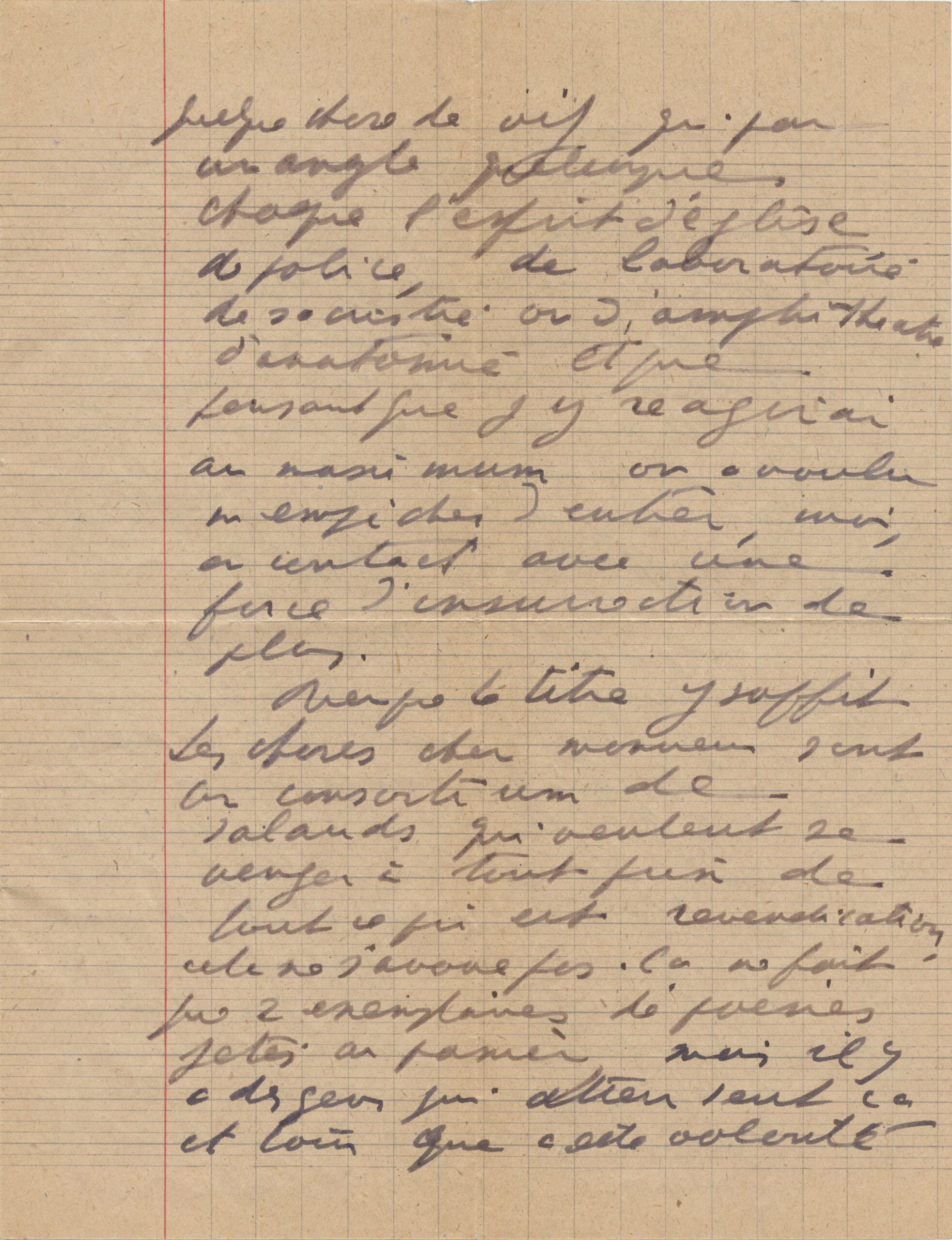
The administration finally granted me my freedom on March 19th, and I am no longer in the Rodez asylum . I informed Guy Lévis Mano, but I still haven't received my copies. This leads me to believe that the two copies of your book that never reached me were intercepted. Perhaps they contain something provocative that, from a political angle, offends the sensibilities of the church, the police, the laboratory, the sacristy, or the anatomy lecture hall, and perhaps, thinking I would react strongly, they wanted to prevent me from engaging with yet another force of insurrection.
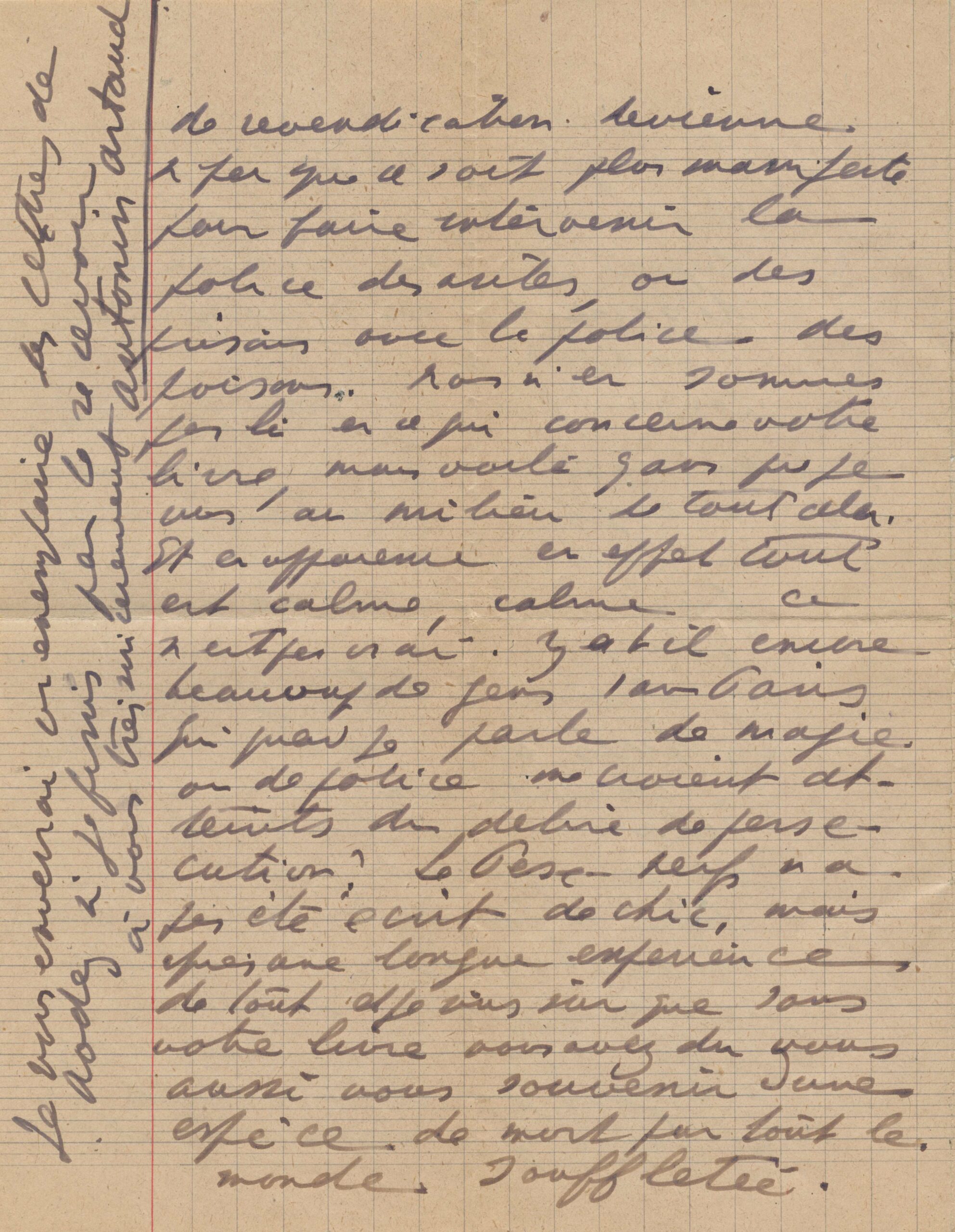
Although the title speaks for itself, my dear sir, things are a consortium of bastards who want revenge at any cost for anything that represents a protest; they won't admit it. It's only two copies of poetry thrown in the bin, but there are people waiting for this, and while this desire for protest may become unyielding, let it be more overt, so that the asylum police, or the prison police, can intervene. We're not there yet with regard to your book, but here I am, in the middle of it all. And on the surface, everything is indeed calm, very calm. It's not true.
Are there still many people in Paris who, when I speak of magic or the police, believe me to be suffering from delusions of persecution? The Nerve-Weigher wasn't written out of style, but after a long experience of everything, and I'm sure that, even without your book, you too must have remembered a kind of death, slapped by everyone. I will send you a copy of the Rodez letters if I ever receive them. Yours very sincerely, Antonin Artaud.
______________________________________________________________
The poet Jacques Marie Prevel (1915-1951) was one of Antonin Artaud's last faithful followers. A poet without a publisher, Prevel had to self-publish his poems, including Les Poèmes mortels (1945), which Artaud mentions in this letter.
The meeting between the two men took place on May 27, 1946, at the Café de Flore, described by Prevel in his diary as follows: " It is past noon. Artaud was supposed to be at the Flore at 11:15. He suddenly appeared, his Basque beret pulled down to his ears, his face ravaged. He resembles my father at the end of his life, his lip like a knife blade, his speech cutting. "
From then on, a deep friendship was born, tinged with poetry, bohemianism, and artificial paradises. Until Artaud's death in March 1948, Prevel, fascinated by his friend, wrote about their daily life and the intimacy of their relationship: “The intensity of his life drew me into an absolute, his own. I was caught in his whirlwind. I followed him like a sleepwalker. And when I left him at Jussieu or somewhere in the night, I returned drunk, strangely obsessed by his words, by the chants he recited, by his unique face, by his poignant gaze. I walked through Paris without thinking, or rather, I thought only of him. My life was transformed, illuminated. There was Antonin Artaud. I was alive.”
This journal, a precious testimony of Artaud's last two years, was published posthumously in 1974 under the title In the Company of Antonin Artaud.
Weakened by poverty and drugs, Prevel died of tuberculosis in 1951, five years to the day after his meeting with Artaud.