Émile-Othon FRIESZ (1879-1949)
Autographed letter signed to the collector Léon Pédron.
Nine and a half pages in-4° illustrated.
Cap-Brun. Monday [28] August 1922.
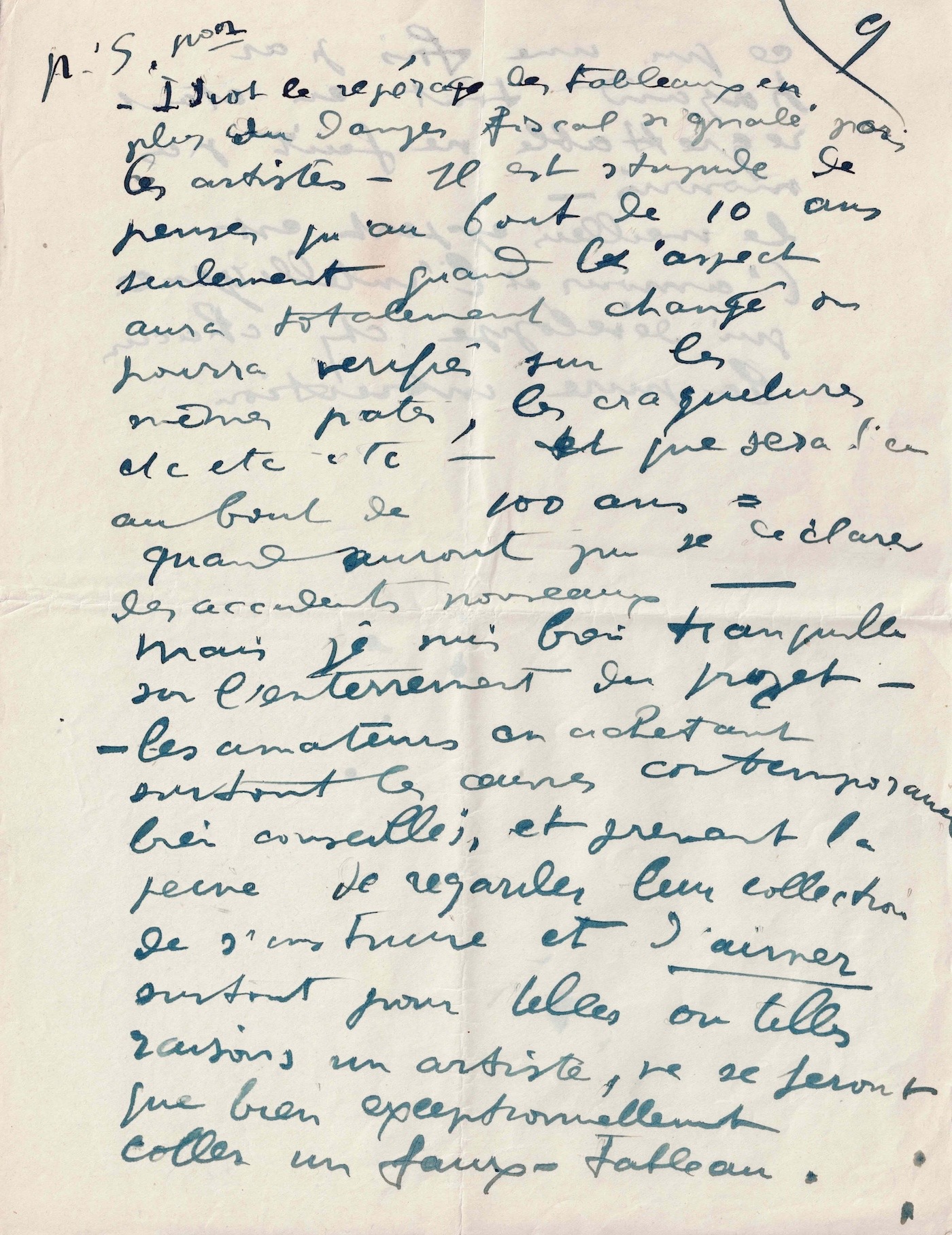
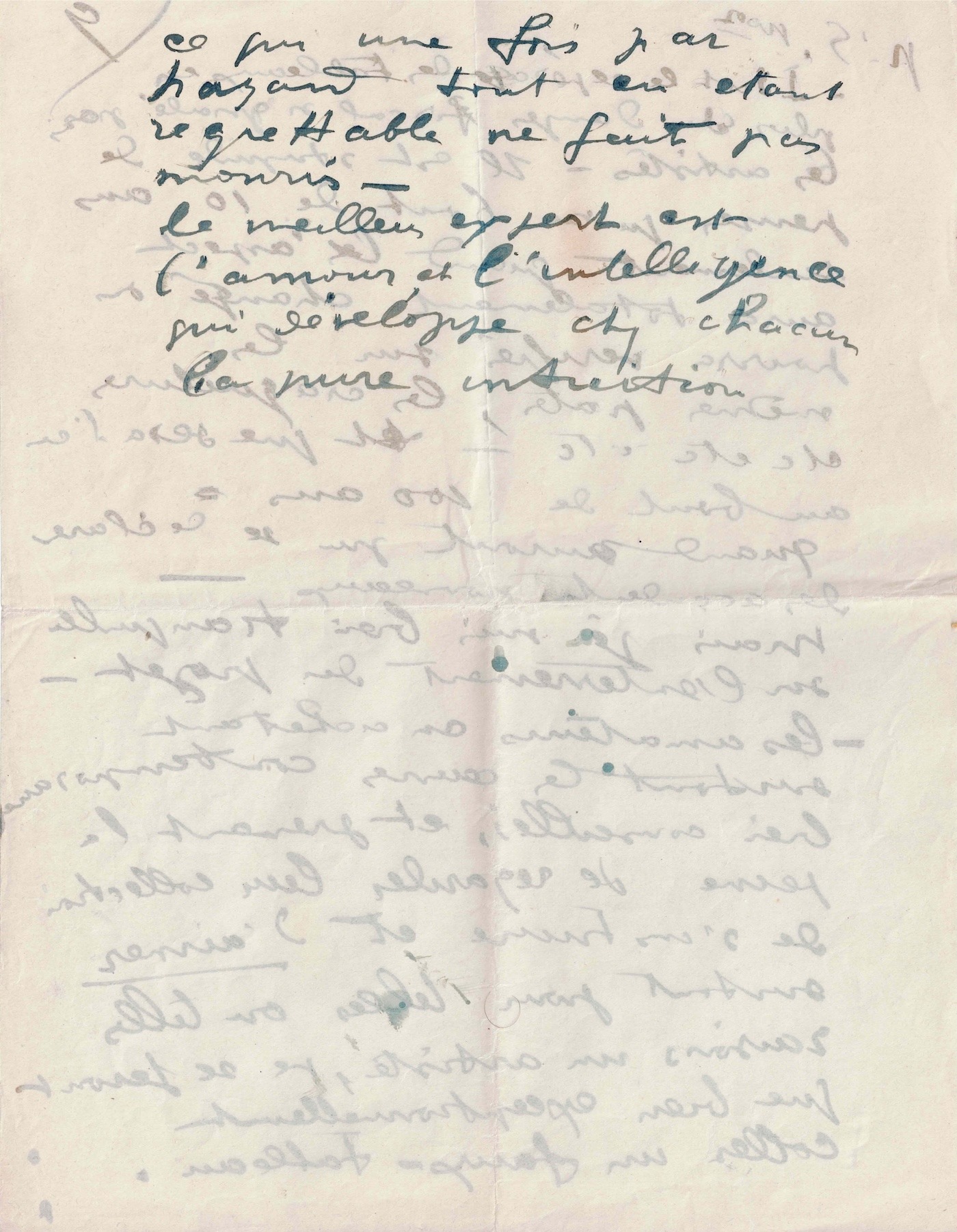
"Collectors who buy mostly contemporary works, receive good advice, and take the time to examine their collection, educate themselves, and appreciate an artist for one reason or another, will very rarely find themselves with a fake painting."
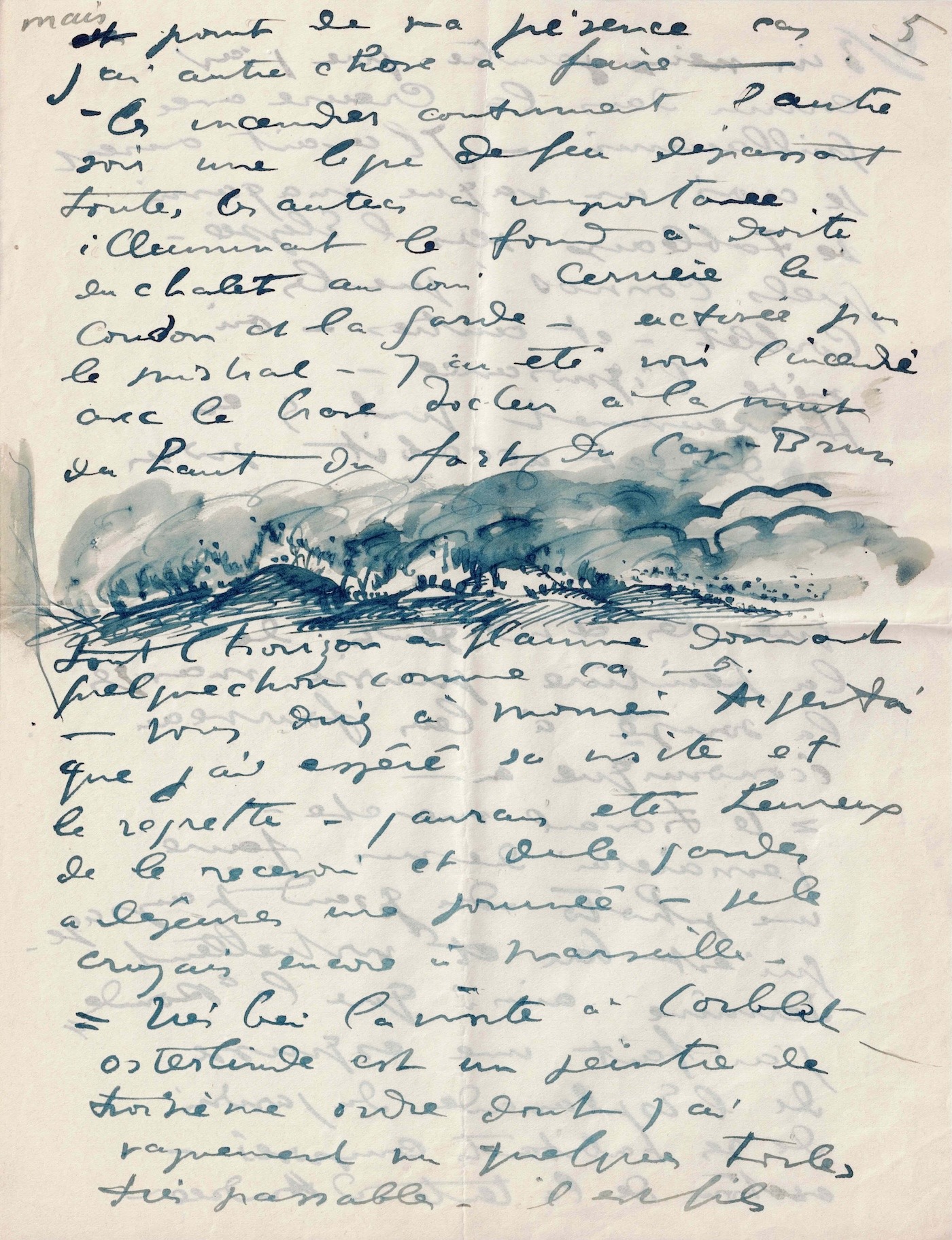
A remarkable illustrated letter from the Le Havre painter, written from his refuge at Cap-Brun, to his friend and fellow citizen, the great collector Léon Pédron. Émile-Othon Friesz comments sarcastically on the great strike of the Le Havre metalworkers and the clashes that ensued during the summer of 1922. He then mentions his desire to acquire the country house at Cap-Brun, Les Jarres, the raging summer fires, and the progress of his painting work.
_______________________________________________
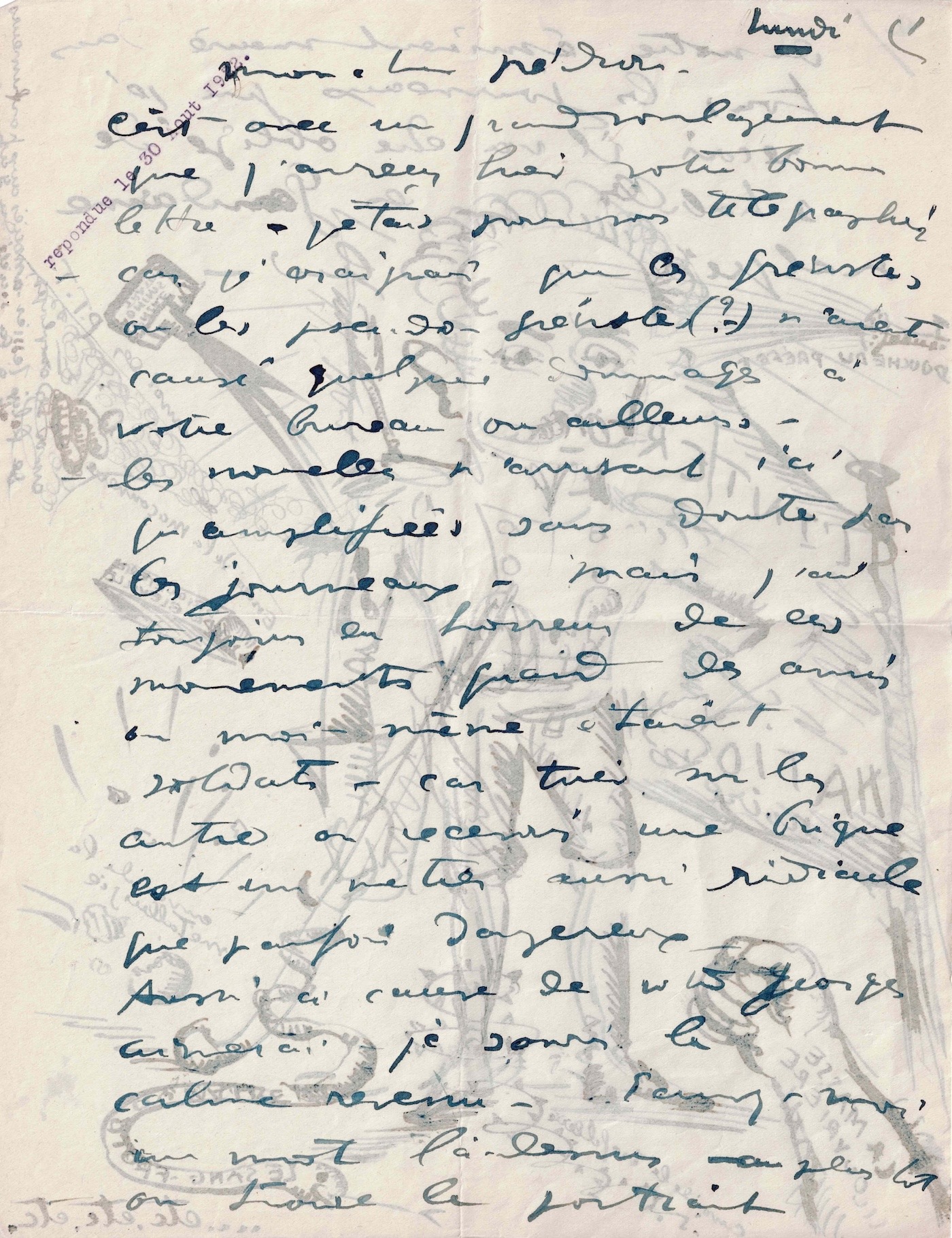
"My dear Pedron, It was with great relief that I received your kind letter yesterday. I was going to telegraph you because I feared that the strikers, or pseudo-strikers (?), might have caused some damage to your office or elsewhere—the news only reaching us here, no doubt amplified by the newspapers—but I have always abhorred such movements when friends—or myself—were soldiers, for shooting at others or being hit by a brick is a job as ridiculous as it is sometimes dangerous. Therefore, on behalf of Mr. St. Georges, I would like to know that calm has been restored. Write me a note about it as soon as possible.".
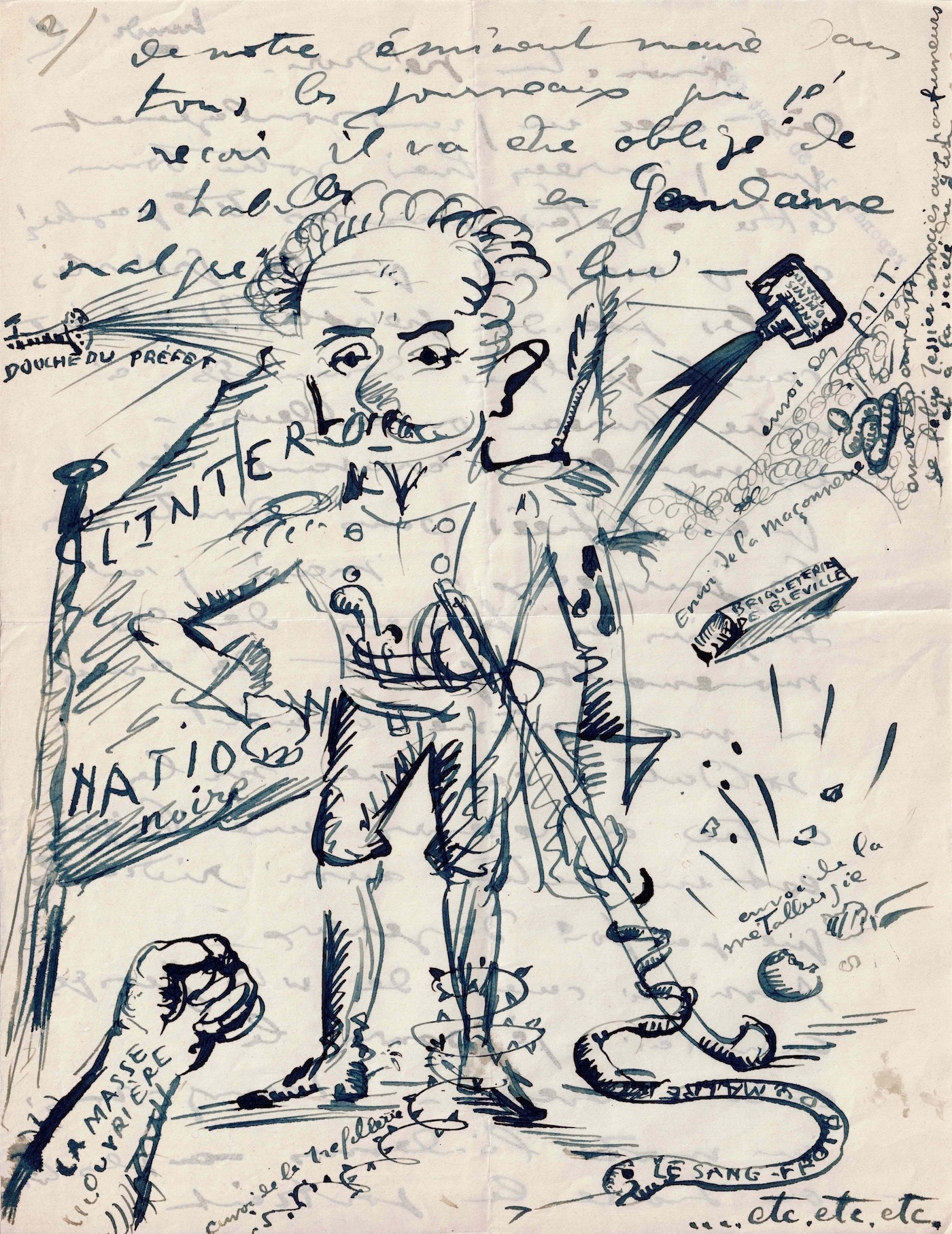
The portrait of our eminent mayor appears in every newspaper I receive. He will be forced to dress as a policeman against his will. [Friesz here draws a formidable full-page portrait of the mayor of Le Havre, dressed as a policeman, covered in various projectiles].
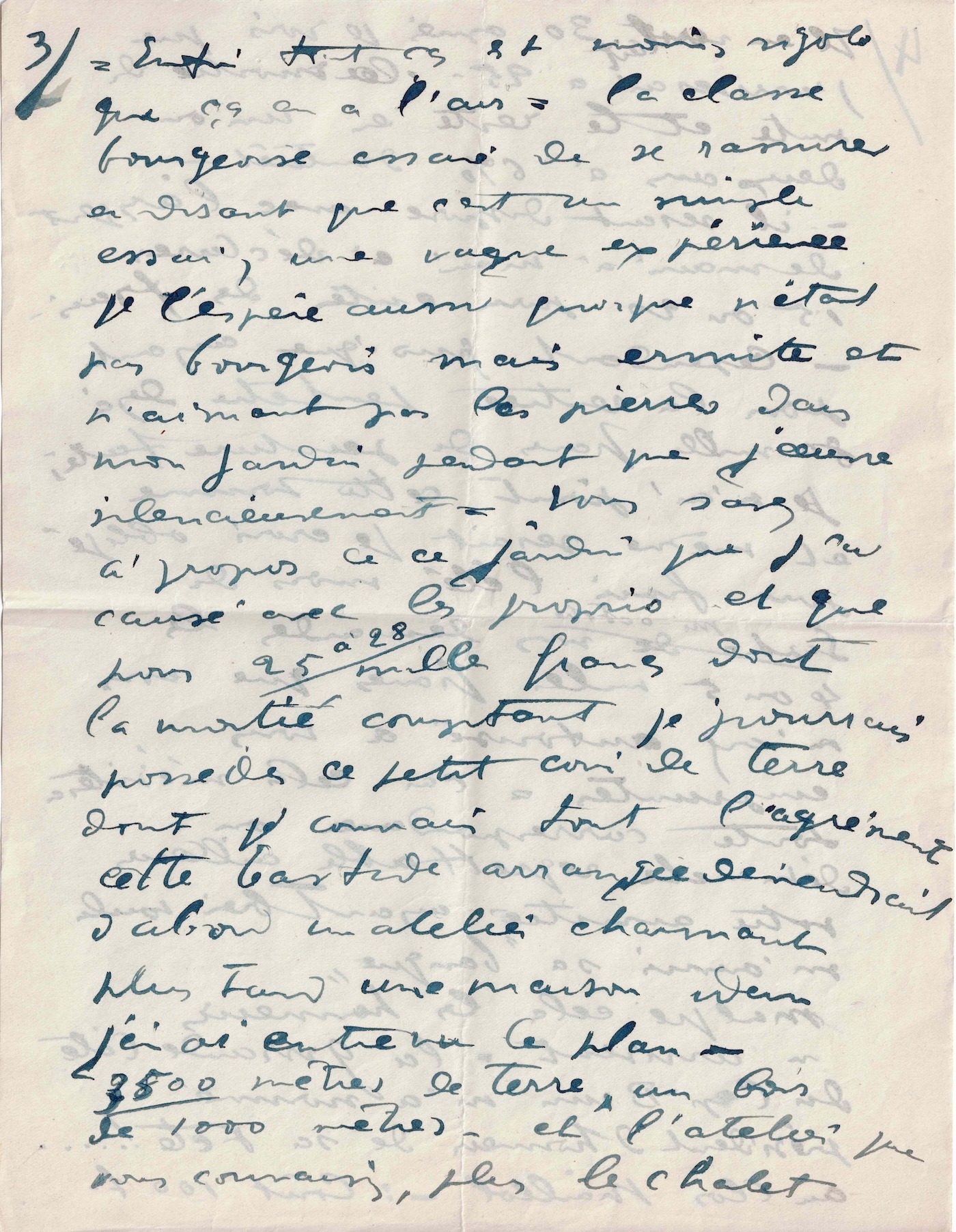
In the end, it's all less amusing than it seems: the bourgeois class tries to reassure itself by saying it's just a trial run, a vague experiment. I hope so too, although I'm not bourgeois but a hermit, and I don't like stones in my garden while I work silently. You know, about this garden, I spoke with the owners, and for 25,000 to 28,000 francs, half of which would be upfront, I could own this little piece of land, the charm of which I know so well. This renovated country house would first become a charming workshop, later a similarly charming house. I've glimpsed the plan: 3,500 square meters of land, a 1,000-square-meter wood—and the workshop you know, plus the chalet. He wanted 30, after that I think I'll get to 25. Half at once and the rest in one or two years at 6% interest – he would be insured with the cash hand-to-hand to declare 15 or 20 to avoid fees.
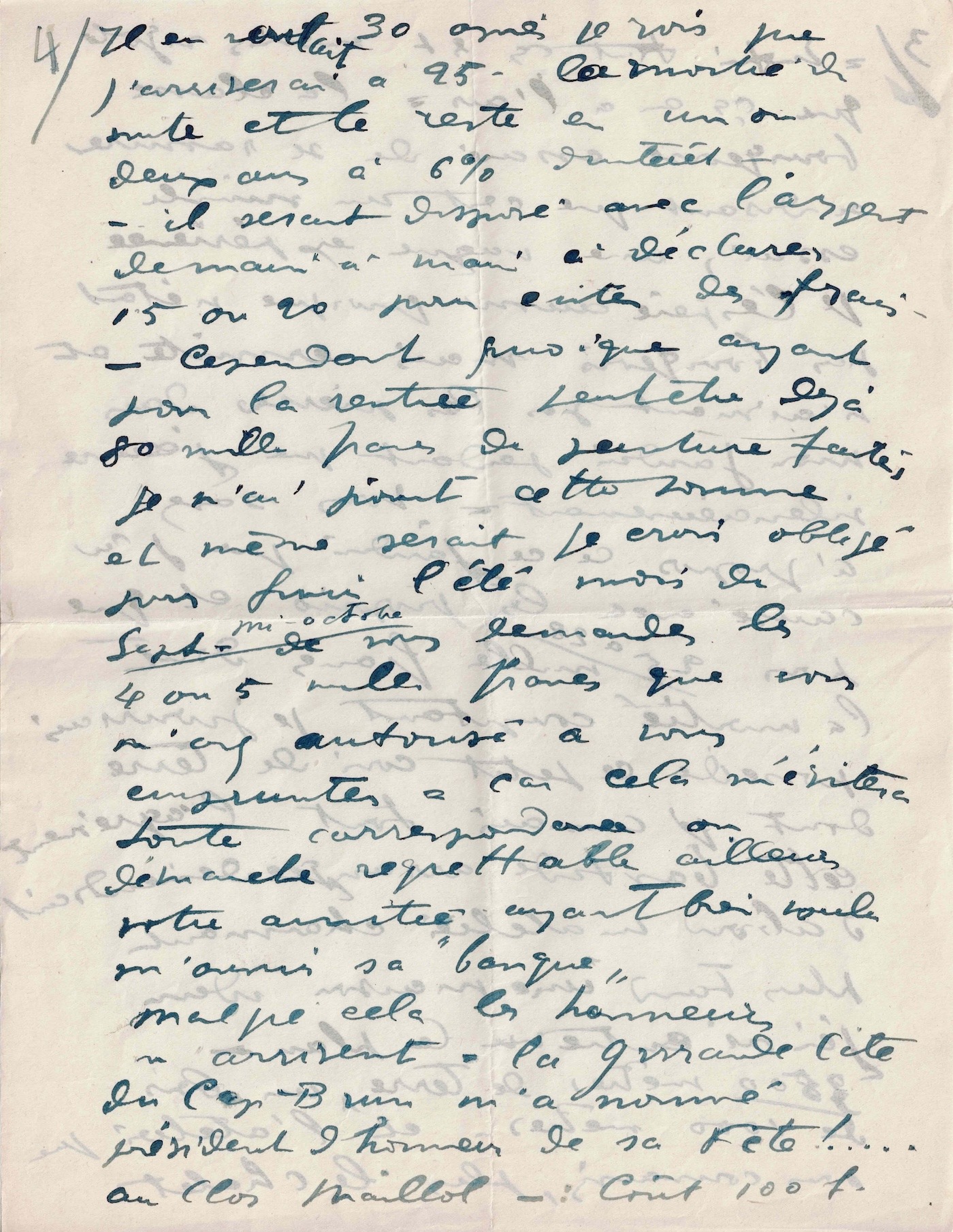
However, although I may already have 80,000 francs worth of painting done for the start of the academic year, I don't have that sum and I believe I would even be obliged, to finish the summer, from September to mid-October, to ask you for the 4,000 or 5,000 francs you authorized me to borrow, as this will save me any regrettable correspondence or dealings elsewhere. Your friendship has been kind enough to open its "bank" to me.
Despite this, honors are coming my way – the great lady of Cap-Brun has named me honorary president of her festival! … at Clos Maillol – Cost 100 francs, but I won't be there because I have other things to do.
The fires continue. The other night, a line of fire surpassed all the others in size, illuminating the far right side of the chalet behind Coudon and La Garde – fanned by the Mistral wind. I went to see the fire with the brave doctor at night from the top of Fort Cap-Brun. The entire horizon ablaze, giving something like this. [Friesz depicts his view of the ongoing fires across the entire width of the page].
You will tell Mr. Argenta that I hoped for his visit and regret it – I would have been happy to receive him and keep him for lunch for a day – I still thought he was in Marseille.
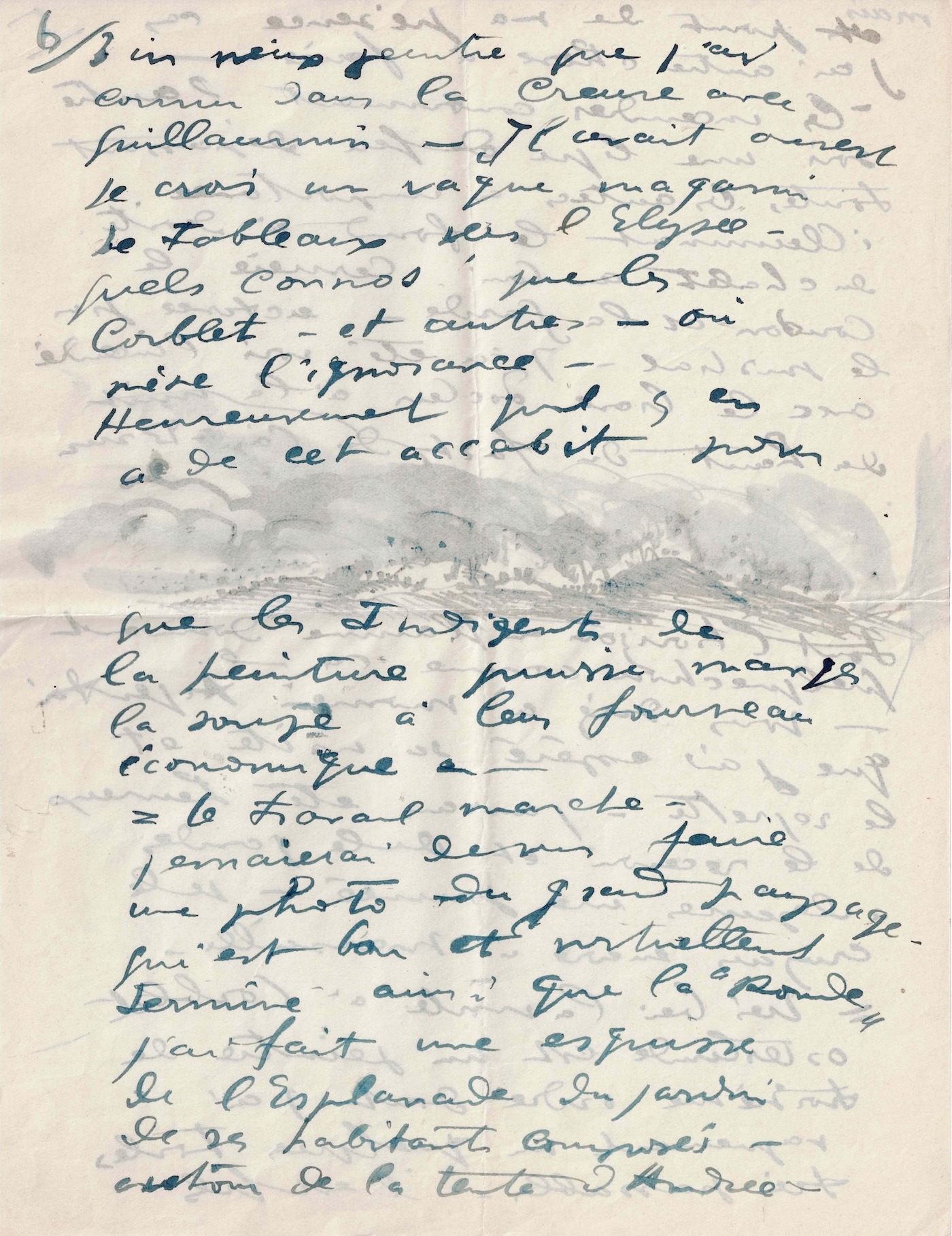
The visit to Corblet was very good. Osterlinde [Anders Osterlind (1887-1960)] is a third-rate painter of whom I've vaguely seen a few very passable canvases. He's the son of an old painter I knew in the Creuse region with Guillaumin. He had, I believe, opened a shady art shop near the Élysée Palace – what idiots the Corblets are – and others – where ignorance leads – luckily there are some of that ilk so that the impoverished painters can eat their fill of the poor.
The work is progressing. I'll try to take a picture of the large landscape, which is good and virtually finished, as well as the "Round." I've made a sketch of the esplanade, the garden, and its inhabitants—all arranged around Andrée's aunt. She continues to do well—though with caution.
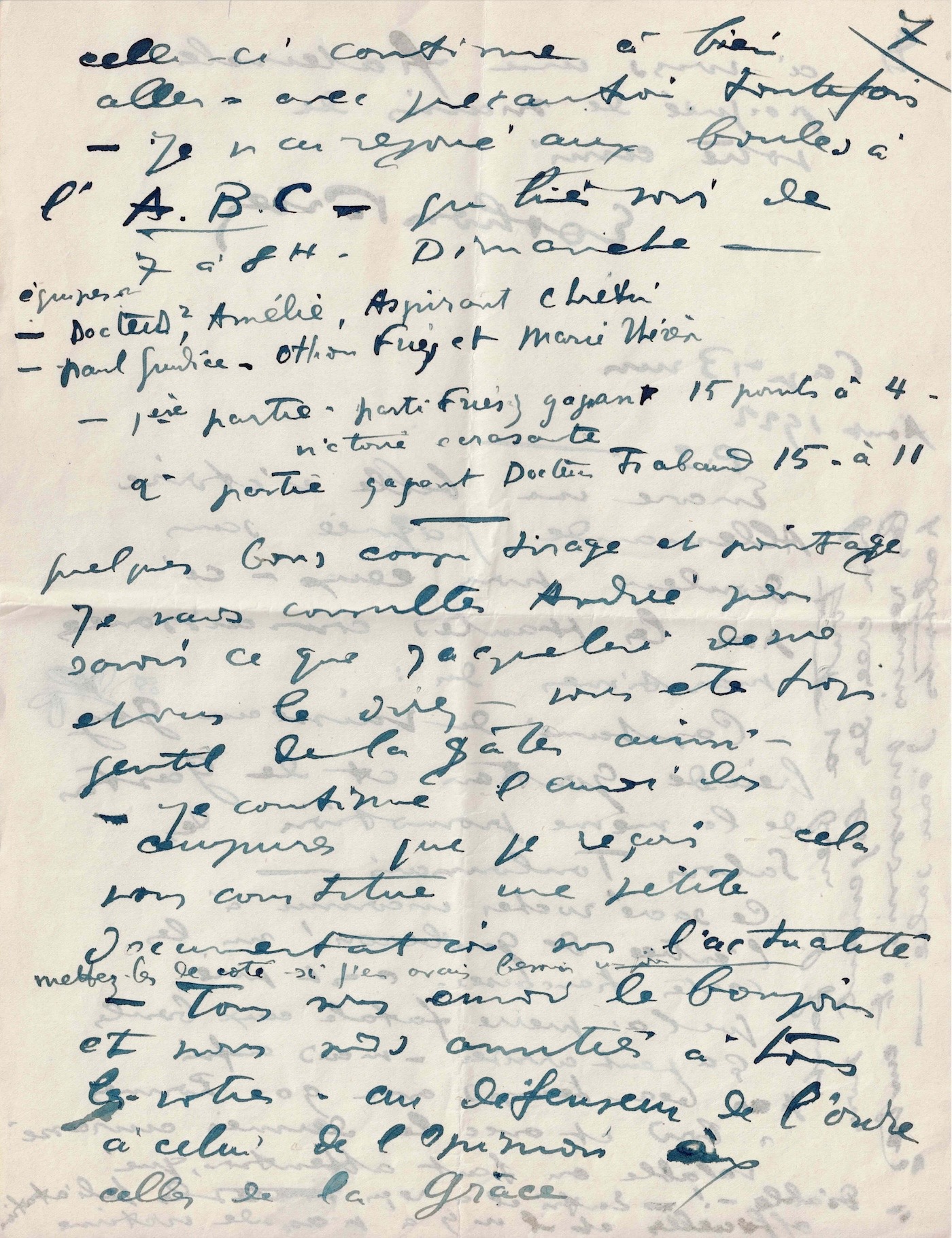
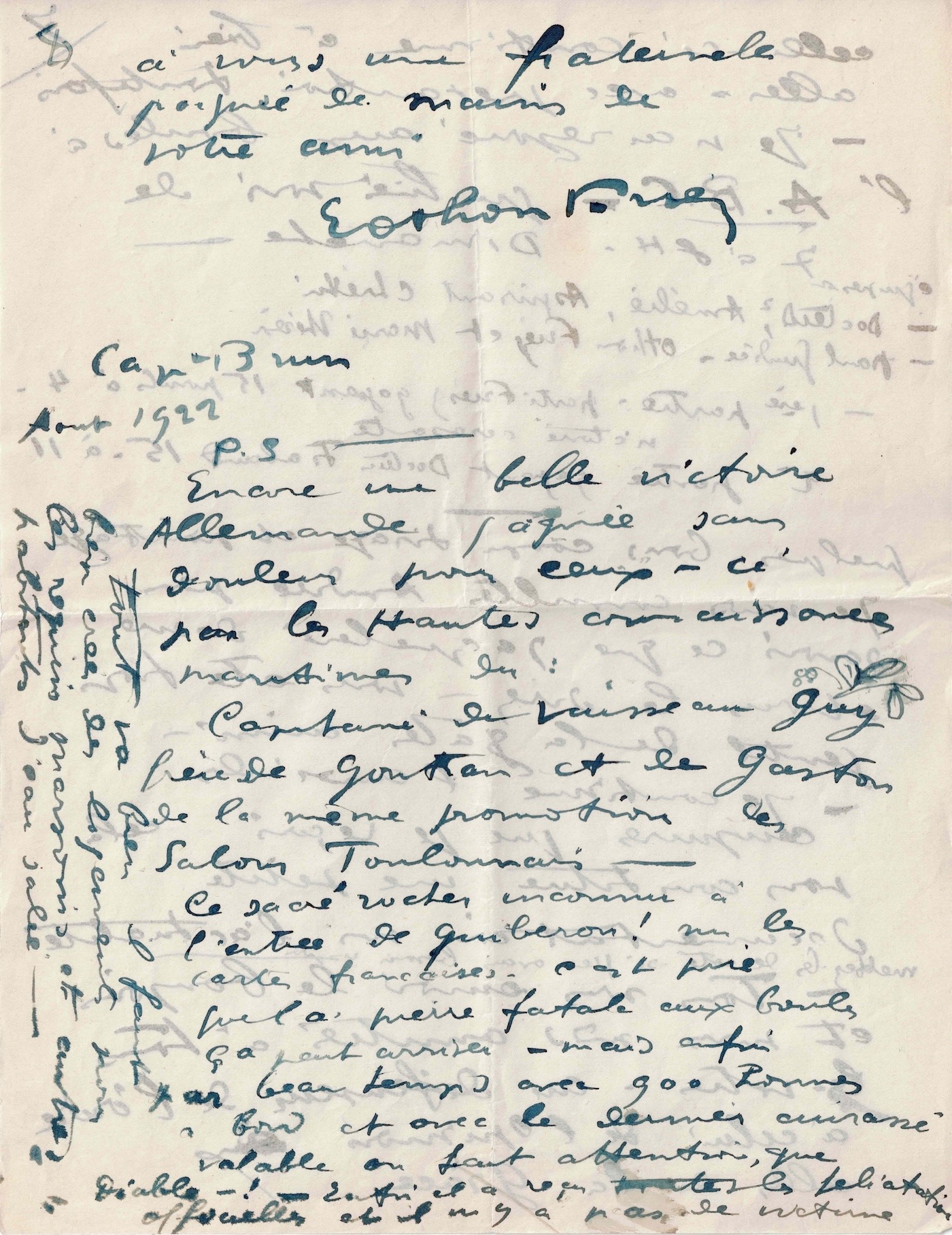
I only played boules at the ABC yesterday evening from 7 to 8 pm. [Friesz here gives details of his pétanque games before concluding his letter with two long postscripts relating to the sinking of the battleship France, which occurred on the night of August 25-26, 1922, at the entrance to Quiberon Bay, and then to the fight against forgeries in art and the meaning of art collecting.] All our best to all of you—to the defender of order, to the defender of public opinion, to those of grace. To you, a fraternal handshake from your friend E. Othon Friesz.
PS – Another fine German victory, won without any pain for them thanks to the extensive maritime knowledge of Captain Guy, brother of Gontran and Gaston from the same graduating class at the Toulon naval salons. That darned unknown rock at the entrance to Quiberon! Not even on the French charts. It's worse than the fatal stone, it can happen in boules – but still, in good weather with 900 men on board and with the last usable battleship, you're careful, for goodness' sake! […]
PS – Identifying paintings is idiotic, in addition to the tax risks pointed out by the artists. It's foolish to think that after only 10 years, when the appearance has completely changed, we can check the same areas for cracks, etc., etc., etc., and what will it be like after 100 years when new problems could have arisen? But I'm quite confident that the project will be shelved – collectors, especially those buying contemporary works, well-advised, and taking the time to examine their collection, educate themselves, and , appreciate an artist for their own reasons, will only very rarely find themselves with a fake painting. Which, once by chance, while regrettable, isn't fatal. The best expert is love and intelligence, which develop pure intuition in everyone.
_______________________________________________
Léon Pédron (1869-1927), an industrialist from Le Havre, friend and loyal patron of Friesz, assembled a rich collection of modern paintings between 1914 and 1926: it included works by Pissarro, Derain, van Gogh, Gauguin, Marquet, Redon, Othon Friesz, Boudin, Corot, Cézanne, Renoir, Vlaminck, Braque, etc. Upon his death in 1927, the painter found himself in a precarious financial situation, without support, until his meeting with the gallery owner Katia Granoff.