
"It seems to me that I'm only just learning the painter's trade."
15.000€
Jules FLANDRIN (1871.1947)
Correspondence to Alfred Rome.
43 signed autograph letters, 3 handwritten invoices for paintings and 4 original photographs of the painter. Approximately 150 handwritten pages – between June 1909 and November 1922 – enriched with numerous drawings, sketches, studies and wash drawings.
Various octavo and quarto formats. Some envelopes preserved.
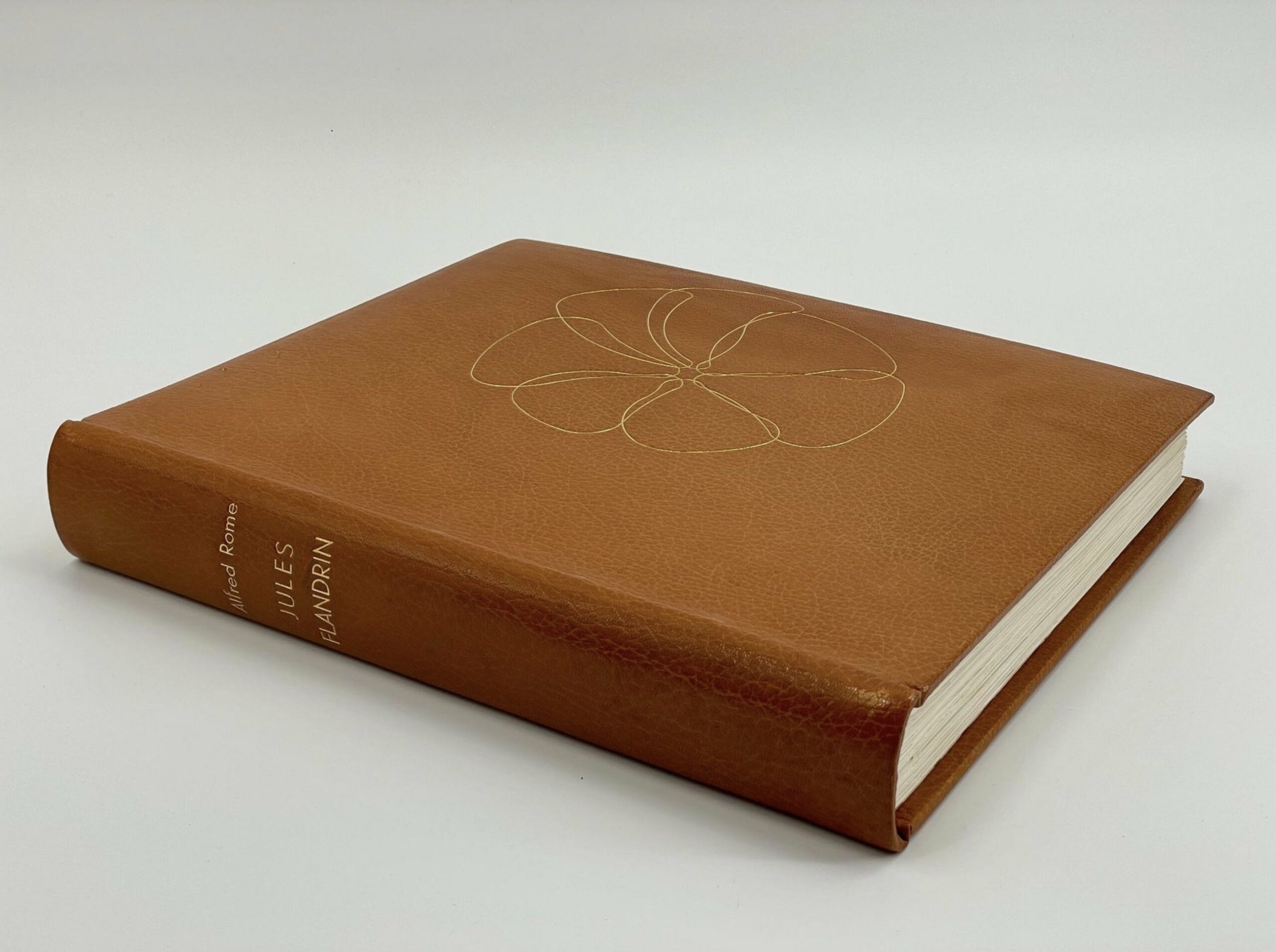
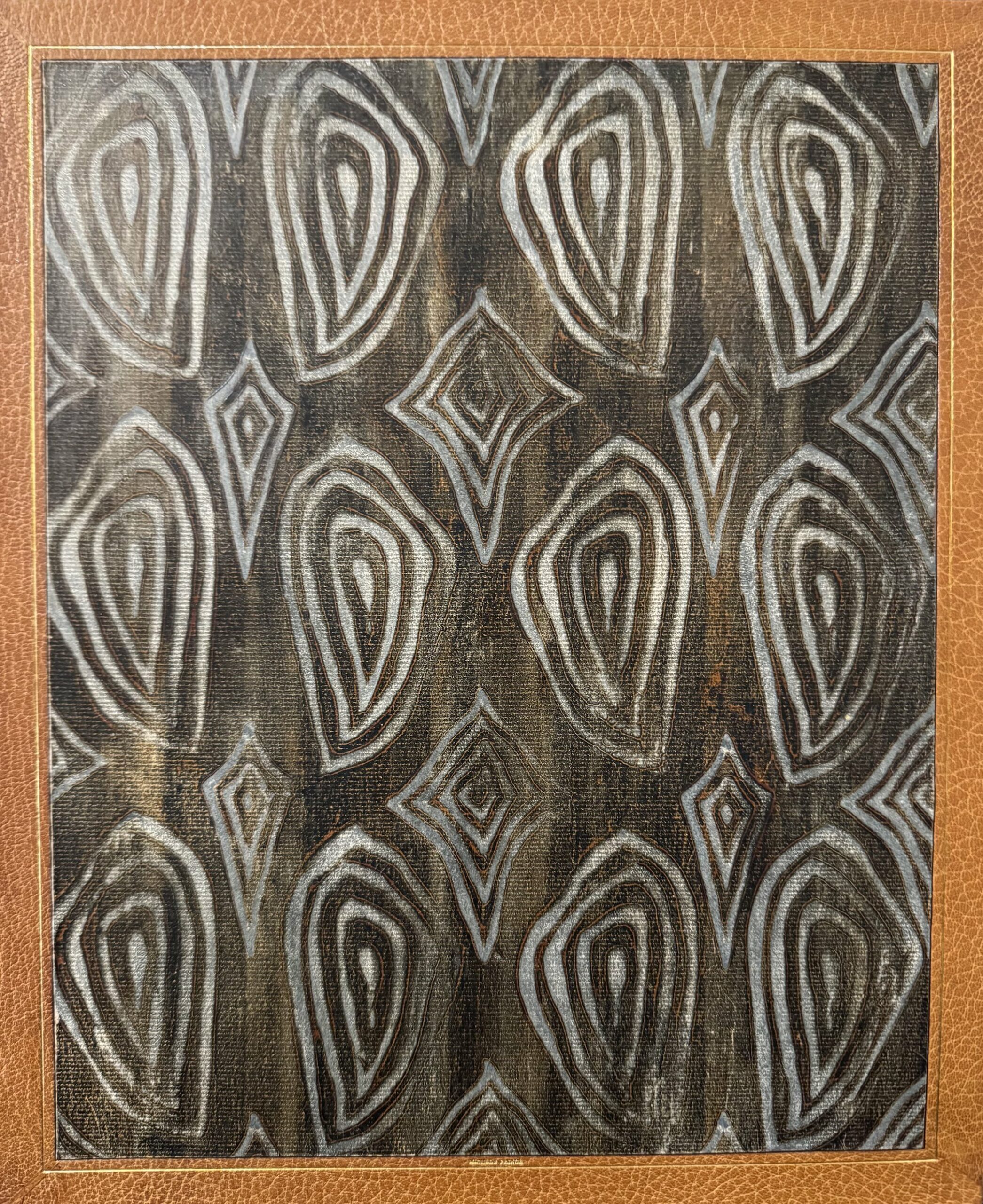
The set is preserved in a superb double-layered binding – in a slipcase – in full tan morocco leather by Michèle Prince. Smooth spine and gilt title “Alfred Rome – Jules Flandrin”, interlacing gilt fillets forming a stylized flower on the front cover, gilt top edge, gilt fillet inside, heavy embossed paper lining and endpapers.
"It seems to me that I'm only just learning the painter's trade."
An extraordinary and abundant correspondence, entirely devoted to painting, with his friend, the architect and collector Alfred Rome.
Flandrin immerses us in the daily life of the Fine Arts at the beginning of the 20th century. A recognized painter, exhibiting at the Salon d'Automne and the Salon des Indépendants, he describes to his friend, a collector from Grenoble, his creative projects, his doubts and pictorial enthusiasms, while also acting as an intermediary-buyer of works of art for the latter with the dealers Bernheim, Rosenberg and Vollard.
A veritable artistic gazette of his time, Flandrin describes, from the inside, the world of the arts of the early 20th century and evokes in no particular order his admiration for Van Gogh, Cézanne, Hokusai and Toulouse-Lautrec; his friends Matisse, Marquet, Forain and Denis; his master Gustave Moreau; his companion Jacqueline Marval, and his pictorial analyses of Gauguin, Manet, Renoir, Monet, Raphael, Bouguereau, Rodin, Degas, Vallotton, Ravier, Fantin-Latour, Urtin, Jongkind, Corot, Millet, Van Dongen, Delacroix, Rousseau, Bellini, Veronese, Mantegna, Monticelli, Rubens, Henner, Redon, Douanier Rousseau, Lhote, Anquetin, Segonzac, Calès, Michel Ange, Chardin.
________________________________________________________
I. Paris. June 13, 1909. Flandrin is looking for works by Fantin-Latour for his collector friend: “… As a pictorial beauty, one struck me, 25 or 30 francs I think, a nude woman lying on her back in a landscape, with a marvelous light and a beautiful, not overly plump, drawing […] well, it’s up to you and I’ll take the best one I can…”
II. Paris. June 15, 1909. The acquisitions are made (for a total of 75 francs): “…You will receive a postal package sent by Mr. Kleinman: 3 lithographs, the nude we discussed, the lithograph entitled Lelio which I find very beautiful […] and another lovely little one where a young woman is walking in a delightful undergrowth […] I think they will look good in your office or apartment, without cluttering it up. […] I received a lovely volume on Ravier […] the reproductions are admirable.”
III. Paris. November 2, 1910. Flandrin is enthusiastic about Toulouse-Lautrec and disappointed by Maurice Denis: “ I feel I haven’t thanked you enough for your kindness towards my paintings. I will certainly try to deserve it. […] For today, I’m sending you, as a topic for discussion, an issue of Le Figaro on Lautrec. […] You will find the text very interesting. It is as true and accurate as the works are brilliant. […] I will talk to you at greater length about the Salon d’Automne. Maurice Denis disappointed me with his decorative approach, which relies on misguided tones. Oh, it’s well done, for decorative painters. Not a smudge, not a stain; I understand that these daubers didn’t tremble before their task, but him!?? I know that a complete work must render the labor invisible to make room for emotion, but they, ignorant like the public, see only the finished product as their goal.”
IV. Paris. November 13, 1910. “…I’m starting to get back on track. Getting back on track is rather complicated for me, because it means combining the observations and knowledge I gained during my vacation with the reflections and conclusions that the new face of the Parisian art scene inevitably brings about. My latest observation was yesterday, at the installation of a small exhibition on Rue Lafitte, bringing together about sixty former students of Gustave Moreau. Since Matisse only sent studio studies, it was Marquet’s three small landscapes that made the best impression on me. […] Many things here strike me as something from Urtin next to your watercolor by Jongkind. This feeling can be had with the same artist. […] I feel all this even more strongly in myself, especially when looking at my sketches for Druet, where it’s a matter of truly saying what it should say, and not of representing objects.” […] The comparisons make me think I want to tell Farcy [Pierre-André Farcy, the curator of the Grenoble museum] about the (astonishing) appearance of the white rooster stuck to the walls of the rue de la grande chaumière… »
V. Paris. November 26, 1910. Flandrin is enthusiastic about his decorating projects and his painting work: “…I recently had lunch with the Bouchayers and we had a lively discussion; it reminded me of our pleasant evenings in Grenoble. I was delighted to see again his entire series of Ravier paintings, admirably lit in his entrance hall. It's a simple yet truly perfect arrangement of a long, narrow space. I'm going to make three narrow panels for the tops of sliding doors. One for the dining room (where I'd like to do a large still life with a stunning Buddha I have) and the two for the gallery where I'll paint landscapes of the valley [Flandrin here draws two sketches, in plan and perspective, of the described space]. Here, I do have my canvases for the Druet decoration, but I'm still finishing my sketches, which will be better than floundering on the large canvases.” I'll start as if nothing needs changing, then I'll see what needs to be done. I think you received the crates of paint safely. I was worried about the windows; did they arrive in one piece?
VI. Paris. December 18, 1910. Flandrin promises his lithographs to his friend before proclaiming his admiration for Hokusai: “…I haven’t forgotten your lithographs; I’m just waiting for the printer to tell me he’s prepared my lithographs (sketches from 1909), for which I’ve already sourced everything, including Dutch vat paper and old Japanese paper. Without prejudging the future, you know I’ll keep for you whatever I feel is best in terms of prints. […] I must get into the habit of wanting to create beautiful things, and I’m very happy to succeed without wanting to enjoy them alone. […] Seeing the Chauchard collection yesterday, I was thinking, focusing only on Corot, of old Hokusai saying that it wasn’t until he was 70 that he understood drawing.” […] As for the rest, apart from a few pastels by Millet and a beautiful Delacroix, "Tiger Hunt," it's a jumble of old-fashioned, cheaply executed works, a complete ignorance of true drawing, and some Théodore Rousseau pieces that I still don't like at all, and the rest is even worse. I was also looking at a painting of Egypt by Gentile Bellini, brother of Giovanni Bellini; it's much closer to our time than the 1830s, and the Veronese and, before them, Mantegna, etc. And then there are Hokusai's 100 Views of Mount Fuji, and that, well, that blows us all away.
VII. Paris. December 31, 1910. The end of the year prompts the artist to take stock of his pictorial evolution and his own learning: “…This is how painting says what no word can teach, one might say, and why it was invented. Step by step, I strive to achieve this; it seems to me that this year ends with one more step: a feeling I have of seeing a little more clearly in the problem of the complete drawing , of the alliance of the mark with the line […] I tried it in quick sketches and I saw that the line is certainly a means of expression, but that, complemented by the mark, it yields 100 to one. […] But that's saying too much. I must do it…”
VIII. Paris. February 28, 1911. “…painting, to which I don’t even have time to devote my full mental concentration. Now the longer days will allow for more work […] And to think that once, a friend of mine in Paris used to say to me: ‘Are you lucky, painters! When night falls, your day is over, and all you have to do is relax and smoke your cigars.’ ” The letter continues on March 2: “…Amidst my worries about canvases in progress, I hope for the happiness of starting others; it would be wiser to finish the first ones. I will at least allow myself some studies from nature from time to time…”
IX. Paris. March 26, 1911. Monticelli's painting: “… yesterday at Druet's, I looked at what he has by Monticelli ; unfortunately, I didn't see one I remembered that had enough similarities to yours. […] From a technical point of view, yours is done entirely in one go and certainly in a single stroke, and he must have done many like that, to sell. […] I still find, beneath this hastily executed appearance, truths of painting and drawing and a general poetry that I don't dislike at all . […] It's there, at the moment, next to a small Odilon Redon that I bought in Montmartre […] and it doesn't look out of place…”
X. Paris. April 4, 1911. Alfred Rome has just acquired a work by Toulouse-Lautrec: “… I know your Lautrec well; it was featured last year in the exhibition at Georges Petit’s gallery. It’s very good Lautrec, enhanced with charming touches (I remember, among others, a very Lautrec-like Veronese green). As for its longevity, compared to other paintings, I think it will withstand quite a few centuries , and since it was created, it has taken on its final form.” Flandrin then mentions a series of fake Monticelli paintings bearing forged signatures before discussing his own work and his preparation for the Salon des Indépendants : “ I’m working hard on both sides, for the Indépendants. I’m amusing myself with horsemen (1.80m canvas) in wood. I would like to achieve a sense of truth, movement, and light that would be entirely original…”
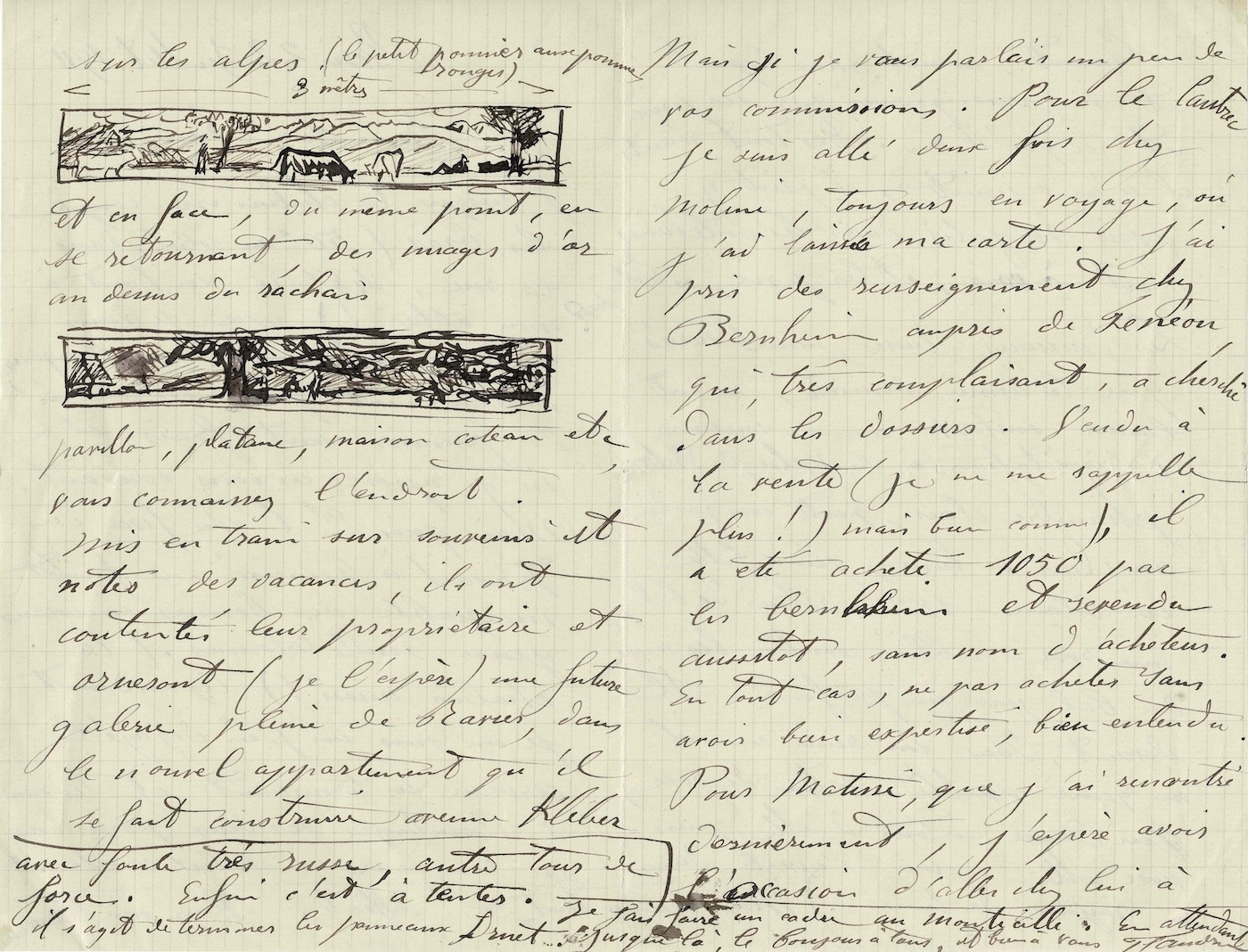
XI. Paris. July 22, 1911. “… I cleared my head a bit by finishing and delivering to Bouchayer his two long panels , sunset over the Alps and opposite, from the same vantage point, turning around, golden clouds above the rachais [Flandrin is drawing here, in ink, the two horizontal panels, 3 meters long]. Started from memories and holiday notes, they pleased their owner and will (I hope) adorn a future gallery full of Ravier , in the new apartment they are having built on Avenue Kléber. But if I were to tell you a little about your commissions. For the Lautrec, I went twice to Molini, always while traveling, where I left my card. I inquired at Bernheim's with Fénéon, who, very obliging, searched through the files.” Sold at auction (I don't remember exactly!), it was bought for 1050 by the Bernheims and resold immediately, without a buyer's name. […] As for Matisse, whom I met recently, I hope to have the opportunity to visit him eventually. Well, it's worth a try… »
XII. Paris. November 29, 1911. Alfred Rome has just acquired some paintings by Flandrin: “Thank you for your kind letter, which reassures me about the arrival of my paintings, and doubly thank you for the purchase and the compliments. I am pleased with your choice, which won't make me too embarrassed in your home. […] Yes, I have a lot to do, and I would like to do it in complete freedom , with the idea that I won't show any of it! And with this awful yellow fog, what I want to finish right now isn't progressing. Now for the serious matters: do you have Uhde's book on Douanier [Rousseau]? [Flandrin sketches the cover of the book published by Eugène Figuière here]. Remember, of course, that it's a German who wrote this and that it's serious. But it's very good nonetheless, and the reproductions too. And besides, what do you know, this German guy!” "He's the one who has my 'Sleeping Woman' with the two does, and Mozart at the piano, then!"
XIII. Paris. January 21, 1912. Flandrin is preparing for the Salon des Indépendants: “…I won’t forget you in my engraving experiments (original engravings, of course!). And I’m going to try my best to resolve these Russian dances. I also intend to resume, with the help of nature, a large canvas left unfinished, a long canvas, bucolic in style, depicting a sleeping harvester , a man and child, and a harvester in the distance in the sunlight. I’ll keep you informed, because I’m going to try to have it ready for the Salon des Indépendants. I think I’m going to enjoy it…”
XIV. Paris. [21] February 1912. " That's it, the painting is marked as sold. We'll keep them waiting as little as possible; it will leave as soon as we close. That's François's choice too! I think it would be a unanimous choice? Thanks again…"
XV. Paris. February 22, 1912. Flandrin rejoices in the success of his exhibition and, without false modesty, in the sale of his painting in Rome: “I will tell you first, for my part, that I am delighted to see that the jewel of the exhibition is destined for you. I have wished for nothing less since I saw, like my friends, this miracle of a final work, in a room of masterpieces, even more exquisite and ever more powerful. It is the canvas entitled ‘The Three Roses (Bathers).’ I believe, moreover, that photography could not capture all the youthfulness of this flesh, where color plays such a great role.” […] It's a square canvas, 1.30 by 1.30 meters (and the price, a thousand francs , which the author's modesty can never bring himself to write! Alas, a Flandrin is displayed on the Avenue de l'Opéra for 7,000! Oh, the absurdity!) […] Besides, the exhibition is a fairytale palace, and from the youngsters ( this will make the youngsters blush, the young Cubist Lhote told me ) to the old connoisseurs who don't hide their delight, the reaction is unanimous. Do you know what several collectors were saying? "I have a crazy urge to buy something, but I'm afraid of ruining my collection!" One said: "Only my Renoirs and Monets would survive." …"
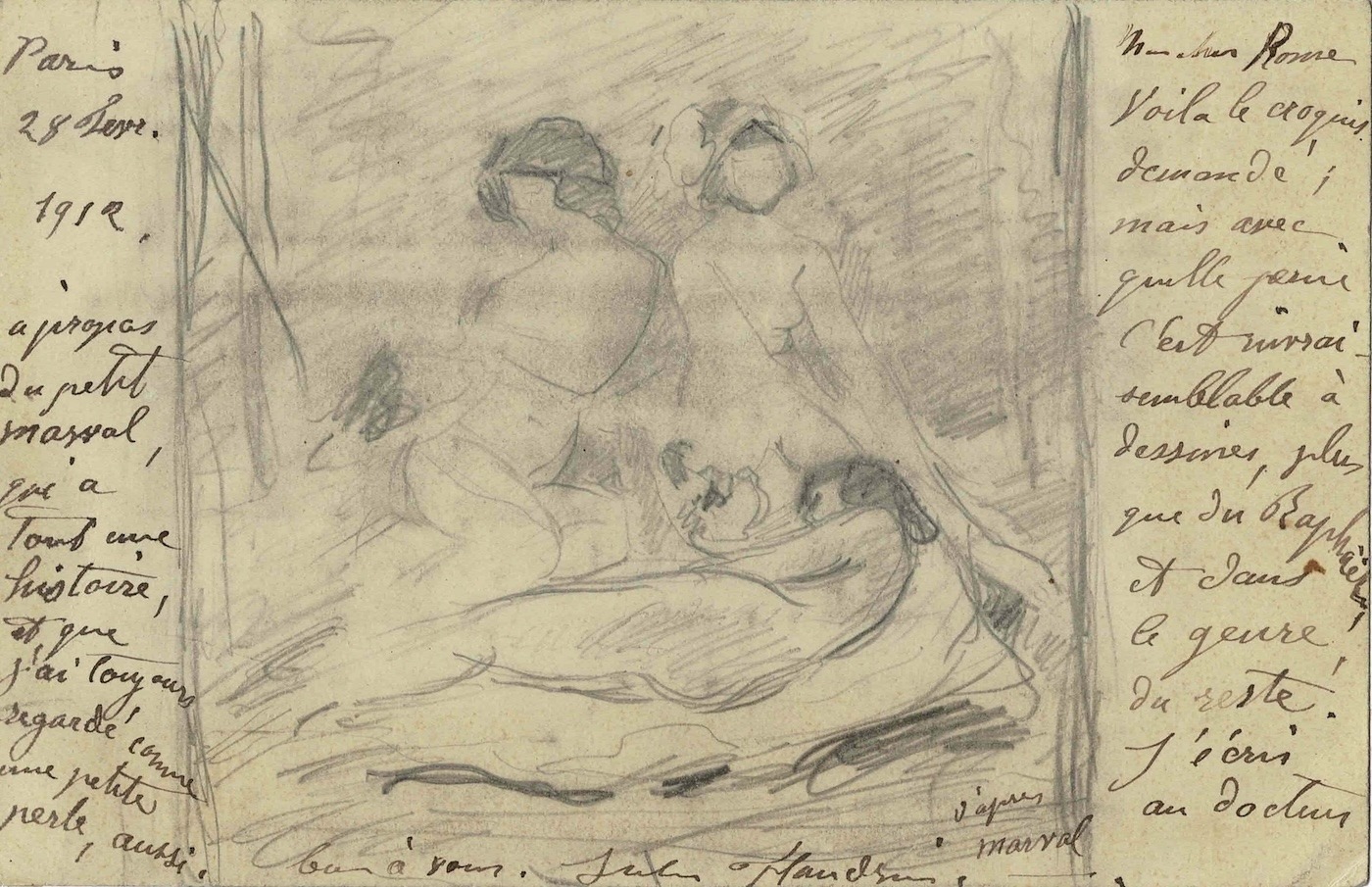
XVI. Paris. February 28, 1912. Magnificent card written in the margin of the pencil sketch of three female nudes after Jacqueline Marval: “My dear Rome, here is the requested sketch ; but with what difficulty. It is unbelievable to draw, more so than Raphael , and in the same style, moreover! Speaking of little Marval, who has quite a story, and whom I have long regarded as a pearl as well. The painting will be packed on its own, in a screw-top crate, with a Louis XVI style frame. ”
XVII. Paris. March 5, 1912. Flandrin sent to Grenoble the painting acquired by Rome at the salon: “The painting left yesterday, March 4. I hope the little sketch has calmed your understandable impatience a little. It continued to arouse envy until closing time…”
XVIII. Paris. May 13, 1912. “My dear Rome, this isn’t a very long letter yet, but at least it’s the answer to your request. The orange dancer, worked on until the very last moment, without really knowing the result, has been included in the Druet lot ; it’s a fairly large canvas (like the 3 roses) which he intends to keep and let develop. He has therefore priced it at 4000 francs . I don’t have a photograph of it at the moment. The trial run having been quite successful, this encourages me to pursue another from the same period, Corner of a Masked Ball, which I will dare to tackle with more confidence. I promise you, if it turns out as I wish, I will show it to you first, without any obligation on your part, of course…”
XIX. Paris. May 27, 1912. “Count on me to choose a fine canvas of the Russians. The one in the exhibition is simply a slightly larger version of the small sketch you saw in Corenc, blue, green, and red. […] I am preparing to begin the large Bouchayer panel. It will be a pleasure to depict the great slopes of the Alps over a 5-meter span ; it will look like a sightseeing trip…”
XX. Paris. August 29, 1912. Flandrin struggles against the agonies of creation: “ … Painting is getting harder and harder! […] What consoles me is that you have to be incredibly stubborn to emerge honorably from a canvas […] I was laughing yesterday when my framer’s boy came to ask when we would be taking the painting to the Salon! I had just lowered my entire chain of the Alps by 10 centimeters over a length of 5 meters. […] Simultaneously, for the past two months, I have been enduring the same torment on a canvas measuring 50 cm , a young Italian woman with a calm face, seated in an armchair […] It seems to me that I am only just learning the painter’s craft and why there is bad painting… more than good.”
XXI. Paris. January 7, 1913. After advising his correspondent on matters of decoration, Flandrin promised him a Maurice Denis and informed him of a Forain exhibition: “Your commission is settled. I will try to find something, like Maurice Denis, who continues to demonstrate his talent. I was thinking of you yesterday, when I saw that a Forain exhibition was opening at the Musée des Arts Décoratifs. Yours would certainly look good there… ”
XXII. Paris. May 14, 1913. “I have decided to thank you for your letter and the two lovely photos of Cézanne. They seem to me to be two lovely studies, rather from what I would call the third period if not the end . The very first is the period based on black and green-black, then the second , the beautiful period rather heavy with impasto, at least in the more developed works; the third is stronger in that it achieves greater harmony and expression with effortless means, as if written on the brush. […] Certainly, all the artist's progress must lead him to express himself strongly and profoundly, everything being constructed in the air. […] A visit to the Champs-Élysées filled me with shame at the thought that I, too, was a painter! …”
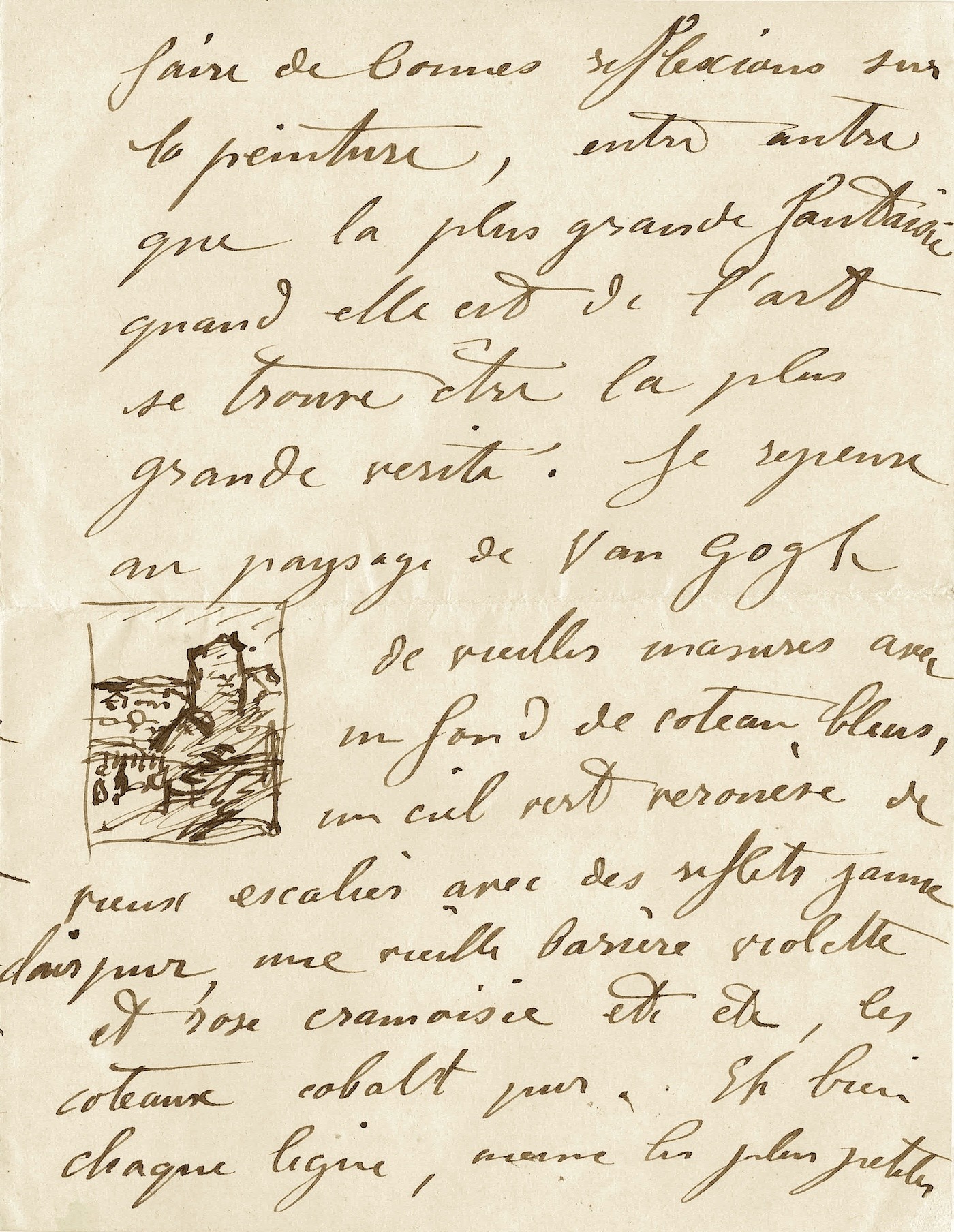
XXIII. Paris. June 28, 1913. Regarding Russian ballet: “You don’t obsess me in the least with your Russian ballet. You can be assured that I will get to work on it shortly, seeking some good reflections on painting to do so, […]. I am thinking again of Van Gogh’s landscape, [Flandrin draws the said Van Gogh painting] of old hovels with a blue hillside background, a Veronese green sky, old staircases with pure light yellow reflections, an old violet and crimson rose fence, etc., etc., the hillsides pure cobalt. Well, every line, even the smallest, every tone, is a miracle of truth, and even Renoir’s colleagues look a bit like pipe juice and a bit like a Bouguereau drawing next to it. Below, there is a Cézanne that is not pipe juice, but a bit like laundry detergent blue; in short, it’s good to be demanding.”
XXIV. Paris. November 1913. Flandrin received by Ambroise Vollard: “ I’m finally rid of my Salon d’Automne canvas, I went all the way to Vollard. He received me with overflowing courtesies ; for a bear, he was a very well-groomed one. […] He’s doing a book on Degas, 96 or 98 drawings that may have passed through his hands […] A quick look in the cellars of the Salon d’Automne, 2 Van Dongen, no, no, not exciting at all.”
XXV. Paris. November 15, 1913. "You are right to remind me of the Vallotton engraving; I will certainly take care of it. [...] We need time until the work to arrange our new workshops is finished ..."
XXVI. Paris. November 20, 191[?]. “…enclosed is your letter from the Bernheims. I can only urge you to accept their offer to display your painting there, as I don't know who else I would offer it to, and it would certainly diminish its value to run around to unknown shops with it under my arm.” Flandrin mentions a Jongkind painting damaged by a framer, then returns to the painting of Rome: “ Let's hope your painting will make a good impression at Bernheim's; it will certainly look good in the window…”
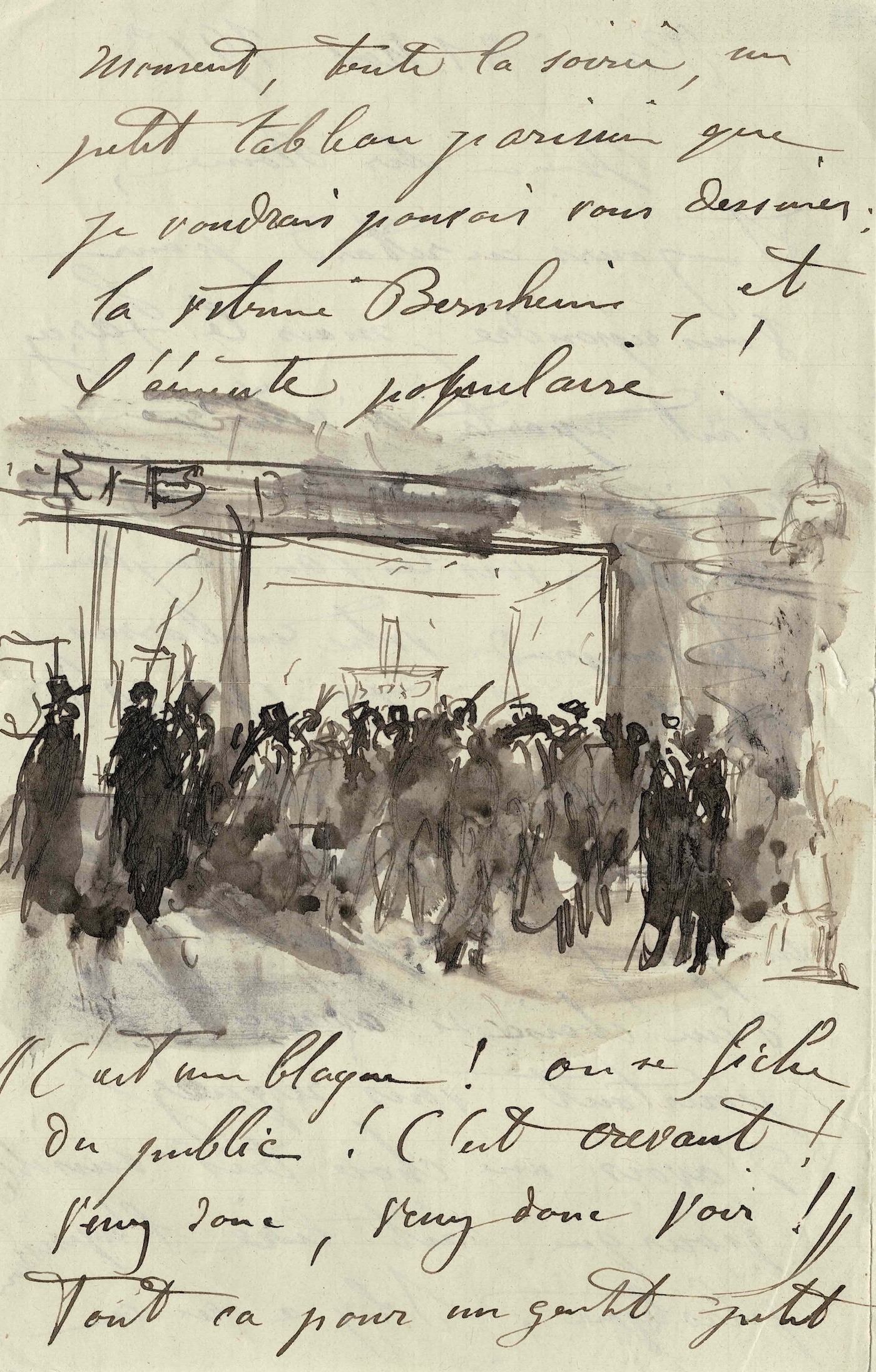
XXVII. Paris. November 21, 1913. Alfred Rome wants to buy a Van Dongen painting from Bernheim. Flandrin sketches the window display and the ensuing commotion at the exhibition: “Always late in replying, but Farcy left so quickly that I couldn't go with him to Bernheim to see the Van Dongens. I understand your predicament. The profession (the art!) of collecting is no sinecure. […] There was this moment, all evening, a little Parisian scene I wish I could draw for you: the Bernheim window display, and the popular commotion! [Flandrin is drawing the gallery here, teeming with visitors, seen from the outside] all this for a nice little Van Dongen , Van Dongen Egyptian painting: a princess-like figure under a parasol held by a smiling attendant, a beautiful white donkey, an opal necklace around her neck […] The Thinker (written on the pedestal), all Van Dongen! Of course, and delightfully impertinent!” And the boulevard, the Boulevard de la Madeleine, doesn't understand that! ..."
XXVIII. Paris. December 19, 1913. “ … I want to arm myself with a great deal of patience, since it replaces genius . If only we only ever did exciting things like this little idol! […] I didn’t dare confront Forain because I heard he’s currently having some trouble with a gentleman who wants him to sign his old portrait. And he’s not going along with it. Rumor has it he wants the painting back …”
XXIX . Paris. January 29, 1914. “…I forgot to send you my best wishes, as I did to Madame Rome. It's as if art absorbs me entirely ! I wish I could! And in peace and quiet, but the world keeps turning! Turning! At least in Paris. And now the Independents are already calling us? Farewell to winter. It will be a spring exhibition, then, at Fenoglio's. […] I will receive the Van Dongen with pleasure. Here, at Rosenberg's, there are some new Lautrecs, but more admirable than ever. At our first meeting, I will discuss our matter with Maurice Denis and keep you informed. Nothing new regarding Vollard's book on Cézanne…”
XXX. Paris. February 5, 1914. “…I believe I mentioned the Matisse painting to you. The dealer was supposed to send it to me for a sketch if it was available. If I have a moment these days, I'll definitely go. I'm told that Blot has some small, old Marquet paintings at very, very good prices. […] The Matisse was from that period, the Arcueil aqueduct, seen from the road, with houses bathed in sunlight. [Flandrin sketches the aforementioned Matisse painting]. I did a pastel of almost that spot with Marquet. Marquet had done a study there; I think it was the following year that he went back there with Matisse . […] The Segonzac exhibition is on at the moment. The public is still hesitant because it's too much for them… ”
XXXI. Paris. February 14, 1914. “… A quick hello, on the run, about the little Matisse. The dealer brought it to me, and I've been putting it through the wringer of hanging it these past few days. [Flandrin draws a scene of hanging where the Matisse painting is surrounded by canvases by Denis, Redon, Calès, and d'Espagnat] It's doing very well , I must say, so I intend to get it a little insurance, a little trip, and if you have a little space and a nail, do as I did. The very nature of Matisse's painting is that it can only be judged with the eyes. You have to look at it like you look at fine weather through the window. […] Out of curiosity, I went to Blot's to ask him the price of his little Marquet paintings (done around the same time). A tiny, very tiny wheat field, wall in shadow, like the Matisse, 1000 francs . It's nothing. It's just to say that 800 francs for the Matisse is a minimum […] And besides, it's history! Michelangelo, Matisse, Marquet, Marval! …”
XXXII. Paris. February 22, 1914. Flandrin has sent the promised Matisse to Rome and describes a sculpture he discovered at the Salon des Indépendants: “… I finally sent the Matisse painting last night with declared value parcels ! […] I only mentioned Marquet to you as a point of comparison, not to persuade you to buy any of his works. I will pass on your offer to Maurice Denis when I see him, and as a courtesy from friend to friend, I hope it will be suitable. The opening of the Salon des Indépendants will be a welcome distraction for a while, and I will eagerly look for new works there. I saw a sculpture there, in any case! […] Michelangelo's flayed figure holding his head , you know, constructed of pipes, scrolls, box bases, etc., of cardboard covered with an extraordinarily rich polychromy! […] There are even piano keys in one spot!! [Flandrin sketches details of the sculpture]…”
XXXIII. Paris. March 16, 1914. The assassination of Gaston Calmette and the Cubist lucubrations: “… I am sending you herewith the receipt for the 800 francs for the Matisse. […] You must have read in the Bernheim bulletin that Coquiot’s book is about to be published. Vollard would do well not to keep us waiting either, with his Cézanne… I was about to continue talking about painting; I hear the patrons of La Closerie des Lilas saying that Madame Caillaux has just shot Calmette [the director of Le Figaro] with a revolver!! That’s Paris for you! What headlines for the newspapers tomorrow morning. […] Art softens manners, because the terrible Cubists are content with punches …”
XXXIV. Paris. April 6, 1914. “…Along with a greeting, a note to advise you not to buy the Gazette des Beaux-Arts; I will have two copies which I will send you with proofs of the different printings…” At the top of the letter are two female busts in the style of Kees Van Dongen: “the best memories of all things Van Dongen .”
XXXV. Paris. July 25, 1914. Flandrin is preparing the illustration for an official banquet menu at the request of Rome: "...I hope to satisfy you because it is a more difficult undertaking than it seems."
XXXVI. Paris. September 15, 1914. The First World War has begun: “…You are right to remind me that I promised you my etching. Naturally, one tends to think as little as possible about things before the war; it's instinctive. However, the turn of events, while we wait for it to become more firmly established, is well suited to allow a moment of respite and a return to peacetime matters. The enemy no longer hides its intentions: destroy France or die… ”
XXXVII. From the Front. February 8, 1916. Flandrin is at the front. Despite the Germans, his thoughts still turn to his painting and to art: “ The most difficult thing, for the moment, about my trip to the front is having gone almost 15 days without any news. Finally, having a temporary address, I was able to start receiving some. So it's my turn to send some. I said a temporary address because in our group from Vaison, half of us were too old to be in the front-line troops. […] It gave us the pleasure of feeling the Germans very close; I just fired at them. […] The weather was fortunately favorable for this approach, which we hadn't counted on. […] I've had news from Paris. […] Mrs. Druet is temporarily continuing her husband's business, certainly with someone to help her.” […] Thanks to Mrs. Marval [his partner Jacqueline Marval] I will still have two canvases at the Triennial exhibition in the Tuileries Gardens , including the large afternoon landscape in the pavilion's meadow that I painted from life two years ago, do you remember? […] Here, the sunlit sketches have been replaced by pencil portraits of friends. If I change garrisons, I will keep my talents hidden; they are easily misused. Please accept, dear friend, and Mrs. Rome, my warmest regards from the front… »
XXXVIII. Paris. June 24, 1918. Flandrin enthusiastically defends the qualities of his partner, Jacqueline Marval, as a painter: “… Mrs. Marval came to spend two days in Paris to finally see her portrait. The impression was good, which is important. The other important thing, above all, is that the exhibition ends and that I can take care of the shipping: she didn't mention the price to you, I believe, which is 4,000 francs. But first, the painting must arrive . […] I would truly fear that a photographic reproduction would not give you the full impression of the work. […] It is truly, in its freshest form, the current self-portrait of Mrs. Marval, and of all that is mysterious in her strength, her genius. Yesterday, we searched her various studios where the efforts, the treasures of 20 years of work, are accumulated. If only I had a museum to bring all this out of the dust.” But I have a good eye. I swiped (with permission), for you, the tiny sunset in the Luxembourg Gardens from my first year of painting […] It's a little gem. Try, as you did with the Chardin, to find it a nice old frame. […] The momentary tranquility of Paris allowed me to get back to work […] Thank you again for choosing the landscape with the bench. I was tempted to take it to Paris, but it didn't make much sense at the moment… »
XXXIX. Paris. July 9, 1918. “…I will see how the painting looks on a small black plate. But rest assured, it shines there just as brightly as it will at home. I went back to see it again yesterday, and like all beautiful things, it seemed even more beautiful to me. […] I am finishing two large decorative panels for aviation! …”
XL. Paris. July 16, 1918. Painting, always, despite the war: “I am sending you, as luggage from a friend going to Grenoble, the crate containing the model for a decoration you are expecting. […] The original is like a superb jewel, pearl, opal, amethyst, set in lapis and turquoise […] You can imagine how interested I am in following the offensive. It's happening right in my dugouts after two years at the front…”
XLI. Paris. November 12, 1918. The day after the armistice, Flandrin rejoiced in the French victory and described the joy in the streets of Paris: “…To the whirlwind of work was added that of events, with a cataclysmic pace. Thrones crumble, and there is victory, such as one dared not dream of. Paris yesterday was unheard of, jubilation unleashed, Parisians in a frenzy, by the thousands, invaded the boulevards, cannons dragged through the crowd […] Two beautiful golden crowns on the brows of Metz and Strasbourg, like a note that only such deliverance allows. Today in the newspapers, the conditions, and the unforgettable words of Clemenceau. I am returning to the boulevards this afternoon…”
XLII. Paris. August 24, 1922. "Thank you for your kind note for Paul Léon. I hope my exhibition at the Salon d'Automne will reassure him about a possible commission. [...] I'm working hard here for the Salon d'Automne..."
XLIII. Paris. November 4, 1922. "This short note, with my best regards to all of you, is to inform you of a small commission. I had a visit from a Polish man (I believe it was Mercereau the writer) with a small painting of the early Ballets Russes, which he would like to sell for 600 francs. I'd like to make some minor touch-ups to it, and then it would be quite finished. Could you let me know by mail if this would suit you? The price is tempting. [...] The autumn salon may have better weather than at the beginning. Very fine portrait, Marval, no. 1. I believe I've had some success as a landscape painter ! ..."
__________________________________________________________
Jules Flandrin entered Gustave Moreau's studio in 1895, becoming a fellow student of Matisse, Marquet, Camoin and Rouault.
A painter of landscapes, intimate scenes, and still lifes, his free expression allowed him to approach different genres with ease. He was influenced by the richness and variety of modern painting movements: from the Post-Impressionists to the Nabis (his friends Maurice Denis, Bonnard, and Sérusier), and then to Fauvism with his friend Matisse. In Paris, his favorite subjects were the lively spectacle of the streets and the banks of the Seine, which he treated in a style quite similar to that of his friend Marquet.
As Jacqueline Marval's companion, he instilled in her a love of painting. He was thus responsible for introducing many artists to Pierre-André Farcy (known as Andry-Farcy), who, having become curator of the Grenoble museum in 1919, would tirelessly strive to bring modern art into the institution, making it a jewel of national culture.
As early as 1897, Jules Léon Flandrin's paintings were accepted at the Salon du Champs de Mars, and in 1898 he became one of the youngest members of the Société Nationale des Beaux-Arts. He discovered the Ballets Russes upon their arrival in Paris in 1909 with Nijinsky, Pavlova, and Karsavina.
He participated in several international exhibitions: in 1910 in London (Stafford Gallery with the Neo-Impressionists), in 1913 in Interlaken, Berlin and Munich.
Appointed a member of the Salon d'Automne in 1911, he executed various commissions for the State.