Eugène SUE (1804.1857)
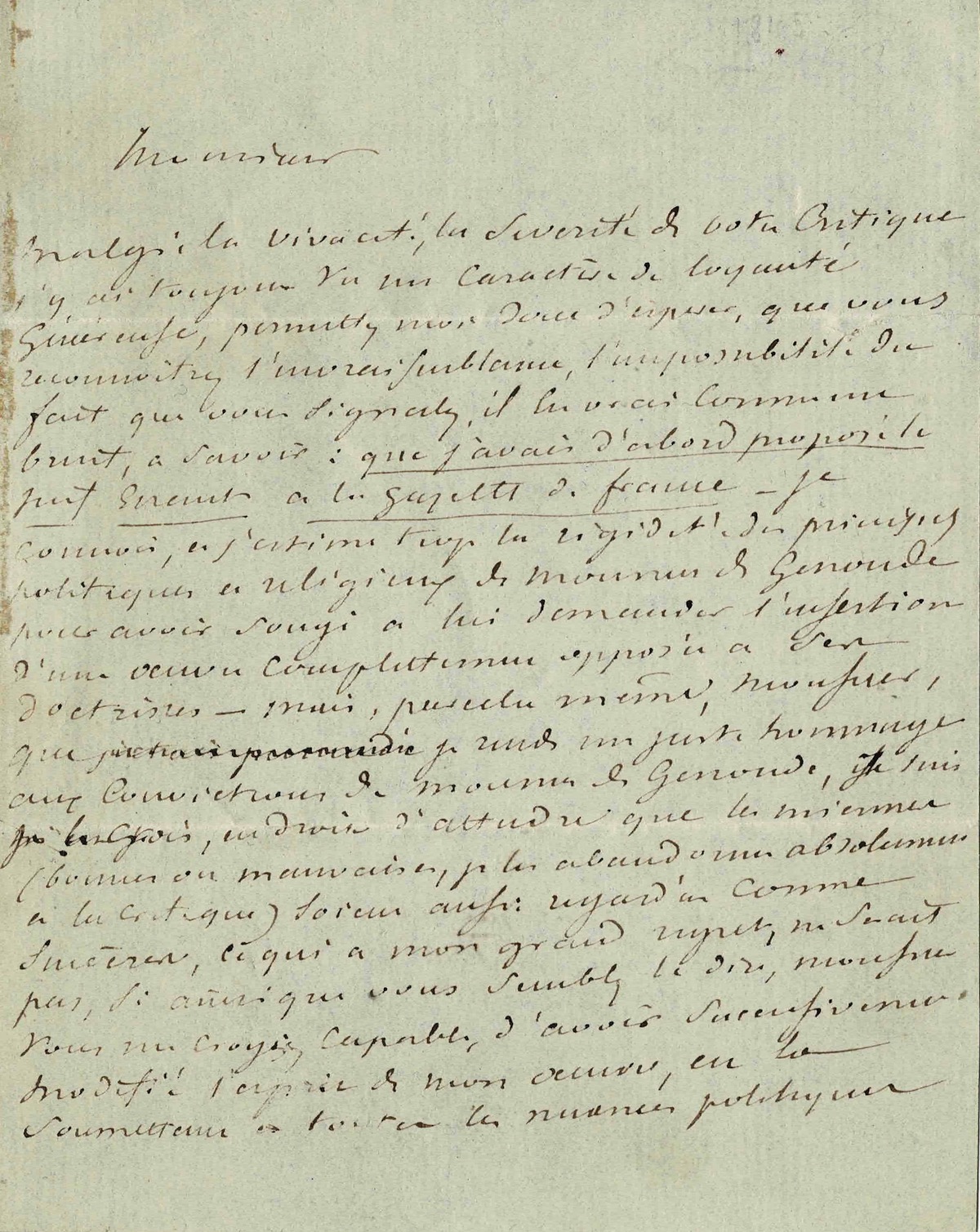
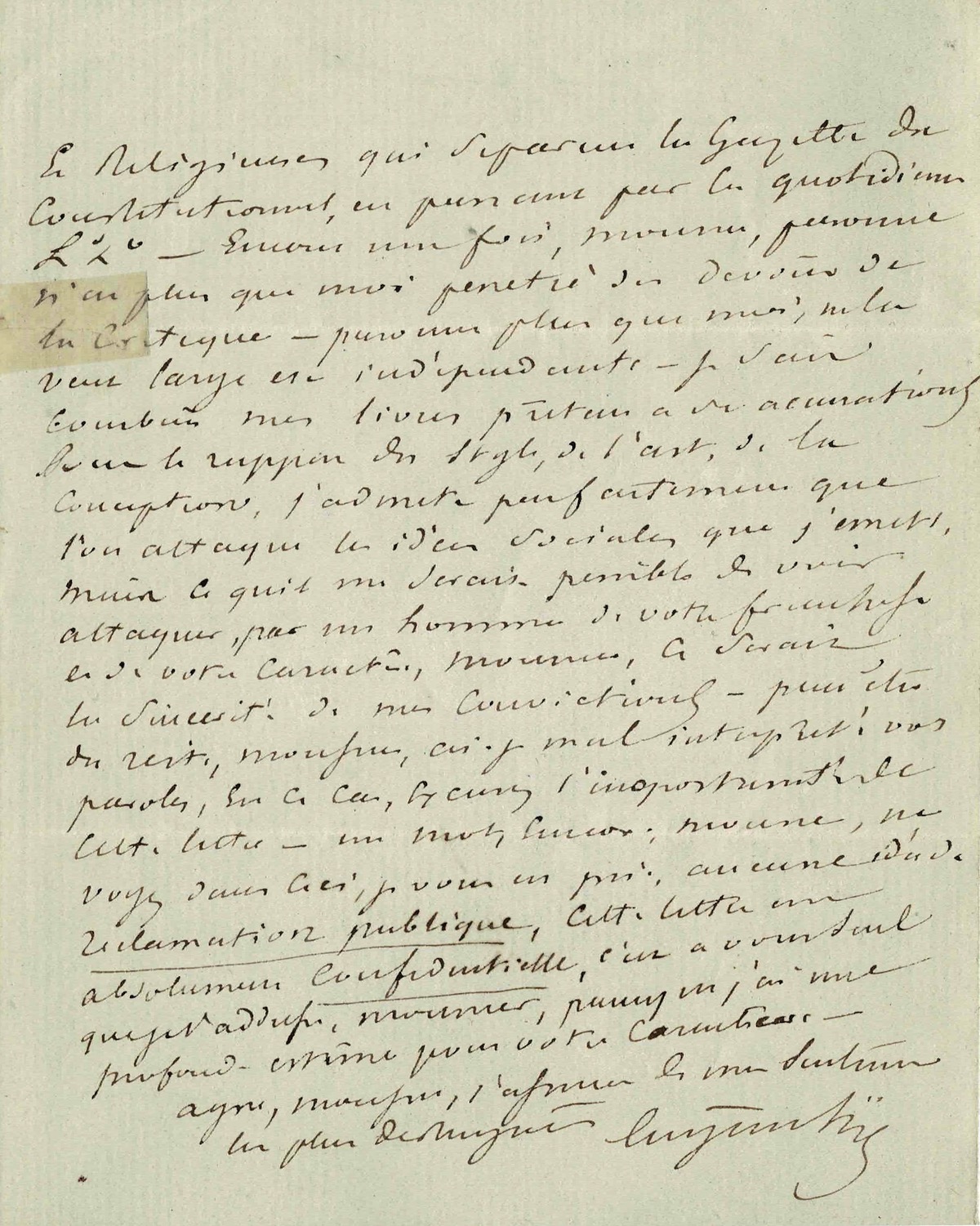
Autographed letter signed to the critic Alfred Nettement.
Two very dense 12mo pages.
Trace of adhesive on the back.
No place or date [November 8, 1844]
"I know how much my books lend themselves to accusations regarding style, art, and conception; I fully admit that the social ideas I express are attacked, but what I would find most painful to see attacked, by a man of your frankness and character, sir, is the sincerity of my convictions."
A very fine letter from the novelist about The Wandering Jew . Eugène Sue protests to Nettement against the improbable rumor that he had offered his novel to the Gazette de France, a royalist newspaper directed by Abbé Genoude.
_______________________________________________________________
"Despite the liveliness and severity of your criticism, I have always seen in it a character of generous loyalty, so allow me to hope that you will recognize the implausibility, the impossibility of the fact that you point out, it is true as a rumor, namely: that I had first proposed The Wandering Jew to the Gazette de France . I know and respect too much the rigidity of Mr. de Genoude's political and religious principles to have thought of asking him to include a work completely opposed to his doctrines – but, by that very fact, sir, I pay just homage to Mr. de Genoude's convictions, I believe I am entitled to expect that my own (good or bad, I leave them entirely to criticism) will also be regarded as sincere, which, to my great regret, would not be the case if, as you seem to say, sir, you believed me capable of having successively modified the spirit of my work, by subjecting it to all the political and religious nuances that separate the Gazette from the Constitutionnel, passing through the Quotidienne, etc. Once again, sir, no one is more deeply imbued than I with the duties of criticism – no one more than I desire it to be broad and independent – I know how much my books lend themselves to accusations regarding style, art, and conception; I fully accept that the social ideas I express are attacked, but what I would find painful to see attacked by a man of your frankness and character, sir, is the sincerity of my convictions – perhaps, moreover, sir, I have misinterpreted your words; in that case, excuse the importunity of this letter – one more word: please do not see in this any idea of a public complaint ; this letter is absolutely confidential ; it is addressed to you alone, sir, since I have a profound esteem for your character. Accept, sir, the assurance of my most distinguished sentiments.
_______________________________________________________________
Eugène Sue responded to Alfred Nettement's article published in La Gazette de France on November 8, 1844. In this article, the first in a series of ten devoted to The Wandering Jew, Nettement wrote: " I must tell you this little story that Mr. Sue's friends are beginning to circulate in salons to excuse the spirit of his book. According to them, the author first proposed his subject to La Gazette de France, promising, of course, to give his novel a social, moral, and religious slant. Upon the Gazette's refusal, which supposedly failed to grasp the inestimable value of the gift Mr. Sue wished to offer, he then turned to La Quotidienne, which was no better advised." So, he would have made offers to the newspaper Les Débats, but he wouldn't have been any happier, supposedly because Les Débats feared the unkind jokes that the name "Jew" might inspire in the bad press, and the incongruous comparisons that, thanks to M. de Cormenin , would be drawn between the unfortunate intendant of the civil list and the Jew, the epitome of avarice and the passion for gold. It was only in desperation, and for lack of finding elsewhere men of sufficient taste to offer one hundred thousand francs for *The Wandering Jew* , that M. Sue resigned himself, as a last resort, to asking the *Constitutionnel* for a home for his perpetual traveler. What could be done? M. Véron was the only one who had the sense to put a price on this treasure, so it was necessary to write *The Wandering Jew* in the spirit of the *Constitutionnel*, and make him an avowed supporter of M. Thiers and M. Cousin . "That's the story, I'm giving it to you for what it's worth. " Clearly added in a footnote: " Is it necessary to say that we place no faith in this little tale, which we attribute to the unofficial imagination of those who wanted to mitigate the wrongs of the author of The Wandering Jew ? "
Bibliography:
Alfred Nettement. Edmond Biré. Lecoffre, 1901. Pages 319-321.
General Correspondence of Eugène Sue. Volume II. JP Galvan. Ed. H. Champion.