Émile ZOLA (1840.1902)
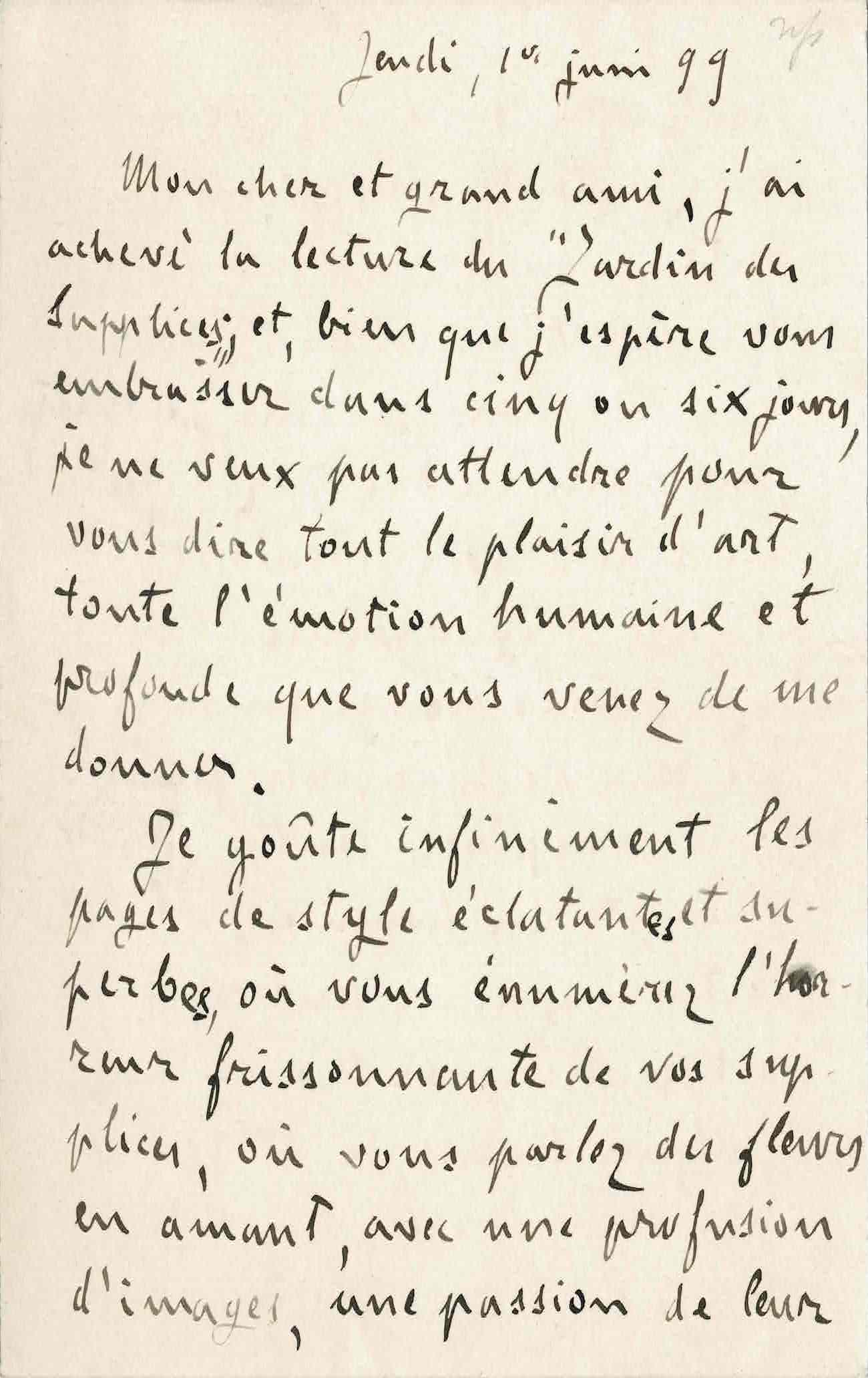
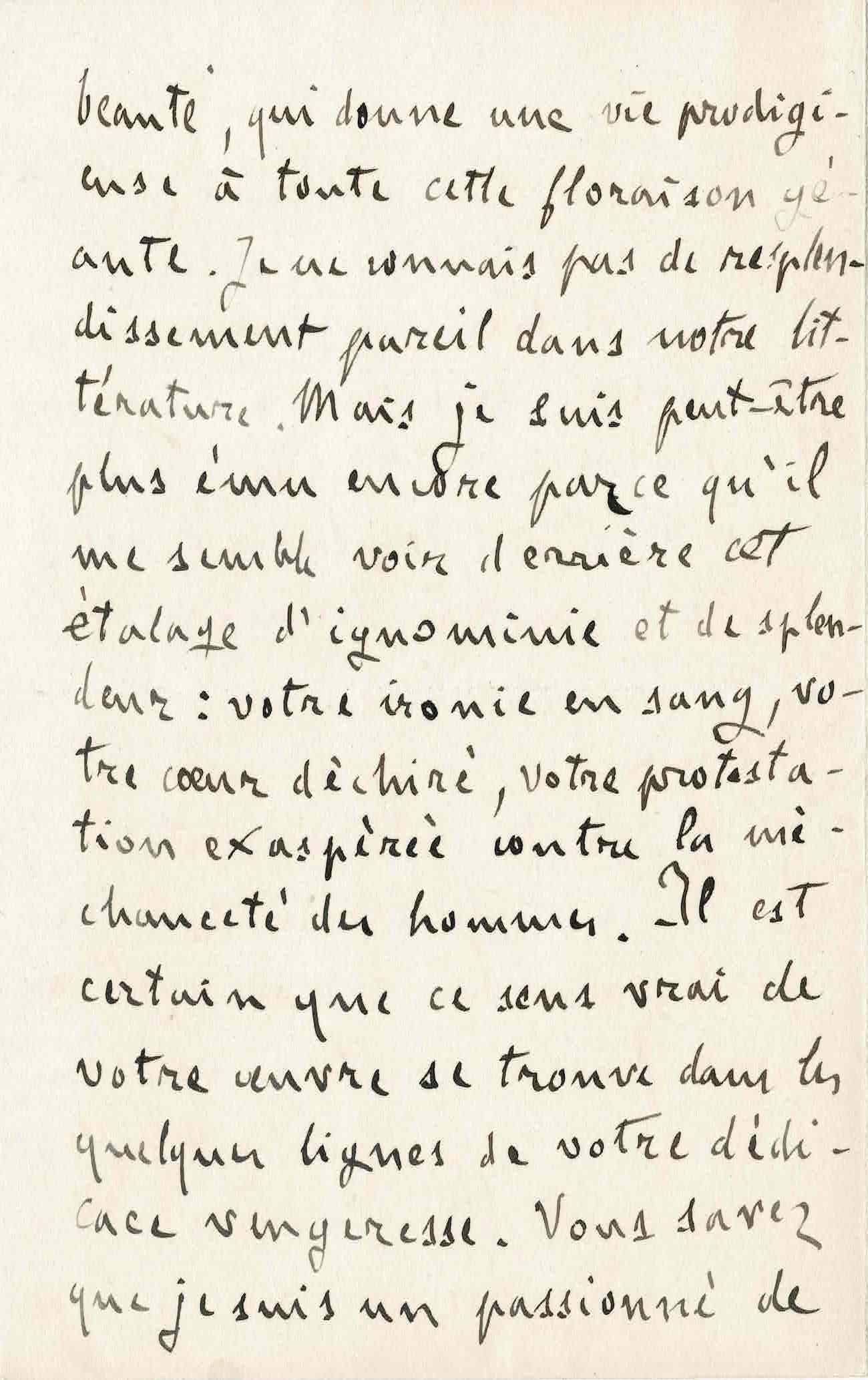
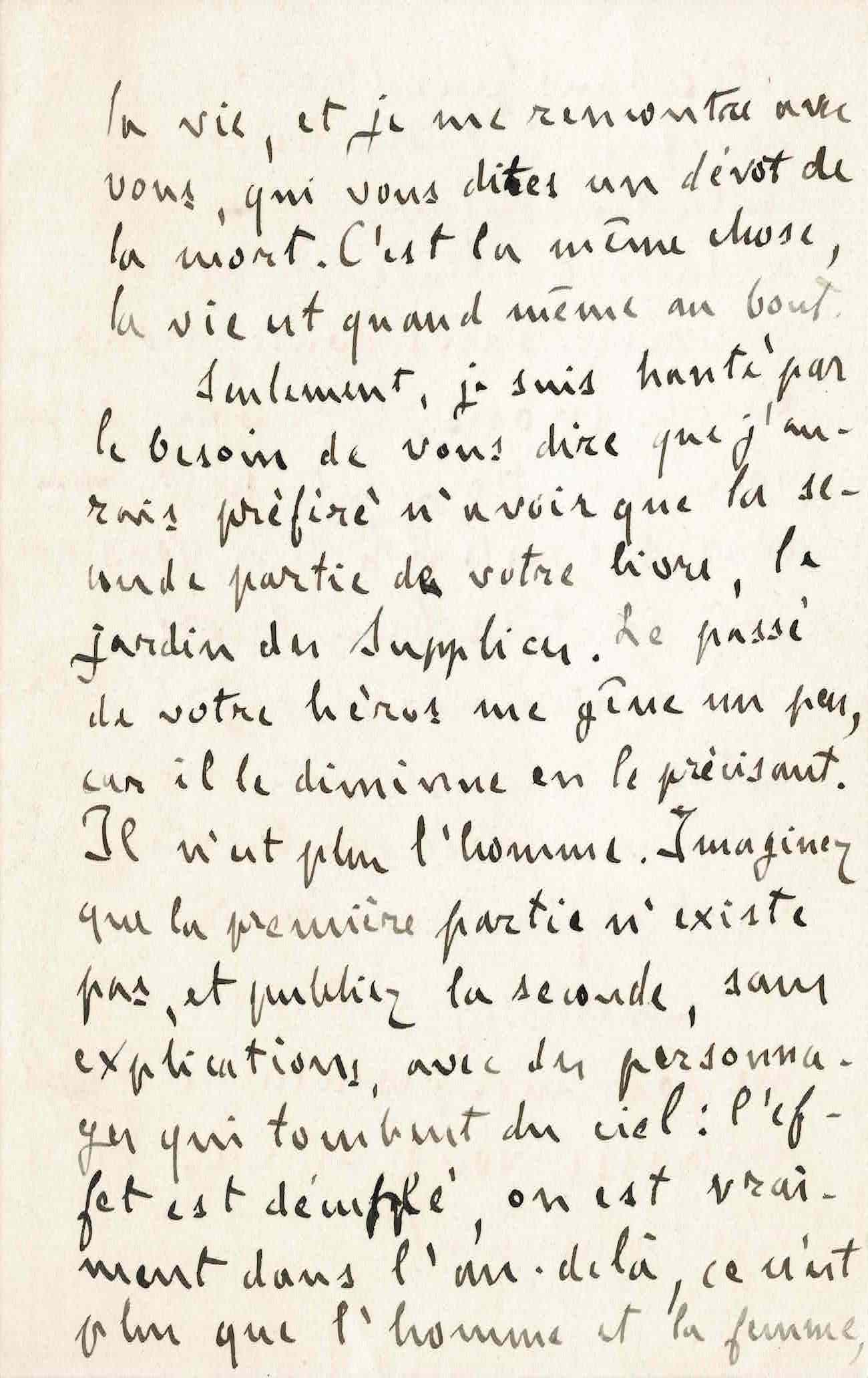
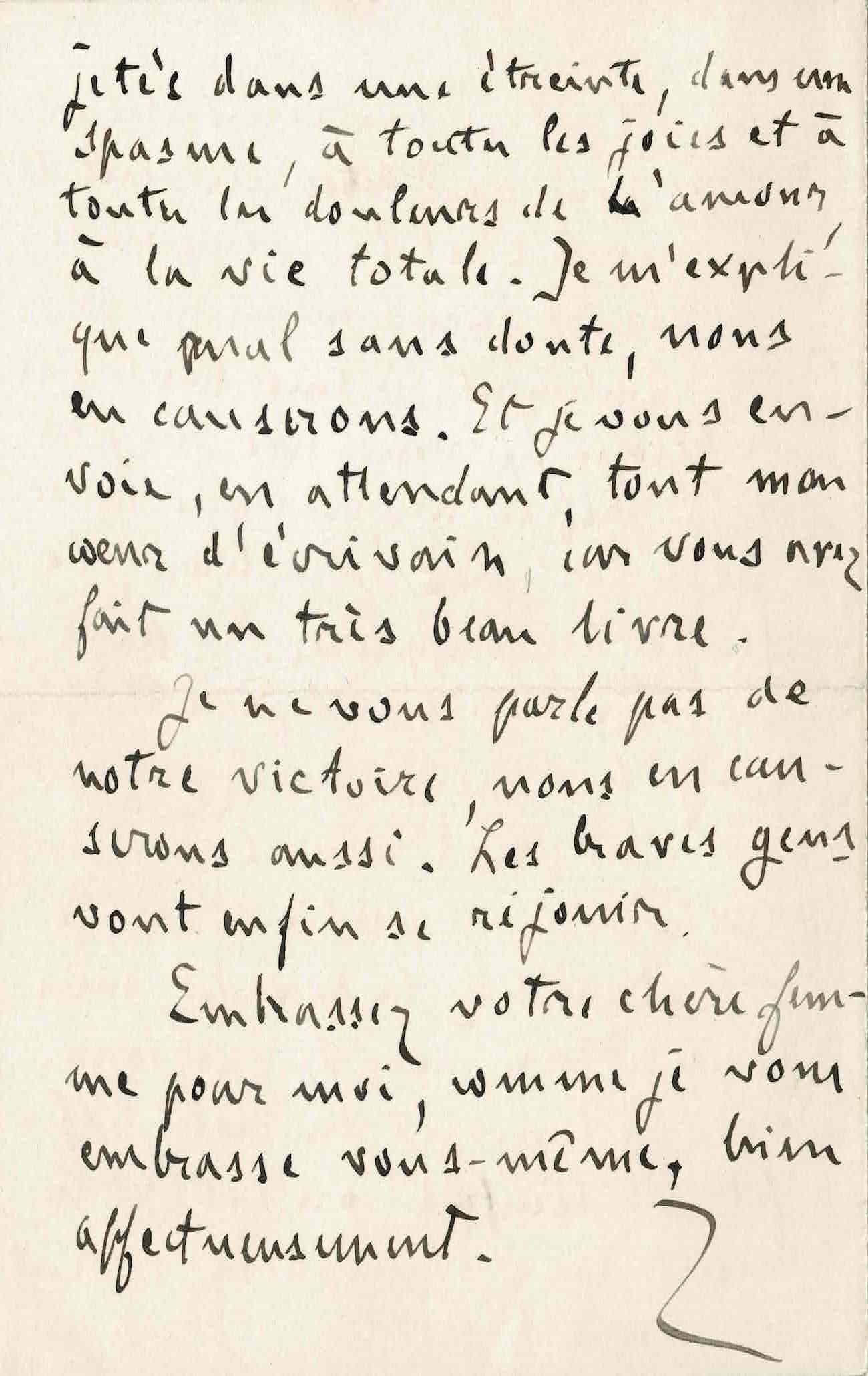
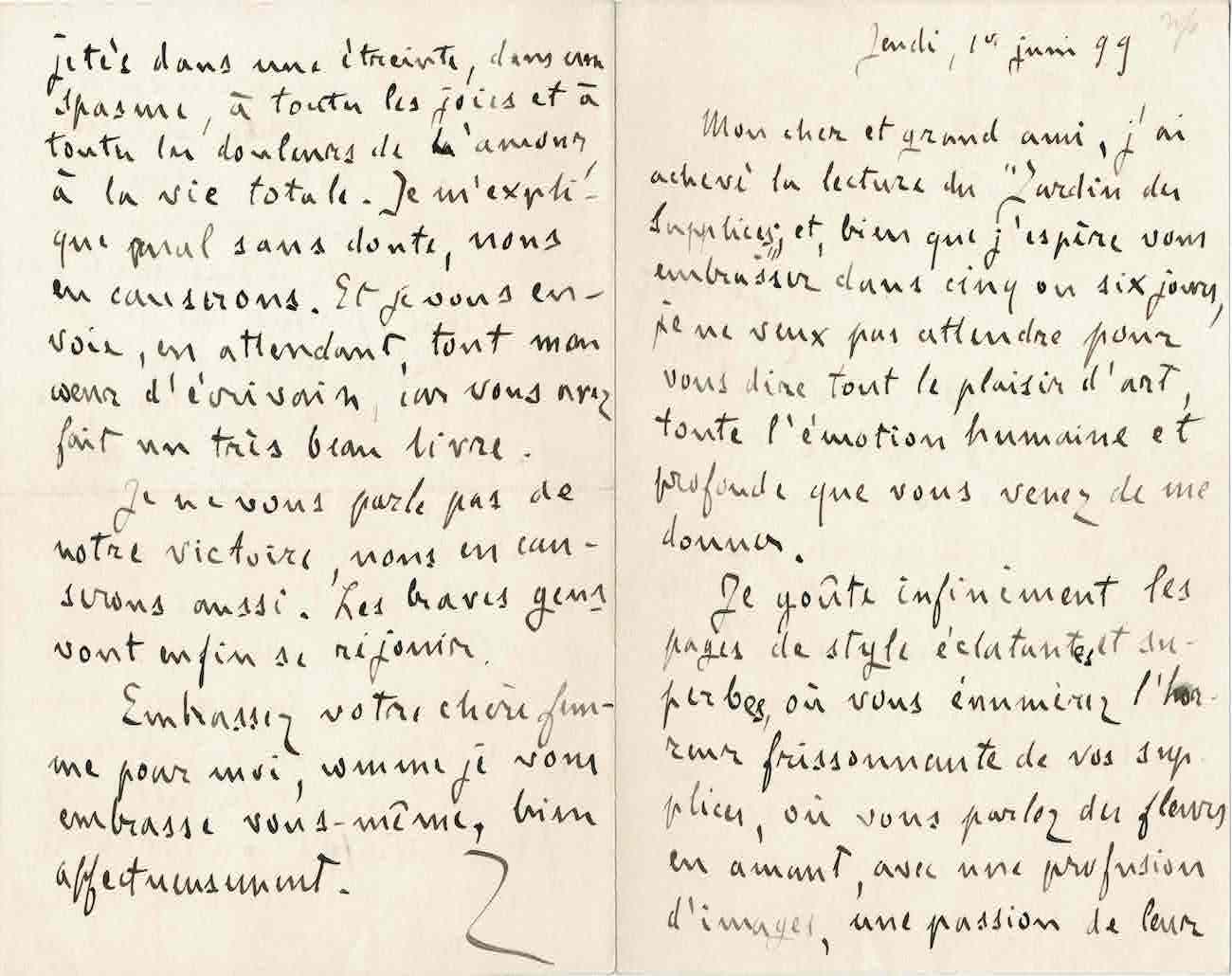
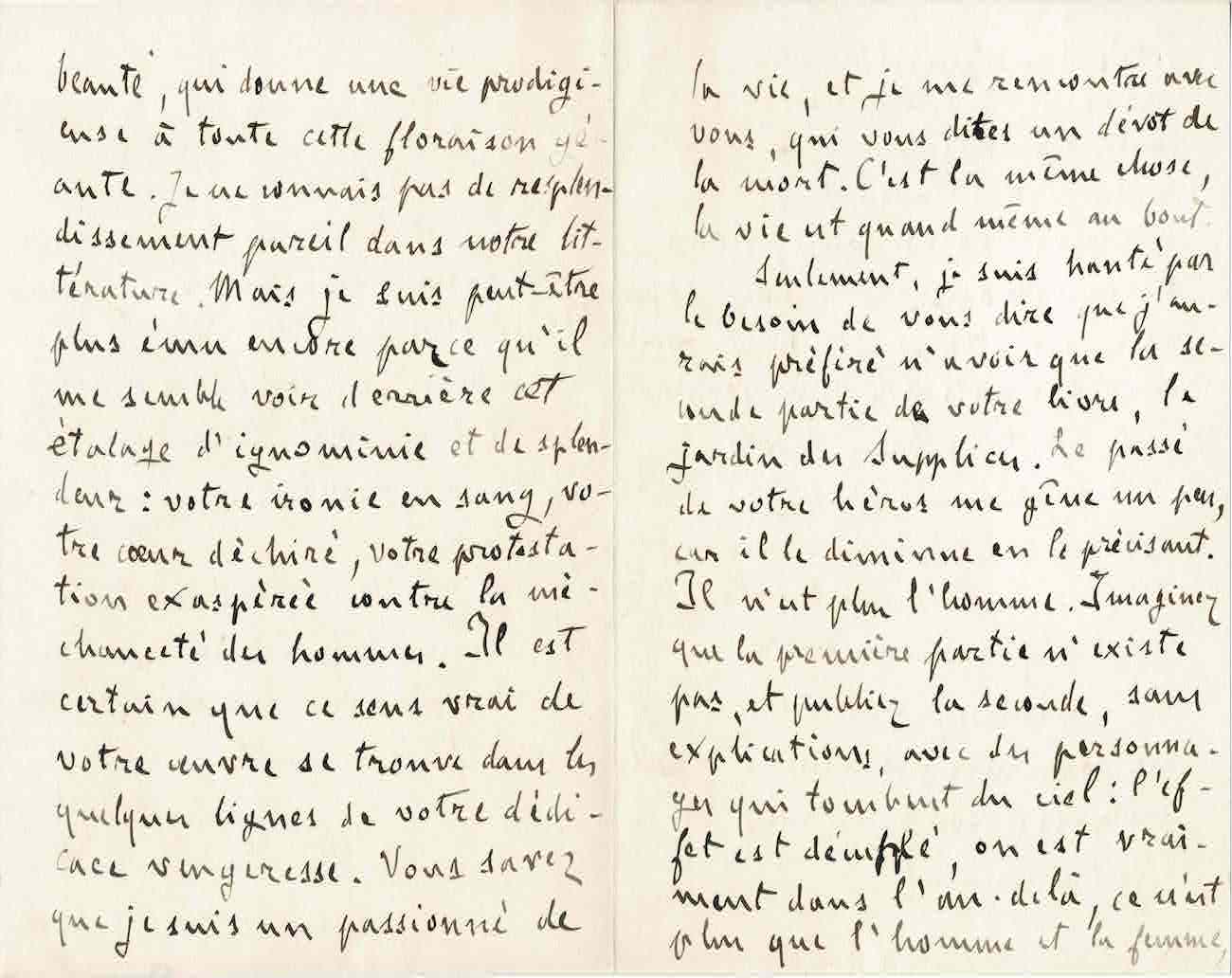
Autograph letter signed " Z " to Octave Mirbeau
Four octavo pages. [London]. June 1, 1899
"I'm not talking about our victory (...) The good people will finally rejoice."
Superb letter from Zola, on the eve of his return from exile, congratulating his friend on his work The Garden of Tortures and referring to the decision of the judges of the Court of Cassation in the Dreyfus Affair.
“My dear and great friend, I have finished reading ‘The Garden of Tortures,’ and although I hope to embrace you in five or six days, I do not wish to wait to tell you of all the artistic pleasure, all the profound human emotion you have just given me. I am infinitely savoring the pages of brilliant and superb style, where you enumerate the chilling horror of your tortures, where you speak of flowers as a lover, with a profusion of imagery, a passion for their beauty, which gives a prodigious life to all this gigantic blooming. I know of no such resplendentity in our literature. But I am perhaps even more moved by what I seem to see behind this display of ignominy and splendor: your bloody irony, your torn heart, your exasperated protest against the wickedness of men. It is certain that this true meaning of your work is found in the few lines of your vengeful dedication.” You know I'm passionate about life , and yet I find myself in agreement with you, who call yourself a devotee of death. It's the same thing; life is still there at the end. However, I'm haunted by the need to tell you that I would have preferred to have only the second part of your book, *The Garden of Tortures*. Your hero's past bothers me somewhat, because it diminishes him by defining it. He is no longer the man. Imagine that the first part doesn't exist, and publish the second, without explanation, with characters who fall from the sky: the effect is tenfold; we are truly in the afterlife, it's nothing but the man and the woman, thrown into an embrace, into a spasm, into all the joys and all the sorrows of love, into life in its entirety. I'm probably not explaining myself well; we'll talk about it. And in the meantime, I send you all my heart as a writer, because you have written a very beautiful book. I won't speak of our victory yet; we'll talk about that too. The good people will finally rejoice. Give your dear wife a kiss for me, as I send you my warmest regards. Z.
Octave Mirbeau published his novel Le Jardin des supplices chez charpentier Fasquelle in June 1899. A novel " of murder and blood " in the very words of its author, dedicated " To the Priests, to the Soldiers, to the Judges, to the Men, who educate, direct, govern men, these pages of Murder and Blood ", the work aroused numerous reactions by the violence of its images and the power of its exoticism.
Sued for libel following the publication of his " J'accuse ," Zola was sentenced in the summer of 1898 to one year in prison and a fine of 3,000 francs, the maximum penalty. Despite appealing to the Court of Cassation, and on the advice of his lawyer Labori, Zola, having been convicted, immediately left France for exile in England before the verdict could be officially served and become enforceable. On July 18, 1898, Zola, alone, took the 9:00 p.m. train to Calais, without any luggage. Reclusive in London, he remained attentive to the progress of the proceedings until his return to France on June 4, 1899.
The relationship between Mirbeau and Zola oscillated for a quarter of a century between contempt and veneration. It was the Dreyfus Affair that definitively reconciled the two men. United and driven by their hatred of injustice, they championed the innocent man.
When the struggle intensified and Zola's life was threatened, Mirbeau resolutely stood by his "dear man." To this end, he wrote letters, petitioned, acted as Zola's bodyguard when he had to appear in court amidst the hostile shouts of the anti-Dreyfusards, and even went so far as to support him financially. As early as August 8th, to prevent the seizure of Zola's property, Mirbeau went to Versailles to pay, out of his own pocket, the 7,525 francs Zola had been ordered to pay to the tax collector of Seine-et-Oise. In early 1899, he also traveled to England to offer moral support to the exiled Zola, all the while continuing to care for his wife, Alexandrine, back in France.
Zola's death on September 29, 1902, did not end this friendship. Beyond death, Mirbeau continued to pay tribute to the author of J'accuse : he established, within a committee, the pilgrimage to Médan.