Émile Durkheim (1858.1917)
A set of four autograph letters signed to Charles Victor Langlois.
Eleven octavo pages in total
Paris. No dates.
"I must confess, I'm eager to be certain that no one is listening to me under duress."
A very interesting correspondence from Durkheim to his colleague, testifying to the sociologist's fierce commitment to defending the excellence of teaching at the Sorbonne.
_____________________________________________
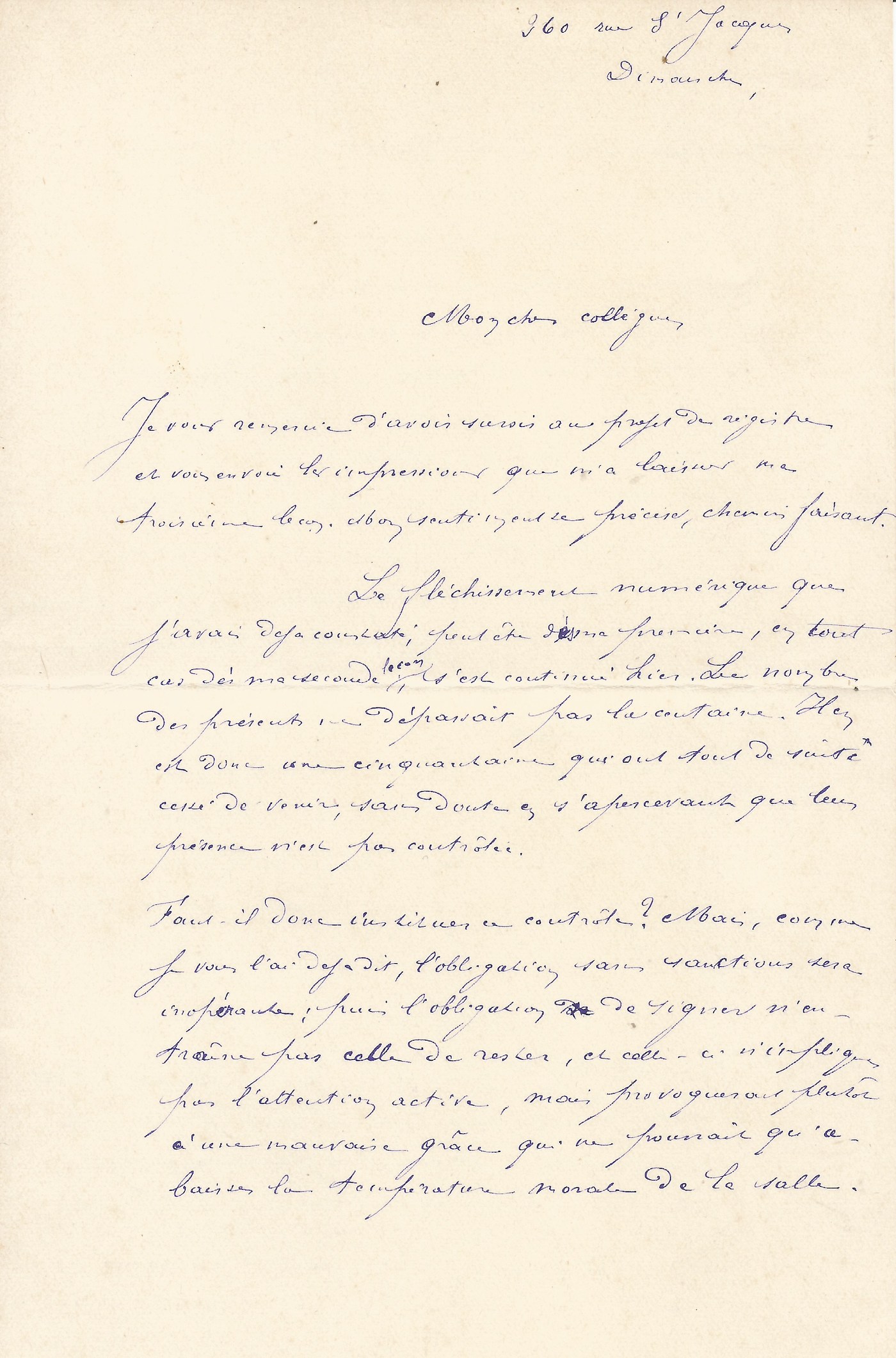
Letter I. 260 rue St Jacques. Sunday. Undated.
“My dear colleague, I thank you for postponing the register project and send you my impressions of my third lesson. My feelings are becoming clearer as I go along. The drop in attendance that I had already noticed, perhaps from my first lesson, but certainly from my second, continued yesterday. The number of attendees did not exceed one hundred. Around fifty of them immediately stopped coming, no doubt upon realizing that their attendance was not being monitored. Should we then institute a system of monitoring? But, as I have already told you, an obligation without a penalty will be ineffective; moreover, the obligation to sign does not entail the obligation to remain, and this obligation does not imply active attention, but would rather provoke a reluctance that could only lower the morale of the room.”
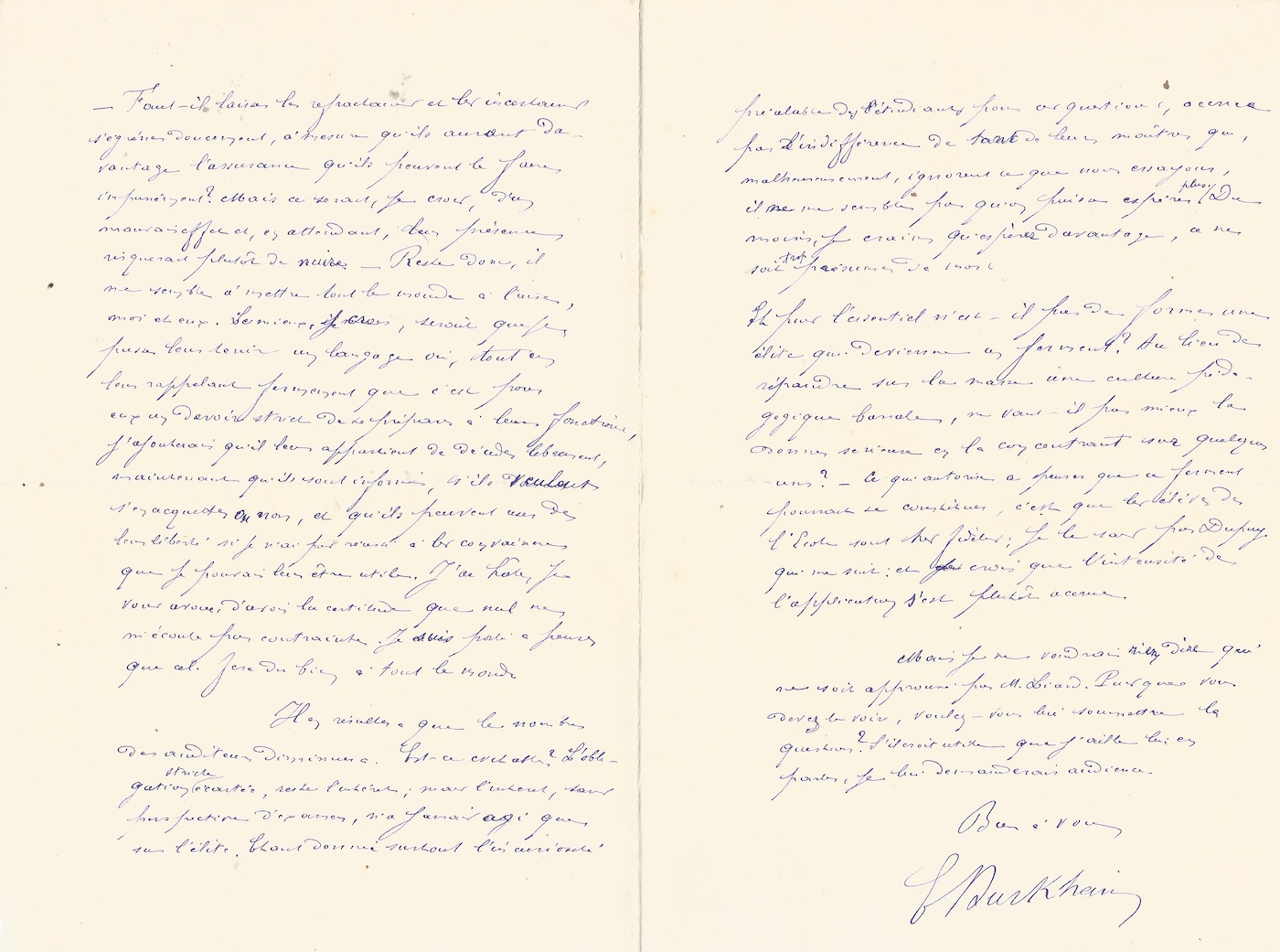
Should we let the reluctant and the uncertain gradually dwindle away, as they become more confident that they can act with impunity? But that would, I believe, have a negative effect, and in the meantime, their presence might detrimental . It seems to me, then, that we must put everyone at ease, myself and them. The best approach, I think, would be to speak to them in a way that, while firmly reminding them that it is their strict duty to prepare for their role, I would add that it is up to them to decide freely, now that they are informed, whether they wish to fulfill it or not, and that they can exercise their freedom if I have not succeeded in convincing them that I could be of service to them. I confess, I am eager to be certain that no one is listening to me under duress. I am inclined to think that this will be beneficial to everyone.
The result will be a decrease in the number of students. With strict obligation removed, what remains is self-interest; but self-interest, without the prospect of examination, has only ever affected the elite. Given, above all, the students' initial lack of curiosity about these matters, exacerbated by the indifference of so many of their teachers who, unfortunately, are unaware of what we are attempting, it seems to me that we can hope for nothing more. At least, I fear that to hope for more would be to presume too much on myself.
Furthermore, isn't the essential point to cultivate an elite that will become a catalyst? Instead of disseminating a banal pedagogical culture to the masses, wouldn't it be better to impart a serious culture by concentrating it on a select few? The reason we can believe this catalyst could be formed is that the elites of the School are very loyal. I know this from Dupuy, who follows me, and I believe that the intensity of their application has actually increased. But I wouldn't want to say anything that isn't approved by Mr. Liard. Since you are going to see him, would you be willing to put the question to him? If he thinks it useful for me to speak with him, I will request an audience.
Letter II. 260 rue St Jacques. Sunday. Undated.
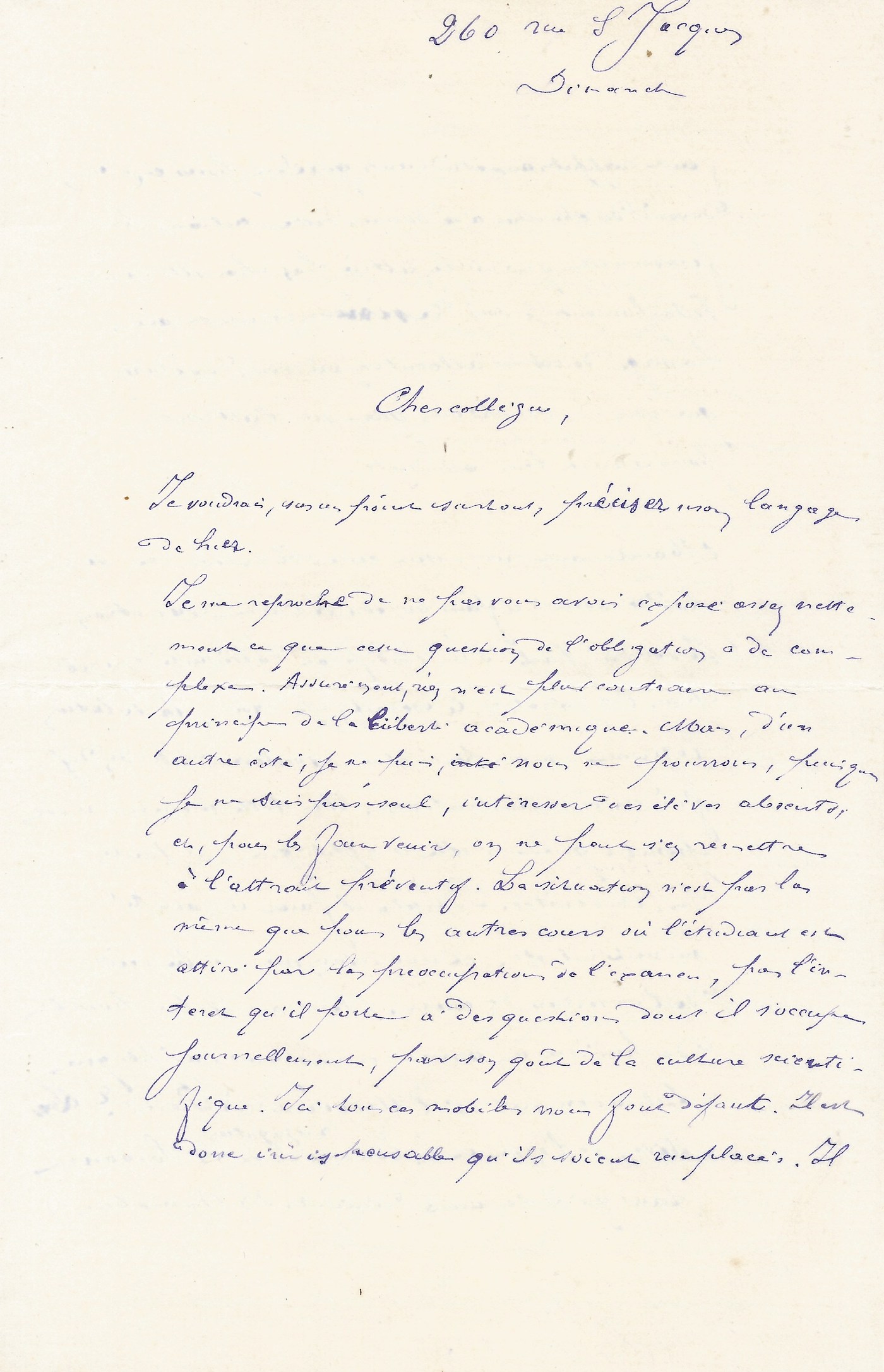
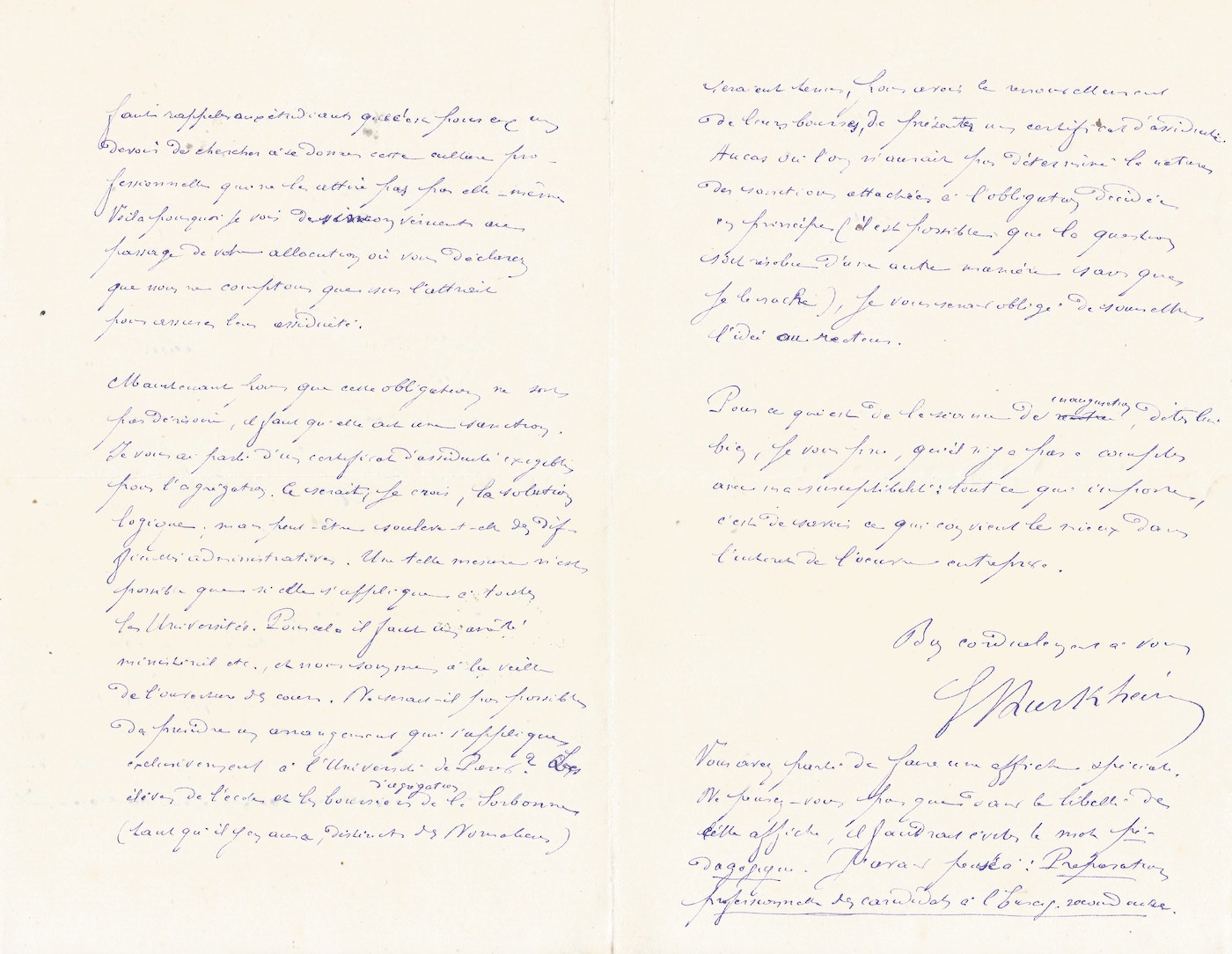
“Dear colleague, I would like to clarify one point in particular. I regret not having explained clearly enough the complexity of this issue of mandatory attendance. Certainly, nothing could be more contrary to the principle of academic freedom. But, on the other hand, I cannot, we cannot, since I am not alone, engage absent students, and for the coming days, we cannot rely on preventative measures. The situation is not the same as for other courses where students are drawn by exam concerns, by their interest in issues they deal with daily, by their taste for scientific culture. Here, we lack all these motivations. It is therefore essential that they be replaced. Students must be reminded that it is their duty to strive to acquire this professional knowledge, which does not inherently appeal to them.” That is why I see drawbacks in the part of your speech where you state that we rely solely on attraction to ensure their attendance.
Now, to ensure this obligation isn't insignificant, it needs to be enforced. I mentioned a certificate of attendance required for the agrégation exam. This would be, I believe, the logical solution; but it might raise administrative difficulties. Such a measure is only possible if it applies to all universities. This would require a ministerial decree, etc., and we are on the eve of the start of classes. Wouldn't it be possible to make an arrangement that applies exclusively to the University of Paris? Students at the École Normale Supérieure and Sorbonne agrégation scholarship recipients (as long as they exist, separate from the students at the École Normale Supérieure) would be required, in order to renew their scholarships, to present a certificate of attendance. In the event that the nature of the sanctions attached to the obligation decided in principle has not been determined (it is possible that the question may be resolved in another way without my knowledge), I would be obliged to submit the idea to the rector.
Regarding the opening ceremony, please tell him that there's no need to compromise with my sensitivities; all that matters is knowing what is best for the sake of the project. Yours sincerely, E. Durkheim. "pedagogical should be avoided in the wording of this poster ? I was thinking of: " Professional Preparation of Candidates for Secondary Education ."
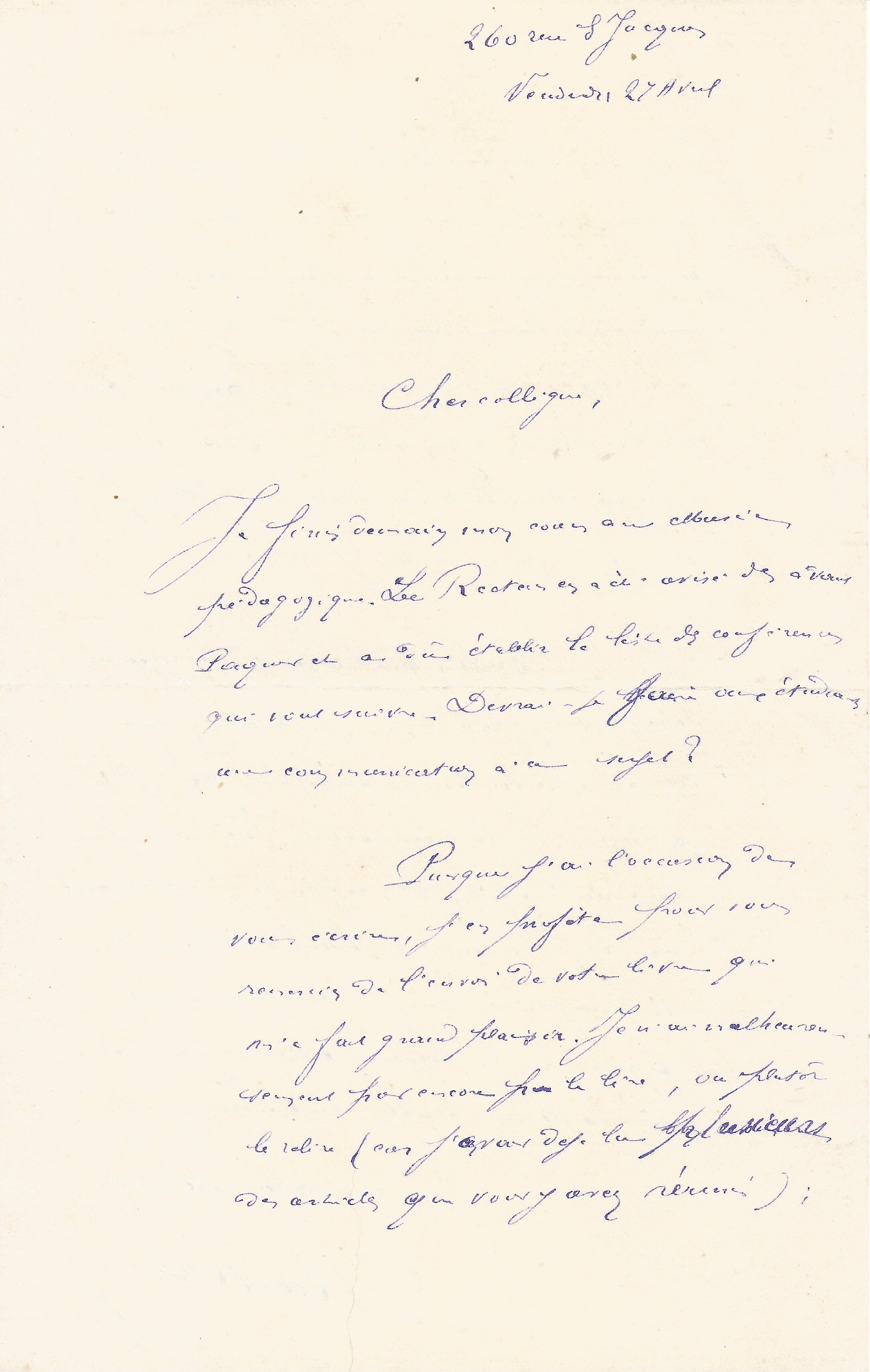
Letter III. 260 rue St Jacques. Friday, April 27. Undated.
"My dear colleague, I finish my course at the educational museum tomorrow. The rector was informed before Easter and must have drawn up the list of lectures that will follow. Should I give a presentation to the students on this subject? Since I have the opportunity to write to you, I would like to take this opportunity to thank you for sending me your book, which I greatly enjoyed. Unfortunately, I haven't yet had the chance to read it, or rather reread it, having already read about it in several of the articles you've compiled there."
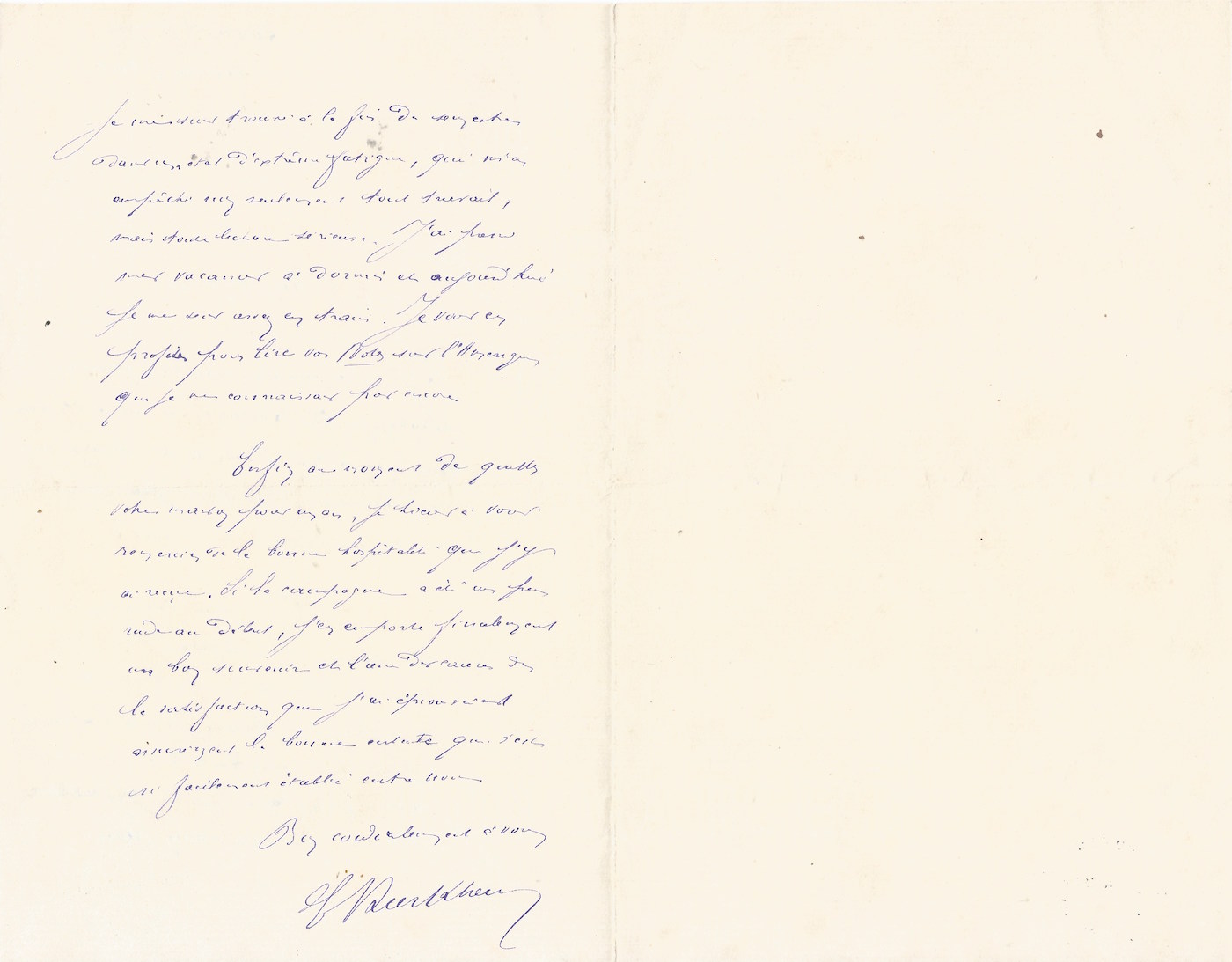
I found myself […] in a state of extreme fatigue, which prevented me not only from doing any work, but also from doing any serious reading. I spent my vacation sleeping, and today I feel quite well. I will take advantage of this time to read your notes on [?] which I was not yet familiar with […]. I wish to thank you for the warm hospitality I received there. While the campaign was a little rough at the beginning, I ultimately have fond memories of it, and one of the reasons for my satisfaction was sincerely the excellent understanding that was so easily established between us.
Letter IV. 260 rue St Jacques. Undated.
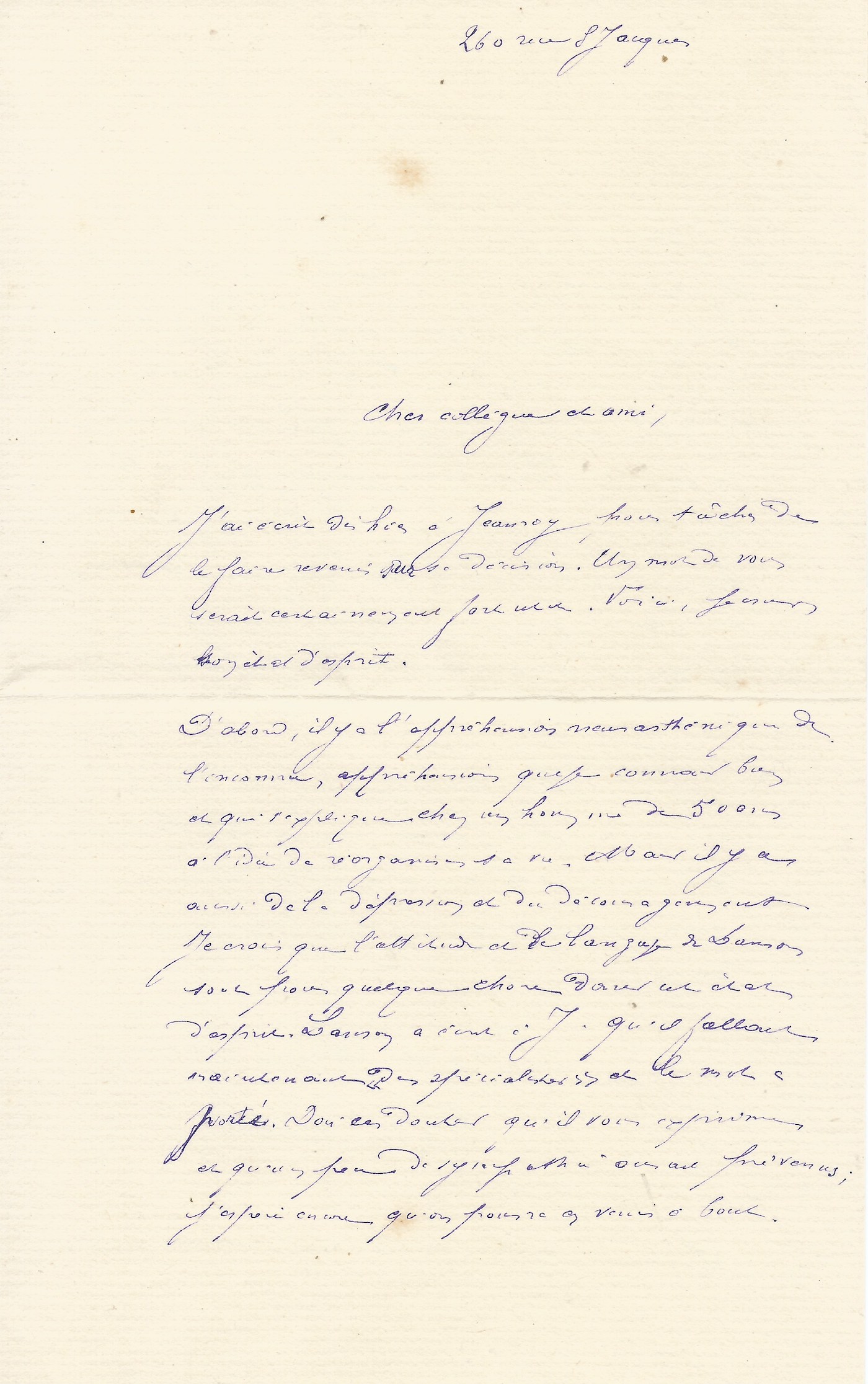
[Alfred Jeanroy] yesterday to try to persuade him to reconsider his decision. A word from you would certainly be very helpful. Here, I believe, is his state of mind. First, there is the neurasthenic apprehension of the unknown, an apprehension I know well and which is understandable in a 50-year-old man at the idea of reorganizing his life. But there is also depression and discouragement. I believe that Lanson's [Gustave Lanson, professor of French eloquence at the Sorbonne] have something to do with this state of mind. Lanson wrote to J. that "specialists" were now needed, and the word had an effect. Hence these doubts he expresses to you, which a little sympathy would have prevented; I still hope that we can overcome them.”
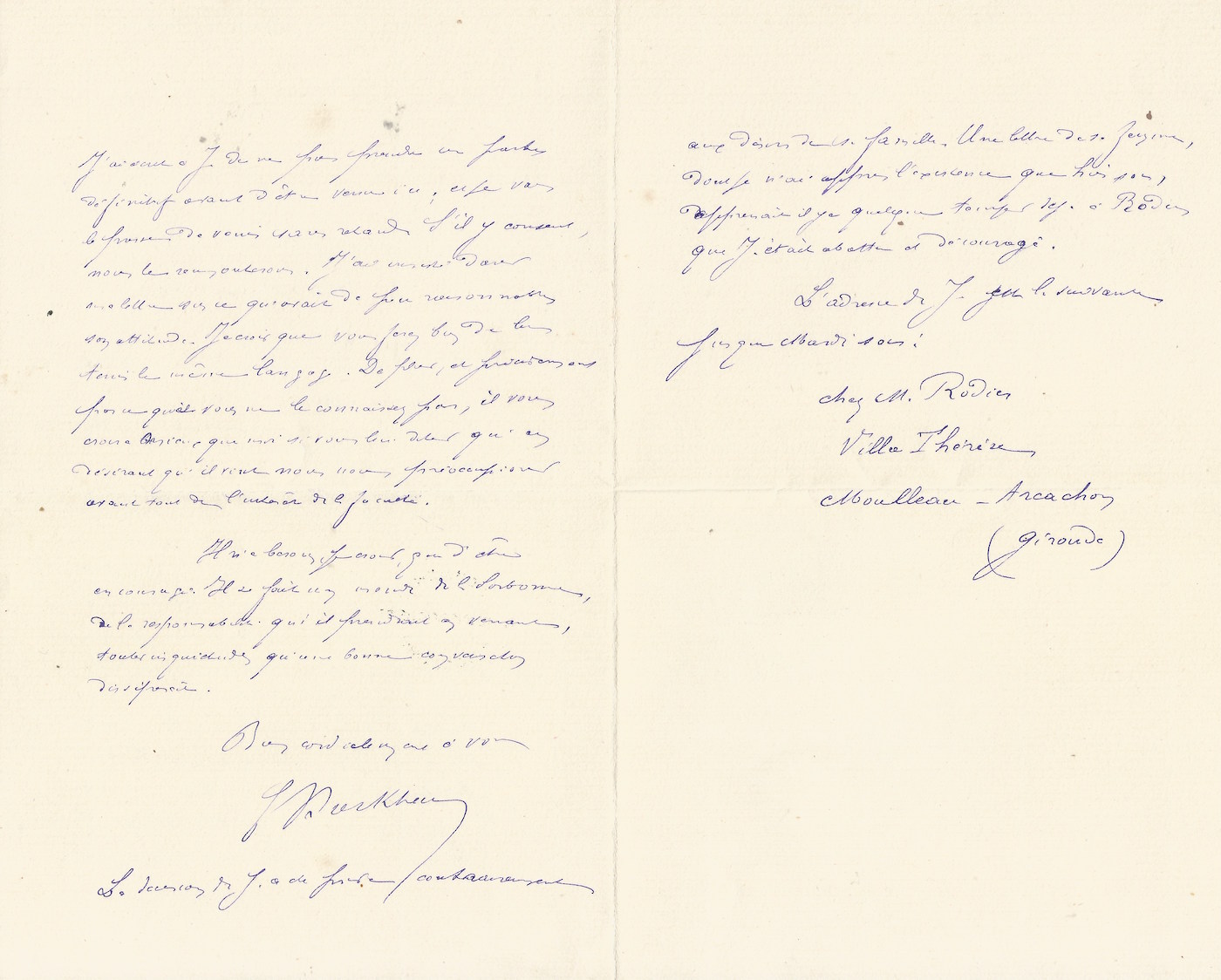
I wrote to J., asking him not to make a final decision before coming here; and I will urge him to come without delay. If he agrees, we will meet him. I emphasized in my letter how unreasonable his attitude was. I believe you would do well to speak to him in the same way. Moreover, and fortunately because you don't know him, he will believe you better than I if you tell him that in wanting him to stay, we are primarily concerned with the best interests of the faculty. I think he only needs encouragement. He's making a mountain out of a molehill about the Sorbonne, about the responsibility he would assume by coming here—all anxieties that a good conversation would dispel.
_____________________________________________
Following his thesis defended in 1893 on The Division of Labor in Society , Emile Durkheim was appointed to the University of Bordeaux, then in 1902 to the Sorbonne, to a chair of educational science. It was only in 1913 that his chair took the title of "Educational Science and Sociology".
Durkheim's commitment had a decisive influence on the educational policy of the Third Republic. He taught continuously at the Sorbonne from 1904 to 1912. His lectures were published posthumously under the title L'Évolution pédagogique en France (Educational Evolution in France).
The historian Charles-Victor Langlois (1863-1929) was a professor at the Sorbonne from 1888. He became an assistant professor in 1901, then a professor of auxiliary sciences of history from 1906 to 1909 and finally a professor of medieval history from 1909 to 1913.