Edmond JALOUX pays homage to the greatness of CHATEAUBRIAND.
"Great French prose is that of Rabelais, Montaigne, Bossuet, Châteaubriant, and Victor Hugo."
750€

"Great French prose is that of Rabelais, Montaigne, Bossuet, Châteaubriant, and Victor Hugo."
750€
Edmond JALOUX (1878.1949)
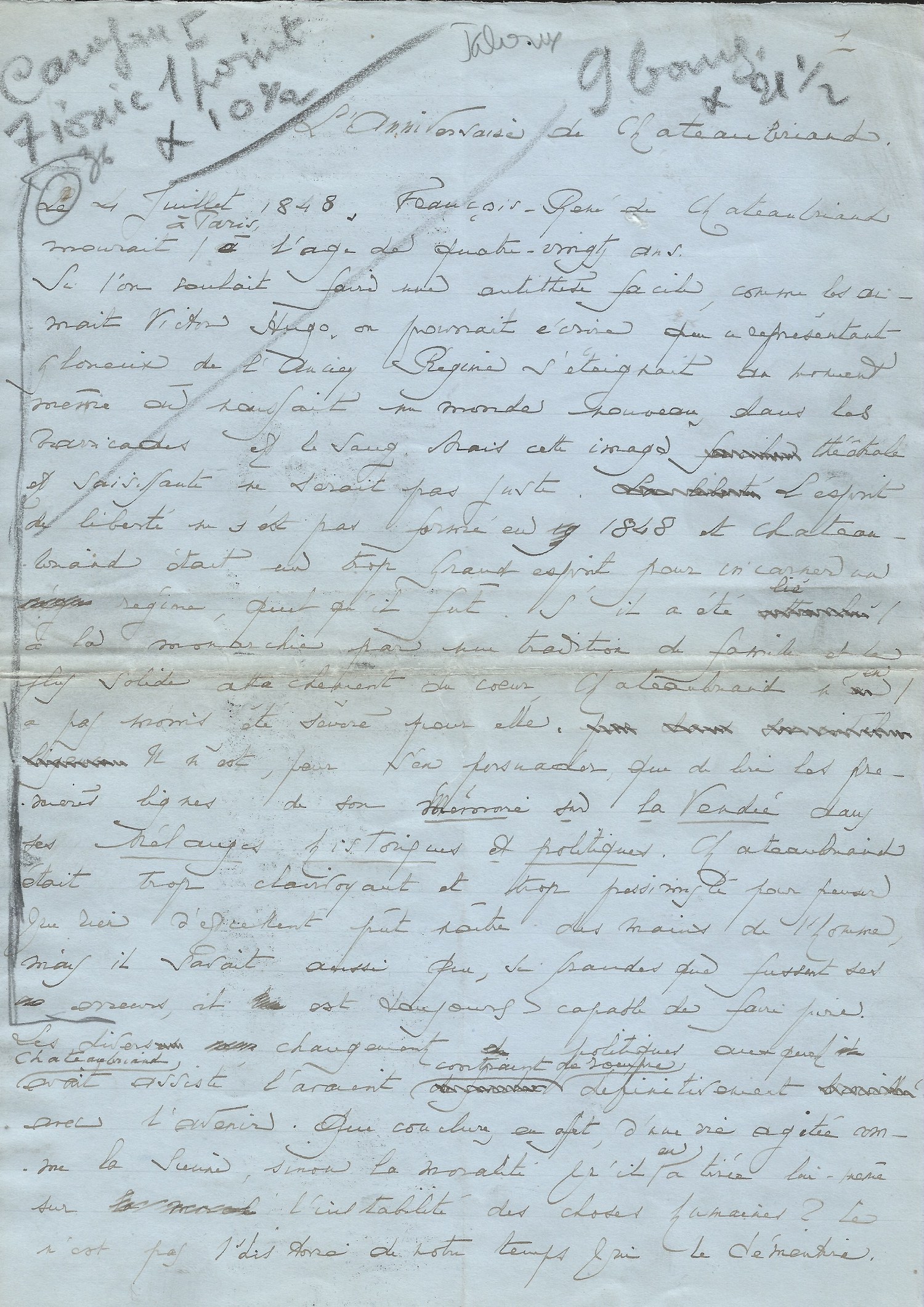
Autograph manuscript signed – Chateaubriand's birthday.
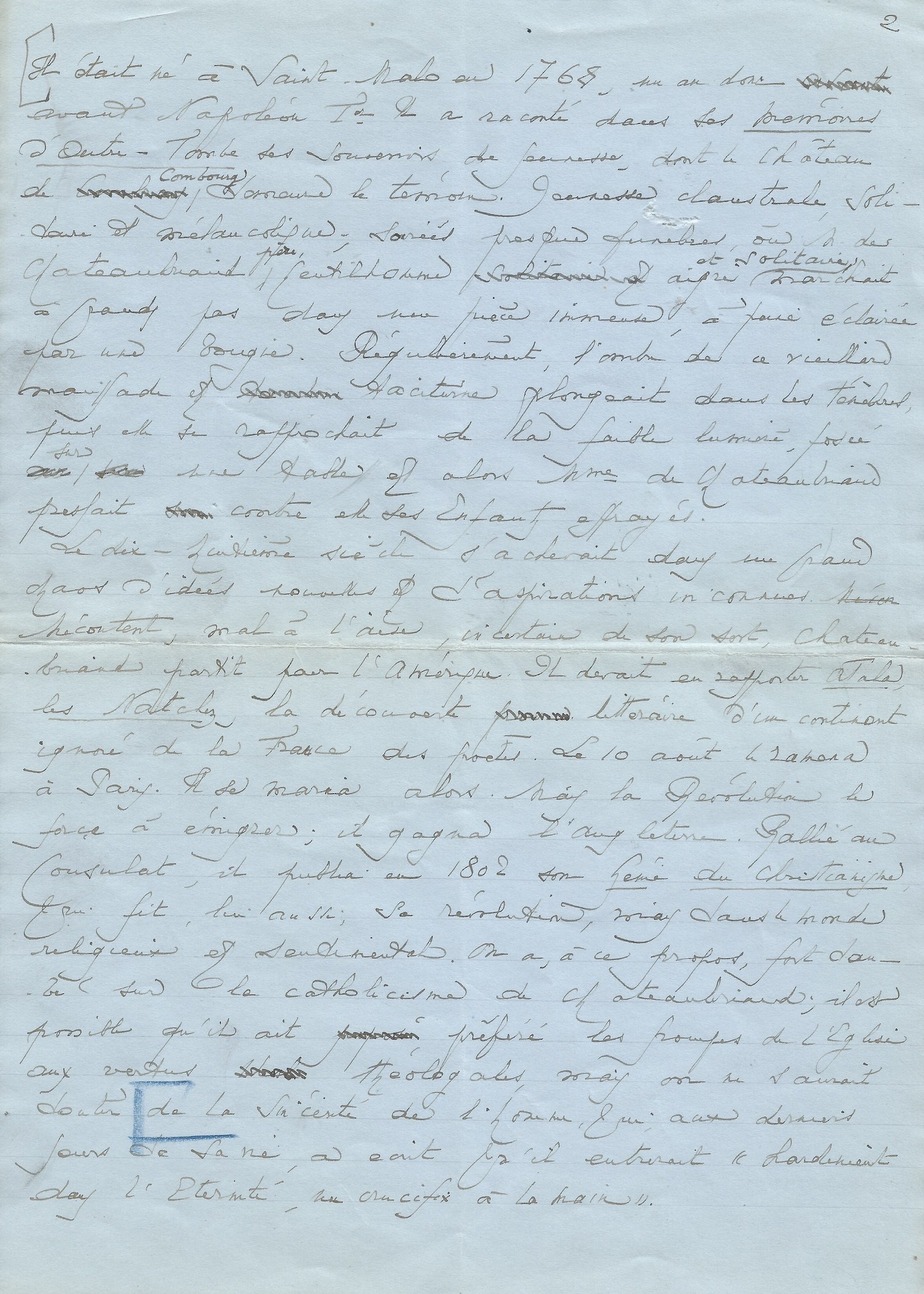
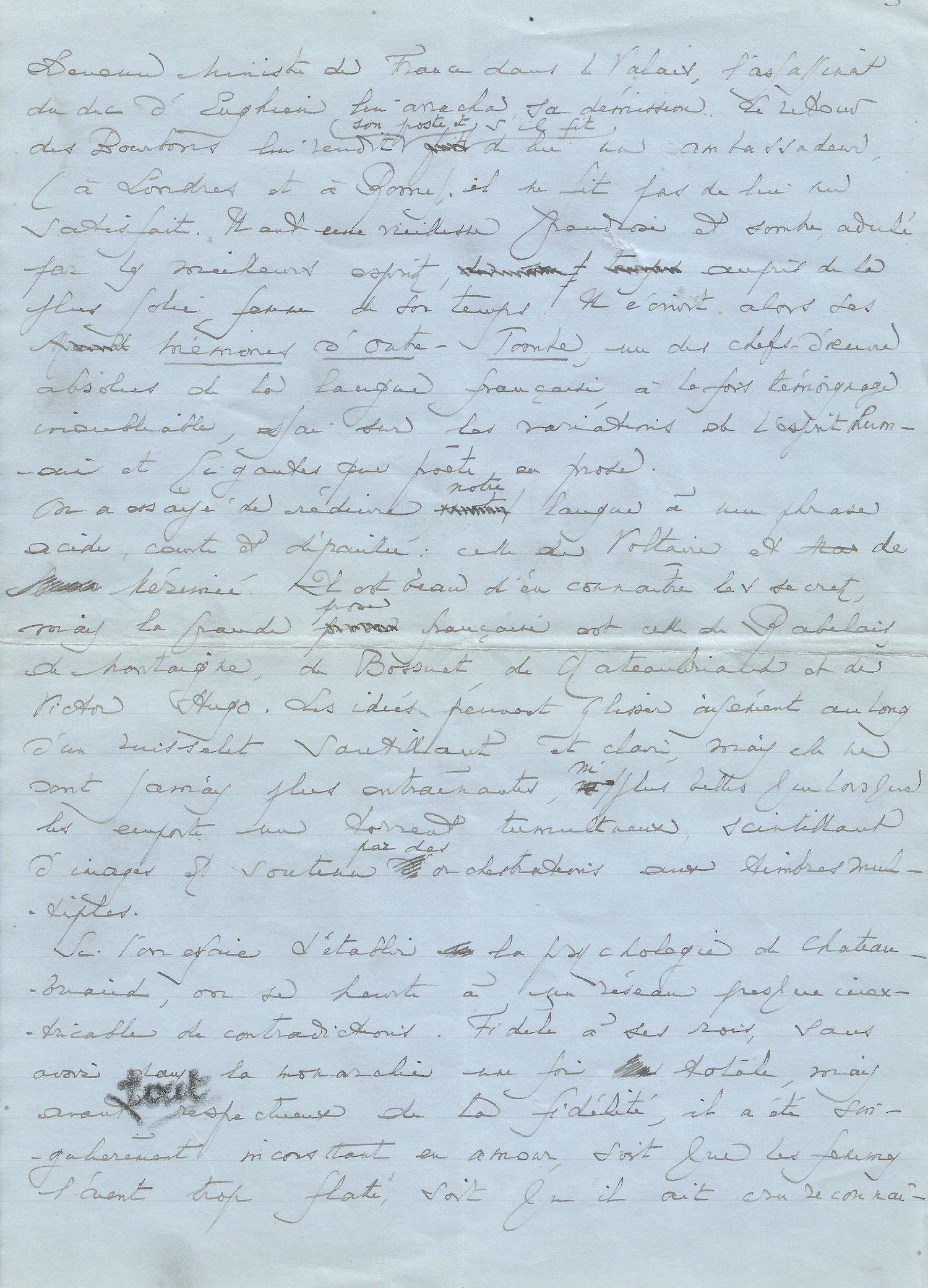
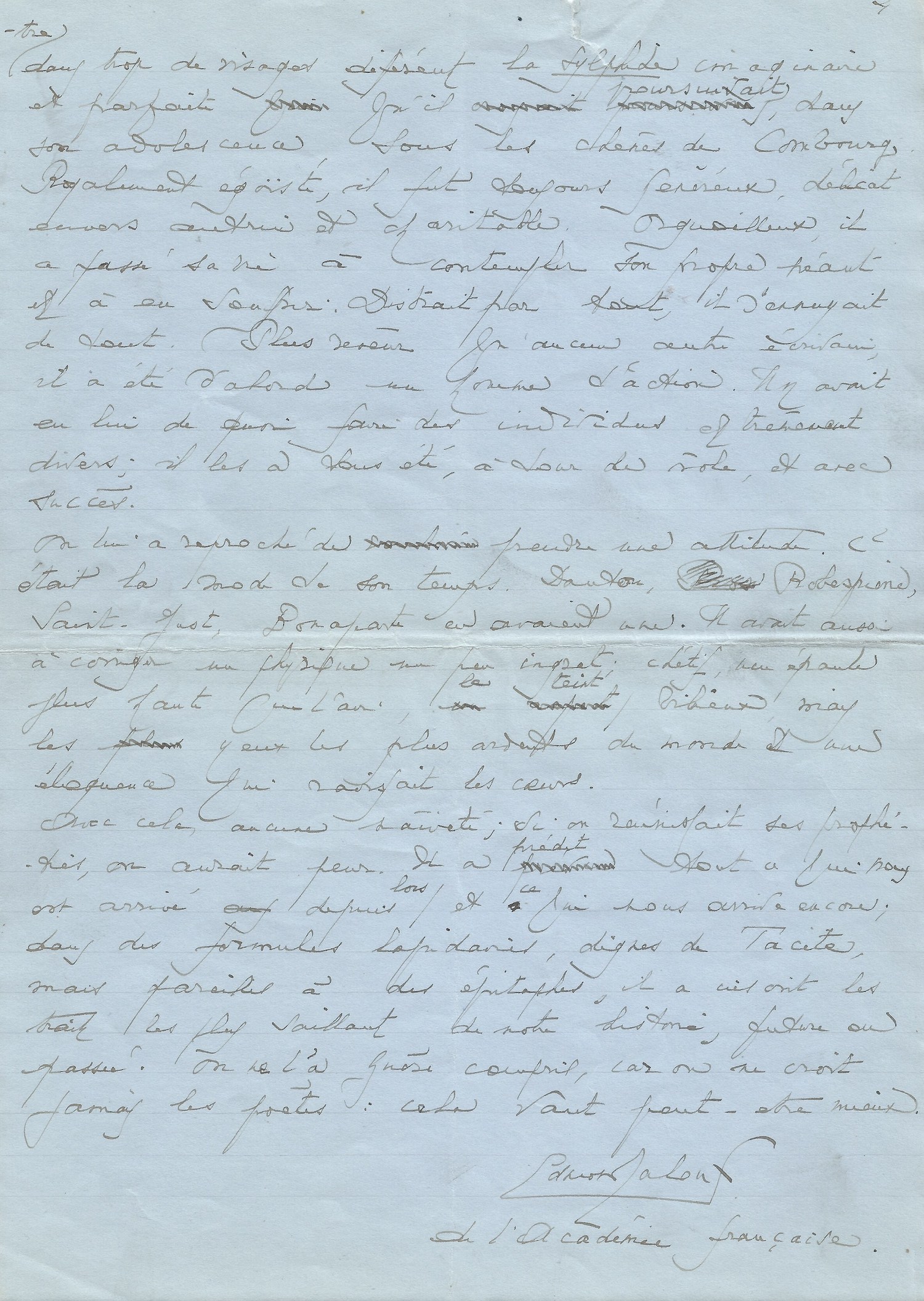
Four folio pages on blue paper. No place or date.
First draft manuscript with typographer's annotations in the margin.
"Great French prose is that of Rabelais, Montaigne, Bossuet, Châteaubriant, and Victor Hugo."
The Academician pays tribute to Chateaubriand, master of our national literature.
___________________________________
On July 4, 1848, in Paris, François-René de Chateaubriand died at the age of eighty. If one wished to offer a facile antithesis, as Victor Hugo was wont to do, one could write that this glorious representative of the Ancien Régime died at the very moment a new world was being born amidst barricades and bloodshed. But this dramatic and striking image would not be accurate. The spirit of liberty did not take shape in 1848, and Chateaubriand was too great a mind to embody any regime whatsoever. While he was bound to the monarchy by family tradition and the strongest attachment of his heart, Chateaubriand was nonetheless critical of it. To be convinced of this, one need only read the opening lines of his Memoir on the Vendée in his Historical and Political Miscellany . Chateaubriand was too far-sighted and too pessimistic to believe that anything excellent could come from human hands, but he also knew that, however great his errors, he was always capable of doing worse. The various political shifts he had witnessed had forced him to break definitively with the future. What, indeed, could one conclude from a turbulent life like his, if not the moral lesson he himself drew from it about the instability of human affairs? The history of our time will not contradict him.
He was born in Saint-Malo in 1768, a year before Napoleon I. Memoirs from Beyond the Grave, he recounted his childhood memories , of which the Château de Combourg remains a testament. A cloistered, solitary, and melancholic youth; evenings almost funereal, when Monsieur de Chateaubriand, the elder, a bitter and solitary gentleman, would stride about a vast room, barely lit by a candle. Regularly, the shadow of this sullen and taciturn old man would plunge into the darkness, then approach the dim light on a table, and then Madame de Chateaubriand would curse it, her frightened children.
The eighteenth century was drawing to a close in a great chaos of new ideas and unfamiliar aspirations. Discontented, uneasy, and uncertain of his fate, Chateaubriand set off for America. He was to bring back " Atala, the Natchez ," the literary discovery of a continent unknown to the French poets. August 10th brought him back to Paris. He then married. But the revolution forced him to emigrate; he went to England. Joining the Consulate, he published in 1802 his * Genius of Christianity*, which also brought about a revolution, but in the religious and sentimental realm. In this regard, Chateaubriand's Catholicism has been the subject of much doubt . It is possible that he preferred church groups to theological virtues, but one cannot doubt the sincerity of the man, who, in the last days of his life, wrote that he would "boldly enter Eternity with a crucifix in his hand."
Having become France's minister to the Valais, the assassination of the Duke of Enghien forced his resignation. The Bourbon Restoration reinstated him to his post, and although he was appointed ambassador (to London and Rome), he was not complacent. He lived a magnificent and somber old age, adored by the finest minds, in the company of the most beautiful woman of his time. It was then that he wrote his * Mémoires d'Outre-Tombe * (Memoirs from Beyond the Grave), one of the absolute masterpieces of the French language , at once an unforgettable testimony and an essay on the variations of the human mind…
We have tried to reduce our language to a sharp, short, and stripped-down sentence: that of Voltaire and Mérimée. It is fine to know their secrets, but great French prose is that of Rabelais, Montaigne, Bossuet, Châteaubriant, and Victor Hugo. Ideas can easily glide along a clear, skipping stream, but they are never more compelling or more beautiful than when swept away in a tumultuous torrent sparkling with imagery and sustained by orchestrations of multiple timbres.
If one tries to understand Chateaubriand's psychology, one encounters an almost inextricable web of contradictions. Loyal to his kings, without having absolute faith in the monarchy, but above all, respectful of fidelity, he was singularly fickle in love, whether because women flattered him too much, or because he believed he recognized in too many different faces the sylph he pursued in his adolescence beneath the oaks of Combourg. Royally selfish, he was always generous, considerate of others, and charitable. Proud, he spent his life contemplating his own nothingness and suffering from it. Distracted everywhere, he was bored by everything. More of a dreamer than any other writer, he was first and foremost a man of action. He possessed the potential to create extremely diverse individuals; he was all of them, in turn, and with success.
He was criticized for adopting a certain pose. It was the fashion of his time. Danton, Robespierre, Saint-Just, Bonaparte all had one. He also had to overcome a somewhat unattractive physique; slight build, one shoulder higher than the other, (…) but with the most ardent eyes in the world and an eloquence that captivated hearts. Despite this, he possessed no naiveté; if one were to gather his prophecies together, one would be frightened. He predicted everything that has happened to us since then, and everything that is still happening to us; in lapidary formulas, worthy of Tacitus, but like epitaphs, he inscribed the most salient features of our history, past and future. He was hardly understood, for poets are never believed : perhaps that's for the best.
Edmond Jaloux of the French Academy.